- Prepare the bolus dose in one of the following ways: Remove the appropriate volume from the vial of reconstituted (1 mg/mL) Activase using a syringe and needle. If this method is used with the 50 mg vials, the syringe should not be primed with air and the needle should be inserted into the Activase vial stopper. If the 100 mg vial is used, the needle should be inserted away from the puncture mark made by the transfer device.
- Remove the appropriate volume from a port (second injection site) on the infusion line after the infusion set is primed.
- Program an infusion pump to deliver the appropriate volume as a bolus at the initiation of the infusion
Bleeding
Acute Ischemic Stroke (AIS)
In clinical studies in patients with AIS (Studies 1 and 2) the incidence of intracranial hemorrhage, especially symptomatic intracranial hemorrhage, was higher in Activase-treated patients than in placebo patients. A dose-finding study of Activase suggested that doses greater than 0.9 mg/kg may be associated with an increased incidence of intracranial hemorrhage.
The incidence of all-cause 90-day mortality, intracranial hemorrhage, and new ischemic stroke following Activase treatment compared to placebo are presented in Table 3 as a combined safety analysis (n=624) for Studies 1 and 2. These data indicate a significant increase in intracranial hemorrhage following Activase treatment, particularly symptomatic intracranial hemorrhage within 36 hours. There was no increase in the incidences of 90-day mortality or severe disability in Activase-treated patients compared to placebo.
Table 3 Combined Safety Outcomes for Studies 1 and 2 | Placebo
(n= 312) | Activase
(n=312) |
p-ValueFisher's Exact Test. |
|---|
| All-Cause 90-day Mortality | 64 (20.5%) | 54 (17.3%) | 0.36 |
| Total ICH Within trial follow-up period. Symptomatic intracranial hemorrhage was defined as the occurrence of sudden clinical worsening followed by subsequent verification of intracranial hemorrhage on CT scan. Asymptomatic intracranial hemorrhage was defined as intracranial hemorrhage detected on a routine repeat CT scan without preceding clinical worsening. | 20 (6.4%) | 48 (15.4%) | <0.01 |
| Symptomatic | 4 (1.3%) | 25 (8.0%) | <0.01 |
| Asymptomatic | 16 (5.1%) | 23 (7.4%) | 0.32 |
| Symptomatic Intracranial Hemorrhage within 36 hours | 2 (0.6%) | 20 (6.4%) | <0.01 |
| New Ischemic Stroke (3-months) | 17 (5.4%) | 18 (5.8%) | 1.00 |
Bleeding events other than intracranial hemorrhage were noted in the studies of AIS and were consistent with the general safety profile of Activase. In Studies 1 and 2, the frequency of bleeding requiring red blood cell transfusions was 6.4% for Activase-treated patients compared to 3.8% for placebo (p = 0.19).
Although exploratory analyses of Studies 1 and 2 suggest that severe neurological deficit (National Institutes of Health Stroke Scale [NIHSS > 22]) at presentation was associated with an increased risk of intracranial hemorrhage, efficacy results suggest a reduced but still favorable clinical outcome for these patients.
Acute Myocardial Infarction (AMI)
For the 3-hour infusion regimen in the treatment of AMI, the incidence of significant internal bleeding (estimated as > 250 mL blood loss) has been reported in studies in over 800 patients (Table 4). These data do not include patients treated with the Activase accelerated infusion.
Table 4 Incidence of Bleeding in 3-Hour Infusion in AMI Patients | Total Dose ≤100 mg |
|---|
| Gastrointestinal | 5% |
| Genitourinary | 4% |
| Ecchymosis | 1% |
| Retroperitoneal | <1% |
| Epistaxis | <1% |
| Gingival | <1% |
The incidence of intracranial hemorrhage in AMI patients treated with Activase is presented in Table 5.
Table 5 Incidence of Intracranial Hemorrhage in AMI Patients| Dose | Number of Patients | Intracranial Hemorrhage (%) |
|---|
| 100 mg, 3-hour | 3272 | 0.4 |
| ≤ 100 mg, accelerated | 10,396 | 0.7 |
| 150 mg | 1779 | 1.3 |
| 1-1.4 mg/kg | 237 | 0.4 |
A dose of 150 mg or greater should not be used in the treatment of AMI because it has been associated with an increase in intracranial bleeding.
Pulmonary Embolism (PE)
For acute massive pulmonary embolism, bleeding events were consistent with the general safety profile observed with Activase treatment of AMI patients receiving the 3-hour infusion regimen.
Acute Ischemic Stroke: Cerebral edema, cerebral herniation, seizure, new ischemic stroke, embolism. These events may be life threatening and may lead to death.
Acute Myocardial Infarction: Arrhythmias, AV block, cardiogenic shock, heart failure, cardiac arrest, recurrent ischemia, myocardial reinfarction, myocardial rupture, electromechanical dissociation, pericardial effusion, pericarditis, mitral regurgitation, cardiac tamponade, thromboembolism, pulmonary edema. These events may be life threatening and may lead to death. Nausea and/or vomiting, hypotension and fever have also been reported.
Pulmonary Embolism: Pulmonary reembolization, pulmonary edema, pleural effusion, thromboembolism, hypotension. These events may be life threatening and may lead to death. Fever has also been reported.
Risk Summary
Published studies and case reports on alteplase use in pregnant women are insufficient to inform a drug associated risk of adverse developmental outcomes. Alteplase is embryocidal in rabbits when intravenously administered during organogenesis at the clinical exposure for AMI, but no maternal or fetal toxicity was evident at lower exposure in pregnant rats or rabbits (see Data).
All pregnancies have a background risk of birth defect, loss, or other adverse outcomes. The estimated background risk of major birth defects and miscarriage for the indicated populations is unknown. In the U.S. general population, the estimated background risk of major birth defects and miscarriage in clinically recognized pregnancies is 2-4% and 15-20%, respectively.
Maternal Adverse Reactions
The most common complication of thrombolytic therapy is bleeding. Pregnancy may increase this risk [see Warnings and Precautions (5.1)].
Data
Animal Data
Alteplase is embryocidal in rabbits when administered intravenously during organogenesis in doses (3 mg/kg) approximately equal to the human exposure (based on AUC) at the dose for AMI. No maternal or fetal toxicity was evident at doses (1 mg/kg) approximately 0.3 times the human exposure. In pregnant rats, no maternal or fetal toxicity was evident at doses (1 mg/kg) approximately 0.6 times the human dose for AMI (based on body weight) dosed during the period of organogenesis.
Risk Summary
There are no data on the presence of alteplase in human milk, the effects on the breastfed infant, or the effects on milk production.
Acute Ischemic Stroke
In exploratory, multivariate analyses of Studies 1 and 2, age greater than 77 years was one of several interrelated baseline characteristics associated with an increased risk of intracranial hemorrhage. Efficacy results suggest a reduced but still favorable clinical outcome for Activase-treated elderly [see Clinical Studies (14.1)].
Acute Myocardial Infarction
In a large trial of accelerated-infusion Activase that enrolled 41,021 patients with AMI to one of four thrombolytic regimens [see Clinical Studies (14.2)], patients over 75 years of age, a predefined subgroup, comprised 12% of enrollment. In these patients, the incidence of stroke was 4.0% for the Activase accelerated infusion group, 2.8% for streptokinase IV [SK (IV)], and 3.2% for streptokinase SQ [SK (SQ)]. The incidence of combined 30-day mortality or nonfatal stroke was 20.6% for accelerated infusion of Activase, 21.5% for SK (IV), and 22.0% for SK (SQ).
Accelerated Infusion in AMI Patients
Accelerated infusion of Activase was studied in an international, multi-center trial that randomized 41,021 patients with AMI to four thrombolytic regimens (Study 3). Entry criteria included onset of chest pain within 6 hours of treatment and ST-segment elevation of ECG. The four treatment regimens included accelerated infusion of Activase (≤100 mg over 90 minutes) plus intravenous (IV) heparin (n = 10,396); Streptokinase (1.5 million units over 60 minutes) plus IV heparin (SK [IV], n =10,410); Streptokinase plus subcutaneous (SQ) heparin (SK [SQ] n= 9841). A fourth regimen combined Activase and Streptokinase (n =10,374). All patients received 160 mg chewable aspirin administered as soon as possible, followed by 160-325 mg daily. Bolus IV heparin 5000 U was initiated as soon as possible, followed by a 1000 U/hour continuous IV infusion for at least 48 hours; subsequent heparin therapy was at the physician's discretion. Heparin SQ 12,500 U was administered 4 hours after initiation of SK therapy, followed by 12,500 U twice daily for 7 days or until discharge, whichever came first. Many of the patients randomized to receive SQ heparin received some IV heparin, usually in response to recurrent chest pain and/or the need for a medical procedure. Some received IV heparin on arrival to the emergency room prior to enrollment and randomization.
Key results from Study 3 are shown in Table 8. The incidence of 30-day mortality for Activase accelerated infusion was 1.0% lower than for either Streptokinase plus heparin regimen. The incidence of combined 30-day mortality or nonfatal stroke for the Activase accelerated infusion was 1.0% lower than for SK (IV) and 0.8% lower than for SK (SQ).
Table 8 Efficacy and Safety Results for Study 3| Event | Accelerated Activase | SK (IV) | p-Value Two-tailed p-value is for comparison of Accelerated Activase to the respective SK control arm. | SK (SQ) | p-Value |
|---|
| 30-Day Mortality | 6.3% | 7.3% | 0.003 | 7.3% | 0.007 |
30-Day Mortality
or Nonfatal Stroke | 7.2% | 8.2% | 0.006 | 8.0% | 0.036 |
| 24-Hour Mortality | 2.4% | 2.9% | 0.009 | 2.8% | 0.029 |
| Any Stroke | 1.6% | 1.4% | 0.32 | 1.2% | 0.03 |
| Intracerebral Hemorrhage | 0.7% | 0.6% | 0.22 | 0.5% | 0.02 |
Subgroup analysis of patients by age, infarct location, time from symptom onset to thrombolytic treatment, and treatment in the U.S. or elsewhere showed consistently lower 30-day mortality on Activase.
For patients who were over 75 years of age, a predefined subgroup consisting of 12% of patients enrolled, the incidence of stroke was 4.0% for the Activase accelerated infusion group, 2.8% for SK (IV), and 3.2% for SK (SQ); the incidence of combined 30-day mortality or nonfatal stroke was 20.6% for accelerated infusion of Activase, 21.5% for SK (IV), and 22.0% for SK (SQ).
3-Hour Infusion in AMI Patients
In a double-blind, randomized trial (n = 138) comparing 3-hour infusion of Activase to placebo (Study 4), patients infused with Activase within 4 hours of onset of symptoms experienced improved left ventricular function at Day 10 compared to the placebo group, when ejection fraction was measured by gated blood pool scan (53.2% vs. 46.4%, p =0.018). Relative to baseline (Day 1) values, the net changes in ejection fraction were + 3.6% and -4.7% for the treated and placebo groups, respectively (p=0.0001). The treated group had a reduced incidence of clinical heart failure (14%) compared to the placebo group (33%) (p = 0.009).
In a double-blind, randomized trial (n =5013) comparing 3-hour infusion of Activase to placebo (Study 5), patients infused with Activase within 5 hours of AMI symptom onset experienced improved 30-day survival compared to the placebo arm. At 1 month, the overall mortality rates were 7.2% for the Activase group and 9.8% for the placebo group (p = 0.001). At 6 months, the overall mortality rate for Activase-treated patients was 10.4% compared to the placebo arm (13.1%, p= 0.008).
Activase® (alteplase)
Manufactured by:
Genentech, Inc.
A Member of the Roche Group
1 DNA Way
South San Francisco, CA
94080-4990
U.S. License No. 1048
Activase® is a registered trademark of Genentech, Inc.
©2018 Genentech, Inc.
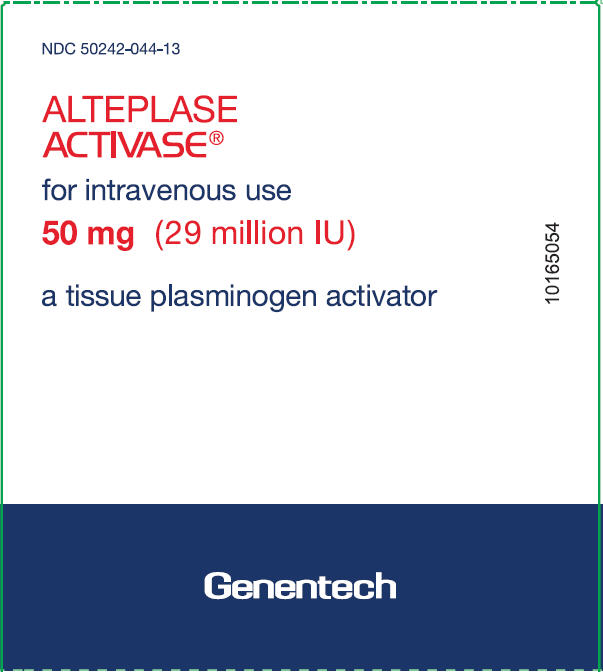
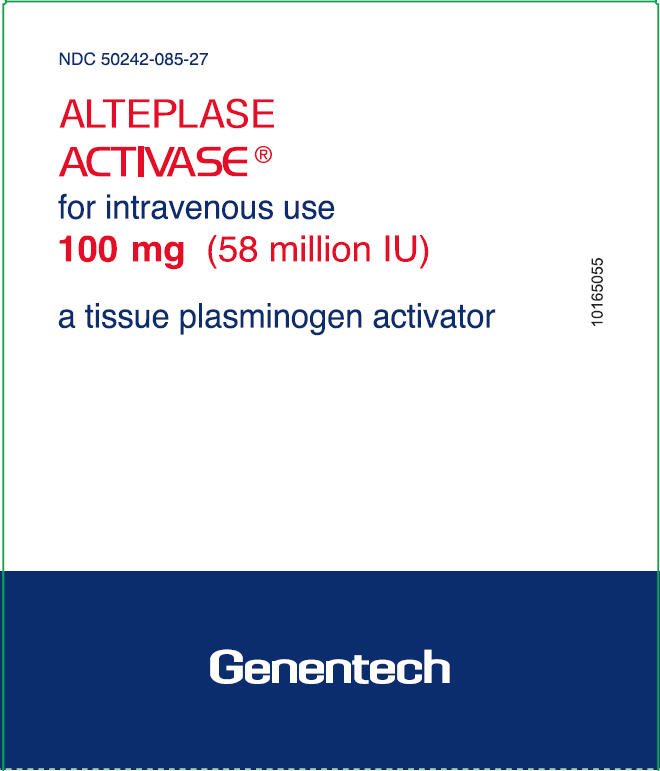
Representative sample of labeling (see the HOW SUPPLIED section for complete listing):