Safety was also evaluated in 173 adult patients with relapsed or refractory lymphoma who received POLIVY, bendamustine, and either a rituximab product or obinutuzumab in Study GO29365, including the 45 patients with DLBCL described above. In the expanded safety population, the median age was 66 years (range 27 – 86), 57% were male, 91% had an ECOG performance status of 0-1, and 32% had a history of peripheral neuropathy at baseline.
Fatal adverse reactions occurred in 4.6% of recipients of POLIVY within 90 days of last treatment, with infection as a leading cause. Serious adverse reactions occurred in 60%, most often from infection.
- General disorders: infusion-related reaction (7%)
- Infection: upper respiratory tract infection (16%), lower respiratory tract infection (10%), herpesvirus infection (12%), cytomegalovirus infection (1.2%)
- Respiratory: dyspnea (19%), pneumonitis (1.7%)
- Nervous system disorders: dizziness (10%)
- Investigations: weight decrease (10%), transaminase elevation (8%), lipase increase (3.5%)
- Musculoskeletal disorders: arthralgia (7%)
- Eye disorders: blurred vision (1.2%)
Strong CYP3A Inhibitors
Concomitant use with a strong CYP3A4 inhibitor may increase unconjugated MMAE AUC [see Clinical Pharmacology (12.3)], which may increase POLIVY toxicities. Monitor patients for signs of toxicity.
Strong CYP3A Inducers
Concomitant use with a strong CYP3A4 inducer may decrease unconjugated MMAE AUC [see Clinical Pharmacology (12.3)].
Risk Summary
Based on findings from animal studies and its mechanism of action [see Clinical Pharmacology (12.1)], POLIVY can cause fetal harm. There are no available data in pregnant women to inform the drug-associated risk. In animal reproduction studies, administration of the small molecule component of POLIVY, MMAE, to pregnant rats during organogenesis at exposures below the clinical exposure at the recommended dose of 1.8 mg/kg POLIVY every 21 days resulted in embryo-fetal mortality and structural abnormalities (see Data). Advise a pregnant woman of the potential risks to a fetus.
The estimated background risk of major birth defects and miscarriage for the indicated population is unknown. All pregnancies have a background risk of birth defect, loss, or other adverse outcomes. In the U.S. general population, the estimated background risk of major birth defects and miscarriage in clinically recognized pregnancies is 2–4% and 15–20%, respectively.
Data
Animal Data
No embryo-fetal development studies in animals have been performed with polatuzumab vedotin-piiq. In an embryo-fetal developmental study in pregnant rats, administration of two intravenous doses of MMAE, the small molecule component of POLIVY, on gestational days 6 and 13 caused embryo-fetal mortality and structural abnormalities, including protruding tongue, malrotated limbs, gastroschisis, and agnathia compared to controls at a dose of 0.2 mg/kg (approximately 0.5-fold the human area under the curve [AUC] at the recommended dose).
Risk Summary
There is no information regarding the presence of polatuzumab vedotin-piiq in human milk, the effects on the breastfed child, or milk production. Because of the potential for serious adverse reactions in breastfed children, advise women not to breastfeed during treatment with POLIVY and for at least 2 months after the last dose.
Pregnancy Testing
Verify pregnancy status in females of reproductive potential prior to initiating POLIVY [see Use in Specific Populations (8.1)].
Contraception
Females
POLIVY can cause embryo-fetal harm when administered to pregnant women [see Use in Specific Populations (8.1)]. Advise females of reproductive potential to use effective contraception during treatment with POLIVY and for 3 months after the final dose [see Nonclinical Toxicology (13.1)].
Males
Based on genotoxicity findings, advise males with female partners of reproductive potential to use effective contraception during treatment with POLIVY and for at least 5 months after the final dose [see Nonclinical Toxicity (13.1)].
Infertility
Based on findings from animal studies, POLIVY may impair male fertility. The reversibility of this effect is unknown [see Nonclinical Toxicology (13.1)].
Cardiac Electrophysiology
Polatuzumab vedotin-piiq did not prolong the mean QTc interval to any clinically relevant extent based on ECG data from two open-label studies in patients with previously treated B-cell malignancies at the recommended dosage.
Distribution
The acMMAE central volume of distribution estimated based on population PK analysis is 3.15 L. For humans, MMAE plasma protein binding is 71% to 77% and the blood-to-plasma ratio is 0.79 to 0.98, in vitro.
Elimination
The acMMAE terminal half-life is approximately 12 days (95% CI: 8.1 to 19.5 days) at Cycle 6 with predicted clearance of 0.9 L/day. The unconjugated MMAE terminal half-life is approximately 4 days after the first polatuzumab vedotin-piiq dose.
Metabolism
Polatuzumab vedotin-piiq catabolism has not been studied in humans; however, it is expected to undergo catabolism to small peptides, amino acids, unconjugated MMAE, and unconjugated MMAE-related catabolites. MMAE is a substrate for CYP3A4.
Specific Populations
No clinically significant differences in the pharmacokinetics of polatuzumab vedotin-piiq were observed based on age (20 to 89 years), sex, or race/ethnicity (Asian and non-Asian). No clinically significant differences in the pharmacokinetics of acMMAE or unconjugated MMAE were observed based on mild to moderate renal impairment (CLcr 30 to 89 mL/min). In mild hepatic impairment (AST or ALT >1.0 to 2.5 × ULN or total bilirubin >1.0 to 1.5 × ULN), there was a 40% increase in MMAE exposure, which was not deemed clinically significant.
The effect of severe renal impairment (CLcr 15 to 29 mL/min), end-stage renal disease with or without dialysis, moderate to severe hepatic impairment (AST or ALT >2.5 × ULN or total bilirubin >1.5 × ULN), or liver transplantation on the pharmacokinetics of acMMAE or unconjugated MMAE is unknown.
Drug Interaction Studies
No dedicated clinical drug-drug interaction studies with POLIVY in humans have been conducted.
Physiologically-Based Pharmacokinetic (PBPK) Modeling Predictions:
Strong CYP3A Inhibitor: Concomitant use of polatuzumab vedotin-piiq with ketoconazole (strong CYP3A inhibitor) is predicted to increase unconjugated MMAE AUC by 45%.
Strong CYP3A Inducer: Concomitant use of polatuzumab vedotin-piiq with rifampin (strong CYP3A inducer) is predicted to decrease unconjugated MMAE AUC by 63%.
Sensitive CYP3A Substrate: Concomitant use of polatuzumab vedotin-piiq is predicted not to affect exposure to midazolam (sensitive CYP3A substrate).
Population Pharmacokinetic (popPK) Modeling Predictions:
Bendamustine or Rituximab: No clinically significant differences in the pharmacokinetics of acMMAE or unconjugated MMAE when polatuzumab vedotin-piiq is used concomitantly with bendamustine or rituximab.
In Vitro Studies Where Drug Interaction Potential Was Not Further Evaluated Clinically:
Cytochrome P450 (CYP) Enzymes: MMAE does not inhibit CYP1A2, CYP2B6, CYP2C8, CYP2C9, CYP2C19, or CYP2D6. MMAE does not induce major CYP enzymes.
Transporter Systems: MMAE does not inhibit P-gp. MMAE is a P-gp substrate.
Peripheral Neuropathy
Advise patients that POLIVY can cause peripheral neuropathy. Advise patients to report to their healthcare provider any numbness or tingling of the hands or feet or any muscle weakness [see Warnings and Precautions (5.1)].
Infusion-Related Reactions
Advise patients to contact their healthcare provider if they experience signs and symptoms of infusion reactions, including fever, chills, rash, or breathing problems, within 24 hours of infusion [see Warnings and Precautions (5.2)].
Myelosuppression
Advise patients to report signs or symptoms of bleeding or infection immediately. Advise patients of the need for periodic monitoring of blood counts [see Warnings and Precautions (5.3)].
Infections
Advise patients to contact their healthcare provider if a fever of 38°C (100.4°F) or greater or other evidence of potential infection such as chills, cough, or pain on urination develops. Advise patients of the need for periodic monitoring of blood counts [see Warnings and Precautions (5.4)].
Progressive Multifocal Leukoencephalopathy
Advise patients to seek immediate medical attention for new or changes in neurological symptoms such as confusion, dizziness, or loss of balance; difficulty talking or walking; or changes in vision [see Warnings and Precautions (5.5)].
Tumor Lysis Syndrome
Advise patients to seek immediate medical attention for symptoms of tumor lysis syndrome such as nausea, vomiting, diarrhea, and lethargy [see Warnings and Precautions (5.6)].
Hepatotoxicity
Advise patients to report symptoms that may indicate liver injury, including fatigue, anorexia, right upper abdominal discomfort, dark urine, or jaundice [see Warnings and Precautions (5.7)].
Embryo-Fetal Toxicity
Advise females of reproductive potential of the potential risk to a fetus. Advise females to contact their healthcare provider if they become pregnant, or if pregnancy is suspected, during treatment with POLIVY [see Warnings and Precautions (5.8) and Use in Specific Populations (8.1)].
Females and Males of Reproductive Potential
Advise females of reproductive potential, and males with female partners of reproductive potential, to use effective contraception during treatment with POLIVY and for at least 3 months and 5 months after the last dose, respectively [see Use in Specific Populations (8.3)].
Lactation
Advise women not to breastfeed while receiving POLIVY and for at least 2 months after the last dose [see Use in Specific Populations (8.2)].
POLIVY® [polatuzumab vedotin-piiq]
Manufactured by:
Genentech, Inc.
A Member of the Roche Group
1 DNA Way
South San Francisco, CA 94080-4990
POLIVY is a registered trademark of Genentech, Inc.
© 2020 Genentech, Inc.
U.S. License No. 1048
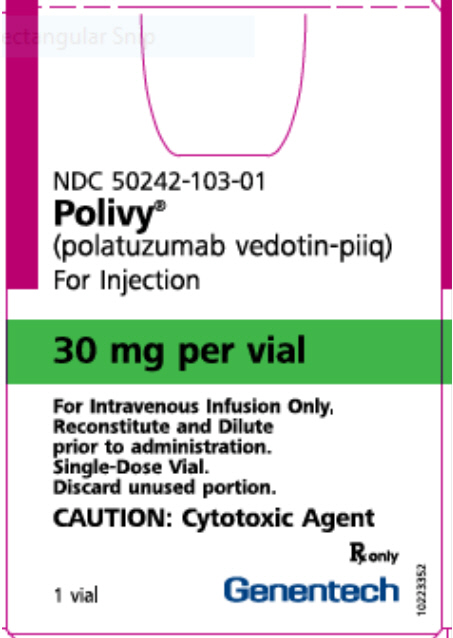
Representative sample of labeling (see the HOW SUPPLIED section for complete listing):