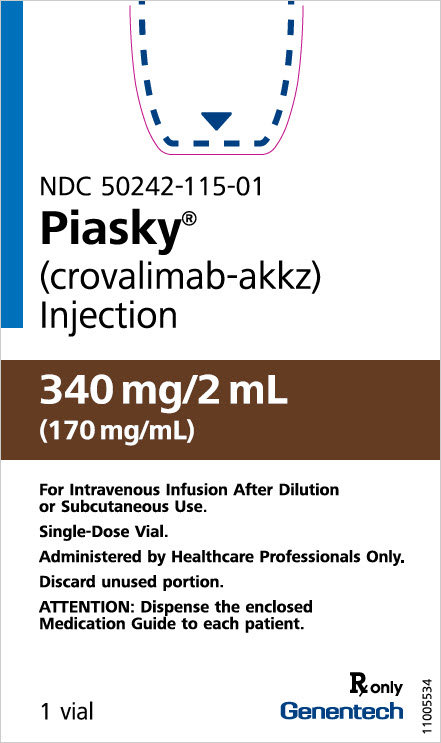
- Each injection is a volume of 2 mL PIASKY, corresponding to 340 mg. A 2 mL-size or 3 mL-size syringe should be used for each injection. A dose of 680 mg is achieved by performing two consecutive subcutaneous injections of 340 mg. A dose of 1020 mg is achieved by performing three consecutive subcutaneous injections of 340 mg.
- Inject PIASKY subcutaneously in the abdomen region and rotate abdominal injection sites with every injection. Consecutive injections must be at least 2 inches apart. No data are available on injection at other sites of the body. Injections should never be given into moles, scars, or areas where the skin is tender, bruised, red, hard, or not intact.
Storage of Solution for Injection
Once transferred from the vial to the syringe, PIASKY should be injected immediately because PIASKY does not contain any antimicrobial-preservative. If immediate use is not possible, the capped syringe can be refrigerated at 2°C to 8°C (36°F to 46°F) for up to 64 hours protected from light and stored at room temperature up to 30°C (86°F) for up to 5 hours under ambient light conditions.
Protect from direct sunlight.
Patients Who are Complement Inhibitor-Naïve
The data described below reflect exposure of 204 patients with PNH who were complement inhibitor-naïve and who were randomized in COMMODORE 2 to receive PIASKY (n = 135) or eculizumab (n = 69) at the recommended dosing regimen for 24 weeks [see Clinical Studies (14)].
Serious adverse reactions occurred in 6% of patients receiving PIASKY in the COMMODORE 2 study, including epistaxis and pneumonia, which occurred in 2 patients each, and infusion related reaction, pyelonephritis, COVID-19, and hypovolemic shock which were reported in 1 patient each.
Table 4 lists adverse reactions that occurred at a rate of 5% or more among patients randomized to PIASKY treatment for 24 weeks in the COMMODORE 2 study. The most common adverse reactions (≥10%) in patients treated with PIASKY were infusion related reaction, respiratory tract infection, and viral infection.
Table 4 Adverse Reactions Reported In 5% or More of Complement-Inhibitor Naïve Patients with PNH Randomized to PIASKY in COMMODORE 2| Adverse reactions | PIASKY
(N = 135)
% | ECULIZUMAB
(N = 69)
% |
|---|
| Infusion-related reaction | 16 | 13 |
| Respiratory tract infection Grouped terms.
Diarrhea includes diarrhea and diarrhea infectious.
Headache includes headache and migraine.
Injection-related reaction includes injection related reaction and injection site reaction.
Respiratory tract infection includes nasopharyngitis, pharyngitis, rhinitis, rhinitis allergic, upper respiratory tract infection and pneumonia.
Viral infection includes viral infection, COVID-19, influenza, herpes virus infection and oral herpes. | 13 | 20 |
| Viral infection | 11 | 7 |
| Hyperuricemia | 8 | 9 |
| Headache | 8 | 6 |
| Diarrhea | 7 | 1 |
| Injection-related reaction Injection-related reactions are only expected to occur in the PIASKY arm as eculizumab is not given by subcutaneous injection | 6 | 0 |
Patients Previously Treated with a Complement C5 Inhibitor
The data described below reflect exposure of 86 patients with PNH who received PIASKY (n=44) or eculizumab (n=42) at the recommended dosing regimen for 24 weeks in COMMODORE 1, an open-label, active-controlled, multicenter study conducted in patients switching from eculizumab. The median age was 47 years (range: 21 to 85); 52% were female, and race included White (73%), Asian (19%), unknown (5%), and Black/African-American (3%). The population ethnicities were 17% Hispanic or Latino and 76% not Hispanic or Latino.
Serious adverse reactions in COMMODORE 1 were reported in 3 patients (7%) with PNH receiving PIASKY. Serious adverse reactions included pneumonia, nasopharyngitis, and urinary tract infection, which occurred in 1 patient each.
Table 5 lists adverse reactions that occurred at a rate of 5% or more among patients randomized to PIASKY treatment for 24 weeks in the COMMODORE 1 study. The most common adverse reactions (≥10%) in patients treated with PIASKY were viral infections, respiratory tract infection, Type III hypersensitivity reaction, infusion-related reaction, peripheral edema, and headache.
Table 5 Adverse Reactions Reported In 5% or More of Complement-Inhibitor Treated Patients with PNH Randomized to PIASKY in COMMODORE 1| Adverse reactions | PIASKY
(N = 44)
% | ECULIZUMAB
(N = 42)
% |
|---|
| Viral infection Grouped terms
Fatigue includes fatigue, malaise and asthenia.
Injection-related reaction includes injection related reaction and injection site reaction.
Rash includes rash and skin exfoliation.
Peripheral edema includes edema peripheral and peripheral swelling.
Respiratory tract infection includes respiratory tract infection, nasopharyngitis, pneumonia and upper respiratory tract infection.
Viral infection includes viral infection, influenza, COVID-19, and respiratory syncytial virus infection | 23 | 21 |
| Respiratory tract infection | 18 | 5 |
| Type III hypersensitivity reaction Type III immune complex mediated reaction is only expected to occur in the PIASKY arm as patients in the eculizumab arm did not change C5 inhibitor treatment | 16 | 0 |
| Infusion-related reaction Infusion-related reactions are not expected to occur in the eculizumab arm as these patients tolerated eculizumab prior to study initiation | 14 | 0 |
| Peripheral edema | 11 | 2 |
| Headache | 11 | 2 |
| Injection-related reaction Injection-related reactions are only expected to occur in the PIASKY arm as eculizumab is not given by subcutaneous injection | 9 | 0 |
| Fatigue | 9 | 12 |
| Rash | 9 | 0 |
| Diarrhea | 7 | 2 |
| Nausea | 7 | 5 |
| Arthralgia | 7 | 0 |
Type III Hypersensitivity Reactions Related to Drug-Target-Drug Complexes [see Warnings and Precautions (5.3), and Drug Interactions (7)].
Across the COMMODORE 1 and 2 studies, 39 out of 201 (19.4%) patients who switched from eculizumab or ravulizumab to PIASKY experienced a Type III hypersensitivity reaction (reported as Type III immune complex mediated reaction). A total of 6 patients had switched two times and of the 6 patients, 2 patients experienced a second episode of Type III hypersensitivity reaction after discontinuing PIASKY and switching to ravulizumab. One of these patients developed Grade 3 axonal neuropathy and a Type III hypersensitivity reaction could not be excluded and the other developed Grade 2 arthralgia and myalgia. These two events remained unresolved at the last follow up visit of the clinical studies (the duration of the events until last follow-up was 313 days for the event of Grade 3 axonal neuropathy and 142 days for the event of Grade 2 arthralgia and myalgia, respectively). Two additional patients who experienced Grade 3 rash and Grade 3 arthralgia, respectively, had unresolved Type III hypersensitivity reaction at the last follow-up visit.
The median time to onset of Type III hypersensitivity reaction in patients who switched treatment from eculizumab or ravulizumab to PIASKY was 1.6 weeks (range: 0.7 – 4.4 weeks) and the median duration of Type III hypersensitivity reactions was 1.9 weeks (range 0.4 – 34.1 weeks). The majority of events were Grade 1-2. Grade 3 Type III hypersensitivity reaction occurred in 8% of patients who switched from eculizumab or ravulizumab to PIASKY. Out of 42 Type III hypersensitivity reactions, 37 (88%) resolved, including 1 (2.4%) that resolved with PIASKY discontinuation, 2 (4.8%) that resolved with PIASKY interruption and 34 (81%) that resolved without discontinuation, interruption, or dose change in PIASKY therapy.
Axonal Neuropathy
In COMMODORE 1 and 2, Grade 3 distal axonal demyelinating polyneuropathy and Grade 3 axonal neuropathy were reported, each in 1 patient who switched from another C5 inhibitor to PIASKY or from PIASKY to another C5 inhibitor. The Grade 3 distal axonal demyelinating polyneuropathy occurred 11 weeks after a patient switched from eculizumab to PIASKY (with first dose of PIASKY received 12 days after the last dose of eculizumab treatment) and was preceded by a bacterial respiratory tract infection. The Grade 3 axonal neuropathy occurred in a patient who had switched to ravulizumab treatment after 6 weeks of treatment with PIASKY, and previously received ravulizumab treatment prior to switching to treatment with PIASKY [see Warnings and Precautions (5.3)]. Events associated with the axonal neuropathy included COVID-19, sepsis and administration of a fluoroquinolone. In both cases of axonal neuropathy, a Type III hypersensitivity reaction as a cause of, or contributor to, the axonal neuropathy could not be excluded. Both cases of axonal neuropathy remained unresolved at the last follow up visit of the clinical studies.
Pediatric Population with PNH Treated with PIASKY
Twelve pediatric patients with PNH (9 treatment-naïve patients and 3 patients who switched from another C5 inhibitor) were treated with PIASKY in COMMODORE 1 (n=2), COMMODORE 2 (n=7), and in a single-arm trial [(COMMODORE 3 (n=3)]. The safety profile of PIASKY appeared comparable between adult and pediatric patients, but conclusions are limited by the small number of pediatric patients.
Risk Summary
Available data on PIASKY use in pregnant women are insufficient to evaluate for a drug associated risk of major birth defects, miscarriage, or other adverse maternal or fetal outcomes. Human IgG antibody is known to cross the placenta and its transport increases as pregnancy progresses and peaks during the third trimester; therefore, PIASKY may be transmitted from the mother to the developing fetus. There are risks to the mother and fetus associated with untreated PNH in pregnancy (see Clinical Considerations). In an enhanced pre- and postnatal development study, no adverse developmental outcomes were observed when monkeys were exposed to crovalimab-akkz during the period of organogenesis through parturition at doses that produced maternal exposures 14-times the exposures at the maximum recommended human dose (MRHD), (see Data).
The background risk of major birth defects and miscarriage for the indicated population is unknown. All pregnancies have a background risk of birth defect, loss, or other adverse outcomes. In the U.S. general population, the estimated background risks of major birth defects and miscarriage in clinically recognized pregnancies are 2-4% and 15-20%, respectively.
Clinical Considerations
Disease-associated maternal and/or fetal/neonatal risk
PNH in pregnancy is associated with adverse maternal outcomes, including worsening cytopenias, thrombosis, infections, bleeding, miscarriages, and increased maternal mortality, and adverse fetal outcomes, including fetal death and premature delivery.
Data
Animal data
In an enhanced pre- and post-natal development study, pregnant cynomolgus monkeys were given an intravenous loading dose of crovalimab-akkz 100 mg/kg on gestation day (GD) 20 followed by weekly subcutaneous injections of up to 100 mg/kg up to parturition. The dams and infants were then observed untreated for 6 months. There were no adverse effects of crovalimab-akkz on pregnancy or on the viability, growth, and development of the infants up to 100 mg/kg at exposures 14-times the human exposure at the MRHD, based on area under the concentration-time curve (AUC).
Risk Summary
There are no data on the presence of crovalimab-akkz in either human or animal milk, the effects on the breastfed child or on milk production. Endogenous IgG and monoclonal antibodies are transferred in human milk. The effects of local gastrointestinal exposure and limited systemic exposure in the breastfed child to crovalimab-akkz is unknown. Because of the potential for serious adverse reactions in a breastfed child, advise patients that breastfeeding is not recommended during treatment with PIASKY and for 9 months after the final dose.
Absorption
The mean absorption rate constant is 0.126 day-1 [90% CI: 0.105, 0.176]. Following subcutaneous administration, the bioavailability is 83.0% [90% CI: 69.6, 92.0].
Distribution
The mean central and peripheral volume of distribution is 3.23 L [90% CI: 3.16, 3.29] and 2.32 L [90% CI: 2.02, 2.67], respectively.
Elimination
In PNH treatment-naïve patients, the mean clearance is 0.0791 L/day [90% CI: 0.0678, 0.0872]. The mean estimated terminal half-life is 53.1 days [90% CI: 47.7, 58.6].
Metabolism
Crovalimab-akkz is expected to be catabolized by lysosomal proteolysis into small peptides and amino acids.
Excretion
Crovalimab-akkz is not eliminated via renal or hepatic pathways.
Special Populations
After inclusion of body weight, population pharmacokinetic analyses in patients with PNH showed that age (13-85 years of age), gender, and race (Caucasian, Black, and Asian) did not meaningfully influence the pharmacokinetics of PIASKY. No clinically significant differences in the pharmacokinetics of PIASKY were observed based on renal impairment (mild, moderate, and severe) and mild hepatic impairment. PIASKY has not been studied in patients with moderate or severe hepatic impairment.
Pediatric Patients
Data obtained in PNH clinical studies indicates that exposure in pediatric patients weighing ≥ 40 kg was consistent with that of adult patients.
Patients Switching from Another C5 Inhibitor
In patients switching from another C5 inhibitor (e.g., eculizumab or ravulizumab), a transient increase in clearance is observed due to the formation of transient immune complexes, leading to a faster elimination of PIASKY. However, this transiently different clearance does not require dose adjustment in patients switching from another C5 inhibitor.
Pediatric Population with PNH Treated with PIASKY
Efficacy was evaluated in 12 pediatric patients (with body weight ≥ 40 kg) treated with PIASKY in COMMODORE 2 (n=7; 13–17 years old), COMMODORE 1 (n=2, 13 – 16 years old) and in a single arm study in patients who were complement-inhibitor naïve, COMMODORE 3 (NCT04654468; n=3; 15–17 years old).
Nine pediatric patients were treatment-naïve, two patients switched from standard dose eculizumab and one patient switched from ravulizumab. Six pediatric patients were females and six were males. Nine patients were Asian, two were White and for one pediatric patient the race was unknown. The proportion of patients with a history of transfusions in the prior 12 months was 58%, with a median number of 1.3 pRBC units (range: 0-40.5) transfused, and a baseline median LDH of 6.4 × ULN (range 1.1-26.6). Aplastic anemia was reported in 50% of patients. All pediatric patients received the same dosing as adult patients based on body weight [see Dosage and Administration (2.2)]. Hemolysis control (defined as LDH ≤1.5 × ULN) from baseline to Week 25 was achieved in 7 of the 9 patients who were treatment-naïve, and the 3 patients switching from eculizumab or ravulizumab to PIASKY maintained hemolysis control through 24 weeks of PIASKY treatment. Nine (six patients who were treatment-naïve and three patients who switched from eculizumab or ravulizumab) out of the 12 pediatric patients achieved transfusion avoidance and hemoglobin stabilization, and no patients had a breakthrough hemolysis event during the 24-week treatment period.
Overall, the treatment effect of PIASKY in pediatric patients with PNH was consistent with that observed in adults with PNH.
Serious Meningococcal Infection
Advise patients of the risk of serious meningococcal infection. Inform patients of the need to complete or update their meningococcal vaccinations at least 2 weeks prior to receiving the first dose of PIASKY or receive antibacterial drug prophylaxis if PIASKY treatment must be initiated immediately and they have not previously been vaccinated. Inform patients of the requirement to be revaccinated according to current ACIP recommendations for meningococcal infection while on PIASKY therapy.
Inform patients that vaccination may not prevent serious meningococcal infection and to seek immediate medical attention if the following signs or symptoms occur [see Warnings and Precautions (5.1)].
- fever
- fever and a rash
- headache with nausea or vomiting
- fever with a high heart rate
- headache and a fever
- headache with a stiff neck or stiff back
- confusion
- muscle aches, with flu-like symptoms
- eye sensitive to light
Inform patients that they will be given a Patient Safety Card for PIASKY that they should carry with them at all times during and for 11 months following treatment with PIASKY. This card describes symptoms which, if experienced, should prompt the patient to immediately seek medical evaluation.
PIASKY REMS
PIASKY is available only through a restricted program called PIASKY REMS [see Warnings and Precautions (5.2)].
Inform the patient of the following requirements:
- Patients must receive counseling about the risk of serious meningococcal infections.
- Patients must receive written educational materials about this risk.
- Patients must be instructed to carry the Patient Safety Card with them at all times during and for 11 months following treatment with PIASKY.
- Patients must be instructed to complete or update meningococcal vaccines for serogroups A, C, W, Y and B per ACIP recommendations as directed by the prescriber prior to treatment with PIASKY.
- Patients must receive antibiotics as directed by the prescriber if they are not up to date with meningococcal vaccines and have to start PIASKY right away.
Type III Hypersensitivity Reactions
Inform patients of the risk of experiencing a Type III hypersensitivity reaction in the first 30 days after switching from another C5 inhibitor to PIASKY (or if they are planning to switch from PIASKY to another C5 inhibitor) [see Warnings and Precautions (5.3)]. Inform patients about the signs and symptoms of a Type III hypersensitivity reaction, and advise patients to seek immediate medical attention if the following signs or symptoms occur:
- rash
- itching
- joint pain
- numbness and tingling or a feeling of pins and needles, especially of the hands and feet
Other Infections
Counsel patients of the increased risk of infections, particularly those due to encapsulated bacteria, especially Neisseria species [see Warnings and Precautions (5.4)]. Advise patients of the need for vaccination against Streptococcus pneumoniae infections according to current ACIP recommendations. Inform parents or caregivers of children receiving PIASKY that their child should be vaccinated against Streptococcus pneumoniae and Haemophilus influenzae type b (Hib) according to current medical guidelines.
Advise patients to report any new signs and symptoms of infection.
Infusion- and Injection-Related Reactions
Advise patients that administration of PIASKY may result in infusion-related reactions or systemic injection-related reactions depending on the route of administration [see Warnings and Precautions (5.5)]. Advise patients to seek immediate medical attention if symptoms of serious allergic reactions occur.
Discontinuation of PIASKY
Inform patients that they may develop hemolysis due to PNH when PIASKY is discontinued and that they will be closely monitored by their healthcare professional for at least 20 weeks following PIASKY discontinuation [see Warnings and Precautions (5.6)]. Inform patients who discontinue PIASKY to keep the Patient Safety Card with them for 11 months after the last PIASKY dose, because the increased risk of meningococcal infection persists for several months following discontinuation of PIASKY [see Warnings and Precautions (5.1 and 5.2)].
Lactation
Advise patients it is not recommended to breastfeed during treatment with PIASKY and for 9 months after the final dose [see Use in Specific Populations (8.2)].
Manufactured by:
Genentech, Inc.
A Member of the Roche Group
1 DNA Way
South San Francisco, CA 94080-4990
U.S. License No.: 1048
PIASKY is a registered trademark
of Chugai Pharmaceutical Co., Ltd., Tokyo, Japan.
©2024 Genentech, Inc.