Prior to initiating OCREVUS, perform Hepatitis B virus (HBV) screening. OCREVUS is contraindicated in patients with active HBV confirmed by positive results for HBsAg and anti-HBV tests. For patients who are negative for surface antigen [HBsAg] and positive for HB core antibody [HBcAb+] or are carriers of HBV [HBsAg+], consult liver disease experts before starting and during treatment [see Warnings and Precautions (5.2)].
Because vaccination with live-attenuated or live vaccines is not recommended during treatment and after discontinuation until B-cell repletion, administer all immunizations according to immunization guidelines at least 4 weeks prior to initiation of OCREVUS for live or live-attenuated vaccines and, whenever possible, at least 2 weeks prior to initiation of OCREVUS for non-live vaccines [see Warnings and Precautions (5.2) and Clinical Pharmacology (12.2)].
Prior to every infusion of OCREVUS, determine whether there is an active infection. In case of active infection, delay infusion of OCREVUS until the infection resolves [see Warnings and Precautions (5.2)].
Pre-medicate with 100 mg of methylprednisolone (or an equivalent corticosteroid) administered intravenously approximately 30 minutes prior to each OCREVUS infusion to reduce the frequency and severity of infusion reactions [see Warnings and Precautions (5.1)]. Pre-medicate with an antihistamine (e.g., diphenhydramine) approximately 30-60 minutes prior to each OCREVUS infusion to further reduce the frequency and severity of infusion reactions.
The addition of an antipyretic (e.g., acetaminophen) may also be considered.
Immediately stop and permanently discontinue OCREVUS if there are signs of a life-threatening or disabling infusion reaction [see Warnings and Precautions (5.1)]. Provide appropriate supportive treatment.
Immediately interrupt the infusion and administer appropriate supportive treatment, as necessary [see Warnings and Precautions (5.1)]. Restart the infusion only after all symptoms have resolved. When restarting, begin at half of the infusion rate at the time of onset of the infusion reaction [see Dosage and Administration (2.2)]. If this rate is tolerated, increase the rate as described in Table 1. This change in rate will increase the total duration of the infusion but not the total dose.
Reduce the infusion rate to half the rate at the onset of the infusion reaction and maintain the reduced rate for at least 30 minutes [see Warnings and Precautions (5.1)]. If this rate is tolerated, increase the rate as described in Table 1. This change in rate will increase the total duration of the infusion but not the total dose.
OCREVUS must be prepared by a healthcare professional using aseptic technique. A sterile needle and syringe should be used to prepare the diluted infusion solution.
Visually inspect for particulate matter and discoloration prior to administration. Do not use the solution if discolored or if the solution contains discrete foreign particulate matter. Do not shake.
Withdraw intended dose and further dilute into an infusion bag containing 0.9% Sodium Chloride Injection, to a final drug concentration of approximately 1.2 mg/mL.
- Withdraw 10 mL (300 mg) of OCREVUS and inject into 250 mL
- Withdraw 20 mL (600 mg) of OCREVUS and inject into 500 mL
Do not use other diluents to dilute OCREVUS since their use has not been tested. The product contains no preservative and is intended for single use only.
Storage of Infusion Solution
Prior to the start of the intravenous infusion, the content of the infusion bag should be at room temperature.
Use the prepared infusion solution immediately. If not used immediately, store up to 24 hours in the refrigerator at 2°C to 8°C (36°F to 46°F) and 8 hours at room temperature up to 25°C (77°F), which includes infusion time. In the event an intravenous infusion cannot be completed the same day, discard the remaining solution.
No incompatibilities between OCREVUS and polyvinyl chloride (PVC) or polyolefin (PO) bags and intravenous (IV) administration sets have been observed.
Administration
Administer the diluted infusion solution through a dedicated line using an infusion set with a 0.2 or 0.22 micron in-line filter.
Reducing the Risk of Infusion Reactions and Managing Infusion Reactions
Administer pre-medication (e.g., methylprednisolone or an equivalent corticosteroid, and an antihistamine) to reduce the frequency and severity of infusion reactions. The addition of an antipyretic (e.g., acetaminophen) may also be considered [see Dosage and Administration (2.3)].
Management recommendations for infusion reactions depend on the type and severity of the reaction [see Dosage and Administration (2.5)]. For life-threatening infusion reactions, immediately and permanently stop OCREVUS and administer appropriate supportive treatment. For less severe infusion reactions, management may involve temporarily stopping the infusion, reducing the infusion rate, and/or administering symptomatic treatment.
Respiratory Tract Infections
A higher proportion of OCREVUS-treated patients experienced respiratory tract infections compared to patients taking REBIF or placebo. In RMS trials, 40% of OCREVUS-treated patients experienced upper respiratory tract infections compared to 33% of REBIF-treated patients, and 8% of OCREVUS-treated patients experienced lower respiratory tract infections compared to 5% of REBIF-treated patients. In the PPMS trial, 49% of OCREVUS-treated patients experienced upper respiratory tract infections compared to 43% of patients on placebo and 10% of OCREVUS-treated patients experienced lower respiratory tract infections compared to 9% of patients on placebo. The infections were predominantly mild to moderate and consisted mostly of upper respiratory tract infections and bronchitis.
Herpes
In active-controlled (RMS) clinical trials, herpes infections were reported more frequently in OCREVUS-treated patients than in REBIF-treated patients, including herpes zoster (2.1% vs. 1.0%), herpes simplex (0.7% vs. 0.1%), oral herpes (3.0% vs. 2.2%), genital herpes (0.1% vs. 0%), and herpes virus infection (0.1% vs. 0%). Infections were predominantly mild to moderate in severity.
In the placebo-controlled (PPMS) clinical trial, oral herpes was reported more frequently in the OCREVUS-treated patients than in the patients on placebo (2.7% vs 0.8%).
Serious cases of infections caused by herpes simplex virus and varicella zoster virus, including central nervous system infections (encephalitis and meningitis), intraocular infections, and disseminated skin and soft tissue infections, have been reported in the postmarketing setting in multiple sclerosis patients receiving OCREVUS. Serious herpes virus infections may occur at any time during treatment with OCREVUS. Some cases were life-threatening.
If serious herpes infections occur, OCREVUS should be discontinued or withheld until the infection has resolved, and appropriate treatment should be administered [see Patient Counseling Information (17)].
Progressive Multifocal Leukoencephalopathy (PML)
PML is an opportunistic viral infection of the brain caused by the John Cunningham (JC) virus that typically only occurs in patients who are immunocompromised, and that usually leads to death or severe disability. Although no cases of PML were identified in OCREVUS clinical trials, JC virus infection resulting in PML has been observed in patients treated with other anti-CD20 antibodies and other MS therapies and has been associated with some risk factors (e.g., immunocompromised patients, polytherapy with immunosuppressants). At the first sign or symptom suggestive of PML, withhold OCREVUS and perform an appropriate diagnostic evaluation. MRI findings may be apparent before clinical signs or symptoms. Typical symptoms associated with PML are diverse, progress over days to weeks, and include progressive weakness on one side of the body or clumsiness of limbs, disturbance of vision, and changes in thinking, memory, and orientation leading to confusion and personality changes.
Hepatitis B Virus (HBV) Reactivation
Hepatitis B reactivation has been reported in MS patients treated with OCREVUS in the postmarketing setting. Fulminant hepatitis, hepatic failure, and death caused by HBV reactivation have occurred in patients treated with anti-CD20 antibodies. Perform HBV screening in all patients before initiation of treatment with OCREVUS. Do not administer OCREVUS to patients with active HBV confirmed by positive results for HBsAg and anti-HB tests. For patients who are negative for surface antigen [HBsAg] and positive for HB core antibody [HBcAb+] or are carriers of HBV [HBsAg+], consult liver disease experts before starting and during treatment.
Possible Increased Risk of Immunosuppressant Effects with Other Immunosuppressants
When initiating OCREVUS after an immunosuppressive therapy or initiating an immunosuppressive therapy after OCREVUS, consider the potential for increased immunosuppressive effects [see Drug Interactions (7.1) and Clinical Pharmacology (12.1, 12.2)]. OCREVUS has not been studied in combination with other MS therapies.
Vaccinations
Administer all immunizations according to immunization guidelines at least 4 weeks prior to initiation of OCREVUS for live or live-attenuated vaccines and, whenever possible, at least 2 weeks prior to initiation of OCREVUS for non-live vaccines.
OCREVUS may interfere with the effectiveness of non-live vaccines [see Drug Interactions (7.2)].
The safety of immunization with live or live-attenuated vaccines following OCREVUS therapy has not been studied, and vaccination with live-attenuated or live vaccines is not recommended during treatment and until B-cell repletion [see Clinical Pharmacology (12.2)].
Vaccination of Infants Born to Mothers Treated with OCREVUS During Pregnancy
In infants of mothers exposed to OCREVUS during pregnancy, do not administer live or live-attenuated vaccines before confirming the recovery of B-cell counts as measured by CD19+ B-cells. Depletion of B-cells in these infants may increase the risks from live or live-attenuated vaccines.
You may administer non-live vaccines, as indicated, prior to recovery from B-cell depletion, but should consider assessing vaccine immune responses, including consultation with a qualified specialist, to assess whether a protective immune response was mounted [see Use in Specific Populations (8.1)].
Adverse Reactions in Patients with Relapsing Forms of MS
In active-controlled clinical trials (Study 1 and Study 2), 825 patients with RMS received OCREVUS 600 mg intravenously every 24 weeks (initial treatment was given as two separate 300 mg infusions at Weeks 0 and 2) [see Clinical Studies (14.1)]. The overall exposure in the 96-week controlled treatment periods was 1448 patient-years.
The most common adverse reactions in RMS trials (incidence ≥ 10%) were upper respiratory tract infections and infusion reactions. Table 2 summarizes the adverse reactions that occurred in RMS trials (Study 1 and Study 2).
Table 2 Adverse Reactions in Adult Patients with RMS with an Incidence of at least 5% for OCREVUS and Higher than REBIF| Adverse Reactions | Studies 1 and 2 |
|---|
OCREVUS
600 mg IV
Every 24 WeeksThe first dose was given as two separate 300 mg infusions at Weeks 0 and 2.
(n=825)
% | REBIF
44 mcg SQ
3 Times per Week
(n=826)
% |
|---|
| Upper respiratory tract infections | 40 | 33 |
| Infusion reactions | 34 | 10 |
| Depression | 8 | 7 |
| Lower respiratory tract infections | 8 | 5 |
| Back pain | 6 | 5 |
| Herpes virus- associated infections | 6 | 4 |
| Pain in extremity | 5 | 4 |
Adverse Reactions in Patients with Primary Progressive MS
In a placebo-controlled clinical trial (Study 3), a total of 486 patients with PPMS received one course of OCREVUS (600 mg of OCREVUS administered as two 300 mg infusions two weeks apart) given intravenously every 24 weeks and 239 patients received placebo intravenously [see Clinical Studies (14.2)]. The overall exposure in the controlled treatment period was 1416 patient-years, with median treatment duration of 3 years.
The most common adverse reactions in the PPMS trial (incidence ≥ 10%) were upper respiratory tract infections, infusion reactions, skin infections, and lower respiratory tract infections. Table 3 summarizes the adverse reactions that occurred in the PPMS trial (Study 3).
Table 3 Adverse Reactions in Adult Patients with PPMS with an Incidence of at least 5% for OCREVUS and Higher than Placebo | Adverse Reactions | Study 3 |
|---|
OCREVUS
600 mg IV Every 24 WeeksOne dose of OCREVUS (600 mg administered as two 300 mg infusions two weeks apart) | Placebo |
|---|
(n=486)
% | (n=239)
% |
|---|
| Upper respiratory tract infections | 49 | 43 |
| Infusion reactions | 40 | 26 |
| Skin infections | 14 | 11 |
| Lower respiratory tract infections | 10 | 9 |
| Cough | 7 | 3 |
| Diarrhea | 6 | 5 |
| Edema peripheral | 6 | 5 |
| Herpes virus associated infections | 5 | 4 |
Adverse Reactions in Patients who Received 2-hour Infusions
Study 4 was designed to characterize the safety profile of OCREVUS infusions administered over 2 hours in patients with Relapsing-Remitting Multiple Sclerosis who did not experience a serious infusion reaction with any previous OCREVUS infusion. In this study, the incidence, intensity, and types of symptoms of infusion reactions were consistent with those of infusions administered over 3.5 hours [see Clinical Studies (14.3)].
Laboratory Abnormalities
Decreased Immunoglobulins
OCREVUS decreased total immunoglobulins with the greatest decline seen in IgM levels; however, a decrease in IgG levels was associated with an increased rate of serious infections.
In the active-controlled (RMS) trials (Study 1 and Study 2), the proportion of patients at baseline reporting IgG, IgA, and IgM below the lower limit of normal (LLN) in OCREVUS-treated patients was 0.5%, 1.5%, and 0.1%, respectively. Following treatment, the proportion of OCREVUS-treated patients reporting IgG, IgA, and IgM below the LLN at 96 weeks was 1.5%, 2.4%, and 16.5%, respectively.
In the placebo-controlled (PPMS) trial (Study 3), the proportion of patients at baseline reporting IgG, IgA, and IgM below the LLN in OCREVUS-treated patients was 0.0%, 0.2%, and 0.2%, respectively. Following treatment, the proportion of OCREVUS-treated patients reporting IgG, IgA, and IgM below the LLN at 120 weeks was 1.1%, 0.5%, and 15.5%, respectively.
The pooled data of OCREVUS clinical studies (RMS and PPMS) and their open-label extensions (up to approximately 7 years of exposure) have shown an association between decreased levels of IgG and increased rates of serious infections. The type, severity, latency, duration, and outcome of serious infections observed during episodes of immunoglobulins below LLN were consistent with the overall serious infections observed in patients treated with OCREVUS.
Decreased Neutrophil Levels
In the PPMS clinical trial (Study 3), decreased neutrophil counts occurred in 13% of OCREVUS-treated patients compared to 10% in placebo patients. The majority of the decreased neutrophil counts were only observed once for a given patient treated with OCREVUS and were between LLN - 1.5 × 10⁹/L and 1.0 × 10⁹/L. Overall, 1% of the patients in the OCREVUS group had neutrophil counts less than 1.0 × 10⁹/L and these were not associated with an infection.
Pregnancy Exposure Registry
There is a pregnancy exposure registry that monitors pregnancy and fetal/neonatal/infant outcomes in women exposed to OCREVUS during pregnancy. Physicians are encouraged to register patients and pregnant women are encouraged to register themselves by calling 1-833-872-4370 or visiting www.ocrevuspregnancyregistry.com.
Risk Summary
OCREVUS is a humanized monoclonal antibody of an immunoglobulin G1 subtype and immunoglobulins are known to cross the placental barrier. There are no adequate data on the developmental risk associated with use of OCREVUS in pregnant women. However, transient peripheral B-cell depletion and lymphocytopenia have been reported in infants born to mothers exposed to other anti-CD20 antibodies during pregnancy. B-cell levels in infants following maternal exposure to OCREVUS have not been studied in clinical trials. The potential duration of B-cell depletion in such infants, and the impact of B-cell depletion on vaccine safety and effectiveness, is unknown [see Warnings and Precautions (5.2)].
Following administration of ocrelizumab to pregnant monkeys at doses similar to or greater than those used clinically, increased perinatal mortality, depletion of B-cell populations, renal, bone marrow, and testicular toxicity were observed in the offspring in the absence of maternal toxicity [see Data].
In the U.S. general population, the estimated background risk of major birth defects and miscarriage in clinically recognized pregnancies is 2% to 4% and 15% to 20%, respectively. The background risk of major birth defects and miscarriage for the indicated population is unknown.
Data
Animal Data
Following intravenous administration of OCREVUS to monkeys during organogenesis (loading doses of 15 or 75 mg/kg on gestation days 20, 21, and 22, followed by weekly doses of 20 or 100 mg/kg), depletion of B-lymphocytes in lymphoid tissue (spleen and lymph nodes) was observed in fetuses at both doses.
Intravenous administration of OCREVUS (three daily loading doses of 15 or 75 mg/kg, followed by weekly doses of 20 or 100 mg/kg) to pregnant monkeys throughout the period of organogenesis and continuing through the neonatal period resulted in perinatal deaths (some associated with bacterial infections), renal toxicity (glomerulopathy and inflammation), lymphoid follicle formation in the bone marrow, and severe decreases in circulating B-lymphocytes in neonates. The cause of the neonatal deaths is uncertain; however, both affected neonates were found to have bacterial infections. Reduced testicular weight was observed in neonates at the high dose.
A no-effect dose for adverse developmental effects was not identified; the doses tested in monkey are 2 and 10 times the recommended human dose of 600 mg, on a mg/kg basis.
Risk Summary
There are no data on the presence of ocrelizumab in human milk, the effects on the breastfed infant, or the effects of the drug on milk production. Ocrelizumab was excreted in the milk of ocrelizumab-treated monkeys. Human IgG is excreted in human milk, and the potential for absorption of ocrelizumab to lead to B-cell depletion in the infant is unknown. The developmental and health benefits of breastfeeding should be considered along with the mother's clinical need for OCREVUS and any potential adverse effects on the breastfed infant from OCREVUS or from the underlying maternal condition.
Contraception
Women of childbearing potential should use effective contraception while receiving OCREVUS and for 6 months after the last infusion of OCREVUS [see Clinical Pharmacology (12.3)].
Distribution
The population PK estimate of the central volume of distribution was 2.78 L. Peripheral volume and inter-compartment clearance were estimated at 2.68 L and 0.29 L/day, respectively.
Elimination
Constant clearance was estimated at 0.17 L/day, and initial time-dependent clearance at 0.05 L/day, which declined with a half-life of 33 weeks. The terminal elimination half-life was 26 days.
Metabolism
The metabolism of OCREVUS has not been directly studied because antibodies are cleared principally by catabolism.
Specific Populations
Renal impairment
Patients with mild renal impairment were included in clinical trials. No significant change in the pharmacokinetics of OCREVUS was observed in those patients.
Hepatic impairment
Patients with mild hepatic impairment were included in clinical trials. No significant change in the pharmacokinetics of OCREVUS was observed in those patients.
Infusion Reactions
Inform patients about the signs and symptoms of infusion reactions, and that infusion reactions can occur up to 24 hours after infusion. Advise patients to contact their healthcare provider immediately for signs or symptoms of infusion reactions [see Warnings and Precautions (5.1)].
Infection
Advise patients to contact their healthcare provider for any signs of infection during treatment or after the last dose [see Clinical Pharmacology (12.2)]. Signs include fever, chills, constant cough, or signs of herpes such as cold sore, shingles, or genital sores [see Warnings and Precautions (5.2)].
Advise patients that PML has happened with drugs that are similar to OCREVUS and may happen with OCREVUS. Inform the patient that PML is characterized by a progression of deficits and usually leads to death or severe disability over weeks or months. Instruct the patient of the importance of contacting their doctor if they develop any symptoms suggestive of PML. Inform the patient that typical symptoms associated with PML are diverse, progress over days to weeks, and include progressive weakness on one side of the body or clumsiness of limbs, disturbance of vision, and changes in thinking, memory, and orientation leading to confusion and personality changes [see Warnings and Precautions (5.2)].
Advise patients that OCREVUS may cause reactivation of hepatitis B infection and that monitoring will be required if they are at risk [see Warnings and Precautions (5.2)].
Advise patients that herpes infections, including serious herpes infections affecting the central nervous system, skin, and eyes, have occurred during treatment with OCREVUS. Advise patients to promptly contact their healthcare provider if they experience any signs or symptoms of herpes infections including oral or genital symptoms, fever, skin rash, pain, itching, decreased visual acuity, eye redness, eye pain, headache, neck stiffness, or change in mental status [see Warnings and Precautions (5.2)].
Vaccination
Advise patients to complete any required live or live-attenuated vaccinations at least 4 weeks and, whenever possible, non-live vaccinations at least 2 weeks prior to initiation of OCREVUS. Administration of live-attenuated or live vaccines is not recommended during OCREVUS treatment and until B-cell recovery [see Warnings and Precautions (5.2)].
Malignancies
Advise patients that an increased risk of malignancy, including breast cancer, may exist with OCREVUS. Advise patients that they should follow standard breast cancer screening guidelines [see Warnings and Precautions (5.4)].
Contraception
Females of childbearing potential should use effective contraception while receiving OCREVUS and for 6 months after the last infusion of OCREVUS [see Clinical Pharmacology (12.3)].
Pregnancy Registry
Instruct patients that if they are pregnant or plan to become pregnant while taking OCREVUS they should inform their healthcare provider [see Use in Specific Populations (8.1)].
Encourage patients to enroll in the OCREVUS Pregnancy Registry if they become pregnant while taking OCREVUS [see Use in Specific Populations (8.1)].
OCREVUS® [ocrelizumab]
Manufactured by:
Genentech, Inc.
A Member of the Roche Group
1 DNA Way
South San Francisco, CA 94080-4990
OCREVUS is a registered trademark of Genentech, Inc.
©2021 Genentech, Inc.
U.S. License No. 1048
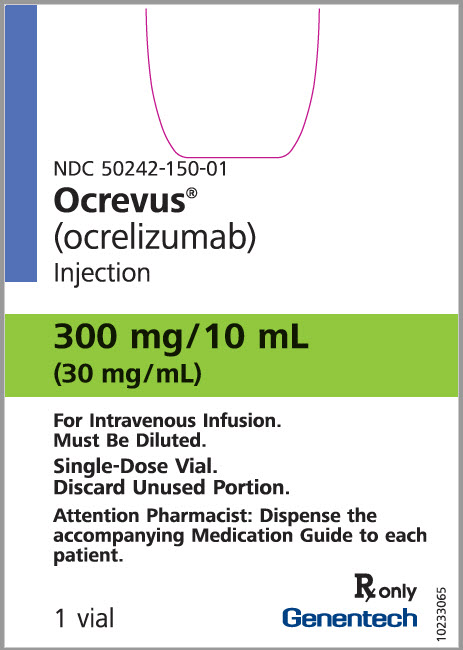
Representative sample of labeling (see the HOW SUPPLIED section for complete listing):