Because clinical trials are conducted under widely varying conditions, adverse reaction rates observed in the clinical trials of a drug cannot be directly compared to rates in the clinical trials of another drug and may not reflect the rates observed in practice.
Relapsed or Refractory Follicular Lymphoma
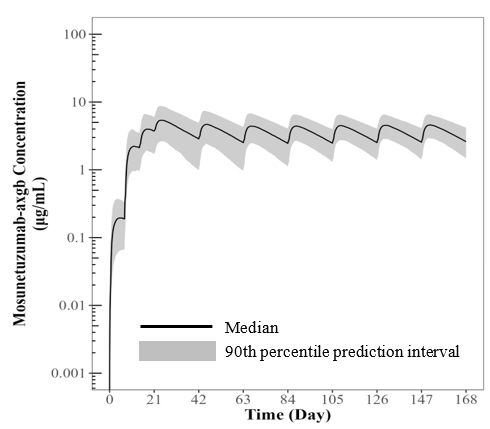
The safety of LUNSUMIO VELO was evaluated in an open-label, multicenter study which included a cohort of 94 patients with relapsed or refractory follicular lymphoma (FL) after at least two lines of systemic therapy [see Clinical Studies (14)]. Patients received step-up doses of 5 mg via subcutaneous injection on Cycle 1 Day 1 and 45 mg on Cycle 1 Day 8, followed by 45 mg on Cycle 1 Day 15, then 45 mg every 3 weeks in subsequent cycles. A treatment cycle was 21 days. The median number of cycles was 8 (range: 1 to 17), with 78% of patients exposed for at least 8 cycles and 6% exposed for 17 cycles.
The median age was 65 years (range: 35 to 84 years), 56% were male, 85% were White, 2.1% were Black or African American, 11% were Asian, and 2% were Hispanic or Latino.
Serious adverse reactions occurred in 39% of patients. Serious adverse reactions in ≥ 10% of patients included infection (17%, including pneumonia, other respiratory tract infections, and sepsis) and CRS (15%). Fatal adverse reactions occurred in 4.3% of patients from COVID-19 (3.2%) and HLH (1.1%).
Permanent discontinuation LUNSUMIO VELO due to an adverse reaction occurred in 7% of patients, including from COVID-19.
Dosage interruptions of LUNSUMIO VELO due to an adverse reaction occurred in 40% of patients. Adverse reactions which required dosage interruption in ≥ 5% of patients included COVID-19 and neutropenia.
The most common adverse reactions (≥ 20%), excluding laboratory abnormalities, were injection site reactions, fatigue, rash, CRS, COVID-19 infection, musculoskeletal pain, and diarrhea. The most common Grade 3-4 laboratory abnormalities (≥ 15%) were decreased lymphocyte count, decreased neutrophil count, and increased uric acid. Grade 4 laboratory abnormalities in > 5% included lymphocyte count decreased (22%) and neutrophil count decreased (9%).
Table 7 summarizes the adverse reactions.
Table 7. Adverse Reactions (≥ 10%) in Patients with Relapsed or Refractory FL Who Received LUNSUMIO VELO Subcutaneous Injection in GO29781| Adverse Reaction | LUNSUMIO VELO
(N = 94) |
|---|
All Grades
(%) | Grade 3 or 4
(%) |
|---|
| Immune system disorders |
|---|
| The table includes a combination of grouped and ungrouped terms. Adverse reactions were graded based on CTCAE Version 4.0, with the exception of CRS, which was graded per ASTCT 2019 criteria. |
| Cytokine release syndrome | 30 | 2.1 |
| General disorders and administration site conditions |
| Injection site reactions Injection site reactions includes injection site reaction, injection site discharge, injection site erythema, injection site edema, injection site pain, injection site pruritus and injection site rash. | 69 | 0 |
| Fatigue Fatigue includes fatigue, asthenia, and lethargy. | 39 | 0 |
| Edema Edema includes edema, edema peripheral, face edema, pulmonary edema, fluid overload, and related terms. | 13 | 0 |
| Pyrexia | 11 | 1.1 |
| Chills | 11 | 0 |
| Skin and subcutaneous tissue disorders |
| Rash Rash includes rash, injection site rash, erythema, dermatitis, palmar-plantar erythrodysesthesia, erythema multiforme, urticaria, and related terms. | 35 | 3.2 |
| Dry skin | 11 | 0 |
| Nervous system |
| Headache | 17 | 0 |
| Peripheral neuropathy Peripheral neuropathy includes peripheral neuropathy, peripheral sensory neuropathy, peripheral motor neuropathy, paresthesia, dysesthesia, hypoesthesia, burning sensation, and neuralgia. | 11 | 0 |
| Dizziness Dizziness includes dizziness and vertigo. | 10 | 0 |
| Musculoskeletal and connective tissue disorders |
| Musculoskeletal pain Musculoskeletal pain includes musculoskeletal pain, back pain, myalgia, musculoskeletal chest pain, and neck pain. | 20 | 0 |
| Arthralgia | 13 | 0 |
| Respiratory, thoracic, and mediastinal disorders |
| Cough | 13 | 0 |
| Dyspnea | 11 | 0 |
| Gastrointestinal disorders |
| Diarrhea | 20 | 0 |
| Nausea | 14 | 0 |
| Constipation | 14 | 0 |
| Abdominal pain | 13 | 0 |
| Infections |
| COVID-19 Adverse reaction with fatal outcome. ,Grade 5 COVID-19 occurred in 3.2% of patients. | 27 | 4.3 |
| Upper respiratory tract infection Upper respiratory tract infection includes upper respiratory tract infection, nasopharyngitis, sinusitis, rhinovirus infection, and related terms. | 15 | 2.1 |
| Pneumonia Pneumonia includes lung consolidation and specific types of pneumonia including COVID-19 pneumonia. | 13 | 4.3 |
| Psychiatric disorder |
| Insomnia | 15 | 0 |
Clinically relevant adverse reactions in < 10% of patients who received LUNSUMIO VELO included pruritus, skin exfoliation, herpes zoster infection, tremor, sepsis, cytomegalovirus (CMV) infection, ICANS, febrile neutropenia, capillary leak syndrome, tumor flare, and HLH .
Table 8 summarizes select laboratory abnormalities.
Table 8. Select Laboratory Abnormalities (≥ 20%) That Worsened from Baseline in Patients with Relapsed or Refractory FL Who Received LUNSUMIO VELO Subcutaneous Injection in GO29781| Laboratory Abnormality | LUNSUMIO VELO The denominator used to calculate the rate varied from 85 to 94 based on the number of patients with a baseline value and at least one post-treatment value. |
|---|
All Grades
(%) | Grade 3 or 4
(%) |
|---|
| Hematology |
|---|
| Lymphocyte count decreased | 84 | 69 |
| Hemoglobin decreased | 60 | 10 |
| Neutrophils decreased | 50 | 26 |
| Platelets decreased | 33 | 6.4 |
| Chemistry |
| Phosphate decreased | 48 | 11 |
| Alanine aminotransferase increased | 34 | 1.1 |
| Gamma-glutamyl transferase increased | 31 | 1.1 |
| Uric acid increased | 28 | 28 |
| Aspartate aminotransferase increased | 28 | 2.1 |
| Potassium decreased | 27 | 0 |
| Magnesium decreased | 25 | 2.1 |
Clinically relevant laboratory abnormalities in < 20% of patients included glucose increased.