Anastrozole Tablet
Product Images NDC 50268-075

View Photos of Packaging, Regulatory Labels, and Product Appearance

Product Visual Gallery

This gallery contains 8 technical images submitted to the FDA as part of the official labeling for Anastrozole (NDC 50268-075). Unlike standard consumer photos, these assets often include clinical data figures, molecular chemical structures, and official manufacturer packaging layouts.

As provided by Avpak, these visuals offer a comprehensive scientific overview of the product's physical and chemical identity, aiding pharmacists and researchers in product verification and study.

FDA Label Image

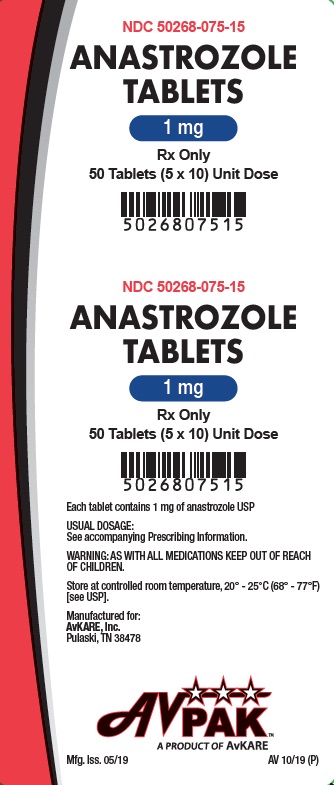
1mg (075 15)

1mg (075 15)
This is a description of a medication called Anastrozole, which is only available with a prescription. The medication comes in a box with 5 blister strips, each containing 10 tablets (50 tablets total). Each tablet contains 1 mg of Anastrozole USP. The product warning advises users to keep the medication away from children. The medication should be stored at controlled room temperature. The manufacturer of this medication is Avkare, Inc.*
FDA Label Image

Chemical Structure (Anastrozole 01)

FDA Label Image

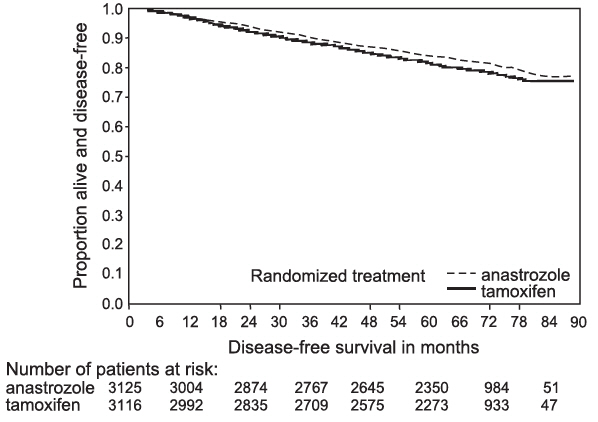
Figure 1 (Anastrozole 02)

Figure 1 (Anastrozole 02)
This appears to be a graph or chart showing disease-free survival in months for two treatments, anastrozole and tamoxifen. The x-axis shows the time in months (ranging from 0 to 90), and the y-axis shows the proportion of patients who are alive and disease-free (ranging from 0 to 1). The two treatments are represented by different colored lines. Additionally, the number of patients at risk for each treatment is listed on the bottom.*
FDA Label Image

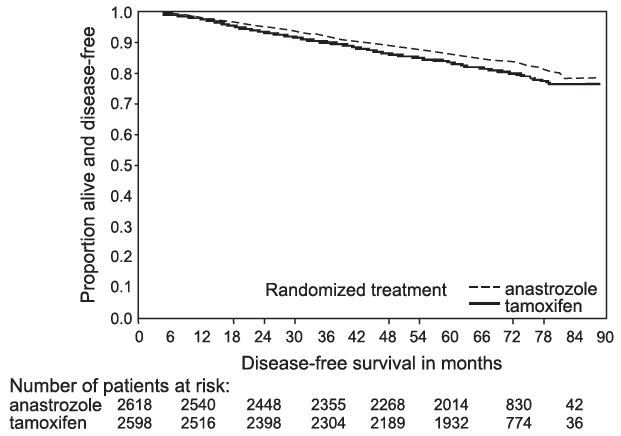
Figure 2 (Anastrozole 03)

Figure 2 (Anastrozole 03)
This appears to be a graph showing the disease-free survival rates of patients receiving either anastrozole or tamoxifen treatment over a period of 90 months. The x-axis shows the time in months, while the y-axis shows the proportion of patients who were disease-free and alive. The graph seems to suggest that anastrozole might be a more effective treatment, as the survival rate for patients who received it was consistently higher than that of patients who received tamoxifen.*
FDA Label Image

Figure 3 (Anastrozole 04)

FDA Label Image

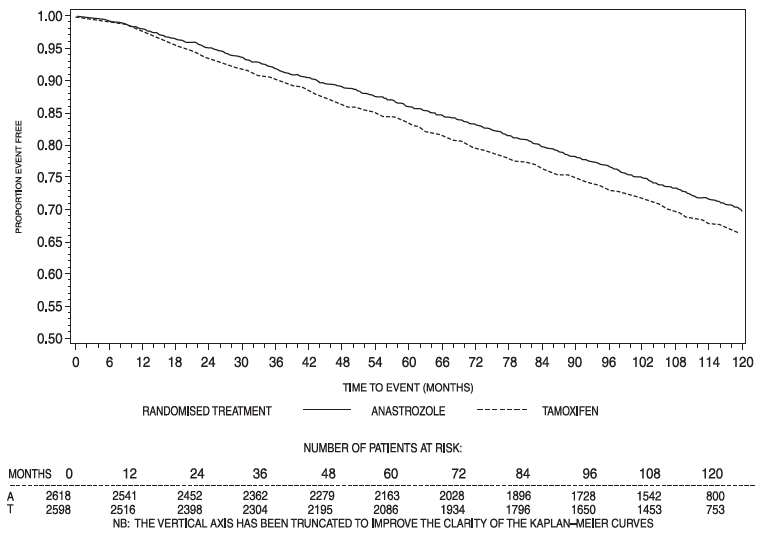
Figure 4 (Anastrozole 05)

Figure 4 (Anastrozole 05)
This appears to be a graph showing the "Proportion Event Free" over time in months, for a study on randomized treatment of anastrozole and tamoxifen. The graph includes a legend indicating the treatments being compared, and notes that the vertical axis has been truncated to improve clarity. There are also numbered markers along the x-axis indicating time points where the number of patients at risk have been recorded.*
FDA Label Image

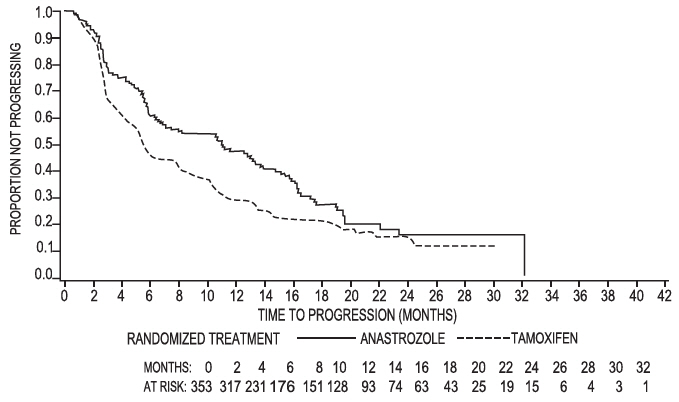
Figure 5 (Anastrozole 06)

Figure 5 (Anastrozole 06)
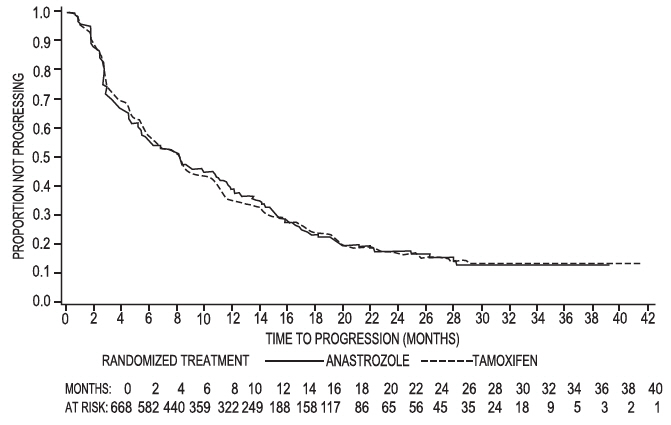
This appears to be a graph displaying the time to progression (in months) for a randomized treatment of anastrozole compared to tamoxifen. The graph shows that the proportion of patients who progressed did not increase significantly over time for either treatment. The text includes a table showing the number of patients at risk for each time point.*
FDA Label Image

Figure 6 (Anastrozole 07)

Figure 6 (Anastrozole 07)
This seems to be an incomplete data chart displaying different treatments of a medical condition over a span of 40 months. There are two types of treatments given, ANASTROZOLE, and TAMOXIFEN, and the chart displays the time to progression for both treatments. However, there isn't enough context to determine the medical condition being treated, the details of the treatments, and the source of the data. Therefore, this description is limited to just the interpretation of the given text.*

* These product label images have been analyzed using experimental machine learning. Please verify findings with the primary label text.