Famotidine
FDA Label NDC 50268-303

40 label sections · Submitted to the FDA by Avpak · Indications, Dosage, Usage, and Precautions

Structured Product Label

The following Structured Product Label (SPL) was submitted to the FDA by Avpak for the product Famotidine (NDC 50268-303). This document serves as the official prescribing information, containing essential scientific data and clinical materials required for healthcare providers and patients.

This specific version of the label includes detailed information regarding indications and usage, dosage and administration, 2.1 recommended dosage, 2.2 dosage in renal impairment, 2.3 administration instructions, dosage forms and strengths, contraindications, warnings and precautions, and other regulatory disclosures. Use the navigation below to review specific sections of the FDA submission.

Indications And Usage

Famotidine tablets are indicated in adult and pediatric patients 40 kg and above for the treatment of:

  • active duodenal ulcer (DU).
  • active gastric ulcer(GU).
  • symptomatic non-erosive gastroesophageal reflux disease (GERD).
  • erosive esophagitis due to GERD, diagnosed by biopsy. Famotidine tablets are indicated in adults for the:
  • treatment of pathological hypersecretory conditions (e.g., Zollinger-Ellison Syndrome, multiple endocrine neoplasias).
  • reduction of the risk of duodenal ulcer recurrence.

Dosage And Administration

Table 1 shows the recommended dosage of Famotidine 20 mg and 40 mg tablets in adult and pediatric patients weighing 40 kg and greater with normal renal function. The use of Famotidine 20 mg and 40 mg tablets is not recommended in pediatric patients weighing less than 40 kg because the lowest available strength (20 mg) exceeds the recommended dose for these patients. Use another famotidine formulation for pediatric patients weighing less than 40 kg.

2.2 Dosage In Renal Impairment

Dosage adjustments of Famotidine are recommended for patients with moderate to severe renal impairment (creatinine clearance less than 60 mL/min) [see Use in Specific Populations ( 8.6)]. Table 2 shows the recommended maximum dosage of Famotidine 20 mg or 40 mg tablets for patients with renal impairment, by indication. Use the lowest effective dose. Some dosage adjustments may require switching to other formulations of famotidine (e.g., oral suspension, lower dose tablet).

2.3 Administration Instructions

  • Take Famotidine once daily before bedtime or twice daily in the morning and before bedtime, as recommended.
  • Famotidine tablets may be taken with or without food [see Clinical Pharmacology ( 12.3)].
  • Famotidine tablets may be given with antacids.

Contraindications

Famotidine is contraindicated in patients with a history of serious hypersensitivity reactions (e.g., anaphylaxis) to famotidine or other histamine-2 (H 2) receptor antagonists.

Adverse Reactions

Overdosage

The types of adverse reactions in overdosage of Famotidine are similar to the adverse reactions encountered with use of recommended dosages [see Adverse Reactions ( 6.1)].

In the event of overdosage, treatment should be symptomatic and supportive. Unabsorbed material should be removed from the gastrointestinal tract, the patient should be monitored, and supportive therapy should be employed.

Due to low binding to plasma proteins, famotidine is eliminated by hemodialysis. There is limited experience on the usefulness of hemodialysis as a treatment for Famotidine overdosage.

Description

The active ingredient in famotidine, is a histamine H 2 -receptor antagonist. Famotidine is N'-(aminosulfonyl)-3-[[[2-[(diamino-methylene)amino]-4- thiazolyl]methyl]thio]propanimidamide. The empirical formula of famotidine is C 8H 15N 7O 2S 3 and its molecular weight is 337.45. Its structural formula is:

Structural Formula (Fam00 0002 01)

Structural Formula (Fam00 0002 01)

Each Famotidine tablet for oral administration contains either 20 mg or 40 mg of famotidine and the following inactive ingredients: hydroxypropyl cellulose, magnesium stearate, microcrystalline cellulose, polydextrose, polyethylene glycol, pregelatinized starch (modified corn starch), sodium starch glycolate, talc, titanium dioxide and triacetin.

Famotidine is a white to pale yellow crystalline compound that is freely soluble in glacial acetic acid, slightly soluble in methanol, very slightly soluble in water, and practically insoluble in ethanol.

Clinical Pharmacology

How Supplied

Round, white to off-white film-coated tablets coded with CTI 121 on one side and the other side plain.

NDC 50268-303-15 (10 tablets per card, 5 cards per carton).

Round, white to off-white film-coated tablets coded with CTI 122 on one side and the other side plain

Famotidine tablets are supplied as follows:
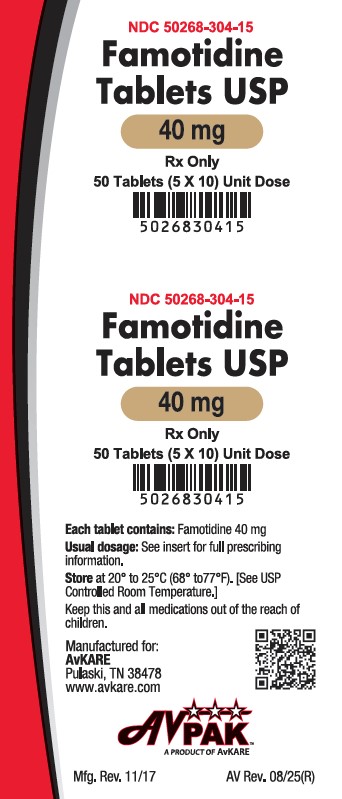
NDC 50268-304-15 (10 tablets per card, 5 cards per carton).

Dispensed in Unit Dose Packaging. For Institutional Use Only.

Storage
Store at 25°C (77°F); excursions permitted to 15° to 30°C (59° to 86°F) [see USP controlled room temperature]. Dispense in a USP tight, light-resistant container.

Manufactured for:
AvKARE
Pulaski, TN 38478
Mfg.Rev. 03/24
AV Rev. 10/25(M)
AvPAK

Package Label.Principal Display Panel

1 (304 15)

1 (304 15)

* Please review the disclaimer below.