Glycopyrrolate Tablet
FDA Label NDC 50268-363

15 label sections · Submitted to the FDA by Avpak · Indications, Dosage, Usage, and Precautions

Structured Product Label

The following Structured Product Label (SPL) was submitted to the FDA by Avpak for the product Glycopyrrolate (NDC 50268-363). This document serves as the official prescribing information, containing essential scientific data and clinical materials required for healthcare providers and patients.

This specific version of the label includes detailed information regarding indications and usage, dosage and administration, dosage forms and strengths, contraindications, warnings and precautions, adverse reactions, drug interactions, use in specific populations, and other regulatory disclosures. Use the navigation below to review specific sections of the FDA submission.

Indications And Usage

Glycopyrrolate tablets are indicated in adults to reduce symptoms of a peptic ulcer as an adjunct to treatment of peptic ulcer.

Limitations of Use
Glycopyrrolate tablets are not indicated as monotherapy for the treatment of peptic ulcer because effectiveness in peptic ulcer healing has not been established.

Dosage And Administration

2.1 Important Dosing Information
• Glycopyrrolate tablets 2 mg are not recommended for patients in whom a lower dosage strength of oral glycopyrrolate (e.g., glycopyrrolate tablets 1 mg or another 1 mg tablet strength) is appropriate for initial or maintenance treatment because the dosage strength of glycopyrrolate tablets may exceed the recommended initial and maintenance dosage of oral
glycopyrrolate tablets.

2.2 Recommended Dosage
• The recommended initial dosage of glycopyrrolate tablets 1 mg for adults is 1 mg three times daily (in the morning, early afternoon, and at bedtime). Some patients may require 2 mg at bedtime to assure overnight control of symptoms. For maintenance, a dosage of 1 mg twice a day is frequently adequate.
• The recommended dosage of glycopyrrolate tablets 2 mg for adults is 2 mg two or three times daily at equally spaced intervals.
• The maximum recommended daily dosage of glycopyrrolate is 8 mg.
• Use the lowest effective dosage of glycopyrrolate to control symptoms. If patients can be titrated to a lower dose, switch from glycopyrrolate tablets 2 mg to glycopyrrolate tablets 1 mg or another 1 mg oral tablet of glycopyrrolate.

Contraindications

Glycopyrrolate tablets are contraindicated in:
• Patients at risk for anticholinergic toxicity due to an underlying medical condition, including:
• Glaucoma [see Warnings and Precautions (5.1)]
• Obstructive uropathies, including prostatic hypertrophy
• Mechanical obstructive diseases of the gastrointestinal tract (e.g., pyloroduodenal stenosis, strictures) [see Warnings and Precautions (5.2)]
• Gastrointestinal motility disorders (e.g., achalasia, paralytic ileus, intestinal atony) [see Warnings and Precautions (5.3)]
• Bleeding gastrointestinal ulcer
• Active inflammatory or infectious colitis which can lead to toxic megacolon
• History of or current toxic megacolon or Myasthenia gravis
• Patients with a hypersensitivity to glycopyrrolate or any of the inactive ingredients in glycopyrrolate tablets [see Adverse Reactions (6) and Description (11)].

Adverse Reactions

The following serious or otherwise important adverse reactions are discussed elsewhere in the labeling:
• Precipitation of Acute Glaucoma [see Warnings and Precautions (5.1)]
• Partial or Complete Mechanical Intestinal Obstruction [see Warnings and Precautions (5.2)]
• Gastrointestinal Adverse Reactions due to Decreased Gastrointestinal Motility [see Warnings and Precautions (5.3)]
• Cognitive and Visual Adverse Reactions [see Warnings and Precautions (5.4)]
• Heat Prostration at High Environmental Temperatures [see Warnings and Precautions (5.5)]
• Other Conditions Exacerbated by Anticholinergic Adverse Reactions [see Warnings and Precautions (5.6)]
• Increased Risk of Anticholinergic Adverse Reactions in Geriatric Patients [see Warnings and Precautions (5.7)]
The following adverse reactions associated with the use of glycopyrrolate, or other anticholinergic drugs, were identified in clinical studies or postmarketing reports. Because some of these reactions are reported voluntarily from a population of uncertain size, it is not always possible to reliably estimate their frequency or establish a causal relationship to drug exposure.
Cardiac Disorders: chest, pain, hypertension, tachycardia
Endocrine Disorders: decreased sweating
Eye Disorders: blurred vision, cycloplegia, dilatation of the pupil, increased ocular tension
Gastrointestinal Disorders: bloated feeling, constipation, dry mouth, dysgeusia, nausea, vomiting
Immune System Disorders: anaphylaxis [see Contraindications (4)]
Nervous System Disorders: agitation, dizziness, drowsiness, headache, insomnia, mental confusion, nervousness, weakness
Respiratory Disorders: respiratory depression, throat irritation
Renal and Urinary Disorders: urinary hesitancy, urinary retention
Reproductive System and Breast Disorders: impotence, suppression of lactation
Vascular Disorders: flushing


To report SUSPECTED ADVERSE REACTIONS, contact AvKARE at 1-855-361-3993 or FDA at 1-800-FDA-1088 or www.fda.gov/medwatch

Overdosage

Signs and symptoms of glycopyrrolate overdosage are related to excessive anti-muscarinic anticholinergic activity and are generally peripheral (e.g., flushing, hyperthermia, tachycardia, ileus, urinary retention, loss of ocular accommodation, and light sensitivity due to mydriasis), but central nervous system toxicity (agitation, seizures, hyperthermia) may also occur.

If over-exposure occurs, call the Poison Control Center at 1-800-222-1222 for current information on the management of glycopyrrolate poisoning and overdosage.

Management of glycopyrrolate overdosage is based upon presenting signs and symptoms, including close observation for severe or life-threatening complications which may require respiratory and cardiovascular monitoring and support. Consider administration of activated charcoal and/or use of a reversible anticholinesterase as appropriate or recommended by Poison Control.

Description

Glycopyrrolate tablets, USP contain synthetic anticholinergic glycopyrrolate. Glycopyrrolate is a quaternary ammonium compound with the following chemical name: 3-[(cyclopentyl hydroxyphenylacetyl)oxy]-1,1-dimethylpyrrolidinium bromide. The molecular formula for glycopyrrolate is C19H28BrNO3, the molecular weight is 398.3 g/mol, and the structural formula is:


Glycopyrrolate_fig1 (Glycopyrrolate Fig1)

Glycopyrrolate_fig1 (Glycopyrrolate Fig1)

Each glycopyrrolate tablets, USP contains glycopyrrolate, USP 1 mg or 2 mg, as the active ingredient. The inactive ingredients are dibasic calcium phosphate, lactose monohydrate, magnesium stearate, povidone, and sodium starch glycolate.

Clinical Pharmacology

12.1 Mechanism of Action
Glycopyrrolate, an anticholinergic (antimuscarinic) agent, inhibits the action of acetylcholine on parietal cells in the stomach and decreases the volume and acidity of gastric secretions.


12.2 Pharmacodynamics
No formal pharmacodynamic studies have been conducted with glycopyrrolate.

12.3 Pharmacokinetics
Patients with Renal Impairment
In the published literature, glycopyrrolate 4 mcg/kg was administered intravenously (glycopyrrolate tablets are not recommended for intravenous use) in uremic patients undergoing renal transplantation surgery. The mean AUC (10.6 mcg·h/L) and 24-hour urinary excretion (7%) for glycopyrrolate were significantly different from normal healthy adult subjects undergoing general surgery (3.7 mcg·h/L, and 65%, respectively) [see Use in Specific Populations (8.6)].

How Supplied

Glycopyrrolate tablets USP, 1 mg are white to off-white, round, beveled edge uncoated tablets, debossed with ‘Y’ and break line on one side and ‘08’ on the other side.
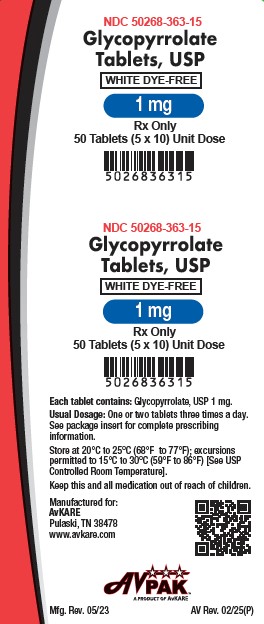
NDC 50268-363-15 (10 tablets per card, 5 cards per carton)

Glycopyrrolate tablets USP, 2 mg are white to off-white, round, beveled edge uncoated tablets, debossed with ‘Y’ and break line on one side and ‘51’ on the other side.

Store at 20°C to 25°C (68°F to 77°F); excursions permitted to 15°C to 30°C (59°F to 86°F) [See USP Controlled Room Temperature].
Dispensed in Unit Dose Packaging. For institutional Use Only. Keep this and all medication out of the reach of children.
Dispense in a tight container.

Package Label-Principal Display Panel - 1 Mg

1 (363 15)

1 (363 15)

* Please review the disclaimer below.