Adults and Adolescents 15 Years of Age and Older with Asthma
Montelukast sodium has been evaluated for safety in approximately 2950 adult and adolescent patients 15 years of age and older in clinical trials. In placebo-controlled clinical trials, the following adverse experiences reported with montelukast sodium occurred in greater than or equal to 1% of patients and at an incidence greater than that in patients treated with placebo:
Table 1 Adverse Experiences Occurring in ≥ 1 % of Patients with an Incidence Greater than that in Patients Treated with Placebo | Montelukast 10 mg/day
(%)
(n=1955)
| Placebo
(%)
(n=1180)
|
|---|
| Body As A Whole | | |
| Pain, abdominal | 2.9 | 2.5 |
| Asthenia/fatigue | 1.8 | 1.2 |
| Fever | 1.5 | 0.9 |
| Trauma | 1.0 | 0.8 |
| Digestive System Disorders | | |
| Dyspepsia | 2.1 | 1.1 |
| Pain, dental | 1.7 | 1.0 |
| Gastroenteritis, infectious | 1.5 | 0.5 |
| Nervous System/Psychiatric | | |
| Headache | 18.4 | 18.1 |
| Dizziness | 1.9 | 1.4 |
| Respiratory System Disorders | | |
| Influenza | 4.2 | 3.9 |
| Cough | 2.7 | 2.4 |
| Congestion, nasal | 1.6 | 1.3 |
| Skin/Skin Appendages Disorder | | |
| Rash | 1.6 | 1.2 |
| Laboratory Adverse Experiences | | |
| ALT increased | 2.1 | 2.0 |
| AST increased | 1.6 | 1.2 |
| Pyuria | 1.0 | 0.9 |
The frequency of less common adverse events was comparable between montelukast sodium and placebo.
The safety profile of montelukast sodium, when administered as a single dose for prevention of EIB in adult and adolescent patients 15 years of age and older, was consistent with the safety profile previously described for montelukast sodium.
Cumulatively, 569 patients were treated with montelukast sodium for at least 6 months, 480 for one year, and 49 for two years in clinical trials. With prolonged treatment, the adverse experience profile did not significantly change.
Pediatric Patients 6 to 14 Years of Age with Asthma
Montelukast sodium has been evaluated for safety in 476 pediatric patients 6 to 14 years of age. Cumulatively, 289 pediatric patients were treated with montelukast sodium for at least 6 months, and 241 for one year or longer in clinical trials. The safety profile of montelukast sodium in the 8-week, double-blind, pediatric efficacy trial was generally similar to the adult safety profile. In pediatric patients 6 to 14 years of age receiving montelukast sodium, the following events occurred with a frequency ≥ 2% and more frequently than in pediatric patients who received placebo: pharyngitis, influenza, fever, sinusitis, nausea, diarrhea, dyspepsia, otitis, viral infection, and laryngitis. The frequency of less common adverse events was comparable between montelukast sodium and placebo. With prolonged treatment, the adverse experience profile did not significantly change.
The safety profile of montelukast sodium, when administered as a single dose for prevention of EIB in pediatric patients 6 years of age and older, was consistent with the safety profile previously described for montelukast sodium.
In studies evaluating growth rate, the safety profile in these pediatric patients was consistent with the safety profile previously described for montelukast sodium. In a 56-week, double-blind study evaluating growth rate in pediatric patients 6 to 8 years of age receiving montelukast sodium, the following events not previously observed with the use of montelukast sodium in this age group occurred with a frequency ≥2% and more frequently than in pediatric patients who received placebo: headache, rhinitis (infective), varicella, gastroenteritis, atopic dermatitis, acute bronchitis, tooth infection, skin infection, and myopia.
Pediatric Patients 2 to 5 Years of Age with Asthma
Montelukast sodium has been evaluated for safety in 573 pediatric patients 2 to 5 years of age in single- and multiple-dose studies. Cumulatively, 426 pediatric patients 2 to 5 years of age were treated with montelukast sodium for at least 3 months, 230 for 6 months or longer, and 63 patients for one year or longer in clinical trials. In pediatric patients 2 to 5 years of age receiving montelukast sodium, the following events occurred with a frequency ≥2% and more frequently than in pediatric patients who received placebo: fever, cough, abdominal pain, diarrhea, headache, rhinorrhea, sinusitis, otitis, influenza, rash, ear pain, gastroenteritis, eczema, urticaria, varicella, pneumonia, dermatitis, and conjunctivitis.
Growth Rate in Pediatric Patients
A 56-week, multi-center, double-blind, randomized, active- and placebo-controlled parallel group study was conducted to assess the effect of montelukast sodium on growth rate in 360 patients with mild asthma, aged 6 to 8 years. Treatment groups included montelukast sodium 5 mg once daily, placebo, and beclomethasone dipropionate administered as 168 mcg twice daily with a spacer device. For each subject, a growth rate was defined as the slope of a linear regression line fit to the height measurements over 56 weeks. The primary comparison was the difference in growth rates between montelukast sodium and placebo groups. Growth rates, expressed as least-squares (LS) mean (95% CI) in cm/year, for the montelukast sodium, placebo, and beclomethasone treatment groups were 5.67 (5.46, 5.88), 5.64 (5.42, 5.86), and 4.86 (4.64, 5.08), respectively. The differences in growth rates, expressed as least-squares (LS) mean (95% CI) in cm/year, for montelukast sodium minus placebo, beclomethasone minus placebo, and montelukast sodium minus beclomethasone treatment groups were 0.03 (-0.26,0.31), -0.78 (-1.06, -0.49); and 0.81 (0.53, 1.09), respectively. Growth rate (expressed as mean change in height over time) for each treatment group is shown in FIGURE 1.
| Figure 1 Change in Height (cm) from Randomization Visit by Scheduled Week (Treatment Group Mean ± Standard Error
of Mean)
|
 Figure 1 (Montelukast Sodium Tablets And Chewable Tablets 1) |
Adolescents and Pediatric Patients: Pharmacokinetic studies evaluated the systemic exposure of the 4-mg oral granule formulation in pediatric patients 6 to 23 months of age, the 4-mg chewable tablets in pediatric patients 2 to 5 years of age, the 5-mg chewable tablets in pediatric patients 6 to 14 years of age, and the 10-mg film-coated tablets in young adults and adolescents ≥15 years of age.
The plasma concentration profile of montelukast following administration of the 10-mg film-coated tablet is similar in adolescents ≥15 years of age and young adults. The 10-mg film-coated tablet is recommended for use in patients ≥15 years of age.
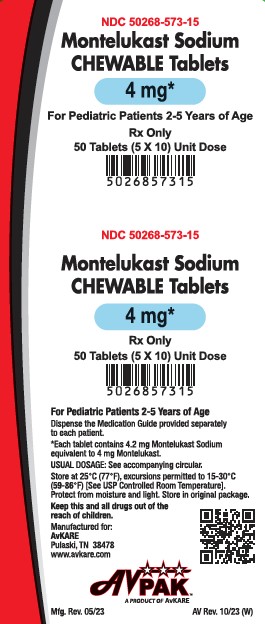
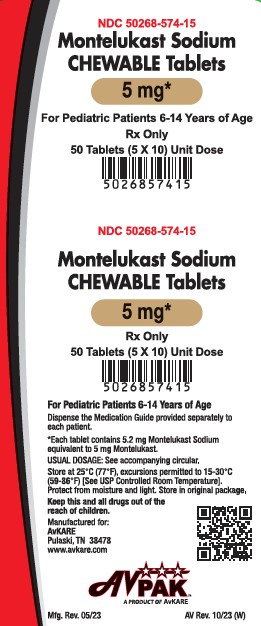
The mean systemic exposure of the 4-mg chewable tablet in pediatric patients 2 to 5 years of age and the 5-mg chewable tablets in pediatric patients 6 to 14 years of age is similar to the mean systemic exposure of the 10-mg film-coated tablet in adults. The 5-mg chewable tablet should be used in pediatric patients 6 to 14 years of age and the 4-mg chewable tablet should be used in pediatric patients 2 to 5 years of age.
In children 6 to 11 months of age, the systemic exposure to montelukast and the variability of plasma montelukast concentrations were higher than those observed in adults. Based on population analyses, the mean AUC (4296 ng∙hr/mL [range 1200 to 7153]) was 60% higher and the mean C
max (667 ng/mL [range 201 to 1058]) was 89% higher than those observed in adults (mean AUC 2689 ng∙hr/mL [range 1521 to 4595]) and the mean C
max (353 ng/mL [range 180 to 548]). The systemic exposure in children 12 to 23 months of age was less variable, but still higher than that observed in adults. The mean AUC (3574 ng∙hr/mL [range 2229 to 5408]) was 33% higher and the mean C
max (562 ng/mL [range 296 to 814]) was 60% higher than those observed in adults. Safety and tolerability of montelukast in a single-dose pharmacokinetic study in 26 children 6 to 23 months of age were similar to that of patients two years and above [see
Adverse Reactions (
6.1)].
Effect of Montelukast on Cytochrome P450 (CYP) Enzymes: Montelukast is a potent inhibitor of CYP 2C8
in vitro. However, data from a clinical drug-drug interaction study involving montelukast and rosiglitazone (a probe substrate representative of drugs primarily metabolized by CYP 2C8) in 12 healthy individuals demonstrated that the pharmacokinetics of rosiglitazone are not altered when the drugs are co-administered, indicating that montelukast does not inhibit CYP 2C8
in vivo. Therefore, montelukast is not anticipated to alter the metabolism of drugs metabolized by this enzyme (e.g., paclitaxel, rosiglitazone, and repaglinide). Based on further
in vitro results in human liver microsomes, therapeutic plasma concentrations of montelukast do not inhibit CYP 3A4, 2C9, 1A2, 2A6, 2C19, or 2D6.
Cytochrome P450 (CYP) Enzyme Inhibitors: In vitro studies have shown that montelukast is a substrate of CYP 2C8, 2C9, and 3A4. Co-administration of montelukast with intraconazole, a strong CYP 3A4 inhibitor, resulted in no significant increase in the systemic exposure of montelukast. Data from a clinical drug-drug interaction study involving montelukast and gemfibrozil (an inhibitor of both CYP 2C8 and 2C9) demonstrated that gemfibrozil, at a therapeutic dose, increased the systemic exposure of montelukast by 4.4-fold. Co-administration of itraconazole, gemfibrozil, and montelukast did not further increase the systemic exposure of montelukast. Based on available clinical experience, no dosage adjustment of montelukast is required upon co-administration with gemfibrozil [
see Overdosage (
10)
].
Adults and Adolescents 15 Years of Age and Older with Asthma
Clinical trials in adults and adolescents 15 years of age and older demonstrated there is no additional clinical benefit to montelukast doses above 10 mg once daily.
The efficacy of montelukast sodium for the chronic treatment of asthma in adults and adolescents 15 years of age and older was demonstrated in two (U.S. and Multinational) similarly designed, randomized, 12-week, double-blind, placebo-controlled trials in 1576 patients (795 treated with montelukast sodium, 530 treated with placebo, and 251 treated with active control). The median age was 33 years (range 15 to 85); 56.8% were females and 43.2% were males. The ethnic/racial distribution in these studies was 71.6% Caucasian, 17.7% Hispanic, 7.2% other origins and 3.5% Black. Patients had mild or moderate asthma and were non-smokers who required approximately 5 puffs of inhaled β-agonist per day on an "as-needed" basis. The patients had a mean baseline percent of predicted forced expiratory volume in 1 second (FEV
1) of 66% (approximate range, 40 to 90%). The co-primary endpoints in these trials were FEV
1 and daytime asthma symptoms. In both studies after 12 weeks, a random subset of patients receiving montelukast sodium was switched to placebo for an additional 3 weeks of double-blind treatment to evaluate for possible rebound effects.
The results of the U.S. trial on the primary endpoint, morning FEV
1, expressed as mean percent change from baseline averaged over the 12-week treatment period, are shown in FIGURE 2. Compared with placebo, treatment with one montelukast sodium 10-mg tablet daily in the evening resulted in a statistically significant increase in FEV
1 percent change from baseline (13%-change in the group treated with montelukast sodium vs. 4.2%-change in the placebo group, p<0.001); the change from baseline in FEV
1 for montelukast sodium was 0.32 liters compared with 0.10 liters for placebo, corresponding to a between-group difference of 0.22 liters (p<0.001, 95% CI 0.17 liters, 0.27 liters). The results of the Multinational trial on FEV
1 were similar.
| Figure 2 FEV
1 Mean Percent Change from Baseline (U.S. Trial: montelukast sodium N=406; Placebo N=270) (ANOVA Model)
|
 Figure 2 (Montelukast Sodium Tablets And Chewable Tablets 3) |
The effect of montelukast sodium on other primary and secondary endpoints, represented by the Multinational study is shown in TABLE 2. Results on these endpoints were similar in the US study.
Table 2 Effect of montelukast sodium on Primary and Secondary Endpoints in a Multinational Placebo-controlled Trial (ANOVA Model) | Montelukast Sodium | Placebo |
|---|
| Endpoint | N | Baseline | Mean Change from Baseline | N | Baseline | Mean Change from Baseline |
|---|
Daytime Asthma Symptoms
(0 to 6 scale)
| 372 | 2.35 | -0.49
| 245 | 2.40 | -0.26 |
| β-agonist (puffs per day) | 371 | 5.35 | -1.65
| 241 | 5.78 | -0.42 |
| AM PEFR (L/min) | 372 | 339.57 | 25.03
| 244 | 335.24 | 1.83 |
| PM PEFR (L/min) | 372 | 355.23 | 20.13
| 244 | 354.02 | -0.49 |
| Nocturnal Awakenings (#/week) | 285 | 5.46 | -2.03
| 195 | 5.57 | -0.78 |
Both studies evaluated the effect of montelukast sodium on secondary outcomes, including asthma attack (utilization of health-care resources such as an unscheduled visit to a doctor's office, emergency room, or hospital; or treatment with oral, intravenous, or intramuscular corticosteroid), and use of oral corticosteroids for asthma rescue. In the Multinational study, significantly fewer patients (15.6% of patients) on montelukast sodium experienced asthma attacks compared with patients on placebo (27.3%, p < 0.001). In the US study, 7.8% of patients on montelukast sodium and 10.3% of patients on placebo experienced asthma attacks, but the difference between the two treatment groups was not significant (p = 0.334). In the Multinational study, significantly fewer patients (14.8% of patients) on montelukast sodium were prescribed oral corticosteroids for asthma rescue compared with patients on placebo (25.7%, p < 0.001). In the US study, 6.9% of patients on montelukast sodium and 9.9% of patients on placebo were prescribed oral corticosteroids for asthma rescue, but the difference between the two treatment groups was not significant (p = 0.196).
Effects in Patients on Concomitant Inhaled Corticosteroids
Separate trials in adults evaluated the ability of montelukast sodium to add to the clinical effect of inhaled corticosteroids and to allow inhaled corticosteroid tapering when used concomitantly.
One randomized, placebo-controlled, parallel-group trial (n=226) enrolled adults with stable asthma with a mean FEV
1 of approximately 84% of predicted who were previously maintained on various inhaled corticosteroids (delivered by metered-dose aerosol or dry powder inhalers). The median age was 41.5 years (range 16 to 70); 52.2% were females and 47.8% were males. The ethnic/racial distribution in this study was 92 % Caucasian, 3.5% Black, 2.2% Hispanic, and 2.2% Asian. The types of inhaled corticosteroids and their mean baseline requirements included beclomethasone dipropionate (mean dose, 1203 mcg/day), triamcinolone acetonide (mean dose, 2004 mcg/day), flunisolide (mean dose, 1971 mcg/day), fluticasone propionate (mean dose, 1083 mcg/day), or budesonide (mean dose, 1192 mcg/day). Some of these inhaled corticosteroids were non-U.S.-approved formulations, and doses expressed may not be ex-actuator. The pre-study inhaled corticosteroid requirements were reduced by approximately 37% during a 5- to 7-week placebo run-in period designed to titrate patients toward their lowest effective inhaled corticosteroid dose. Treatment with montelukast sodium resulted in a further 47% reduction in mean inhaled corticosteroid dose compared with a mean reduction of 30% in the placebo group over the 12-week active treatment period (p ≤ 0.05). It is not known whether the results of this study can be generalized to patients with asthma who require higher doses of inhaled corticosteroids or systemic corticosteroids.
In another randomized, placebo-controlled, parallel-group trial (n=642) in a similar population of adult patients previously maintained, but not adequately controlled, on inhaled corticosteroids (beclomethasone 336 mcg/day), the addition of montelukast sodium to beclomethasone resulted in statistically significant improvements in FEV
1 compared with those patients who were continued on beclomethasone alone or those patients who were withdrawn from beclomethasone and treated with montelukast or placebo alone over the last 10 weeks of the 16-week, blinded treatment period. Patients who were randomized to treatment arms containing beclomethasone had statistically significantly better asthma control than those patients randomized to montelukast sodium alone or placebo alone as indicated by FEV
1, daytime asthma symptoms, PEFR, nocturnal awakenings due to asthma, and "as-needed" β-agonist requirements.
In adult patients with asthma with documented aspirin sensitivity, nearly all of whom were receiving concomitant inhaled and/or oral corticosteroids, a 4-week, randomized, parallel-group trial (n=80) demonstrated that montelukast sodium, compared with placebo, resulted in significant improvement in parameters of asthma control. The magnitude of effect of montelukast sodium in aspirin-sensitive patients was similar to the effect observed in the general population of asthma patients studied. The effect of montelukast sodium on the bronchoconstrictor response to aspirin or other non-steroidal anti-inflammatory drugs in aspirin-sensitive asthmatic patients has not been evaluated [
see Warnings and Precautions (5.3)].
Exercise-Induced Bronchoconstriction (Adults, Adolescents, and Pediatric Patients 6 years of age and older)
The efficacy of montelukast, 10 mg, when given as a single dose 2 hours before exercise for the prevention of EIB was investigated in three (U.S. and Multinational), randomized, double-blind, placebo-controlled crossover studies that included a total of 160 adult and adolescent patients 15 years of age and older with EIB. Exercise challenge testing was conducted at 2 hours, 8.5 or 12 hours, and 24 hours following administration of a single dose of study drug (montelukast 10 mg or placebo). The primary endpoint was the mean maximum percent fall in FEV
1 following the 2 hours post-dose exercise challenge in all three studies (Study A, Study B, and Study C). In Study A, a single dose of montelukast 10 mg demonstrated a statistically significant protective benefit against EIB when taken 2 hours prior to exercise. Some patients were protected from EIB at 8.5 and 24 hours after administration; however, some patients were not. The results for the mean maximum percent fall at each timepoint in Study A are shown in Table 3 and are representative of the results from the other two studies.
Table 3 Mean Maximum Percent Fall in FEV
1 Following Exercise Challenge in Study A (N=47) ANOVA Model
| Time of exercise challenge following medication administration | Mean Maximum percent fall in FEV
1 | Treatment difference % for Montelukast Sodium versus Placebo (95%CI)
|
|---|
| Montelukast Sodium | Placebo | |
|---|
| 2 hours | 13 | 22 | -9 (-12, -5) |
| 8.5 hours | 12 | 17 | -5 (-9, -2) |
| 24 hours | 10 | 14 | -4 (-7, -1) |
The efficacy of montelukast sodium 5-mg chewable tablets, when given as a single dose 2 hours before exercise for the prevention of EIB, was investigated in one multinational, randomized, double-blind, placebo-controlled crossover study that included a total of 64 pediatric patients 6 to 14 years of age with EIB. Exercise challenge testing was conducted at 2 hours and 24 hours following administration of a single dose of study drug (montelukast sodium 5 mg or placebo). The primary endpoint was the mean maximum percent fall in FEV
1 following the 2 hours post-dose exercise challenge. A single dose of montelukast sodium 5 mg demonstrated a statistically significant protective benefit against EIB when taken 2 hours prior to exercise (Table 4). Similar results were shown at 24 hours post-dose (a secondary endpoint). Some patients were protected from EIB at 24 hours after administration; however, some patients were not. No timepoints were assessed between 2 and 24 hours post-dose.
Table 4 Mean Maximum Percent Fall in FEV
1 Following Exercise Challenge in Pediatric Patients (N=64) ANOVA Model
Time of exercise challenge following medication administration | Mean Maximum percent fall in FEV1
| Treatment difference % for Montelukast Sodium versus Placebo (95%CI)
|
| Montelukast Sodium | Placebo | |
| 2 hours | 15 | 20 | -5 (-9, -1) |
| 24 hours | 13 | 17 | -4 (-7, -1) |
*Least squares-mean
The efficacy of montelukast sodium for prevention of EIB in patients below 6 years of age has not been established.
Daily administration of montelukast sodium for the chronic treatment of asthma has not been established to prevent acute episodes of EIB.
In a 12-week, randomized, double-blind, parallel group study of 110 adult and adolescent asthmatics 15 years of age and older, with a mean baseline FEV
1 percent of predicted of 83% and with documented exercise-induced exacerbation of asthma, treatment with montelukast sodium, 10 mg, once daily in the evening, resulted in a statistically significant reduction in mean maximal percent fall in FEV
1 and mean time to recovery to within 5% of the pre-exercise FEV
1. Exercise challenge was conducted at the end of the dosing interval (i.e., 20 to 24 hours after the preceding dose). This effect was maintained throughout the 12-week treatment period indicating that tolerance did not occur. Montelukast sodium did not, however, prevent clinically significant deterioration in maximal percent fall in FEV
1 after exercise (i.e., ≥20% decrease from pre-exercise baseline) in 52% of patients studied. In a separate crossover study in adults, a similar effect was observed after two once-daily 10-mg doses of montelukast sodium.
In pediatric patients 6 to 14 years of age, using the 5-mg chewable tablet, a 2-day crossover study demonstrated effects similar to those observed in adults when exercise challenge was conducted at the end of the dosing interval (i.e., 20 to 24 hours after the preceding dose).
Seasonal Allergic Rhinitis
The efficacy of montelukast sodium tablets for the treatment of seasonal allergic rhinitis was investigated in 5 similarly designed, randomized, double-blind, parallel-group, placebo- and active-controlled (loratadine) trials conducted in North America.
The 5 trials enrolled a total of 5029 patients, of whom 1799 were treated with montelukast sodium tablets. Patients were 15 to 82 years of age with a history of seasonal allergic rhinitis, a positive skin test to at least one relevant seasonal allergen, and active symptoms of seasonal allergic rhinitis at study entry.
The period of randomized treatment was 2 weeks in 4 trials and 4 weeks in one trial. The primary outcome variable was mean change from baseline in daytime nasal symptoms score (the average of individual scores of nasal congestion, rhinorrhea, nasal itching, sneezing) as assessed by patients on a 0-3 categorical scale.
Four of the five trials showed a significant reduction in daytime nasal symptoms scores with montelukast sodium 10-mg tablets compared with placebo. The results of one trial are shown below. The median age in this trial was 35 years (range 15 to 81); 65.4% were females and 34.6% were males. The ethnic/racial distribution in this study was 83.1 % Caucasian, 6.4% other origins, 5.8% Black, and 4.8% Hispanic. The mean changes from baseline in daytime nasal symptoms score in the treatment groups that received montelukast sodium tablets, loratadine, and placebo are shown in Table 5. The remaining three trials that demonstrated efficacy showed similar results.
Table 5 Effects of Montelukast Sodium on Daytime Nasal Symptoms Score
in a Placebo- and Active-controlled Trial in Patients with Seasonal Allergic Rhinitis (ANCOVA Model)
| Treatment Group (N) | Baseline Mean Score | Mean Change from Baseline | Difference Between Treatment and Placebo (95% CI)
Least-Squares Mean
|
|---|
Montelukast
10 mg
(344)
| 2.09 | -0.39 | -0.13
(-0.21, -0.06)
|
Placebo
(351)
| 2.10 | -0.26 | N.A. |
Active Control
(Loratadine 10 mg)
(599)
| 2.06 | -0.46 | -0.24
(-0.31, -0.17)
|
Perennial Allergic Rhinitis
The efficacy of montelukast sodium for the treatment of perennial allergic rhinitis was investigated in 2 randomized, double-blind, placebo-controlled studies conducted in North America and Europe. The two studies enrolled a total of 3357 patients, of whom 1632 received montelukast sodium 10-mg tablets. Patients 15 to 82 years of age with perennial allergic rhinitis as confirmed by history and a positive skin test to at least one relevant perennial allergen (dust mites, animal dander, and/or mold spores), who had active symptoms at the time of study entry, were enrolled.
In the study in which efficacy was demonstrated, the median age was 35 years (range 15 to 81); 64.1 % were females and 35.9% were males. The ethnic/racial distribution in this study was 83.2% Caucasian, 8.1 % Black, 5.4% Hispanic, 2.3% Asian, and 1% other origins. Montelukast sodium 10-mg tablets once daily was shown to significantly reduce symptoms of perennial allergic rhinitis over a 6-week treatment period (Table 6); in this study the primary outcome variable was mean change from baseline in daytime nasal symptoms score (the average of individual scores of nasal congestion, rhinorrhea, and sneezing).
Table 6 Effects of Montelukast Sodium on Daytime Nasal Symptoms Score
in a Placebo-controlled Trial in Patients with Perennial Allergic Rhinitis (ANCOVA Model)
| Treatment Group (N) | Baseline Mean Score | Mean Change from Baseline | Difference Between Treatment and Placebo (95% CI)
Least-Squares Mean
|
|---|
Montelukast 10 mg
(1000)
| 2.09 | -0.42 | -0.08
(-0.12, -0.04)
|
Placebo
(980)
| 2.10 | -0.35 | N.A. |
The other 6-week study evaluated montelukast 10 mg (n=626), placebo (n=609), and an active-control (cetirizine 10 mg; n=120). The primary analysis compared the mean change from baseline in daytime nasal symptoms score for montelukast sodium vs. placebo over the first 4 weeks of treatment; the study was not designed for statistical comparison between montelukast sodium and the active-control. The primary outcome variable included nasal itching in addition to nasal congestion, rhinorrhea, and sneezing. The estimated difference between montelukast sodium and placebo was -0.04 with a 95% CI of (-0.09, 0.01). The estimated difference between the active-control and placebo was -0.10 with a 95% CI of (-0.19, -0.01).
Advise patients about the potential risk for serious neuropsychiatric symptoms and behavioral changes with montelukast sodium use [see Warnings and Precautions (5.1)].
Discuss the benefits and risks of montelukast sodium with patients when prescribing or continuing treatment with montelukast sodium [see Warnings and Precautions (5.1)].
Advise patients to monitor for changes in behavior or neuropsychiatric symptoms in patients taking montelukast sodium [see Warnings and Precautions (5.1)].
Instruct patients to discontinue montelukast sodium and contact a healthcare provider immediately if changes in behavior or thinking that are not typical for the patient occur, or if the patient develops suicidal ideation or suicidal behavior [see Warnings and Precautions (5.1)].
Advise patients to take montelukast sodium daily as prescribed, even when they are asymptomatic, as well as during periods of worsening asthma, and to contact their physicians if their asthma is not well controlled.
Advise patients that oral montelukast sodium is not for the treatment of acute asthma attacks. They should have appropriate short-acting inhaled ß-agonist medication available to treat asthma exacerbations. Patients who have exacerbations of asthma after exercise should be instructed to have available for rescue a shortacting inhaled ß-agonist. Daily administration of montelukast sodium for the chronic treatment of asthma has not been established to prevent acute episodes of EIB [see Warnings and Precautions (5.2)].
Advise patients to seek medical attention if short-acting inhaled bronchodilators are needed more often than usual, or if more than the maximum number of inhalations of short-acting bronchodilator treatment prescribed for a 24-hour period are needed.
Instruct patients to continue other anti-asthma medications as prescribed unless instructed by a physician.
Instruct patients with known aspirin sensitivity to continue avoidance of aspirin or non-steroidal antiinflammatory agents while taking montelukast sodium [see Warnings and Precautions (5.4)].
Manufactured for:
AvKARE
Pulaski, TN 38478
Mfg. Rev. 07/23
AV Rev. 01/25 (M)
Dispense with Medication Guide available at: www.avkare.com.