Potassium Chloride Capsule, Extended Release
FDA Label NDC 50268-671

23 label sections · Submitted to the FDA by Avpak · Indications, Dosage, Usage, and Precautions

Structured Product Label

The following Structured Product Label (SPL) was submitted to the FDA by Avpak for the product Potassium Chloride (NDC 50268-671). This document serves as the official prescribing information, containing essential scientific data and clinical materials required for healthcare providers and patients.

This specific version of the label includes detailed information regarding indications and usage, dosage and administration, 2.1 administration and monitoring, 2.2 adult dosing, 2.3 pediatric dosing, dosage forms & strengths, contraindications, warnings and precautions, and other regulatory disclosures. Use the navigation below to review specific sections of the FDA submission.

Indications And Usage

Potassium chloride extended-release capsules are indicated for the treatment and prophylaxis of hypokalemia in adults and children with or without metabolic alkalosis, in patients for whom dietary management with potassium-rich foods or diuretic dose reduction is insufficient.

Dosage And Administration

Contraindications

Potassium chloride extended-release capsules are contraindicated in patients on amiloride or triamterene.

Warnings And Precautions

5.1 Gastrointestinal Adverse Reactions
Solid oral dosage forms of potassium chloride can produce ulcerative and/or stenotic lesions of the gastrointestinal tract, particularly if the drug is in contact with the gastrointestinal mucosa for a prolonged period of time. Consider the use of liquid potassium in patients with dysphagia, swallowing disorders, or severe gastrointestinal motility disorders.

If severe vomiting, abdominal pain, distention, or gastrointestinal bleeding occurs, discontinue potassium chloride extended-release capsules and consider possibility of ulceration, obstruction or perforation.

Potassium chloride extended-release capsules should not be taken on an empty stomach because of its potential for gastric irritation [see Dosage and Administration (2.1)].

Adverse Reactions

The following adverse reactions have been identified with use of oral potassium salts. Because these reactions are reported voluntarily from a population of uncertain size, it is not always possible to reliably estimate their frequency or establish a causal relationship to drug exposure.

The most common adverse reactions to oral potassium salts are nausea, vomiting, flatulence, abdominal pain/ discomfort, and diarrhea. There have been reports of hyperkalemia and of upper and lower gastrointestinal conditions including, obstruction, bleeding, ulceration, and perforation.

Skin rash has been reported rarely.

To report SUSPECTED ADVERSE REACTIONS, contact AvKARE at 1-855-361-3993; email [email protected] or FDA at 1-800-FDA-1088 or www.fda.gov/medwatch.

Overdosage

10.1 Symptoms
The administration of oral potassium salts to persons with normal excretory mechanisms for potassium rarely causes serious hyperkalemia. However, if excretory mechanisms are impaired, potentially fatal hyperkalemia can result. Hyperkalemia is usually asymptomatic and may be manifested only by an increased serum potassium concentration (6.5 mEq/L to 8.0 mEq/L) and characteristic electrocardiographic changes (peaking of T-waves, loss of P-waves, depression of S-T segment, and prolongation of the QT-interval). Late manifestations include muscle paralysis and cardiovascular collapse from cardiac arrest (9 mEq/L to 12
mEq/L).

10.2 Treatment
Treatment measures for hyperkalemia include the following:
1. Monitor closely for arrhythmias and electrolyte changes.
2. Eliminate foods and medications containing potassium and any agents with potassium-sparing properties such as potassium-sparing diuretics, ARBs, ACE inhibitors, NSAIDs, certain nutritional supplements, and many others.
3. Administer intravenous calcium gluconate if the patient is at no risk or low risk of developing digitalis toxicity.
4. Administer 300 mL/hr to 500 mL/hr of 10% dextrose solution containing 10 units to 20 units of crystalline insulin per 1,000 mL.
5. Correct acidosis, if present, with intravenous sodium bicarbonate.
6. Use exchange resins, hemodialysis, or peritoneal dialysis.

In patients who have been stabilized on digitalis, too rapid a lowering of the serum potassium concentration can produce digitalis toxicity.

The extended-release feature means that absorption and toxic effects may be delayed for hours.

Consider standard measures to remove any unabsorbed drug.

Description

Potassium chloride extended-release capsules USP, 10 mEq are an oral dosage form of microencapsulated potassium chloride containing 750 mg of potassium chloride, USP equivalent to 10 mEq of potassium.

The chemical name of the active ingredient is potassium chloride and the structural formula is KCl. It has a molecular mass of 74.55. Potassium chloride, USP occurs as a white granular powder or as colorless crystals. It is odorless and has a saline taste. Its solutions are neutral to litmus. It is freely soluble in water and insoluble in alcohol.

The inactive ingredients are, ethylcellulose, FD&C Blue #1, FD&C Red # 40, gelatin, sodium lauryl sulfate, titanium oxide and triethyl citrate.

Clinical Pharmacology

12.1 Mechanism of Action
The potassium ion (K+) is the principal intracellular cation of most body tissues. Potassium ions participate in a number of essential physiological processes, including the maintenance of intracellular tonicity; the transmission of nerve impulses; the contraction of cardiac, skeletal, and smooth muscle; and the maintenance of normal renal function.

The intracellular concentration of potassium is approximately 150 to 160 mEq per liter. The normal adult plasma concentration is 3.5 to 5 mEq per liter. An active ion transport system maintains this gradient across the plasma membrane.

Potassium is a normal dietary constituent and under steady-state conditions the amount of potassium absorbed from the gastrointestinal tract is equal to the amount excreted in the urine. The usual dietary intake of potassium is 50 to 100 mEq per day.

12.3 Pharmacokinetics
Each crystal of KCl is microencapsulated and allows for the controlled release of potassium and chloride ions over an eight- to ten-hour period.

Specific Populations
Cirrhotics
Based on publish literature, the baseline corrected serum concentrations of potassium measured over 3 hours after administration in cirrhotic subjects who received an oral potassium load rose to approximately twice that of normal subjects who received the same load.

How Supplied

Potassium chloride extended-release capsules USP, 10 mEq are blue opaque elongated hard gelatin capsules filled with white to off-white coated pellets and imprinting ‘amneal’ on the cap and ‘542’ on the body with white ink, each containing 750 mg microencapsulated potassium chloride (equivalent to 10 mEq K).

They are available as follows:
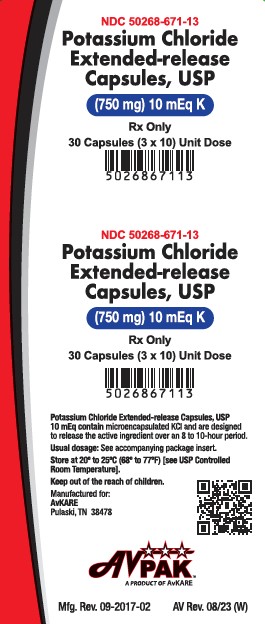
NDC 50268-671-13 (10 capsules per card,3 cards per carton)

Dispensed in Unit Dose Packaging. For Institutional Use Only.

Store at 20° to 25°C (68° to 77°F) [see USP Controlled Room Temperature].

Dispense in a tight container as defined in the USP.

Package Label.Principal Display Panel

1 (671 13)

1 (671 13)

* Please review the disclaimer below.