Rosuvastatin Tablet, Film Coated
Product Images NDC 50268-710

30 FDA label images from Avpak · Packaging, Regulatory Labels, and Product Appearance

Product Visual Gallery

This gallery contains 30 technical images submitted to the FDA as part of the official labeling for Rosuvastatin (NDC 50268-710). Unlike standard consumer photos, these assets often include clinical data figures, molecular chemical structures, and official manufacturer packaging layouts.

As provided by Avpak, these visuals offer a comprehensive scientific overview of the product's physical and chemical identity, aiding pharmacists and researchers in product verification and study.

FDA Label Image

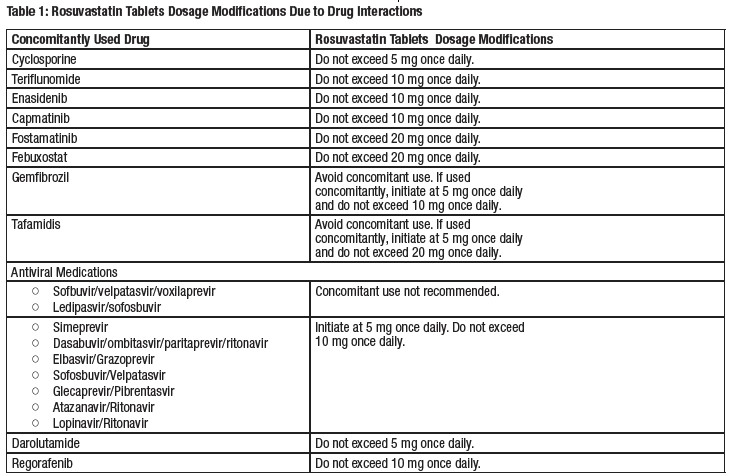
1 (Table 1)

1 (Table 1)
A data table titled "Rosuvastatin Tablets Dosage Modifications Due to Drug Interactions" listing various concomitantly used drugs alongside corresponding dosage modification recommendations for Rosuvastatin tablets. The table includes drugs like Cyclosporine, Teriflunomide, Enasidenib, and others, with specific maximum dosage limits or advisories about concomitant use. It also covers antiviral medications grouped with notes on dosage initiation and restrictions.*
FDA Label Image

1 (Table 2)

1 (Table 2)
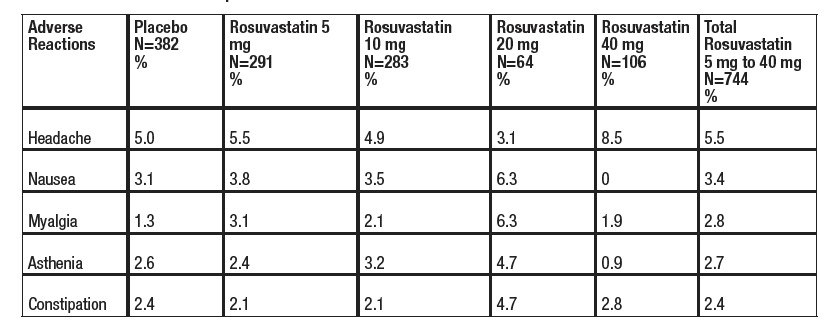
A table presenting adverse reaction percentages for Rosuvastatin tablets at different doses (5 mg, 10 mg, 20 mg, and 40 mg) compared to placebo. It includes reaction types such as headache, nausea, myalgia, asthenia, and constipation, summarizing incidence across 744 patients for doses from 5 mg to 40 mg.*
FDA Label Image

3 (Table 3)

3 (Table 3)
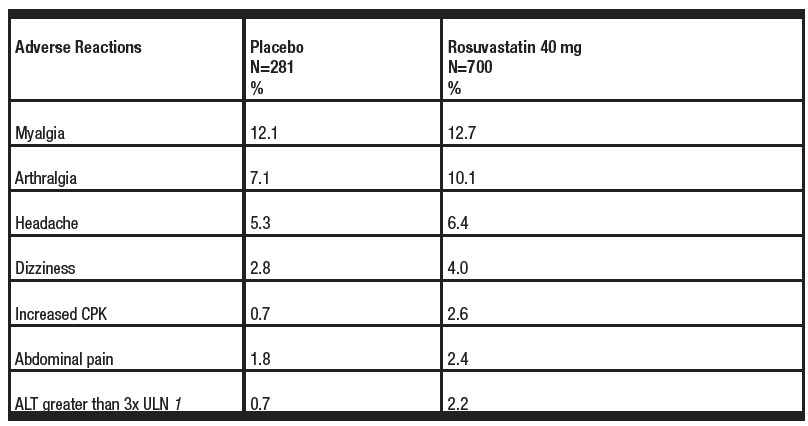
Table presenting adverse reactions reported in clinical trials comparing Rosuvastatin 40 mg (N=700) to placebo (N=281). It lists the percentage of patients experiencing reactions such as myalgia, arthralgia, headache, dizziness, increased CPK, abdominal pain, and elevated ALT greater than 3 times the upper limit of normal.*
FDA Label Image

4 (Table 4)

4 (Table 4)
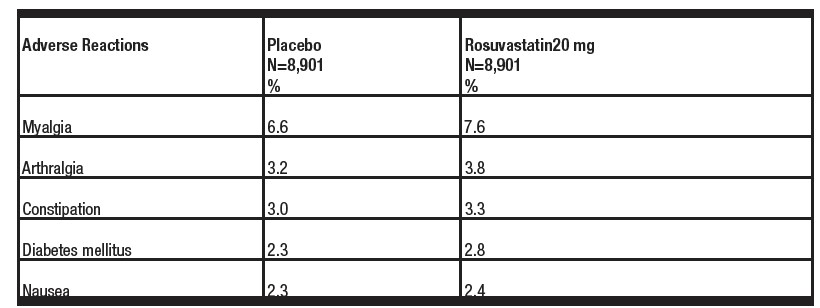
Data table comparing the incidence percentages of various adverse reactions in patients taking Rosuvastatin 20 mg versus placebo, with sample sizes of 8,901 each. Adverse reactions listed include myalgia, arthralgia, constipation, diabetes mellitus, and nausea.*
FDA Label Image

1 (Table 5.1)

1 (Table 5.1)
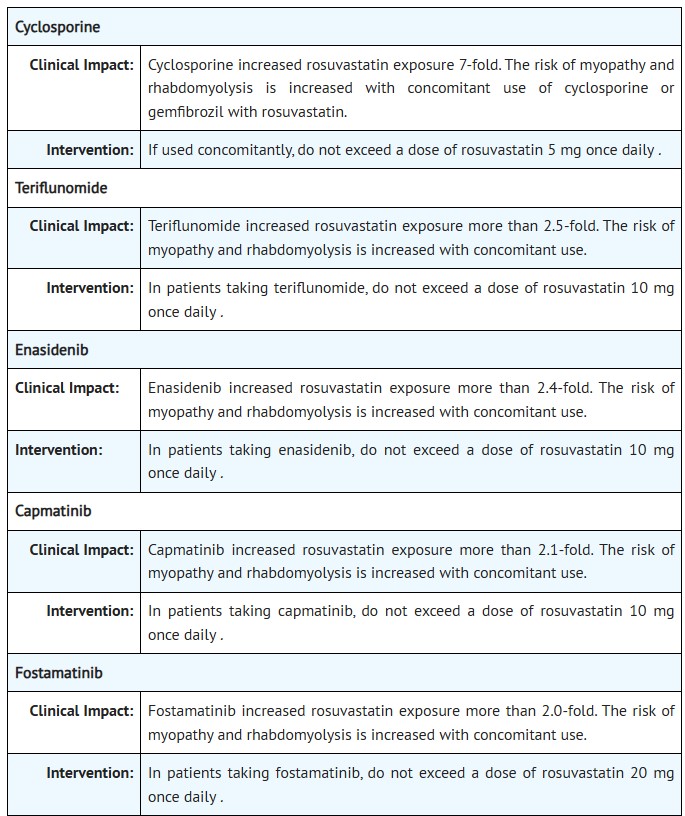
A drug interaction data table showing clinical impact and intervention guidelines for rosuvastatin with several concomitant drugs including cyclosporine, teriflunomide, enasidenib, capmatinib, and fostamatinib. It details the increased exposure levels of rosuvastatin and recommended maximum dosing adjustments.*
FDA Label Image

1 (Table 5.2)

1 (Table 5.2)
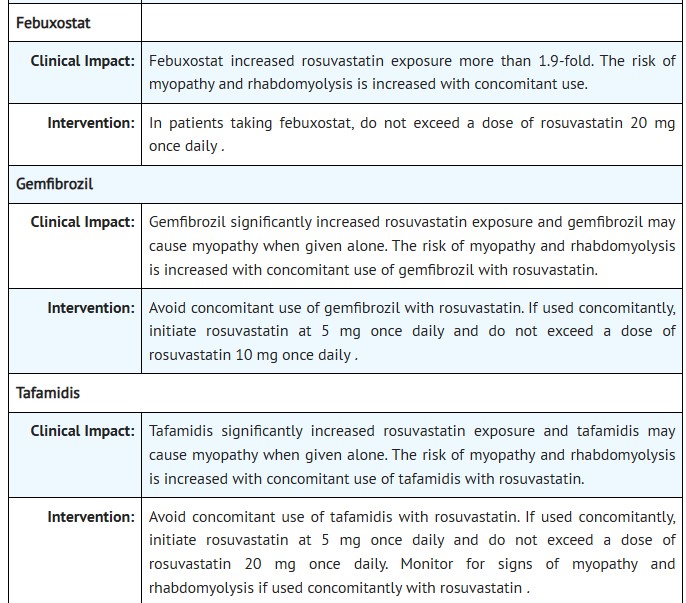
A data table presenting drug interaction clinical impacts and interventions for Rosuvastatin with Febuxostat, Gemfibrozil, and Tafamidis. Each drug's effect on Rosuvastatin exposure and associated risks of myopathy and rhabdomyolysis are summarized, along with recommended interventions to manage dosing and monitoring when used concomitantly.*
FDA Label Image

1 (Table 5.3)

1 (Table 5.3)
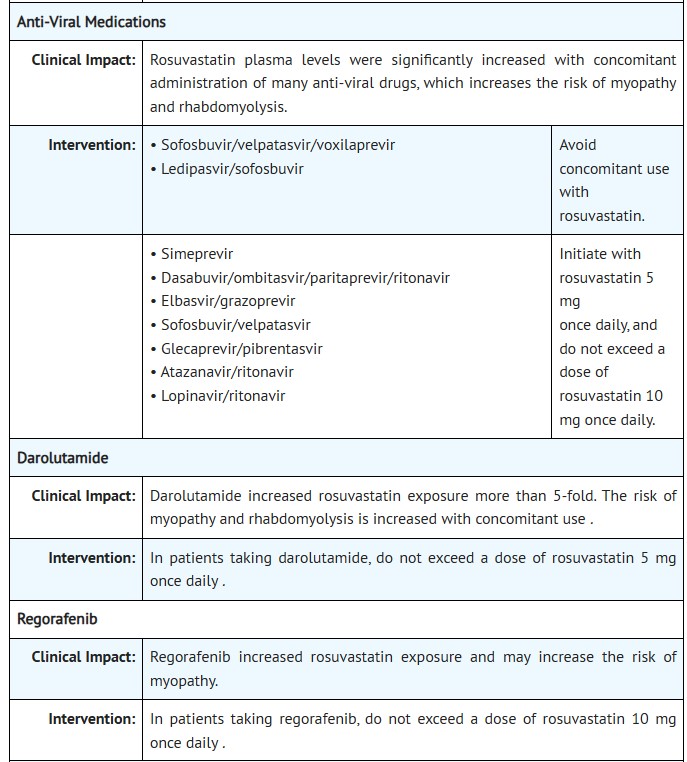
This text panel provides drug interaction information for rosuvastatin. It details the clinical impact and recommended interventions for rosuvastatin when taken with antiviral medications, darolutamide, and regorafenib, including dose adjustments to reduce the risk of myopathy and rhabdomyolysis.*
FDA Label Image

1 (Table 5.4)

1 (Table 5.4)
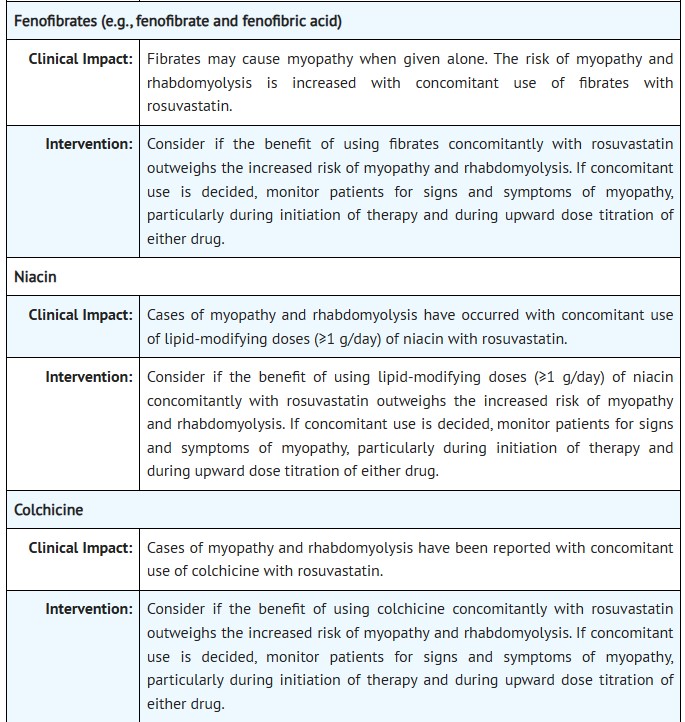
Text panels summarizing clinical impact and intervention recommendations for concomitant use of Rosuvastatin with fenofibrates, niacin, and colchicine. These sections describe increased risks of myopathy and rhabdomyolysis and advise monitoring patients during therapy initiation and dose titration.*
FDA Label Image

1 (Table 5.5)

1 (Table 5.5)
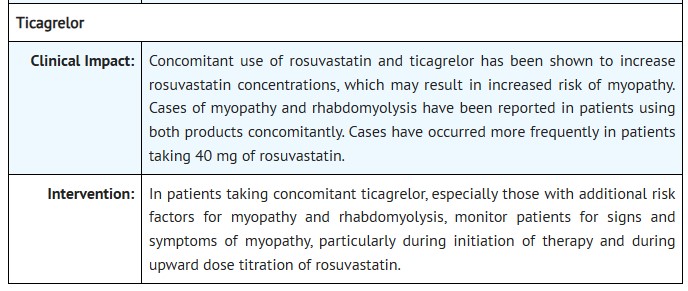
A drug information table discussing the clinical impact and intervention guidelines related to the concomitant use of rosuvastatin and ticagrelor. It highlights increased rosuvastatin concentrations and risk of myopathy and rhabdomyolysis, especially at 40 mg rosuvastatin doses, with monitoring recommendations during therapy initiation and dosage titration.*
FDA Label Image

1 (Table 6)

1 (Table 6)
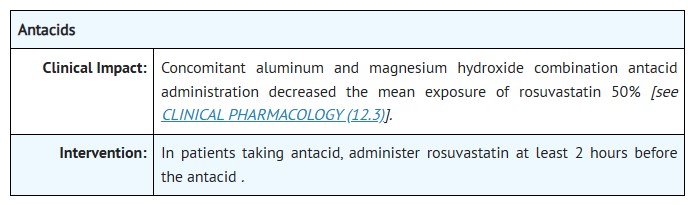
This image is a text excerpt from the Rosuvastatin prescribing information addressing antacid interaction. It explains that concomitant administration of aluminum and magnesium hydroxide antacids reduces rosuvastatin exposure by 50%. It advises to administer rosuvastatin at least 2 hours before taking antacids.*
FDA Label Image

1 (Table 7)

1 (Table 7)
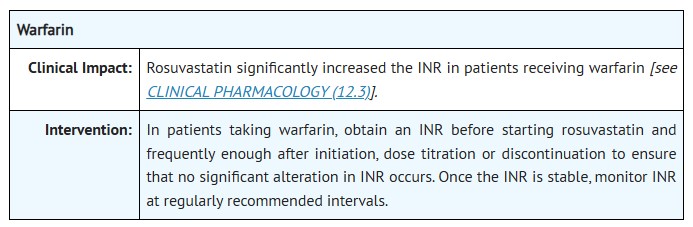
A text panel titled 'Warfarin' summarizing clinical impact and intervention. It states that rosuvastatin significantly increases INR in patients on warfarin and advises monitoring INR before starting rosuvastatin, with dose titration or discontinuation as needed, and regular INR monitoring once stable.*
FDA Label Image

Structure (Structure)

Structure (Structure)
Chemical structure of Rosuvastatin, showing its molecular arrangement with atoms and functional groups including fluorophenyl, sulfonyl, and hydroxyl groups, and calcium salt form as indicated by Ca+2.*
FDA Label Image

1 (Table 8.1)

1 (Table 8.1)
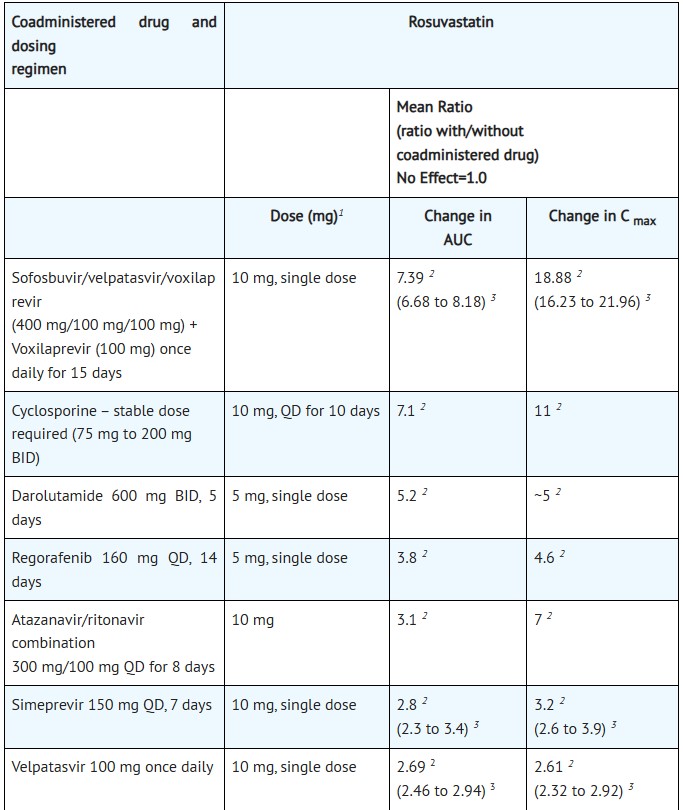
Table showing the effect of various coadministered drugs on Rosuvastatin pharmacokinetics. It lists drug regimens, Rosuvastatin doses, and mean ratio changes in AUC and Cmax compared to Rosuvastatin alone. Included drugs are Sofosbuvir/velpatasvir/voxilaprevir, Cyclosporine, Darolutamide, Regorafenib, Atazanavir/ritonavir, Simeprevir, and Velpatasvir.*
FDA Label Image

1 (Table 8.2)

1 (Table 8.2)
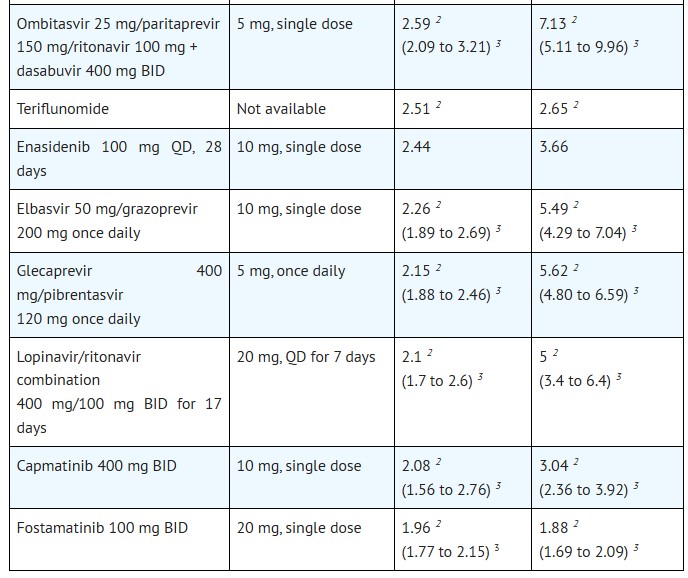
A data table listing various drugs, their dosages, and corresponding numerical values. The table includes medications such as Ombitasvir/paritaprevir/ritonavir/dasabuvir, Teriflunomide, Enasidenib, Elbasvir/grazoprevir, Glecaprevir/pibrentasvir, Lopinavir/ritonavir, Capmatinib, and Fostamatinib. It displays dose information and numerical data across several columns.*
FDA Label Image

1 (Table 8.3)

1 (Table 8.3)
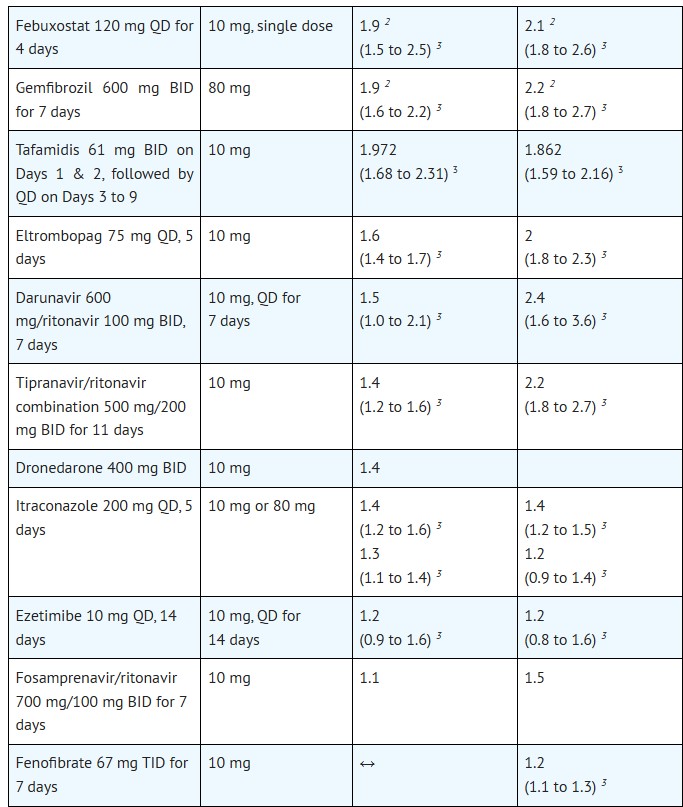
A data table listing various drugs and corresponding dosages, including drugs like Febuxostat, Gemfibrozil, Tafamidis, and others, along with numerical values likely representing dosing metrics or pharmacokinetic parameters for Rosuvastatin exposure at different dosages such as 10 mg, 80 mg, and 40 mg.*
FDA Label Image

1 (Table 8.4)

1 (Table 8.4)
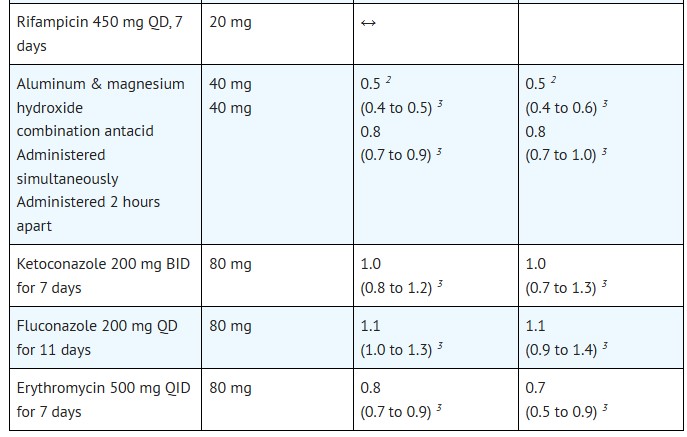
A data table listing drug interaction values between Rosuvastatin at 20 mg and 40 mg doses and several medications including Rifampicin, aluminum & magnesium hydroxide combination antacid, Ketoconazole, Fluconazole, and Erythromycin over various dosing schedules. The table presents interaction ratios with numerical ranges for each drug combination.*
FDA Label Image

1 (Table 9)

1 (Table 9)
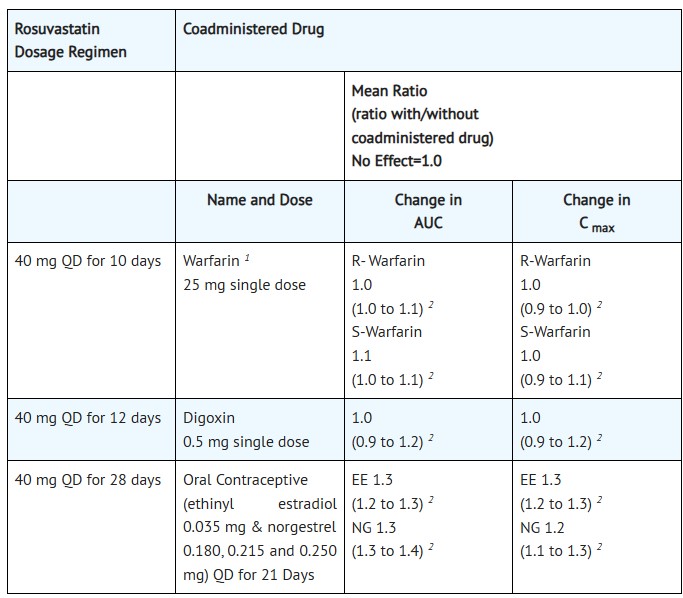
A data table showing the interaction effects of coadministered drugs on Rosuvastatin pharmacokinetics. It lists dosage regimens of Rosuvastatin at 40 mg QD for varying days paired with Warfarin, Digoxin, and oral contraceptives, detailing changes in AUC and Cmax ratios indicating drug interaction impacts.*
FDA Label Image

1 (Figure 1)

1 (Figure 1)
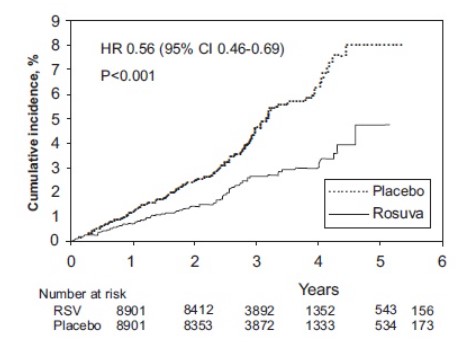
A line graph depicting cumulative incidence percentage over a 5-year period comparing Placebo and Rosuvastatin (Rosuva). The graph includes a hazard ratio (HR 0.56) with 95% confidence interval and a P value less than 0.001. A table below shows the number at risk for both groups at multiple time points.*
FDA Label Image

1 (Figure 2)

1 (Figure 2)
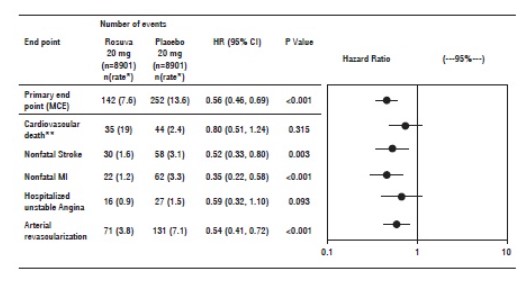
A forest plot chart comparing hazard ratios (HR) and 95% confidence intervals for various cardiovascular endpoints between Rosuvastatin 20 mg and placebo groups. The table includes event counts, hazard ratios, and p-values for primary endpoint, cardiovascular death, nonfatal stroke, nonfatal myocardial infarction, hospitalized unstable angina, and arterial revascularization, illustrating Rosuvastatin's effect relative to placebo.*
FDA Label Image

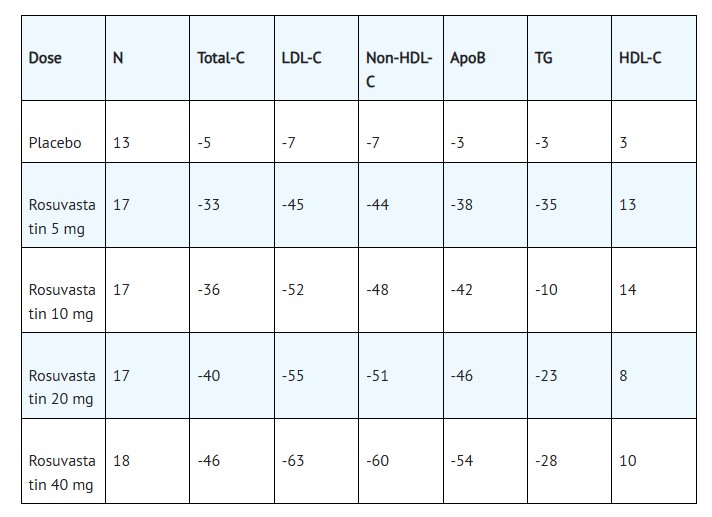
1 (Table 10)

1 (Table 10)
A data table comparing the effects of placebo and Rosuvastatin doses (5 mg, 10 mg, 20 mg, 40 mg) on various cholesterol and lipid parameters. Columns include Dose, N (sample size), Total-C, LDL-C, Non-HDL-C, ApoB, TG, and HDL-C, showing percentage changes for each parameter by dose group.*
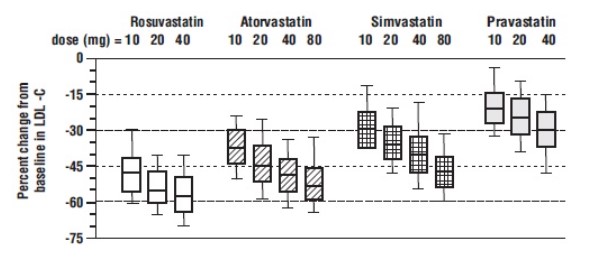
FDA Label Image

1 (Figure 3)

1 (Figure 3)
A box plot graph comparing the percent change from baseline in LDL-C levels for four statin drugs: Rosuvastatin, Atorvastatin, Simvastatin, and Pravastatin. Each drug is shown at multiple doses (mg) along the x-axis, with percent change in LDL-C on the y-axis ranging from 0 to -75 percent. The graph illustrates the variation and median reduction in LDL-C for each dose and drug.*
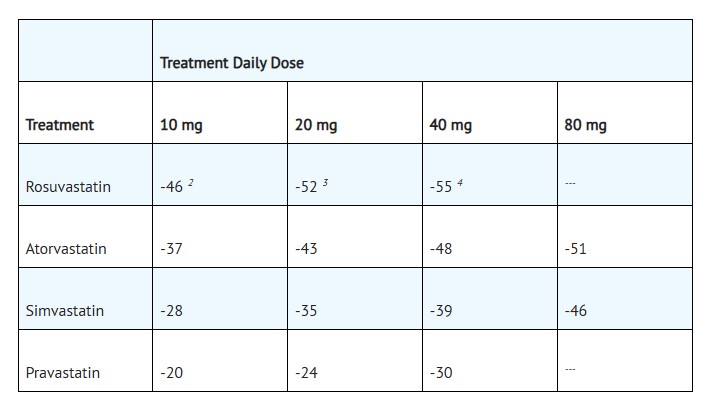
FDA Label Image

1 (Table 11)

1 (Table 11)
A data table showing treatment daily dose effects for different statins including Rosuvastatin, Atorvastatin, Simvastatin, and Pravastatin. The table lists values at doses of 10 mg, 20 mg, 40 mg, and 80 mg for each treatment, indicating comparative data points across these dosages.*
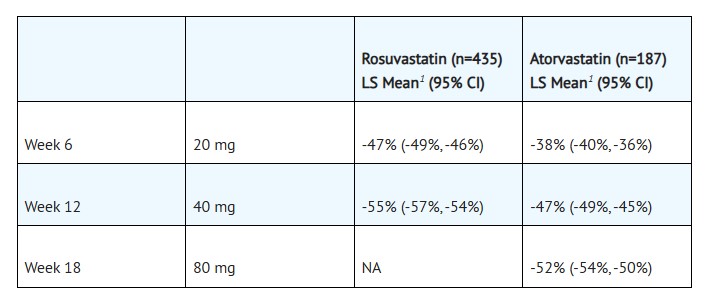
FDA Label Image

1 (Table 12)

1 (Table 12)
A data table comparing the least squares mean percentage changes at weeks 6, 12, and 18 for Rosuvastatin and Atorvastatin at varying dosages. Data includes Rosuvastatin 20 mg and 40 mg, and Atorvastatin 20 mg, 40 mg, and 80 mg, with sample sizes of 435 and 187, respectively.*
FDA Label Image

1 (Table 13)

1 (Table 13)
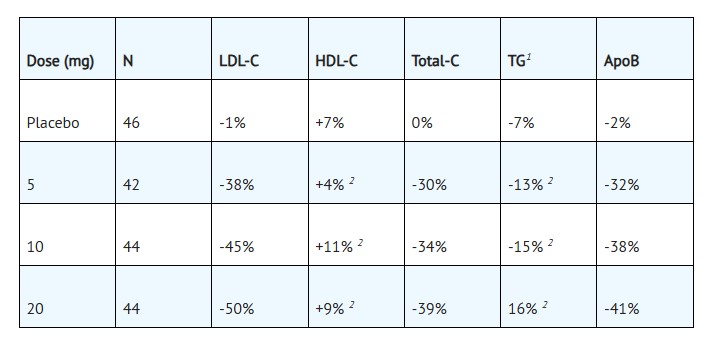
A data table showing the effect of different doses of a drug including Placebo, 5 mg, 10 mg, and 20 mg on various lipid parameters: LDL-C, HDL-C, Total-C, TG, and ApoB. The table includes sample sizes (N) for each dose group and percentage changes in each lipid parameter compared to baseline.*
FDA Label Image

1 (Table 14)

1 (Table 14)
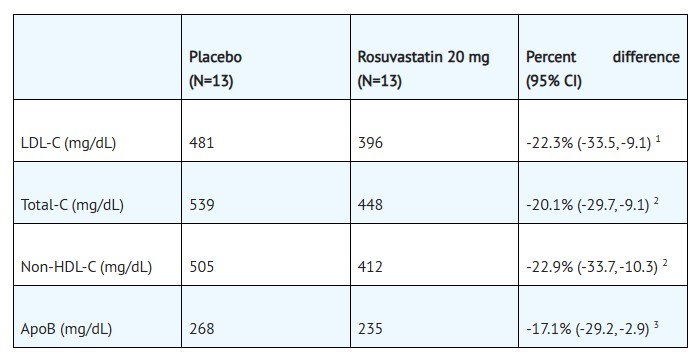
A data table comparing lipid-related blood values between placebo and Rosuvastatin 20 mg groups, including LDL-C, Total-C, Non-HDL-C, and ApoB levels measured in mg/dL, along with the percent difference and 95% confidence intervals for each parameter.*
FDA Label Image

1 (Table 15)

1 (Table 15)
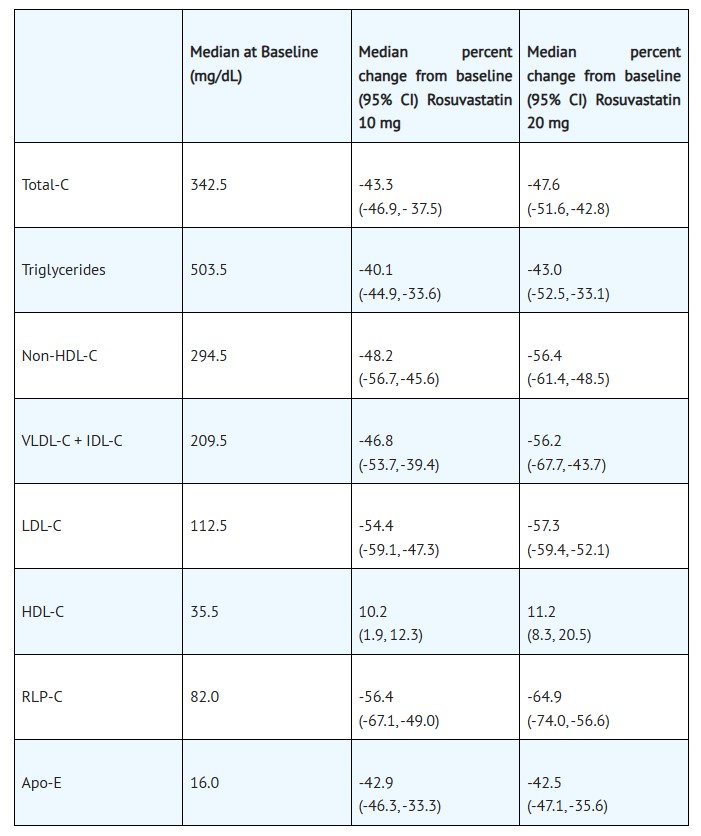
Data table showing median baseline values and median percent change from baseline for various lipid parameters, comparing Rosuvastatin 10 mg and 20 mg dosages. Parameters include Total-C, Triglycerides, Non-HDL-C, VLDL-C + IDL-C, LDL-C, HDL-C, RLP-C, and Apo-E with associated confidence intervals for changes.*
FDA Label Image

1 (Table 16)

1 (Table 16)
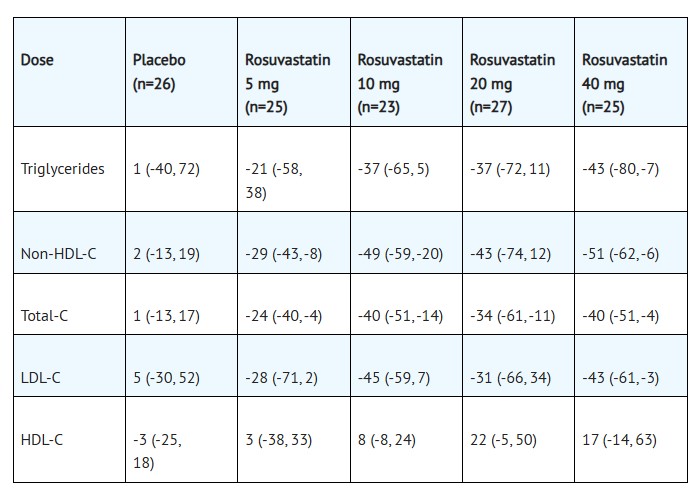
A data table comparing placebo and rosuvastatin doses (5 mg, 10 mg, 20 mg, 40 mg) across lipid parameters: Triglycerides, Non-HDL-C, Total-C, LDL-C, and HDL-C. It lists numerical values with ranges for each dose and parameter, summarizing lipid level changes associated with each rosuvastatin dose relative to placebo.*
FDA Label Image

1 (709 15)

1 (709 15)
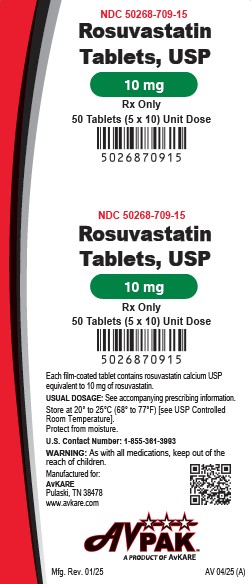
Label for Rosuvastatin Tablets USP 10 mg by AvPAK. Film-coated oral tablets, packaged 50 tablets per bottle (5 bottles of 10 tablets each). The label includes dosage strength, NDC 50268-709-15, storage instructions, and a warning to keep out of reach of children. Manufactured by AvKARE in Pulaski, TN.*
FDA Label Image

1 (710 15)

1 (710 15)
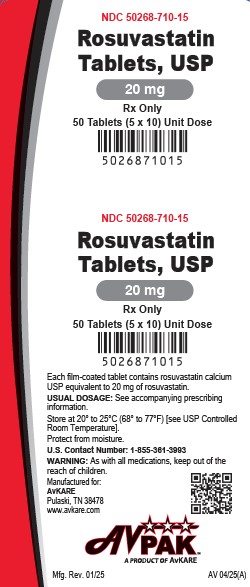
Rosuvastatin 20 mg tablets, USP film-coated oral tablets in a package labeled for prescription use only. The package contains 50 tablets in unit doses of 5 x 10. The label shows the NDC 50268-710-15, barcode, storage instructions at 20° to 25°C, and warnings to protect from moisture and keep out of reach of children. The product is labeled as manufactured for AvPAK in Pulaski, TN.*
FDA Label Image

1 (711 15)

1 (711 15)
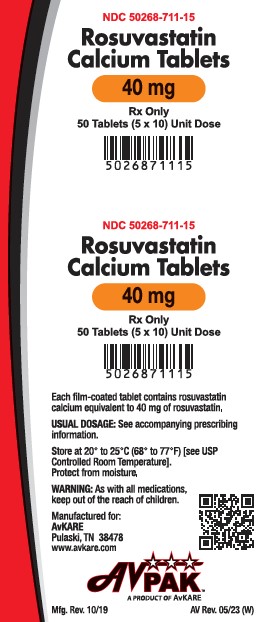
Rosuvastatin Calcium Tablets 40 mg film-coated tablets in a label for Rx only use. The label specifies a package containing 50 tablets (5 x 10) and includes storage instructions (20° to 25°C, protect from moisture). Manufactured by AvPAK, the label displays the NDC 50268-711-15 and includes a barcode and QR code.*

* About these descriptions: Image descriptions on this page are generated by automated AI analysis of the product label images from the manufacturer's FDA label submission (SPL). They are provided for reference only and may contain errors or omissions. Always rely on the printed label itself and the official FDA labeling, and consult a pharmacist or healthcare professional with any questions about this product.