Torsemide Tablet
FDA Label NDC 50268-754

15 label sections · Submitted to the FDA by Avpak · Indications, Dosage, Usage, and Precautions

Structured Product Label

The following Structured Product Label (SPL) was submitted to the FDA by Avpak for the product Torsemide (NDC 50268-754). This document serves as the official prescribing information, containing essential scientific data and clinical materials required for healthcare providers and patients.

This specific version of the label includes detailed information regarding 1 indications & usage, 2 dosage & administration, 3 dosage forms & strengths, 4 contraindications, 5 warnings and precautions, 6 adverse reactions, 7 drug interactions, 8 use in specific populations, and other regulatory disclosures. Use the navigation below to review specific sections of the FDA submission.

1 Indications & Usage

1.1 Edema
Torsemide tablets are indicated for the treatment of edema associated with heart failure, renal disease or hepatic disease.

1.2 Hypertension
Torsemide tablets are indicated for the treatment of hypertension, to lower blood pressure. Lowering blood pressure reduces the risk of fatal and nonfatal cardiovascular events, primarily strokes and myocardial infarctions. These benefits have been seen in controlled trials of antihypertensive drugs from a wide variety of pharmacologic classes including the class to which this drug principally belongs. There are no controlled trials demonstrating risk reduction with torsemide.

Control of high blood pressure should be part of comprehensive cardiovascular risk management, including, as appropriate, lipid control, diabetes management, antithrombotic therapy, smoking cessation, exercise, and limited sodium intake. Many patients will require more than one drug to achieve blood pressure goals. For specific advice on goals and management, see published guidelines, such as those of the National High Blood Pressure Education Program’s Joint National Committee on Prevention, Detection, Evaluation, and Treatment of High Blood Pressure (JNC).

Numerous antihypertensive drugs, from a variety of pharmacologic classes and with different mechanisms of action, have been shown in randomized controlled trials to reduce cardiovascular morbidity and mortality, and it can be concluded that it is blood pressure reduction, and not some other pharmacologic property of the drugs, that is largely responsible for those benefits. The largest and most consistent cardiovascular outcome benefit has been a reduction in the risk of stroke, but reductions in myocardial infarction and cardiovascular mortality also have been seen regularly.

Elevated systolic or diastolic pressure causes increased cardiovascular risk, and the absolute risk increase per mmHg is greater at higher blood pressures, so that even modest reductions of severe hypertension can provide substantial benefit. Relative risk reduction from blood pressure reduction is similar across populations with varying absolute risk, so the absolute benefit is greater in patients who are at higher risk independent of their hypertension (for example, patients with diabetes or hyperlipidemia), and such patients would be expected to benefit from more aggressive treatment to a lower blood pressure goal.

The antihypertensive effects of torsemide tablets are on the average greater in black patients than in nonblack patients [see Clinical Pharmacology (12.2)]. Some antihypertensive drugs have smaller blood pressure effects (as monotherapy) in black patients, and many antihypertensive drugs have additional approved indications and effects (e.g., on angina, heart failure, or diabetic kidney disease). These considerations may guide selection of therapy.

Torsemide tablets can be used alone or in combination with other antihypertensive agents.

2 Dosage & Administration

2.1 Treatment of Edema
Edema associated with heart failure
The recommended initial dose is 10 mg or 20 mg oral torsemide tablets once daily. If the diuretic response is inadequate, titrate upward by approximately doubling until the desired diuretic response is obtained. Doses higher than 200 mg have not been adequately studied.

Edema associated with chronic renal failure
The recommended initial dose is 20 mg oral torsemide tablets once daily. If the diuretic response is inadequate, titrate upward by approximately doubling until the desired diuretic response is obtained. Doses higher than 200 mg have not been adequately studied.

Edema associated with hepatic cirrhosis
The recommended initial dose is 5 mg or 10 mg oral torsemide tablets once daily, administered together with an aldosterone antagonist or a potassium-sparing diuretic. If the diuretic response is inadequate, titrate upward by approximately doubling until the desired diuretic response is obtained. Doses higher than 40 mg have not been adequately studied in this population.

2.2 Treatment of Hypertension

The recommended initial dose is 5 mg once daily. If the 5 mg dose does not provide adequate reduction in blood pressure within 4 to 6 weeks, increase to 10 mg once daily. If the response to 10 mg is insufficient, add another antihypertensive agent to the treatment regimen.

4 Contraindications

Torsemide tablets are contraindicated in patients with known hypersensitivity to torsemide tablets or to povidone.

Torsemide tablets are contraindicated in patients who are anuric.

Torsemide tablets are contraindicated in patients with hepatic coma.

6 Adverse Reactions

The following risks are discussed in more detail in others sections:

  • Hypotension and Worsening Renal Function [see Warnings and Precautions (5.1)]
  • Electrolyte and Metabolic Abnormalities [see Warnings and Precautions (5.2)]
  • Ototoxicity [see Warnings and Precautions (5.3)]
  • 6.1 Clinical Trials Experience
    Because clinical trials are conducted under widely varying conditions, adverse reaction rates observed in the clinical trials of a drug cannot be directly compared to rates in the clinical trials of another drug and may not reflect the rates observed in practice.

    In pre-approval studies, torsemide has been evaluated for safety in approximately 4000 subjects; over 800 of these subjects received torsemide for at least 6 months, and over 380 were treated for more than 1 year. Among these subjects were 564 who received torsemide during United States-based trials in which 274 other subjects received placebo.

    Discontinuation of therapy due to adverse reactions occurred in 3.5% of United States patients treated with torsemide and in 4.4% of patients treated with placebo.

    In United States placebo-controlled trials excessive urination occurred in 6.7% of patients compared with 2.2% of patients receiving placebo. The daily doses of torsemide used in these trials ranged from 1.25 mg to 20 mg, with most patients receiving 5 mg to 10 mg; the duration of treatment ranged from 1 to 52 days, with a median of 41 days.

    In the placebo-controlled hypertension studies excessive urination was dose related; 1% of patients receiving placebo, 4% of those treated with 5 mg of daily torsemide, and 15% of those treated with 10 mg. Excessive urination was generally not reported as an adverse event among patients who received torsemide for cardiac, renal, or hepatic failure.

    There was no effect of age or sex on the incidence of adverse reactions.

    Laboratory Parameters
    Potassium
    In controlled studies in the United States, torsemide was administered to hypertensive patients at doses of 5 mg or 10 mg daily. After 6 weeks at these doses, the mean decrease in serum potassium was approximately 0.1 mEq/L. The percentage of patients who had a serum potassium level below 3.5 mEq/L at any time during the studies was 1.5% on torsemide and 3% on placebo. In patients followed for 1 year, there was no progressive change in mean serum potassium levels. In patients with congestive heart failure, hepatic cirrhosis, or renal disease treated with torsemide at doses higher than those studied in United States antihypertensive trials, hypokalemia was observed with greater frequency, in a dose-related manner.

    Blood Urea Nitrogen (BUN), Creatinine and Uric Acid
    Torsemide produces small dose-related increases in each of these laboratory values. In hypertensive patients who received 10 mg of torsemide daily for 6 weeks, the mean increase in blood urea nitrogen was 1.8 mg/dL (0.6 mmol/L), the mean increase in serum creatinine was 0.05 mg/dL (4 mmol/L), and the mean increase in serum uric acid was 1.2 mg/dL (70 mmol/L). Little further change occurred with long-term treatment, and all changes reversed when treatment was discontinued.

    Glucose
    Hypertensive patients who received 10 mg of daily torsemide experienced a mean increase in serum glucose concentration of 5.5 mg/dL (0.3 mmol/L) after 6 weeks of therapy, with a further increase of 1.8 mg/dL (0.1 mmol/L) during the subsequent year. In long-term studies in diabetics, mean fasting glucose values were not significantly changed from baseline.

    Serum Lipids
    Torsemide tablets, 20 mg caused small increases in total cholesterol and triglycerides in short term hypertension studies. The changes subsided with chronic therapy.

    6.2 Postmarketing Experience
    The following adverse reactions have been identified during the post-approval use of torsemide. Because these reactions are reported voluntarily from a population of uncertain size, it is not always possible to estimate their frequency reliably or establish a causal relationship to drug exposure.
    Gastrointestinal system: Pancreatitis, abdominal pain
    Nervous System: Paresthesia, confusion, visual impairment, loss of appetite
    Hematologic: Leucopenia, thrombocytopenia, anemia
    Hepatobiliary: Increase in liver transaminases, gamma-glutamyltransferase

    Metabolism: Thiamine (vitamin B1) deficiency
    Skin/hypersensitivity: Stevens-Johnson syndrome, toxic epidermal necrolysis, photosensitivity reaction, pruritus
    Urogenital: Acute urinary retention

    To report SUSPECTED ADVERSE REACTIONS, contact AvKARE at 1-855-361-3993 or FDA at 1-800-FDA-1088 or www.fda.gov/medwatch.

11 Description

Torsemide is a diuretic of the pyridine-sulfonylurea class. Its chemical name is 1-isopropyl-3-[(4-m-toluidino-3-pyridyl) sulfonyl]urea and its structural formula is:

Structure.jpg (Structure)

Structure.jpg (Structure)

Its molecular formula is C 16H 20N 4O 3S, its pKa is 6.42, and its molecular weight is 348.43. Torsemide is a white to off-white crystalline powder. The tablets for oral administration also contain lactose monohydrate NF, microcrystalline cellulose NF, crospovidone NF, povidone USP and magnesium stearate NF.

12 Clinical Pharmacology

12.1 Mechanism of Action
Micropuncture studies in animals have shown that torsemide acts from within the lumen of the thick ascending portion of the loop of Henle, where it inhibits the Na +/K +/2CI --carrier system. Clinical pharmacology studies have confirmed this site of action in humans, and effects in other segments of the nephron have not been demonstrated. Diuretic activity thus correlates better with the rate of drug excretion in the urine than with the concentration in the blood.

Torsemide increases the urinary excretion of sodium, chloride, and water, but it does not significantly alter glomerular filtration rate, renal plasma flow, or acid-base balance.

12.2 Pharmacodynamics
With oral dosing, the onset of diuresis occurs within 1 hour and the peak effect occurs during the first or second hour and diuresis lasts about 6 to 8 hours. In healthy subjects given single doses, the dose-response relationship for sodium excretion is linear over the dose range of 2.5 mg to 20 mg. The increase in potassium excretion is negligible after a single dose of up to 10 mg and only slight (5 mEq to 15 mEq) after a single dose of 20 mg.

Edema
Torsemide has been studied in controlled trials in patients with New York Heart Association Class II to Class IV heart failure. Patients who received 10 mg to 20 mg of daily torsemide in these studies achieved significantly greater reductions in weight and edema than did patients who received placebo.

Hypertension
In patients with essential hypertension, torsemide has been shown in controlled studies to lower blood pressure when administered once a day at doses of 5 mg to 10 mg. The antihypertensive effect is near maximal after 4 to 6 weeks of treatment, but it may continue to increase for up to 12 weeks. Systolic and diastolic supine and standing blood pressures are all reduced. There is no significant orthostatic effect, and there is only a minimal peak-trough difference in blood pressure reduction.

The antihypertensive effects of torsemide are, like those of other diuretics, on the average greater in black patients (a low-renin population) than in nonblack patients.

When torsemide is first administered, daily urinary sodium excretion increases for at least a week. With chronic administration, however, daily sodium loss comes into balance with dietary sodium intake. If the administration of torsemide is suddenly stopped, blood pressure returns to pretreatment levels over several days, without overshoot.

Torsemide has been administered together with β-adrenergic blocking agents, ACE inhibitors, and calcium-channel blockers. Adverse drug interactions have not been observed, and special dosage adjustment has not been necessary.

12.3 Pharmacokinetics
Absorption
The bioavailability of torsemide tablets is approximately 80%, with little intersubject variation; the 90% confidence interval is 75% to 89%. The drug is absorbed with little first-pass metabolism, and the serum concentration reaches its peak (C max) within 1 hour after oral administration. C max and area under the serum concentration-time curve (AUC) after oral administration are proportional to dose over the range of 2.5 mg to 200 mg. Simultaneous food intake delays the time to C max by about 30 minutes, but overall bioavailability (AUC) and diuretic activity are unchanged. Absorption is essentially unaffected by renal or hepatic dysfunction.

Distribution
The volume of distribution of torsemide is 12 liters to 15 liters in normal adults or in patients with mild to moderate renal failure or congestive heart failure. In patients with hepatic cirrhosis, the volume of distribution is approximately doubled.

Metabolism
Torsemide is metabolized by the hepatic cytochrome CYP2C9 and, to a minor extent, CYP2C8 and CYP2C18. Three main metabolites have been identified in humans. Metabolite M1 is formed by methyl-hydroxylation of torsemide, metabolite M3 is formed by ring hydroxylation of torsemide, and metabolite M5 is formed by oxidation of M1. The major metabolite in humans is the carboxylic acid derivative M5, which is biologically inactive. Metabolites M1 and M3 possess some pharmacological activity; however, their systemic exposures are much lower when compared to torsemide.

Elimination
In normal subjects the elimination half-life of torsemide is approximately 3.5 hours. Torsemide is cleared from the circulation by both hepatic metabolism (approximately 80% of total clearance) and excretion into the urine (approximately 20% of total clearance in patients with normal renal function). The major metabolite in humans is the carboxylic acid derivative, which is biologically inactive. Two of the lesser metabolites possess some diuretic activity, but for practical purposes metabolism terminates the action of the drug. Because torsemide is extensively bound to plasma protein (>99%), very little enters tubular urine via glomerular filtration. Most renal clearance of torsemide occurs via active secretion of the drug by the proximal tubules into tubular urine.

After a single oral dose, the amounts recovered in urine were: torsemide 21%, metabolite M1 12%, metabolite M3 2%, and metabolite M5 34%.

Renal Impairment
In patients with renal failure, renal clearance of torsemide is markedly decreased but total plasma clearance is not significantly altered. A smaller fraction of the administered dose is delivered to the intraluminal site of action, and the natriuretic action of any given dose of diuretic is reduced.

Hepatic Impairment
In patients with hepatic cirrhosis, the volume of distribution, plasma half-life, and renal clearance are all increased, but total clearance is unchanged.

Geriatric Patients
The renal clearance of torsemide is lower in elderly subjects as compared to younger adults, which is related to the decline in renal function that commonly occurs with aging. However, total plasma clearance and elimination half-life remain unchanged.

Heart failure
In patients with decompensated congestive heart failure, hepatic and renal clearance are both reduced, probably because of hepatic congestion and decreased renal plasma flow, respectively. The total clearance of torsemide is approximately 50% of that seen in healthy volunteers, and the plasma half-life and AUC are correspondingly increased. Because of reduced renal clearance, a smaller fraction of any given dose is delivered to the intraluminal site of action, so at any given dose there is less natriuresis in patients with congestive heart failure than in normal subjects.

Drug Interactions
Digoxin: Coadministration of digoxin is reported to increase the AUC for torsemide by 50%, but dose adjustment of torsemide is not necessary. Torsemide does not affect the pharmacokinetics of digoxin.
Spironolactone: In healthy subjects, coadministration of torsemide was associated with significant reduction in the renal clearance of spironolactone, with corresponding increases in the AUC. However, the pharmacokinetic profile and diuretic activity of torsemide are not altered by spironolactone.
Torsemide does not affect the protein binding of glyburide or warfarin.
Cimetidine: The pharmacokinetic profile and diuretic activity of torsemide are not altered by cimetidine.

14 How Supplied / Storage And Handling

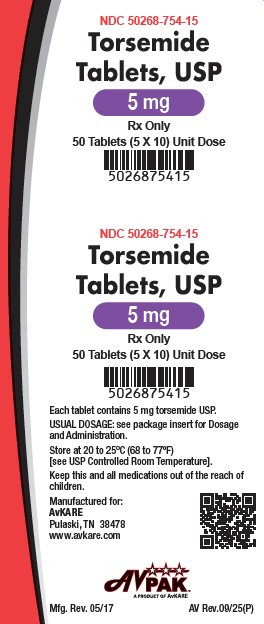
Torsemide tablets 5 mg are supplied as white to off white, oval shaped, scored tablets, debossed with ‘56’ on scored side and ‘H’ on the opposite side.
NDC 50268-754-15 10 tablets per card, 5 cards per carton.

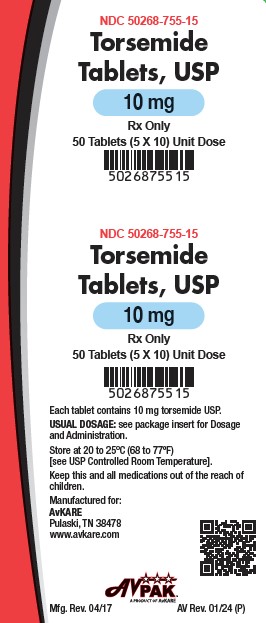
Torsemide tablets 10 mg are supplied as white to off white, oval shaped, scored tablets, debossed with ‘57’ on scored side and ‘H’ on the opposite side.
NDC 50268-755-15 10 tablets per card, 5 cards per carton.

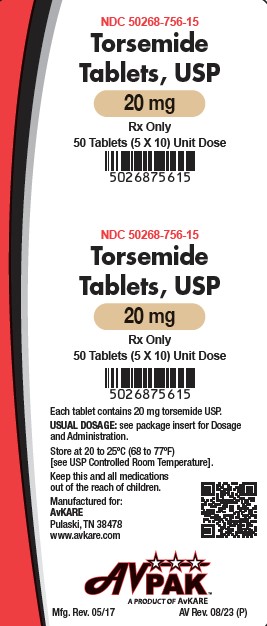
Torsemide tablets 20 mg are supplied as white to off white, oval shaped, scored tablets, debossed with ‘59’ on scored side and ‘H’ on the opposite side.
NDC 50268-756-15 10 tablets per card, 5 cards per carton.

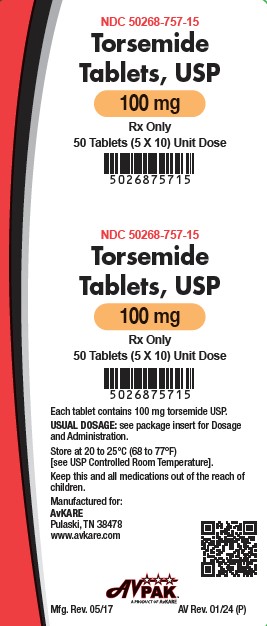
Torsemide tablets 100 mg are supplied as white to off white, oval shaped, scored tablets, debossed with ‘60’ on scored side and ‘H’ on the opposite side.
NDC 50268-757-15 10 tablets per card, 5 cards per carton.

For Institutional Use Only. Dispensed in Unit Dose Package.

Storage
Store at 20° to 25°C (68° to 77°F) [see USP Controlled Room Temperature]

18 Package Label.Principal Display Panel

1 (754 15)

1 (754 15)

2 (755 15)

2 (755 15)

3 (756 15)

3 (756 15)

4 (757 15)

4 (757 15)

* Please review the disclaimer below.