A double-blind, multi-national, multi-center study (PATENT-1) was conducted in 443 patients with PAH as defined by PVR >300 dyn*sec*cm-5 and a PAP mean >25 mmHg.
Patients were randomized to one of three treatment groups: Adempas titrated up to 1.5 mg (n=63), 2.5 mg (n=254) or placebo (n=126) three times a day. Patients with systolic blood pressure < 95 mmHg were excluded from the study. Patients assigned to Adempas were initiated at 1.0 mg three times a day. The dose of Adempas was up-titrated every 2 weeks based on the patient’s systolic blood pressure and signs or symptoms of hypotension. Oral anticoagulants, diuretics, digitalis, calcium channel blockers, and oxygen were allowed. In this study, 50% of the patients were treatment-naive with respect to PAH therapy, 44% were pre-treated with an endothelin receptor antagonist (ERA) and 6% were pre-treated with a PCA (inhaled, oral or subcutaneous). Pre-treated patients were defined as patients on stable treatment for 3 months with either an ERA or PCA; Adempas was added in combination to these background therapies.
The primary endpoint of the study was change from baseline and placebo in 6MWD after 12 weeks in the 2.5 mg group. The mean age of all patients was 51 years and approximately 80% were female. PAH etiologies were either idiopathic (61%) or familial PAH (2%), PAH associated with connective tissue disease (25%), congenital heart disease (8%), portal hypertension (3%), or anorexigen or amphetamine use (1%). The majority of patients had a WHO Functional Class II (42%) or III (54%) at baseline. The overall mean baseline 6MWD was 363 meters. Approximately 75% of patients were up-titrated to receive the maximum dose of 2.5 mg three times a day by week 12; 15%, 6%, 3%, and 2% were titrated to doses of 2, 1.5, 1, and 0.5 mg 3 times a day, respectively.
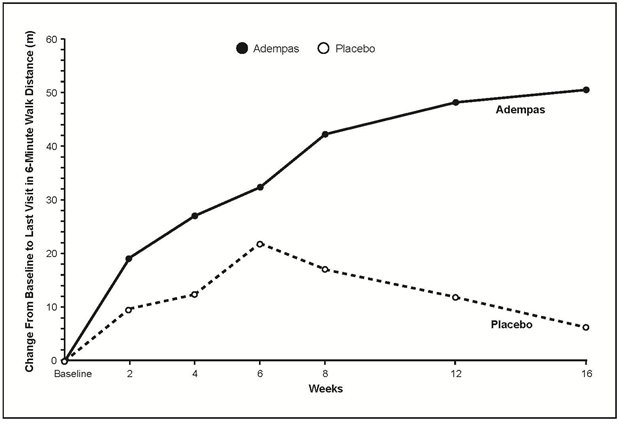
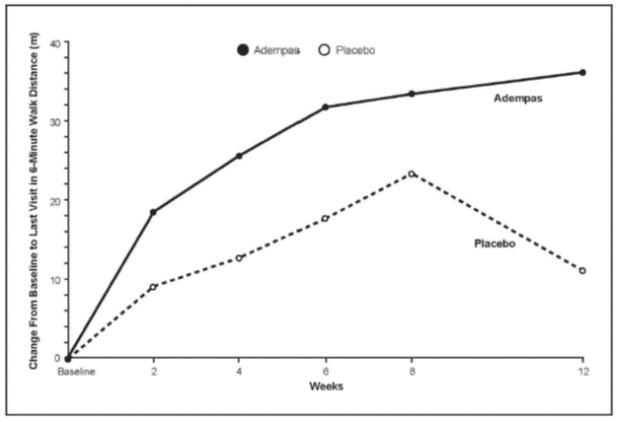
Results of the 6MWD over 12 weeks for the PATENT-1 study are shown in Figure 6.

Patent-1 Mean Change From Baseline In The 6-minute Walk Distance (E9e1a668 1b31 4094 88b7 2004f94af53d 07)
The pre-specified primary endpoint of the study was the change in 6MWD from baseline to week 12 and was based on imputed values. The imputation for missing values included last observed value, not including follow-up for patients who completed the study or withdrew. In case of death or clinical worsening without a termination visit or a measurement at that termination visit, the imputed worst value (zero) was used.
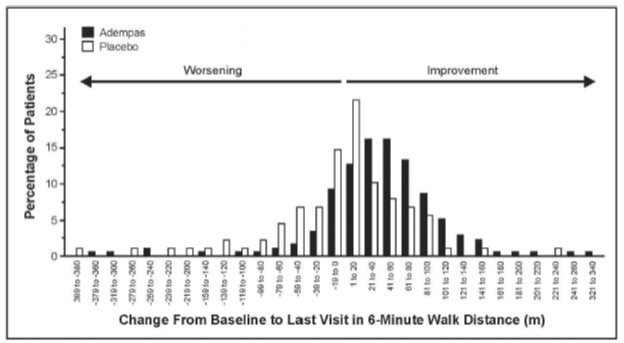
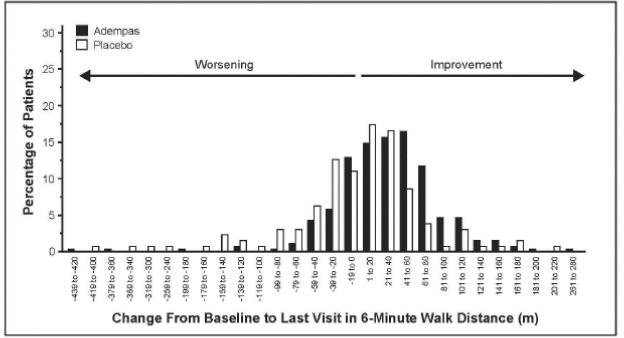
Figure 7 illustrates the results of the Adempas and placebo treatment groups displayed as a histogram summarizing the treatment effect on the 6MWD. The patients are grouped by change in 20 meters from baseline. Overall this figure shows that patients treated with Adempas benefit compared to those treated with placebo. As demonstrated in Figure 7, 193 patients receiving Adempas (76%) experienced an improvement in 6MWD compared to 74 patients (59%) on placebo.

Patent-1 Distribution Of Patients By Change From Baseline In 6-minute Walk Distan (E9e1a668 1b31 4094 88b7 2004f94af53d 08)
Improvements 6MWD were apparent from Week 2 onward. At Week 12, the placebo-adjusted mean increase in 6MWD within the Adempas group was 36 m (95% CI: 20 m to 52 m; p<0.0001). For PATENT-1, the median difference (Hodges-Lehmann non-parametric estimate) in 6MWD was 29 m (95% CI, 17 m to 40 m). There was an exploratory 1.5 mg capped titration arm (n = 63). The data did not suggest incremental benefit from escalating dose from 1.5 mg three times a day to 2.5 mg three times a day.
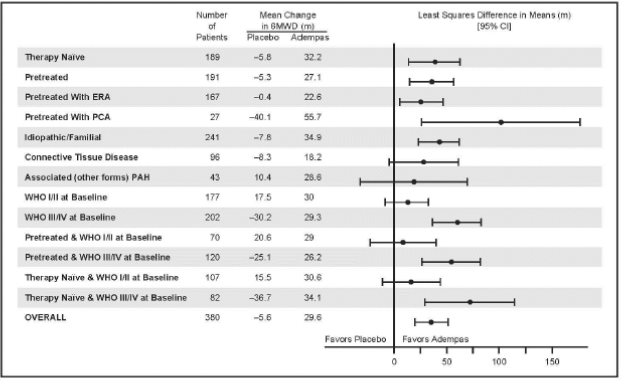
Placebo-adjusted changes in 6MWD at 12 weeks were evaluated in subgroups (see Figure 8).

Patent-1 Mean Treatment Difference In Change From Baseline To Last Visit In 6-minute Walk Distance (meter) By Prespecified Subgroups (E9e1a668 1b31 4094 88b7 2004f94af53d 09)
WHO Functional Class improvements in the IDT (individual dose titration) arm of the PATENT-1 trial are shown in Table 5
Table 5: Effects of Adempas on the Change in WHO Functional Class in PATENT-1 from Baseline to Week 12Change in WHO Functional Class | Adempas (IDT) (n=254) | Placebo (n=125) |
Improved | 53 (21%) | 18 (14%) |
Stable | 192 (76%) | 89 (71%) |
Deteriorated | 9 (4%) | 18 (14%) |
| p-value = 0.0033 |
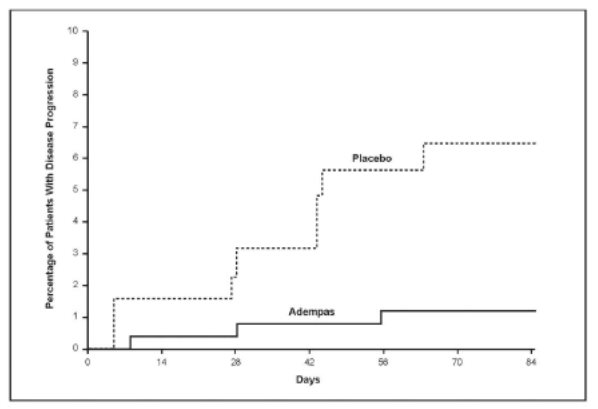
Time to clinical worsening was a combined endpoint defined as death (all-cause mortality), heart/lung transplantation, atrial septostomy, hospitalization due to persistent worsening of pulmonary hypertension, start of new PAH-specific treatment, persistent decrease in 6MWD and persistent worsening of WHO Functional Class.
Effects of Adempas in PATENT-1 on events of clinical worsening are shown in Table 6.
Table 6: Effects of Adempas in PATENT-1 on Events of Clinical Worsening (ITT analysis set)Clinical Worsening Events | Adempas (IDT) (n=254) | Placebo (n=126) |
Patients with any clinical worsening* | 3 (1.2%) | 8 (6.3%) |
| 2 (0.8%) | 3 (2.4%) |
- Hospitalizations due to PH
| 1 (0.4%) | 4 (3.2%) |
- Decrease in 6MWD due to PH
| 1 (0.4%) | 2 (1.6%) |
- Persistent worsening of FC due to PAH
| 0 | 1 (0.8%) |
- Start of new PAH treatment
| 1 (0.4%) | 5 (4.0%) |
* p-value=0.0285 (Mantel-Haenszel estimate)
Note: Patients may have had more than one event of clinical worsening
Adempas-treated patients experienced a significant delay in time to clinical worsening versus placebo-treated patients (p=0.0046; Stratified log-rank test). Significantly fewer events of clinical worsening up to week 12 (last visit) were observed in patients treated with Adempas (1.2%) compared to placebo (6.3%) (p=0.0285, Mantel-Haenszel estimate).
The Kaplan-Meier plot of time to clinical worsening is presented in Figure 9.

Patent-1 Time (in Days) To Clinical Worsening (itt Analysis Set) (E9e1a668 1b31 4094 88b7 2004f94af53d 10)