Absorption
Serum concentrations of DRSP reach peak concentrations approximately 1 hour after administration of Angeliq and mean absolute bioavailability of DRSP ranges from 76–85%. Following oral administration, the median Tmax of serum estradiol was approximately 2 hours after dosing with Angeliq and Tmax ranged between 0.3-10 hours.
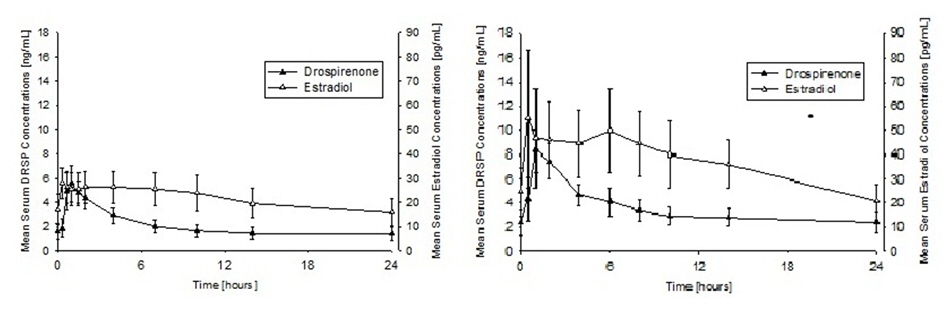
The pharmacokinetics of DRSP are dose proportional within the dose range of 0.25–4 mg. Following daily dosing of Angeliq, steady state DRSP concentrations were observed after 10 days. Mean accumulation ratios for DRSP and estradiol were 2.3 and 2.0, respectively, following multiple doses of 0.5 mg DRSP/1 mg E2, and 2.6 and 1.6, respectively, following multiple doses of 0.25 mg DRSP/0.5 mg E2. Mean concentrations at 2 hours for DRSP ranged between 5.9 and 6.7 ng/mL after treatment with Angeliq (0.5 mg DRSP/1 mg E2) for 365 days. Mean steady state serum DRSP and E2 concentrations are shown in Figure 1, and a summary of primary pharmacokinetic parameters following the administration of 0.25 mg DRSP/0.5 mg E2 or 0.5 mg DRSP/1 mg E2 at steady state is presented in Table 3.
| Figure 1: Mean (± SD) steady state serum drospirenone and estradiol concentrations following daily oral administration of 0.25 or 0.5 mg Drospirenone and 0.5 or 1 mg Estradiol |
| 0.25 mg DRSP/0.5 mg E2 | 0.5 mg DRSP/1 mg E2 |
|
Table 3: Mean (± SD) Steady State Pharmacokinetic Parameters after Administration of Tablets Containing 0.25 or 0.5 mg Drospirenone and 0.5 or 1 mg Estradiol | Parameter | Unit | 0.25 mg DRSP/0.5 mg E2 | 0.5 mg DRSP/1 mg E2 |
|---|
| Drospirenone (DRSP) | | N=12 | N=17 |
|---|
Except for Tmax, the mean PK results of DRSP, E2, and E1 are displayed as the arithmetic mean and standard deviation (SD, in parentheses). For Tmax the median and range are provided.
Cmax=Maximum observed serum concentration
Tmax=time to reach Cmax
AUC (0-24)=area under the serum concentration-time curve from 0 h up to 24 h after daily multiple administration
t1/2=half-life
N/A=Not available |
| Cmax | ng/mL | 5.70 (1.42) | 8.50 (1.63) |
| Tmax | h | 0.992 (0.667 – 1.03) | 1.02 (1 – 2.03) |
| AUC (0-24) | ng∙h/mL | 48.5 (13.7) | 84.3 (19.7) |
| t1/2 | h | N/A | 39.2 N=16 (8.5) |
| Estradiol (E2) |
| Cmax | pg/mL | 29.7 (6.80) | 63.7 (24.2) |
| Tmax | h | 2.33 (0.32 – 10) | 2.01 (0.5 – 6.02) |
| AUC (0-24) | pg∙h/mL | 515.4 (142.0) | 882 (267) |
| t1/2 | h | N/A | 20.5 (2.67) |
| Estrone (E1) |
| Cmax | pg/mL | 165.7 (40.4) | 362 (122) |
| Tmax | h | 3.98 (1.98 – 7.05) | 6 (3.99 – 10) |
| AUC (0-24) | pg∙h/mL | 2839 (658) | 5561 (1689) |
| t1/2 | h | N/A | 19.9 (2.10) |
Effect of Food
The effect of food on the absorption and bioavailability of DRSP and E2 have not been investigated following the administration of Angeliq. However, clinical studies with different formulations containing DRSP or E2 have shown that the bioavailability of both drugs is not affected by concomitant food intake.
Distribution
The mean volume of distribution of DRSP is 4.2 L/kg. DRSP does not bind to SHBG or CBG but binds about 97% to other serum proteins. The distribution of exogenous estrogens is similar to that of endogenous estrogens. Estrogens are widely distributed in the body and are generally found in higher concentrations in the sex hormone target organs. Estradiol circulates in the blood bound to SHBG (37%) and to albumin (61%), while only approximately 1%–2% is unbound.
Metabolism
Mean clearance of DRSP is 1.2 mL/min/kg. DRSP is extensively metabolized after oral administration. The two main metabolites of DRSP found in human plasma were identified to be the acid form of DRSP generated by opening of the lactone ring and the 4,5-dihydrodrospirenone-3-sulfate, formed by reduction and subsequent sulfation. These metabolites were shown not to be pharmacologically active. DRSP is also subject to oxidative metabolism catalyzed by CYP 3A4.
Exogenous estrogens are metabolized in the same manner as endogenous estrogens. Circulating estrogens exist in a dynamic equilibrium of metabolic interconversions. These transformations take place mainly in the liver. Estradiol is converted reversibly to estrone, and both can be converted to estriol, which is a major urinary metabolite. Estrogens also undergo enterohepatic recirculation via sulfate and glucuronide conjugation in the liver, biliary secretion of conjugates into the intestine, and hydrolysis in the gut followed by reabsorption. In postmenopausal women, a significant proportion of the circulating estrogens exist as sulfate conjugates, especially estrone sulfate, which serves as a circulating reservoir for the formation of more active estrogens.
Excretion
DRSP serum concentrations are characterized by a terminal elimination half-life of approximately 36–42 hours. Excretion of DRSP was nearly complete after 10 days and amounts excreted were slightly higher in feces compared to urine. DRSP was extensively metabolized and only trace amounts of unchanged DRSP were excreted in urine and feces. At least 20 different metabolites were observed in urine and feces. About 38% to 47% of the metabolites in urine were glucuronide and sulfate conjugates. In feces, about 17% to 20% of the metabolites were excreted as glucuronides and sulfates. Estradiol, estrone, and estriol are excreted in the urine along with glucuronide and sulfate conjugates.
Hepatic Impairment
Angeliq is contraindicated in patients with hepatic impairment [see Contraindications (4) and Warnings and Precautions (5.10)]. The mean exposure to DRSP in women with moderate liver impairment is approximately three times the exposure in women with normal liver function.
Renal Impairment
Angeliq is contraindicated in patients with renal impairment [see Contraindications (4) and Warnings and Precautions (5.2)].
The effect of renal impairment on the pharmacokinetics of DRSP (3 mg daily for 14 days) and the effects of DRSP on serum potassium concentrations were investigated in female subjects (n=28, age 30-65 years) with creatinine clearance (CLcr) ≥ 80 mL/min (11 patients), and CLcr of 50-79 mL/min (10 patients) and CLcr of 30-49 mL/min (7 patients). All subjects were on a low potassium diet. During the study 7 subjects continued the use of potassium-sparing drugs for the treatment of the underlying illness. On the 14th day (steady-state) of DRSP treatment, the serum DRSP concentrations were on average 37% higher in the group with CLcr of 30-49 mL/min compared to those in the group with normal renal function (CLcr ≥ 80 mL/min). Serum DRSP concentrations in the group with CLcr of 50–79 mL/min were comparable to those in the group with CLcr ≥ 80 mL/min. DRSP treatment was well tolerated by all groups. DRSP treatment did not show any clinically significant effect on serum potassium concentration. Although hyperkalemia was not observed in the study, in 5 of the 7 subjects who continued use of potassium sparing drugs during the study, individual mean serum potassium concentrations increased by up to 0.33 mEq/L. Therefore, potential exists for hyperkalemia to occur in subjects with renal impairment whose serum potassium is in the upper reference range, and who are concomitantly using potassium sparing drugs.
Effects of Drospirenone on Other Drugs: Metabolism of DRSP and potential effects of DRSP on hepatic CYP enzymes have been investigated in in vitro and in vivo studies. In in vitro studies, DRSP did not affect turnover of model substrates of CYP1A2 and CYP2D6, but had an inhibitory influence on the turnover of model substrates of CYP1A1, CYP2C9, CYP2C19 and CYP3A4 with CYP2C19 being the most sensitive enzyme.
The potential effect of DRSP on CYP2C19 activity was investigated in a clinical pharmacokinetic study using omeprazole as a marker substrate. In the study with 24 postmenopausal women [including 12 women with homozygous (wild type) CYP2C19 genotype and 12 women with heterozygous CYP2C19 genotype] the daily oral administration of 3 mg DRSP for 14 days did not affect the systemic clearance of the CYP2C19 substrate omeprazole (40 mg) and the CYP2C19 product 5-hydroxy-omeprazole. Furthermore, no significant effect of DRSP on the systemic clearance of the CYP3A4 product omeprazole sulfone was found. These results demonstrated that DRSP did not inhibit CYP2C19 and CYP3A4 in vivo.
Two further clinical drug-drug interaction studies using simvastatin and midazolam as marker substrates for CYP3A4 were each performed in 24 healthy, postmenopausal women. The results of these studies demonstrated that pharmacokinetics of the CYP3A4 substrates were not influenced by steady-state DRSP concentrations achieved after administration of 3 mg DRSP/day.
Based on the available results of in vivo and in vitro studies, it can be concluded that, at clinical dose concentration, DRSP is unlikely to inhibit significantly CYP enzymes.
There is a potential for an increase in serum potassium in women taking drospirenone with other drugs that may affect electrolytes, such as ACE inhibitors, angiotensin receptor blockers, or NSAIDs.
Electrolytes were studied in 230 postmenopausal women with hypertension and/or diabetes mellitus requiring an ACE inhibitor or angiotensin receptor blocker. Of these, 26 patients had a creatinine clearance >50 mL/min to <80 mL/min. Participants were given 1 mg E2 and 3 mg DRSP (n=112) or placebo (n=118) over 28 days. Non-diabetic women also received ibuprofen 1200 mg/day for 5 days during the study. There was a single case of serum potassium >6 mEq/L and a single case of serum sodium <130 mEq/L on treatment, both occurring following five days of ibuprofen therapy in two women taking E2/DRSP. Serum potassium concentrations ≥5.5 mEq/L were observed in 8 (7.3%) E2/DRSP-treated women (3 diabetic and 5 non-diabetic) and in 3 (2.6%) placebo-treated subjects (2 diabetic and 1 non-diabetic). After 28 days of exposure, the mean change from baseline in serum potassium was 0.11 mEq/L for the E2/DRSP group and 0.08 mEq/L for the placebo group. None of the women with serum potassium concentrations ≥5.5 mEq/L had cardiovascular adverse events.
A drug-drug interaction study of DRSP 3 mg/E2 1 mg versus placebo was performed in 24 mildly hypertensive postmenopausal women taking enalapril maleate 10 mg twice daily. Potassium concentrations were obtained every other day for a total of 2 weeks in all women. Mean serum potassium concentrations in the DRSP/E2 treatment group relative to baseline were 0.22 mEq/L higher than those in the placebo group. Serum potassium concentrations also were measured at multiple timepoints over 24 hours at baseline and on Day 14. On Day 14, the ratios for serum potassium Cmax and AUC in the DRSP/E2 group to those in the placebo group were 0.955 (90% CI: 0.914, 0.999) and 1.01 (90% CI: 0.944, 1.08), respectively. No woman in either treatment group developed hyperkalemia (serum potassium concentrations >5.5 mEq/L).
Of note, occasional or chronic use of NSAID medication was not restricted in any of the Angeliq clinical trials.
Effects of Other Drugs on Estrogens and Progestins: In vitro and in vivo studies have shown that estrogens and progestins are metabolized partially by CYP3A4. Therefore, inducers or inhibitors of CYP3A4 may affect estrogen and progestin drug metabolism [see Drug Interactions (7.1)]. In a clinical drug-drug interaction study conducted in 18 premenopausal women, once daily co-administration of DRSP 3 mg/E2 1.5 mg combination tablets with strong CYP3A4 inhibitor, ketoconazole 200 mg twice daily for 10 days resulted in a 2.30-fold (90% CI: 2.08-2.54) increase of the AUC (0-24) and a 1.66-fold (90% CI: 1.50-1.84) increase of Cmax for DRSP. The E2 exposure [that is, AUC (0-24) and Cmax] was unaffected by ketoconazole, although the AUC(0-24) and Cmax for E1 increased 1.39-fold (90% CI: 1.27-1.52) and 1.32-fold (90% CI: 1.23-1.42), respectively.