The FIDELIO-DKD study was a randomized, double-blind, placebo-controlled, multicenter study in adult patients with chronic kidney disease (CKD) associated with type 2 diabetes (T2D), defined as either having an UACR of 30 to 300 mg/g, eGFR 25 to 60 mL/min/1.73 m2 and diabetic retinopathy, or as having an UACR of ≥300 mg/g and an eGFR of 25 to 75 mL/min/1.73 m2. The trial excluded patients with known significant non-diabetic kidney disease. All patients were to have a serum potassium ≤4.8 mEq/L at screening and be receiving standard of care background therapy, including a maximum tolerated labeled dose of an angiotensin-converting enzyme inhibitor (ACEi) or angiotensin receptor blocker (ARB). Patients with a clinical diagnosis of chronic heart failure with reduced ejection fraction and persistent symptoms (New York Heart Association class II to IV) were excluded. The starting dose of Kerendia was based on screening eGFR (10 mg once daily in patients with an eGFR of 25 to <60 mL/min/1.73 m2 and 20 mg once daily in patients with an eGFR ≥60 mL/min/1.73 m2). The dose of Kerendia could be titrated during the study, with a target dose of 20 mg daily.
The primary objective of the study was to determine whether Kerendia reduced the incidence of a sustained decline in eGFR of ≥40%, kidney failure (defined as chronic dialysis, kidney transplantation, or a sustained decrease in eGFR to <15 mL/min/1.73m2), or renal death.
A total of 5674 patients were randomized to receive Kerendia (N=2833) or placebo (N=2841) and were followed for a median of 2.6 years. The mean age of the study population was 66 years, and 70% of patients were male. The trial population was 63% White, 25% Asian, and 5% Black. At baseline, the mean eGFR was 44 mL/min/1.73m2, with 55% of patients having an eGFR <45 mL/min/1.73m2. Median urine albumin-to-creatinine ratio (UACR) was 852 mg/g, and mean glycated hemoglobin A1c (HbA1c) was 7.7%. Approximately 46% of patients had a history of atherosclerotic cardiovascular disease.
At baseline, 99.8% of patients were treated with an ACEi or ARB. Approximately 97% were on an antidiabetic agent (insulin [64.1%], biguanides [44%], glucagon-like peptide-1 [GLP-1] receptor agonists [7%], sodium-glucose cotransporter 2 [SGLT2] inhibitors [5%]), 74% were on a statin, and 57% were on an antiplatelet agent.
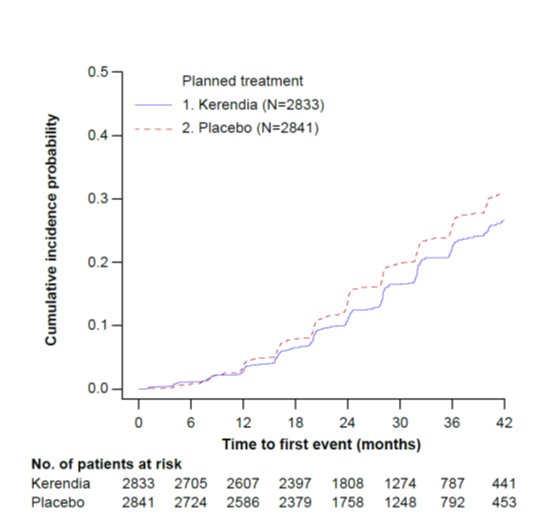
Kerendia reduced the incidence of the primary composite endpoint of a sustained decline in eGFR of ≥40%, kidney failure, or renal death (HR 0.82, 95% CI 0.73-0.93, p=0.001) as shown in Table 4 and Figure 1. The treatment effect reflected a reduction in a sustained decline in eGFR of ≥40% and progression to kidney failure. There were few renal deaths during the trial.
Kerendia also reduced the incidence of the composite endpoint of cardiovascular (CV) death, non-fatal myocardial infarction (MI), non-fatal stroke or hospitalization for heart failure (HR 0.86, 95% CI 0.75-0.99, p=0.034) as shown in Table 4 and Figure 2. The treatment effect reflected a reduction in CV death, non-fatal MI, and hospitalization for heart failure.
The treatment effect on the primary and secondary composite endpoints was generally consistent across subgroups.
Table 4: Analysis of the Primary and Secondary Time-to-Event Endpoints (and their Individual Components) in Phase 3 Study FIDELIO-DKD | Kerendia N=2833 | Placebo N=2841 | Treatment Effect Kerendia / Placebo |
Primary and Secondary Time-to-event Endpoints: | n (%) | Event Rate (100 pt-yr) | n (%) | Event Rate (100 pt-yr) | Hazard Ratio (95% CI) | p-value |
Primary composite of kidney failure, sustained eGFR decline ≥40% or renal death | 504 (17.8%) | 7.6 | 600 (21.1%) | 9.1 | 0.82
[0.73; 0.93] | 0.001 |
Kidney failure | 208 (7.3%) | 3.0 | 235 (8.3%) | 3.4 | 0.87
[0.72; 1.05] | - |
Sustained eGFR decline ≥40% | 479 (16.9%) | 7.2 | 577 (20.3%) | 8.7 | 0.81
[0.72; 0.92] | - |
Renal death | 2 (<0.1%) | - | 2 (<0.1%) | - | - | - |
Secondary composite of CV death, non-fatal MI, non-fatal stroke or hospitalization for heart failure | 367 (13.0%) | 5.1 | 420 (14.8%) | 5.9 | 0.86
[0.75; 0.99] | 0.034 |
CV death | 128 (4.5%) | 1.7 | 150 (5.3%) | 2.0 | 0.86
[0.68;1.08] | - |
Non-fatal MI | 70 (2.5%) | 0.9 | 87 (3.1%) | 1.2 | 0.80
[0.58;1.09] | - |
Non-fatal stroke | 90 (3.2%) | 1.2 | 87 (3.1%) | 1.2 | 1.03
[0.76;1.38] | - |
Hospitalization for heart failure | 139 (4.9%) | 1.9 | 162 (5.7%) | 2.2 | 0.86
[0.68;1.08] | - |
p-value: two-sided p-value from stratified logrank test
CI = confidence interval, CV = cardiovascular, eGFR = estimated glomerular filtration rate, MI = myocardial infarction, N = number of subjects, n = number of subjects with event, pt-yr = patient year.
NOTE: Time to first event was analyzed in a Cox proportional hazards model. For patients with multiple events, only the first event contributed to the composite endpoint. Sums of the numbers of first events for the single components do not add up to the numbers of events in the composite endpoint.

Figure 1 Time To Occurence Of Kidney Failure (Image 04)

Time To Occurrence Of Cv Death (Image 05)