Patient Exposure
Savella was evaluated in three double-blind placebo-controlled trials involving 2209 fibromyalgia patients (1557 patients treated with Savella and 652 patients treated with placebo) for a treatment period up to 29 weeks.
The stated frequencies of adverse reactions represent the proportion of individuals who experienced, at least once, a treatment-emergent adverse reaction of the type listed. A reaction was considered treatment emergent if it occurred for the first time or worsened while receiving therapy following baseline evaluation.
Adverse Reactions Leading to Discontinuation
In placebo-controlled trials in patients with fibromyalgia, 23% of patients treated with Savella
100 mg/day, 26% of patients treated with Savella 200 mg/day discontinued prematurely due to adverse reactions, compared to 12% of patients treated with placebo. The adverse reactions that led to withdrawal in ≥ 1% of patients in the Savella treatment group and with an incidence rate greater than that in the placebo treatment group were nausea (milnacipran 6%, placebo 1%), palpitations (milnacipran 3%, placebo 1%), headache (milnacipran 2%, placebo 0%), constipation (milnacipran 1%, placebo 0%), heart rate increased (milnacipran 1%, placebo 0%), hyperhidrosis (milnacipran 1%, placebo 0%), vomiting (milnacipran 1%, placebo 0%), and dizziness (milnacipran 1% and placebo 0.5%). Discontinuation due to adverse reactions was generally more common among patients treated with Savella 200 mg/day compared to Savella 100 mg/day.
Most Common Adverse Reactions in Placebo Controlled Trials
In the placebo-controlled fibromyalgia patient trials, the most frequently occurring adverse reaction in clinical trials was nausea. The most common adverse reactions (incidence ≥ 5% and twice placebo) in patients treated with Savella were constipation, hot flush, hyperhidrosis, vomiting, palpitations, heart rate increased, dry mouth, and hypertension.
Table 4 lists all adverse reactions that occurred in at least 2% of patients treated with Savella at either 100 or 200 mg/day and at an incidence greater than that of placebo.
Table 4: Treatment-Emergent Adverse Reaction Incidence in Placebo Controlled Trials in Fibromyalgia Patients (Events Occurring in at Least 2% of All Savella-Treated Patients and Occurring More Frequently in Either Savella Treatment Group Than in the Placebo Treatment Group)
System Organ Class–
Preferred Term | Savella
100 mg/day
(n = 623) % | Savella
200 mg/day
(n = 934) % | All Savella
(n = 1557) % | Placebo
(n = 652) % |
| Cardiac Disorders | | | | |
| Palpitations
| 8
| 7
| 7
| 2
|
| Tachycardia
| 3
| 2
| 2
| 1
|
| Eye Disorders | | | | |
| Vision blurred
| 1
| 2
| 2
| 1
|
| Gastrointestinal Disorders | | | | |
| Nausea
| 35
| 39
| 37
| 20
|
| Constipation
| 16
| 15
| 16
| 4
|
| Vomiting
| 6
| 7
| 7
| 2
|
| Dry mouth
| 5
| 5
| 5
| 2
|
| Abdominal pain
| 3
| 3
| 3
| 2
|
| General Disorders | | | | |
| Chest pain
| 3
| 2
| 2
| 2
|
| Chills
| 1
| 2
| 2
| 0
|
| Chest discomfort
| 2
| 1
| 1
| 1
|
| Infections | | | | |
| Upper respiratory tract infection
| 7
| 6
| 6
| 6
|
| Investigations | | | | |
| Heart rate increased
| 5
| 6
| 6
| 1
|
| Blood pressure increased
| 3
| 3
| 3
| 1
|
| Metabolism and Nutrition Disorders | | | | |
| Decreased appetite
| 1
| 2
| 2
| 0
|
| Nervous System Disorders | | | | |
| Headache
| 19
| 17
| 18
| 14
|
| Dizziness
| 11
| 10
| 10
| 6
|
| Migraine
| 6
| 4
| 5
| 3
|
| Paresthesia
| 2
| 3
| 2
| 2
|
| Tremor
| 2
| 2
| 2
| 1
|
| Hypoesthesia
| 1
| 2
| 1
| 1
|
| Tension headache
| 2
| 1
| 1
| 1
|
| Psychiatric Disorders | | | | |
| Insomnia
| 12
| 12
| 12
| 10
|
| Anxiety
| 5
| 3
| 4
| 4
|
| Respiratory Disorders | | | | |
| Dyspnea
| 2
| 2
| 2
| 1
|
| Skin Disorders | | | | |
| Hyperhidrosis
| 8
| 9
| 9
| 2
|
| Rash
| 3
| 4
| 3
| 2
|
| Pruritus
| 3
| 2
| 2
| 2
|
| Vascular Disorders | | | | |
| Hot flush
| 11
| 12
| 12
| 2
|
| Hypertension
| 7
| 4
| 5
| 2
|
| Flushing
| 2
| 3
| 3
| 1
|
Weight Changes
In placebo-controlled fibromyalgia clinical trials, patients treated with Savella for up to 3 months experienced a mean weight loss of approximately 0.8 kg in both the Savella 100 mg/day and the Savella 200 mg/day treatment groups, compared with a mean weight loss of approximately 0.2 kg in placebo-treated patients.
Genitourinary Adverse Reactions in Males
In the placebo-controlled fibromyalgia studies, the following treatment-emergent adverse reactions related to the genitourinary system were observed in at least 2% of male patients treated with Savella, and occurred at a rate greater than in placebo-treated male patients: dysuria, ejaculation disorder, erectile dysfunction, ejaculation failure, libido decreased, prostatitis, scrotal pain, testicular pain, testicular swelling, urinary hesitation, urinary retention, urethral pain, and urine flow decreased.
Other Adverse Reactions Observed During Clinical Trials of Savella in Fibromyalgia
Following is a list of frequent (those occurring on one or more occasions in at least 1/100 patients) treatment-emergent adverse reactions reported from 1824 fibromyalgia patients treated with Savella for periods up to 68 weeks. The listing does not include those events already listed in Table 4, those events for which a drug cause was remote, those events which were so general as to be uninformative, and those events reported only once which did not have a substantial probability of being acutely life threatening.
Adverse reactions are categorized by body system and listed in order of decreasing frequency. Adverse reactions of major clinical importance are described in the Warnings and Precautions section (5).
Gastrointestinal Disorders — diarrhea, dyspepsia, gastroesophageal reflux disease, flatulence, abdominal distension
General Disorders — fatigue, peripheral edema, irritability, pyrexia
Infections — urinary tract infection, cystitis
Injury, Poisoning, and Procedural Complications — contusion, fall
Investigations — weight decreased or increased
Metabolism and Nutrition Disorders — hypercholesterolemia
Nervous System Disorders — somnolence, dysgeusia
Psychiatric Disorders — depression, stress
Skin Disorders — night sweats
Risk Summary
There are no adequate or well-controlled studies in pregnant women. Neonates exposed to dual reuptake inhibitors of serotonin and norepinephrine (such as Savella), or selective serotonin reuptake inhibitors late in the third trimester have developed complications that can arise immediately upon delivery. Reproduction studies have been performed in rats, rabbits and mice. Milnacipran was shown to increase embryo fetal and perinatal lethality in rats and the incidence of a minor skeletal variation in rabbits at doses below (rat) or approximately equal to (rabbit) the maximum recommended human dose (MRHD) of 200 mg/day on a mg/m2 basis. No effects were seen in mice when treated with milnacipran during the period of organogenesis at doses up to 3 times the MHRD on a mg/m2 basis. Because animal reproduction studies are not always predictive of human response, Savella should be used during pregnancy only if the potential benefit justifies the potential risk to the fetus.
Pregnancy Registry
Physicians are advised to recommend that pregnant patients taking Savella enroll in the Savella Pregnancy Registry. Enrollment is voluntary and may be initiated by pregnant patients or their healthcare providers by contacting the registry at 1-877-643-3010 or by email at [email protected]. Data forms may also be downloaded from the registry website at www.savellapregnancyregistry.com.
Clinical Consideration
Neonates exposed to dual reuptake inhibitors of serotonin and norepinephrine, or selective serotonin reuptake inhibitors late in the third trimester have developed complications that can arise immediately upon delivery and require prolonged hospitalization, respiratory support, and tube feeding. Such complications can arise immediately upon delivery. Monitor neonates for reported clinical findings such as respiratory distress, cyanosis, apnea, seizures, temperature instability, feeding difficulty, vomiting, hypoglycemia, hypotonia, hypertonia, hyperreflexia, tremor, jitteriness, irritability, and constant crying. These features are consistent with either a direct toxic effect of these classes of drugs or, possibly, a drug discontinuation syndrome. It should be noted that, in some cases, the clinical picture is consistent with serotonin syndrome [see Warnings and Precautions (5.2)].
Animal Data
Studies were conducted in rats, rabbits and mice with dosing of milnacipran during the period of organogenesis. In rats, milnacipran was shown to increase embryo fetal lethality at doses of 5 mg/kg/day (0.25 times the MRHD on a mg/m2 basis). In rabbits, dose-dependent increases in the incidence of the skeletal variation of an extra single rib were observed in several pups from multiple litters in the absence of maternal toxicity at 15 mg/kg/day (1.5 times the MRHD on a mg/m2 basis). The clinical significance of this finding is unknown. In mice, no embryotoxic or teratogenic effects were seen at doses up to 125 mg/kg/day (3 times the MHRD on a mg/m2 basis).
With peri- and postnatal exposure to oral milnacipran in rats, decreases in viability and body weight were observed on Postpartum Day 4 at a dose of 5 mg/kg/day (approximately 0.25 times the MRHD on a mg/m2 basis). The no-effect dose for maternal and offspring toxicity was 2.5 mg/kg/day (approximately 0.1 times the MRHD on a mg/m2 basis).
Management of Overdose
There is no specific antidote to Savella, but if serotonin syndrome ensues, specific treatment (such as with cyproheptadine and/or temperature control) may be considered. In case of acute overdose, treatment should consist of those general measures employed in the management of overdose with any drug.
An adequate airway, oxygenation, and ventilation should be assured and cardiac rhythm and vital signs should be monitored. Induction of emesis is not recommended. Gastric lavage with a large-bore orogastric tube with appropriate airway protection, if needed, may be indicated if performed soon after ingestion or in symptomatic patients. Because there is no specific antidote for Savella, symptomatic care and treatment with gastric lavage and activated charcoal should be considered as soon as possible for patients who experience a Savella overdose.
Due to the large volume of distribution of this drug, forced diuresis, dialysis, hemoperfusion, and exchange transfusion are unlikely to be beneficial.
In managing overdose, the possibility of multiple drug involvement should be considered. The physician should consider contacting a poison control center for additional information on the treatment of any overdose. Telephone numbers for certified poison control centers are listed in the Physicians' Desk Reference (PDR).
Absorption and Distribution
Savella is absorbed following oral administration with maximum concentrations (Cmax) reached within 2 to 4 hours post dose. Absorption of Savella is not affected by food. The absolute bioavailability is approximately 85% to 90%. The mean volume of distribution of milnacipran following a single intravenous dose to healthy subjects is approximately 400 L.
Plasma protein binding is 13%.
Metabolism and Elimination
Milnacipran and its metabolites are eliminated primarily by renal excretion. Following oral administration of 14C-milnacipran hydrochloride, approximately 55% of the dose was excreted in urine as unchanged milnacipran (24% as l-milnacipran and 31% as d-milnacipran). The l-milnacipran carbamoyl-O-glucuronide was the major metabolite excreted in urine and accounted for approximately 17% of the dose; approximately 2% of the dose was excreted in urine as d-milnacipran carbamoyl-O-glucuronide. Approximately 8% of the dose was excreted in urine as the N-desethyl milnacipran metabolite.
Pharmacokinetics in Special Populations
Renal Impairment-Milnacipran pharmacokinetics were evaluated following single oral administration of 50 mg Savella to subjects with mild (creatinine clearance [CLcr] 50-80 mL/min), moderate (CLcr 30-49 mL/min), and severe (CLcr 5-29 mL/min) renal impairment and to healthy subjects (CLcr > 80 mL/min). The mean AUC0-∞ increased by 16%, 52%, and 199%, and terminal elimination half-life increased by 38%, 41%, and 122% in subjects with mild, moderate, and severe renal impairment, respectively, compared with healthy subjects.
No dosage adjustment is necessary for patients with mild renal impairment. Caution should be exercised in patients with moderate renal impairment. Dose adjustment is necessary in severe renal impairment patients [see Dosage and Administration (2.2)].
Hepatic Impairment-Milnacipran pharmacokinetics were evaluated following single oral administration of 50 mg Savella to subjects with mild (Child-Pugh A), moderate (Child-Pugh B), and severe (Child-Pugh C) hepatic impairment and to healthy subjects. AUC0-∞ and T½ were similar in healthy subjects and subjects with mild and moderate hepatic impairment. However, subjects with severe hepatic impairment had a 31% higher AUC0-∞ and a 55% higher T½ than healthy subjects. Caution should be exercised in patients with severe hepatic impairment.
Elderly-Cmax and AUC parameters of milnacipran were about 30% higher in elderly (> 65 years) subjects compared with young subjects due to age-related decreases in renal function.
No dosage adjustment is necessary based on age unless renal function is severely impaired [see Dosage and Administration (2.2)].
Gender-Cmax and AUC parameters of milnacipran were about 20% higher in female subjects compared with male subjects. Dosage adjustment based on gender is not necessary.
Lactation study- In a pharmacokinetic study, a single, oral dose of 50 mg milnacipran HCl tablet was administered to 8 lactating women who were at least 12 weeks postpartum and weaning their infants. The maximum estimated daily infant dose for milnacipran from breast milk (assuming mean milk consumption of 150 mL/kg/day) was 5% of the maternal dose based on peak plasma concentrations. In most patients, peak concentrations of milnacipran in breast milk were seen within 4 hours after the maternal dose. Because of the limited data regarding infant exposure to Savella, caution should be exercised when Savella is administered to a nursing woman.
Drug-Drug Interactions
In Vitro Studies
In general, milnacipran, at concentrations that were at least 25 times those attained in clinical trials, did not inhibit human CYP1A2, CYP2A6, CYP2C9, CYP2C19, CYP2D6, CYP2E1, and CYP3A4 or induce human CYP1A2, CYP2B6, CYP2C8, CYP2C9, CYP2C19, and CYP3A4/5 enzyme systems, indicating a low potential of interactions with drugs metabolized by these enzymes.
In vitro studies have shown that the biotransformation rate of milnacipran by human hepatic microsomes and hepatocytes was low. A low biotransformation was also observed following incubation of milnacipran with cDNA-expressed human CYP1A2, CYP2A6, CYP2B6, CYP2C9, CYP2C19, CYP2D6, CYP2E1, and CYP3A4 isozymes.
In Vivo Studies
The drug interaction studies described in this section were conducted in healthy adult subjects.
Carbamazepine-There were no clinically significant changes in the pharmacokinetics of milnacipran following co-administration of Savella (100 mg/day) and carbamazepine (200 mg twice a day). No changes were observed in the pharmacokinetics of carbamazepine or its epoxide metabolite due to co-administration with Savella.
Clomipramine-Switching from clomipramine (75 mg once a day) to milnacipran (100 mg/day) without a washout period did not lead to clinically significant changes in the pharmacokinetics of milnacipran. Because an increase in adverse events (eg, euphoria and postural hypotension) was observed after switching from clomipramine to milnacipran, monitoring of patients during treatment switch is recommended.
Digoxin-There was no pharmacokinetic interaction between Savella (200 mg/day) and digoxin
(0.2 mg/day Lanoxicaps) following multiple-dose administration to healthy subjects.
Fluoxetine-Switching from fluoxetine (20 mg once a day), a strong inhibitor of CYP2D6 and a moderate inhibitor of CYP2C19, to milnacipran (100 mg/day) without a washout period did not affect the pharmacokinetics of milnacipran.
Lithium-Multiple doses of Savella (100 mg/day) did not affect the pharmacokinetics of lithium.
Lorazepam-There was no pharmacokinetic interaction between a single dose of Savella (50 mg) and lorazepam (1.5 mg).
Pregabalin-There were no clinically significant changes in the steady-state pharmacokinetics of milnacipran or pregabalin following twice a day co-administration of 50 mg milnacipran and 150 mg pregabalin.
Warfarin-Steady-state milnacipran (200 mg/day) did not affect the pharmacokinetics of R-warfarin and S-warfarin or the pharmacodynamics (as assessed by measurement of prothrombin INR) of a single dose of 25 mg warfarin. The pharmacokinetics of Savella were not altered by warfarin.
Carcinogenesis
Dietary administration of milnacipran to rats at doses of 50 mg/kg/day (2 times the MRHD on a mg/m2 basis) for 2 years caused a statistically significant increase in the incidence of thyroid C-cell adenomas and combined adenomas and carcinomas in males. A carcinogenicity study was conducted in Tg.rasH2 mice for 6 months at oral gavage doses of up to 125 mg/kg/day.
Milnacipran did not induce tumors in Tg.rasH2 mice at any dose tested.
Mutagenesis
Milnacipran was not mutagenic in the in vitro bacterial reverse mutation assay (Ames test) or in the L5178Y TK +/- mouse lymphoma forward mutation assay. Milnacipran was also not clastogenic in an in vitro chromosomal aberration test in human lymphocytes or in the in vivo mouse micronucleus assay.
Impairment of Fertility
Although administration of milnacipran to male and female rats had no statistically significant effect on mating or fertility at doses up to 80 mg/kg/day (4 times the MRHD on an mg/m2 basis), there was an apparent dose-related decrease in the fertility index at clinically relevant doses based on body surface area.
Hepatic Effects
Chronic administration (2 years) of milnacipran to rats at 15 mg/kg (0.6 times the MRHD on an mg/m2 basis) and higher doses showed increased incidences of centrilobular vacuolation of the liver in male rats and eosinophilic foci in male and female rats in the absence of any change in hepatic enzymes. The clinical significance of the finding is not known. Chronic (1 year) administration in the primate at doses up to 25 mg/kg (2 times the MRHD on a mg/m2 basis) did not demonstrate similar evidence of hepatic changes.
Ocular Effects
Chronic (2 years) administration of milnacipran to rats at 15 mg/kg (0.6 times the MRHD on a mg/m2 basis) and higher doses showed increased incidence of keratitis of the eye. One-year studies in the rat and primate did not show this response.
Management of Fibromyalgia
The efficacy of Savella for the management of fibromyalgia was established in two double-blind, placebo-controlled, multicenter studies in adult patients (18-74 years of age). Enrolled patients met the American College of Rheumatology (ACR) criteria for fibromyalgia (a history of widespread pain for 3 months and pain present at 11 or more of the 18 specific tender point sites). Approximately 35% of patients had a history of depression. Study 1 was six months in duration and Study 2 was three months in duration.
A larger proportion of patients treated with Savella than with placebo experienced a simultaneous reduction in pain from baseline of at least 30% (VAS) and also rated themselves as much improved or very much improved based on the patient global assessment (PGIC). In addition, a larger proportion of patients treated with Savella met the criteria for treatment response, as measured by the composite endpoint that concurrently evaluated improvement in pain (VAS), physical function (SF-36 PCS), and patient global assessment (PGIC), in fibromyalgia as compared to placebo.
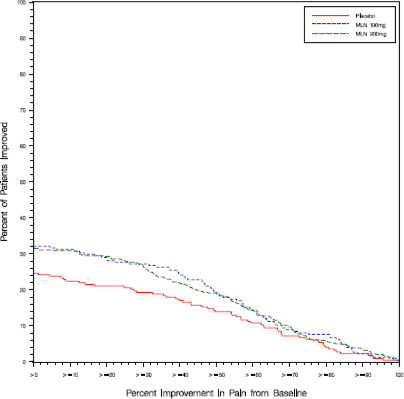
Study 1: This 6-month study compared total daily doses of Savella 100 mg and 200 mg to placebo. Patients were enrolled with a minimum mean baseline pain score of ≥ 50 mm on a 100 mm visual analog scale (VAS) ranging from 0 (“no pain”) to 100 (“worst possible pain”). The mean baseline pain score in this trial was 69. The efficacy results for Study 1 are summarized in Figure 1.
Figure 1 shows the proportion of patients achieving various degrees of improvement in pain from baseline to the 3-month time point and who concurrently rated themselves globally improved (PGIC score of 1 or 2). Patients who did not complete the 3-month assessment were assigned 0% improvement. More patients in the Savella treatment arms experienced at least a 30% reduction in pain from baseline (VAS) and considered themselves globally improved (PGIC) than did patients in the placebo arm. Treatment with Savella 200 mg/day did not confer greater benefit than treatment with Savella 100 mg/day.
Figure 1: Patients Achieving Various Levels of Pain Relief with Concurrent Ratings of Being Much or Very Much Improved on the PGIC — Study 1
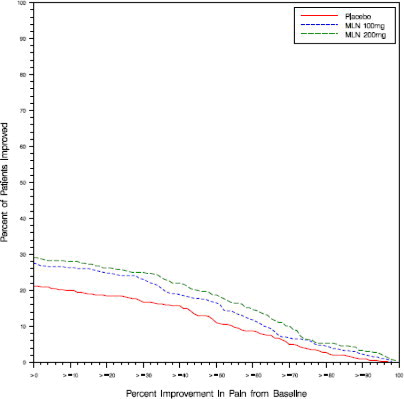
Study 2: This 3-month study compared total daily doses of Savella 100 mg and 200 mg to placebo. Patients were enrolled with a minimum mean baseline pain score of ≥ 40 mm on a 100-mm VAS ranging from 0 (“no pain”) to 100 (“worst possible pain”). The mean baseline pain score in this trial was 65. The efficacy results for Study 2 are summarized in Figure 2.
Figure 2 shows the proportion of patients achieving various degrees of improvement in pain from baseline to the 3-month time point and who concurrently rated themselves globally improved (PGIC score of 1 or 2). Patients who did not complete the 3-month assessment were assigned 0% improvement. More patients in the Savella treatment arms experienced at least a 30% reduction in pain from baseline (VAS) and considered themselves globally improved (PGIC) than did patients in the placebo arm. Treatment with Savella 200 mg/day did not confer greater benefit than treatment with Savella 100 mg/day.
Figure 2: Patients Achieving Various Levels of Pain Relief with Concurrent Ratings of Being Much or Very Much Improved on the PGIC — Study 2
In both studies, some patients who rated themselves as globally “much” or “very much” improved experienced a decrease in pain as early as week 1 of treatment with a stable dose of Savella that persisted throughout these studies.
Information for Patients
Prescribers or other health professionals should inform patients, their families, and their caregivers about the benefits and risks associated with treatment with Savella and should counsel them in its appropriate use. A patient Medication Guide is available for Savella. The prescriber or health professional should instruct patients, their families, and their caregivers to read the Medication Guide and should assist them in understanding its contents. Patients should be given the opportunity to discuss the contents of the Medication Guide and to obtain answers to any questions they may have. The complete text of the Medication Guide is reprinted at the end of this document.
Patients should be advised of the following issues and asked to alert their prescriber if these occur while taking Savella:
Clinical Worsening and Suicide Risk
Patients and their families and caregivers should be advised that Savella is a selective norepinephrine and serotonin reuptake inhibitor and therefore belongs to the same class of drugs as antidepressants. Patients, their families, and their caregivers should be advised that patients with depression may be at increased risk for clinical worsening and/or suicidal ideation if they stop taking anti-depressant medication, change the dose, or start a new medication.
Patients, their families, and their caregivers should be encouraged to be alert to the emergence of anxiety, agitation, panic attacks, insomnia, irritability, hostility, aggressiveness, impulsivity, akathisia (psychomotor restlessness), hypomania, or other unusual changes in behavior, worsening of depression, and suicidal ideation, especially early during treatment with Savella or other drugs that inhibit the reuptake of norepinephrine and/or serotonin, and when the dose is adjusted up or down. Families and caregivers of patients should be advised to observe for the emergence of such symptoms on a day-to-day basis, since changes may be abrupt. Such symptoms should be reported to the patient's prescriber or health professional, especially if they are severe, abrupt in onset, or were not part of the patient's presenting symptoms [see Boxed Warning and Warnings and Precautions (5.1)].
Serotonin Syndrome
Patients should be cautioned about the risk of serotonin syndrome with concomitant use of Savella with other serotonergic drugs including triptans, tricyclic antidepressants, fentanyl, lithium, tramadol, tryptophan, buspirone, amphetamines and St. John's Wort, and with drugs that impair metabolism of serotonin (in particular MAOIs, both those intended to treat psychiatric disorders and also others, such as linezolid) [see Warnings and Precautions (5.2)].
Patients should be advised of the signs and symptoms associated with serotonin syndrome that may include mental status changes (e.g., agitation, hallucinations, delirium, and coma), autonomic instability (e.g., tachycardia, labile blood pressure, dizziness, diaphoresis, flushing, hyperthermia), neuromuscular changes (e.g., tremor, rigidity, myoclonus, hyperreflexia, incoordination), seizures, and/or gastrointestinal symptoms (e.g., nausea, vomiting, diarrhea). Patients should be cautioned to seek medical care immediately if they experience these symptoms.
Elevated Blood Pressure and Heart Rate
Patients should be advised that Savella may increase their blood pressure and heart rate and that they should have their blood pressure and heart rate monitored at regular intervals when receiving treatment with Savella [see Warnings and Precautions (5.3, 5.4)].
Abnormal Bleeding
Patients should be cautioned about the concomitant use of Savella and NSAIDs, aspirin, or other drugs that affect coagulation, since the combined use of agents that interfere with serotonin reuptake and these agents has been associated with an increased risk of abnormal bleeding [see Warnings and Precautions (5.9)].
Angle Closure Glaucoma
Patients should be advised that taking Savella can cause mild pupillary dilation, which in susceptible individuals, can lead to an episode of angle closure glaucoma. Pre-existing glaucoma is almost always open-angle glaucoma because angle closure glaucoma, when diagnosed, can be treated definitively with iridectomy. Open-angle glaucoma is not a risk factor for angle closure glaucoma. Patients may wish to be examined to determine whether they are susceptible to angle closure, and have a prophylactic procedure (e.g., iridectomy), if they are susceptible [see Warnings and Precautions (5.12)].
Ability to Drive and Use Machinery
Savella might diminish mental and physical capacities necessary to perform certain tasks such as operating machinery, including motor vehicles. Patients should be cautioned about operating machinery or driving motor vehicles until they are reasonably certain that Savella treatment does not affect their ability to engage in such activities.
Alcohol
Patients should talk to their healthcare provider about their alcohol intake prior to initiating treatment with Savella [see Warnings and Precautions (5.6, 5.13)].
Discontinuation
Patients should be advised that withdrawal symptoms can occur when discontinuing treatment with Savella, particularly when discontinuation is abrupt [see Warnings and Precautions (5.7)].
Missing a Dose
Patients should be advised that if they miss a dose, they should skip the missed dose and take the next dose at their regular time.
Pregnancy
Patients should be advised to notify their physician if they become pregnant or intend to become pregnant during Savella therapy [see Use in Specific Populations (8.1)].
Patients should be encouraged to enroll in the Savella Pregnancy Registry if they become pregnant, preferably before any prenatal testing is done. This registry is collecting information about the safety of milnacipran during pregnancy. To enroll, patients or their healthcare providers may call the toll-free number 1-877-643-3010 [see Use In Specific Populations (8.1)], download data forms from our website, www.savellapregnancyregistry.com, or email the registry for further information at [email protected].
Nursing
Advise patients to notify their physician if they are breast feeding [see Use in Specific Populations (8.3)].