Xarelto Tablet, Film Coated
Product Images NDC 50458-579

39 FDA label images from Janssen Pharmaceuticals, Inc. · Packaging, Regulatory Labels, and Product Appearance

Product Visual Gallery

This gallery contains 39 technical images submitted to the FDA as part of the official labeling for Xarelto (NDC 50458-579). Unlike standard consumer photos, these assets often include clinical data figures, molecular chemical structures, and official manufacturer packaging layouts.

As provided by Janssen Pharmaceuticals, Inc., these visuals offer a comprehensive scientific overview of the product's physical and chemical identity, aiding pharmacists and researchers in product verification and study.

FDA Label Image

Figure 1 (Xarelto 01)

Figure 1 (Xarelto 01)
A forest plot chart comparing hazard ratios and 95% confidence intervals (CIs) for rivaroxaban versus warfarin across various patient subgroups, including age, gender, weight, prior stroke, diabetic status, kidney function, geographic region, and ASA randomization status. The horizontal axis represents hazard ratios ranging approximately from 0.5 to 2, with a vertical line at 1 indicating no difference. Data points illustrate relative risks favoring rivaroxaban or warfarin in different clinical categories.*
FDA Label Image

Chemical Structure (Xarelto 02)

Chemical Structure (Xarelto 02)
Chemical structure of rivaroxaban, the active ingredient in XARELTO. The diagram shows the molecular connections and rings representative of the drug's chemical composition.*
FDA Label Image

Figure 2 (Xarelto 03)

Figure 2 (Xarelto 03)
A pharmacokinetic chart illustrating fold changes and 90% confidence intervals for rivaroxaban's Cmax and AUC in various populations, including end-stage renal disease, renal impairment (severe, moderate, mild), different age groups, body weights, and hepatic impairment, compared to a normal reference.*
FDA Label Image

Figure 3 (Xarelto 04)

Figure 3 (Xarelto 04)
A pharmacokinetic chart illustrating the fold change and 90% confidence intervals of Cmax and AUC for various interacting drugs relative to rivaroxaban alone. The chart groups drugs into combined P-gp and strong CYP3A inhibitors, combined P-gp and moderate CYP3A inhibitors, moderate CYP3A inhibitors, combined P-gp and strong CYP3A inducers, and other drugs, showing changes in pharmacokinetic parameters with respect to rivaroxaban.*
FDA Label Image

Figure 4 (Xarelto 05)

Figure 4 (Xarelto 05)
A cumulative event rates line graph comparing XARELTO (rivaroxaban) with Warfarin over time. The x-axis represents days from randomization up to 900 days, and the y-axis shows cumulative event rates in percentage. Two lines depict the event rates for XARELTO (solid line) and Warfarin (dashed line). Numbers of subjects at risk for both groups are displayed below the x-axis at various time points. A hazard ratio with confidence interval is noted on the graph.*
FDA Label Image

Figure 5 (Xarelto 06)

Figure 5 (Xarelto 06)
A forest plot showing hazard ratios and 95% confidence intervals comparing rivaroxaban and warfarin across various patient subgroups, including prior warfarin use, age, gender, weight, prior stroke or TIA, diabetic status, CHADS2 score, creatinine clearance, geographic region, and ASA use at randomization. The plot displays individual subgroup risk estimates favoring rivaroxaban or warfarin with corresponding confidence intervals along a horizontal axis ranging from 0.5 to 2.*
FDA Label Image

Figure 6 (Xarelto 07)

Figure 6 (Xarelto 07)
A line graph depicting cumulative event rates (%) over 360 days from randomization comparing XARELTO (rivaroxaban) and Enoxaparin/VKA. The graph shows lower event rates for XARELTO throughout the study period. Below the graph, a table lists the number of patients at risk for each treatment group at different time points.*
FDA Label Image

Figure 7 (Xarelto 08)

Figure 7 (Xarelto 08)
A Kaplan-Meier cumulative event rate graph comparing XARELTO (rivaroxaban) and Enoxaparin/VKA over 360 days from randomization. The y-axis shows the event rate percentage, and the x-axis shows days. The graph includes patient risk numbers at various time points and a hazard ratio with 95% confidence interval.*
FDA Label Image

Figure 8 (Xarelto 09)

Figure 8 (Xarelto 09)
A cumulative event rate line graph comparing XARELTO and Aspirin over 367 days from randomization. The graph shows cumulative event rate percentages on the y-axis and days on the x-axis. XARELTO's event rate is represented by a solid line, which remains lower than Aspirin's dashed line throughout the study period. A table below the graph lists the number of subjects at risk for both treatments at various time points. A hazard ratio with confidence interval is noted in the bottom right corner.*
FDA Label Image

Figure 9 (Xarelto 10)

Figure 9 (Xarelto 10)
A forest plot comparing the efficacy of Xarelto (rivaroxaban) versus placebo across various subgroups, including age, sex, region, weight, kidney function (eGFR), myocardial infarction history, stroke history, prior heart failure, baseline diabetes, and peripheral artery disease (PAD). The plot displays hazard ratios with 95% confidence intervals, indicating relative risk reductions favoring Xarelto in most categories.*
FDA Label Image

Figure 10 (Xarelto 11)

Figure 10 (Xarelto 11)
A cumulative incidence rate graph comparing XARELTO (rivaroxaban) and placebo over 1095 days from randomization. The Y-axis shows cumulative incidence rate percentage, and the X-axis shows days. Two lines represent XARELTO (solid) and placebo (dashed) with subject risk counts below the X-axis. The hazard ratio for XARELTO versus placebo is 0.74 (95% CI 0.65-0.86).*
FDA Label Image

Figure 11 (Xarelto 12)

Figure 11 (Xarelto 12)
A line graph showing cumulative incidence rates (%) over days from randomization comparing XARELTO and placebo treatment groups. The graph features two lines: a solid line for XARELTO and a dashed line for placebo, with placebo showing higher incidence rates. A table below the graph lists the number of subjects at risk over time for each group. A comparison with hazard ratio (0.85, 95% CI 0.76-0.96) is also presented.*
FDA Label Image

Figure 12 (Xarelto 13)

Figure 12 (Xarelto 13)
A forest plot chart comparing XARELTO (rivaroxaban) versus placebo across various subgroups including age, sex, weight, eGFR levels, baseline diabetes, CAD, randomization strata, clopidogrel use, history of revascularization, and critical limb ischemia categories. It shows hazard ratios (HR) with 95% confidence intervals (CIs) for each subgroup and overall, illustrating the relative risk favored by XARELTO or placebo.*
FDA Label Image

Image (Xarelto 14)

Image (Xarelto 14)
An illustration of a purple syringe or test strip device marked with colored bands and numeric labels from 1.5 to 3, with some decimal increments in between, suggesting a measurement scale. The device has a white nozzle at the top and a plunger at the bottom.*
FDA Label Image

Image (Xarelto 15)

FDA Label Image

Image (Xarelto 16)

Image (Xarelto 16)
An illustration of a filled syringe labeled with volume measurements from 0.5 mL to 5 mL. The plunger is purple, and the syringe is transparent, showing purple liquid inside.*
FDA Label Image

Image (Xarelto 17)

Image (Xarelto 17)
An instructional diagram of a purple syringe with labeled parts including the tip at the top and the plunger at the bottom. The syringe barrel features multiple colored measurement bands, likely indicating volume or dosing guidelines.*
FDA Label Image

Image (Xarelto 18)

Image (Xarelto 18)
An illustration showing a brown medicine bottle with a white cap separated above it. Labels identify the 'Cap' and the 'Bottle adaptor' on the bottle neck, with a warning in red text stating 'Do not remove the bottle adaptor.'*
FDA Label Image

Image (Xarelto 19)

Image (Xarelto 19)
An instructional illustration of a medication bottle highlighting where to check the 'Discard after' date on the label. The bottle is depicted in a simple black and white line drawing with a blue circle and text indicating the discard date location on the label.*
FDA Label Image

Image (Xarelto 20)

Image (Xarelto 20)
An illustration showing two hands being washed with water and soap. Water droplets are depicted falling from a faucet onto the hands, with soap bubbles indicating cleansing action. This instructional diagram demonstrates proper handwashing technique.*
FDA Label Image

Image (Xarelto 21)

Image (Xarelto 21)
An instructional illustration showing a hand holding a bottle and shaking it gently, with the warning word 'SLOW!' indicating to shake slowly. The image is likely part of directions for medication preparation or administration involving a liquid bottle.*
FDA Label Image

Image (Xarelto 22)

Image (Xarelto 22)
An instructional illustration showing a hand holding a bottle and a magnified view focusing on a checkmark symbol on the bottle's label, indicating confirmation or verification.*
FDA Label Image

Image (Xarelto 23)

Image (Xarelto 23)
An illustration depicting a vertical syringe-like device with color-coded segments labeled with volume measurements from 0.8 to 3 mL, and a 5 mL marker at the bottom, likely representing a dose or volume scale.*
FDA Label Image

Image (Xarelto 24)

Image (Xarelto 24)
A dosing chart table showing dose volumes in milliliters and their equivalent measurements in milliliter increments. The table lists dose amounts of 7.5 mL, 10 mL, 15 mL, and 20 mL, with corresponding measurement breakdowns using 5 mL and 2.5 mL increments.*
FDA Label Image

Image (Xarelto 25)

Image (Xarelto 25)
An instructional illustration showing a hand holding a syringe with a focus on the syringe plunger being pushed upward, indicated by a blue arrow. A circular inset highlights the syringe stopper or cap being pressed. This image likely demonstrates a step in preparing or using a syringe.*
FDA Label Image

Image (Xarelto 26)

Image (Xarelto 26)
An instructional illustration showing a person holding a bottle with one hand while inserting a bottle adaptor attached to a syringe or dropper into the bottle opening with the other hand. The bottle cap is removed and placed next to the bottle. An arrow points downward indicating insertion of the adaptor into the bottle.*
FDA Label Image

Image (Xarelto 27)

Image (Xarelto 27)
An instructional illustration showing a hand holding a syringe vertically with the needle pointing upward and the plunger being pushed down. A blue downward arrow emphasizes the motion of the plunger being pressed. This diagram likely demonstrates proper syringe use technique.*
FDA Label Image

Image (Xarelto 28)

FDA Label Image

Image (Xarelto 29)

Image (Xarelto 29)
An instructional illustration showing a hand holding a device with a transparent section containing liquid with bubbles, and another hand pointing to a marked area on the device, indicating proper handling or activation steps of a medicinal delivery device.*
FDA Label Image

Image (Xarelto 30)

Image (Xarelto 30)
An instructional illustration showing two hands preparing a syringe for injection. One hand holds the syringe vertically with the thumb pushing the plunger, while the other hand stabilizes the syringe barrel. A blue upward arrow is shown below the plunger, indicating the direction to push or pull. No branding or product-specific information is visible.*
FDA Label Image

Image (Xarelto 31)

Image (Xarelto 31)
An illustration showing a hand holding a bottle with liquid and another hand removing a test strip or dipstick from the bottle. A blue arrow points upward, indicating the direction of pulling the strip out of the liquid-filled bottle.*
FDA Label Image

Image (Xarelto 32)

Image (Xarelto 32)
An instructional illustration showing an adult hand administering a medication syringe to a young child's mouth, positioned near the cheek. The image depicts oral delivery of a liquid or oral solution using a syringe for pediatric patients.*
FDA Label Image

Image (Xarelto 33)

Image (Xarelto 33)
An illustration showing one hand holding a capped test tube or vial under a running water faucet, while another hand holds a purple cylindrical object upright. The image appears to demonstrate a washing or rinsing step involving the test tube and possibly the purple object.*
FDA Label Image

2.5mg (Xarelto 34)

2.5mg (Xarelto 34)
Xarelto (rivaroxaban) 2.5 mg film-coated tablets label from Janssen Pharmaceuticals, Inc. The label includes dosage strength, NDC 50458-577-60, quantity of 60 tablets, and medication guide instructions. It shows a single round beige tablet image and storage instructions.*
FDA Label Image

10mg (Xarelto 35)

10mg (Xarelto 35)
Xarelto 10 mg film-coated tablets label showing the product name, generic name rivaroxaban, and strength 10 mg. The label indicates the package contains 30 tablets and includes reminders to dispense the Medication Guide and usage instructions. The labeler is Janssen Pharmaceuticals, Inc., and it features the NDC 50458-580-30 along with product identification codes and barcodes.*
FDA Label Image

15mg (Xarelto 36)

15mg (Xarelto 36)
Xarelto (rivaroxaban) Tablets 15 mg film-coated oral tablets packaging label for a bottle of 90 tablets by Janssen Pharmaceuticals, Inc. The label includes the NDC number 50458-578-90, a pink round tablet image, and a notice to dispense the accompanying Medication Guide to patients. Additional manufacturing details and storage instructions are present.*
FDA Label Image

20mg (Xarelto 37)

20mg (Xarelto 37)
Xarelto 20 mg (rivaroxaban) film-coated tablets packaging label from Janssen Pharmaceuticals, Inc. The label indicates the product contains 90 tablets, each with 20 mg of rivaroxaban, and is for prescription use only. It includes a visual of a single triangular tablet embossed with '20'. The label also reminds to dispense the accompanying Medication Guide to each patient.*
FDA Label Image

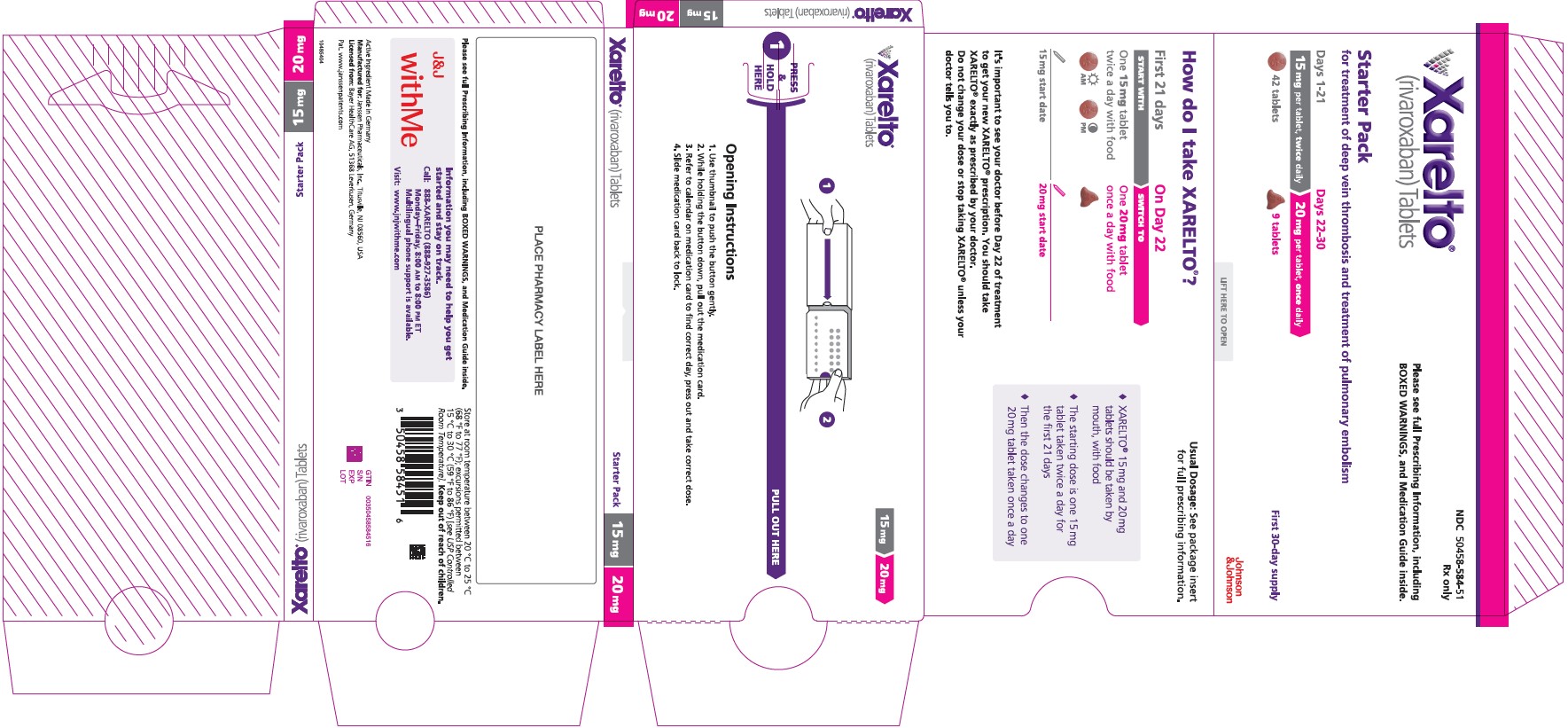
Starter Pack (Xarelto Starter Pack)

Starter Pack (Xarelto Starter Pack)
Xarelto (rivaroxaban) Starter Pack packaging label for oral film-coated tablets by Janssen Pharmaceuticals, Inc. The pack includes 15 mg tablets to be taken twice daily for days 1-21 (42 tablets) and 20 mg tablets to be taken once daily for days 22-30 (9 tablets). The label features dosage instructions, opening instructions for the package, and space for a pharmacy label, with storage information and contact support details.*
FDA Label Image

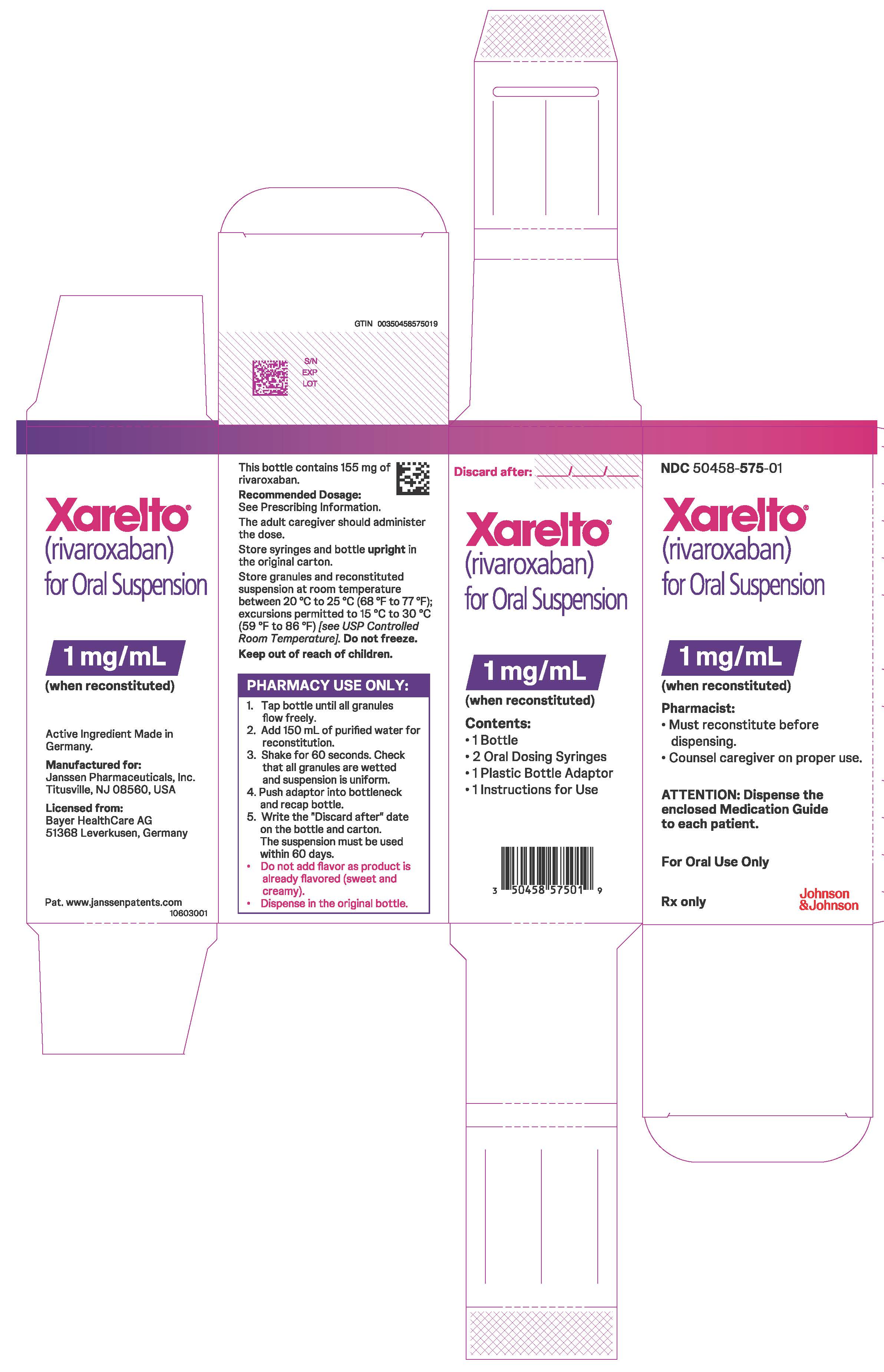
1 mg/ml (Xarelto Oral Solution 1 mg Per mL Box 10603001 Edms Rim 1540253 2.0 Crop)

1 mg/ml (Xarelto Oral Solution 1 mg Per mL Box 10603001 Edms Rim 1540253 2.0 Crop)
Packaging label for Xarelto (rivaroxaban) for Oral Suspension, 1 mg/mL when reconstituted. The label includes dosage preparation instructions, storage recommendations, contents listing (one bottle, two oral dosing syringes, one plastic bottle adaptor, instructions), pharmacy use instructions, and warnings. Manufactured for Janssen Pharmaceuticals, Inc., the label contains the NDC 50458-575-01 and features the Johnson & Johnson logo.*

* About these descriptions: Image descriptions on this page are generated by automated AI analysis of the product label images from the manufacturer's FDA label submission (SPL). They are provided for reference only and may contain errors or omissions. Always rely on the printed label itself and the official FDA labeling, and consult a pharmacist or healthcare professional with any questions about this product.