No clinical studies have been conducted comparing CROFAB with other
antivenins, therefore, no comparisons can be made between CROFAB and
other antivenins.
Two prospective clinical trials using CROFAB have been conducted. They
were prospectively defined, open label, multi-center trials conducted in
otherwise healthy patients 11 years of age or older who had suffered from
minimal or moderate (as defined in Table 5) North American crotalid
envenomation that showed evidence of progression. Progression was defined
as the worsening of any evaluation parameter used in the grading of an
envenomation: local injury, laboratory abnormality or symptoms and signs
attributable to crotalid snake venom poisoning. Both clinical trials excluded
patients with Copperhead envenomation.
Table 5 Definition of Minimal, Moderate, and Severe Envenomation in
Clinical Studies of CROFABEnvenomation
Category | Definition |
| Minimal | Swelling, pain, and ecchymosis limited to the
immediate bite site;
Systemic signs and symptoms absent;
Coagulation parameters normal with no clinical
evidence of bleeding. |
| Moderate | Swelling, pain, and ecchymosis involving less than a
full extremity or, if bite was sustained on the trunk,
head or neck, extending less than 50 cm;
Systemic signs and symptoms may be present but not
life threatening, including but not limited to nausea,
vomiting, oral paresthesia or unusual tastes, mild
hypotension (systolic blood pressure >90 mmHg),
mild tachycardia (heart rate <150), and tachypnea;
Coagulation parameters may be abnormal, but no
clinical evidence of bleeding present. Minor
hematuria, gum bleeding and nosebleeds are allowed if
they are not considered severe in the investigator’s
judgment. |
| Severe | Swelling, pain, and ecchymosis involving more than an
entire extremity or threatening the airway;
Systemic signs and symptoms are markedly abnormal,
including severe alteration of mental status, severe
hypotension, severe tachycardia, tachypnea, or
respiratory insufficiency;
Coagulation parameters are abnormal, with serious
bleeding or severe threat of bleeding. |
In both clinical studies, efficacy was determined using a Snakebite Severity
Score (SSS) [2] (referred to as the efficacy score or ES in these clinical
studies) and an investigator’s clinical assessment (ICA) of efficacy. The SSS
(referred to as the ES) is a tool used to measure the severity of envenomation
based on six body categories: local wound (e.g., pain, swelling and
ecchymosis), pulmonary, cardiovascular, gastrointestinal, hematological, and
nervous system effects. A higher score indicates worse symptoms. In a
retrospective study using medical records of 108 snakebite victims [2], the
SSS has been shown to correlate well with physicians' assessment of the
patient's condition at presentation (Pearson correlation coefficient: r=0.63,
p<0.0001) and when the patient's condition was at its worst (r=0.70,
p<0.0001). In this study, the condition of 87/108 patients worsened during
hospitalization. Changes in the physicians' assessment of condition correlated
well with changes in SSS. CROFAB was required to prevent an increase in the
ES in order to demonstrate efficacy.
The ICA was based on the investigator’s clinical judgment as to whether the
patient had a:
- Clinical response (pre-treatment signs and symptoms of envenomation
were arrested or improved after treatment)
- Partial response (signs and symptoms of envenomation worsened, but
at a slower rate than expected after treatment)
- Non-response (the patient’s condition was not favorably affected by the
treatment).
Safety was assessed by monitoring for early allergic events, such as
anaphylaxis and early serum reactions during CROFAB infusion, and late
events, such as late serum reactions.
TAb001:
In the first clinical study of CROFAB, 11 patients received an intravenous dose
of 4 vials of CROFAB over 60 minutes. An additional 4-vial dose of CROFAB
was administered after completion of the first CROFAB infusion, if deemed
necessary by the investigator. At the 1-hour assessment, 10 out of 11 patients
had no change or a decrease in their ES. Ten of 11 patients were also judged
to have a clinical response by the ICA. Several patients, after initial clinical
response, subsequently required additional vials of CROFAB to stem
progressive or recurrent symptoms and signs. No patient in this first study
experienced an anaphylactic or anaphylactoid response or evidence of an early
or late serum reaction as a result of administration of CROFAB.
TAb002:
Based on observations from the first study, the second clinical study of
CROFAB compared two different dosage schedules. Patients were given an
initial intravenous dose of 6 vials of CROFAB with an option to retreat with an
additional 6 vials, if needed, to achieve initial control of the envenomation
syndrome. Initial control was defined as complete arrest of local
manifestations, and return of coagulation tests and systemic signs to normal.
Once initial control was achieved, patients were randomized to receive
additional CROFAB either every 6 hours for 18 hours (Scheduled Group) or as
needed (PRN Group).
In this trial, CROFAB was administered safely to 31 patients with minimal or
moderate crotalid envenomation. All 31 patients enrolled in the study
achieved initial control of their envenomation with CROFAB, and 30, 25 and
26 of the 31 patients achieved a clinical response based on the ICA at 1, 6 and
12 hours respectively following initial control. Additionally, the mean ES
was significantly decreased across the patient groups by the 12-hour
evaluation time point (p=0.05 for the Scheduled Group; p=0.05 for the PRN
Group) (see Table 6). There was no statistically significant difference
between the Scheduled Group and the PRN Group with regard to the decrease
in ES.
Table 6 Summary of Patient Efficacy Scores for Scheduled and PRN
Groups| * No change or a decline in the Efficacy Score was considered an indication
of clinical response and a sign of efficacy. |
| ** For both the Scheduled and the PRN Groups, differences in the Efficacy
Score at the four post-baseline assessment times were statistically
decreased from baseline by Friedman’s test (p < 0.001). |
| Time Period | Scheduled
Group (n=15)
Efficacy Score*
Mean ± SD | PRN Group
(n=16)
Efficacy Score*
Mean ± SD |
| Baseline | 4.0 ± 1.3 | 4.7 ± 2.5 |
End of Initial Control
Antivenin Infusion(s) | 3.2 ± 1.4 | 3.3 ± 1.3 |
1 hour after Initial
Control achieved | 3.1 ± 1.3 | 3.2 ± 0.9 |
6 hours after Initial
Control achieved | 2.6 ± 1.5 | 2.6 ± 1.3 |
12 hours after Initial
Control achieved | 2.4 ± 1.1** | 2.4 ± 1.2** |
In published literature accounts of rattlesnake bites, it has been noted that a
decrease in platelets can accompany moderately severe envenomation, which
whole blood transfusions could not correct [3]. These platelet count
decreases have been observed to last for many hours and often several days
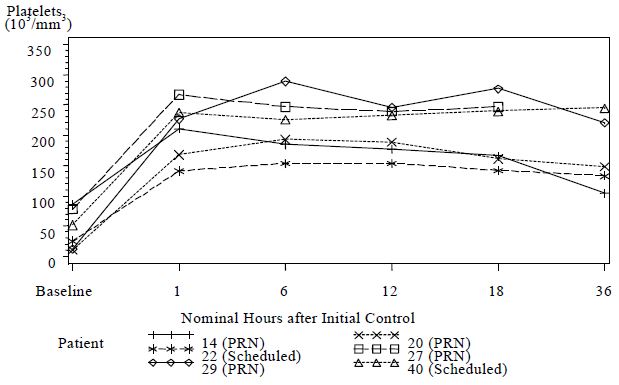
following the venomous bite [3, 4, 5]. In this clinical study, 6 patients had
pre-dosing platelet counts below 100,000/mm3 (baseline average of
44,000/mm3). Of note, the platelet counts for all 6 patients increased to
normal levels (average 209,000/ mm3) at 1 hour following initial control
dosing with CROFAB (see Figure 1).
Figure 1 Graph of Platelet Counts from Baseline to 36 Hours for
Patients with Counts <100,000/mm3 at Baseline (Study
TAb002)
Although there was no significant difference in the decrease in ES between
the two treatment groups, the data suggest that Scheduled dosing may
provide better control of envenomation symptoms caused by the continued
leaking of venom from depot sites. Scheduled patients experienced a lower
incidence of coagulation abnormalities at follow up compared with PRN
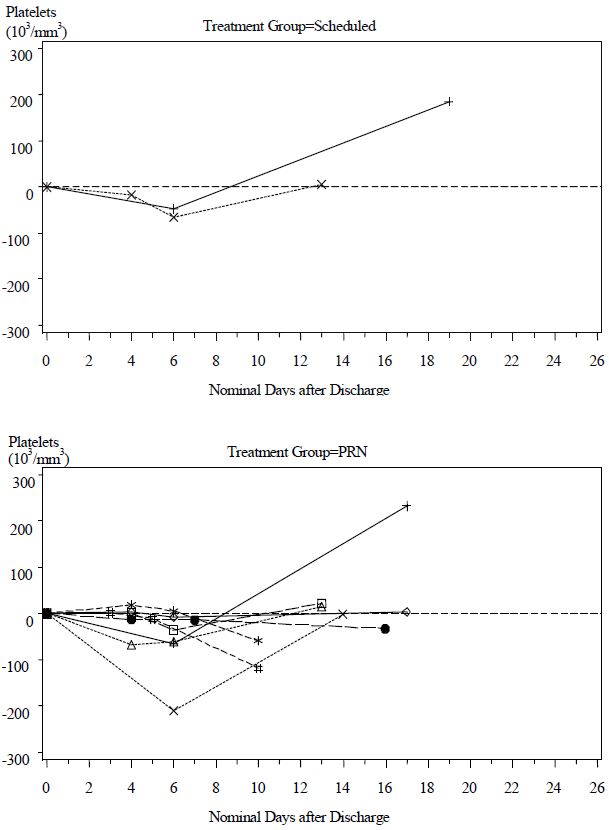
patients (see Table 7 and Figure 2). In addition, the need to administer
additional CROFAB to patients in the PRN Group after initial control
suggests that there is a continued need for antivenin for adequate treatment.
Table 7 Lower Incidence of Recurrence of Coagulopathies at
Follow-Up in Scheduled and PRN Dosing Groups^ Numbers are expressed as percent of patients that had a follow-up
platelet count that was less than the count at hospital discharge, or a
fibrinogen level less than 50% of the level at hospital discharge.
* Follow-up data not available for one patient.
** Statistically significant difference, p=0.04 by Fisher’s Exact test. |
| | Scheduled Group (n=14)*
(percent of patients with
abnormal values)^ | PRN Group (n=16)
(percent of patients
with abnormal
values)^ |
| Platelet | 2/14 (14%)** | 9/16 (56%)** |
| Fibrinogen | 2/14 (14%) | 7/16 (44%) |
Figure 2 Change in Platelet Counts in Individual Patients between Follow-Up
Visits and Discharge
Patients in the Scheduled and PRN Groups are plotted separately. More
patients in the PRN Group showed a reduction in platelet count after
discharge than in the Scheduled Group. Only patients showing a
reduced platelet count after discharge are shown.