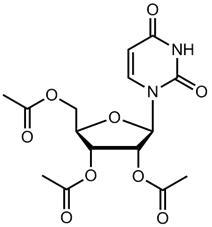
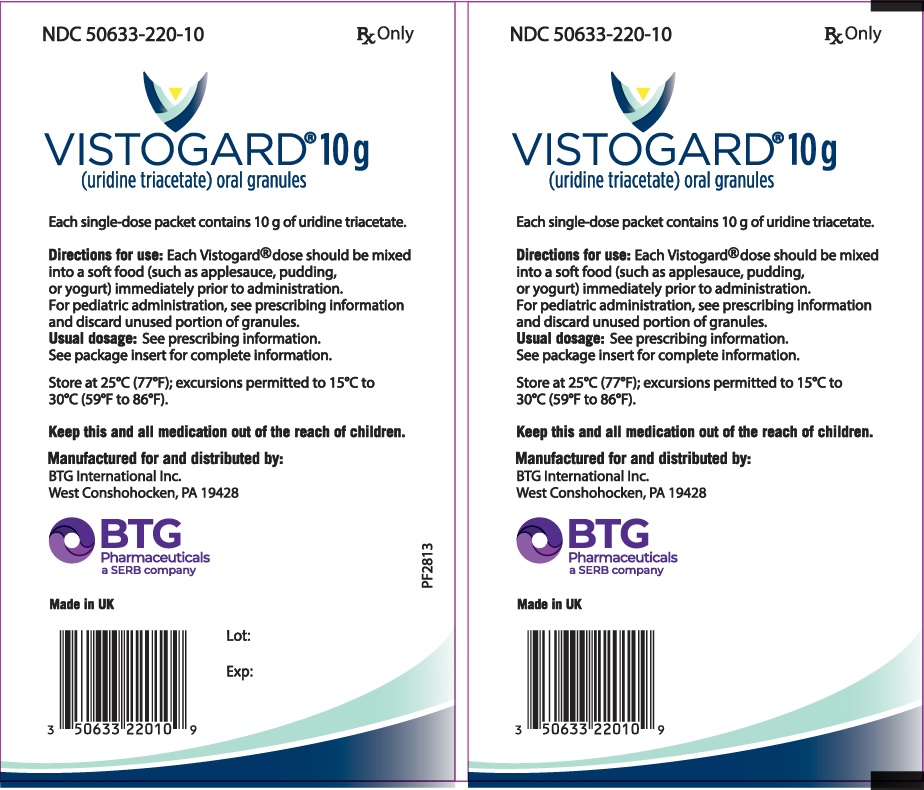
- VISTOGARD is not recommended for the non-emergent treatment of adverse reactions associated with fluorouracil or capecitabine because it may diminish the efficacy of these drugs.
- The safety and efficacy of VISTOGARD initiated more than 96 hours following the end of fluorouracil or capecitabine administration have not been established.
Risk Summary
Limited case reports of uridine triacetate use during pregnancy are insufficient to inform a drug-associated risk of birth defects and miscarriage. When administered orally to pregnant rats during the period of organogenesis, uridine triacetate at doses of one-half the maximum recommended human dose (MRHD) of 40 grams per day was not teratogenic and did not produce adverse effects on embryo-fetal development [see Data].
The background risk of major birth defects and miscarriage for the indicated population are unknown. In the U.S. general population, the estimated background risk of major birth defects and miscarriage in clinically recognized pregnancies is 2% to 4% and 15% to 20%, respectively.
Data
Animal Data
In an embryo-fetal development study, uridine triacetate was administered orally to pregnant rats during the period of organogenesis at doses up to 2000 mg/kg per day (about one-half the maximum recommended human dose (MRHD) of 40 grams per day on a body surface area basis). There was no evidence of teratogenicity or harm to the fetus and no effect on maternal body weight and overall health.
Risk Summary
There are no data on the presence of uridine triacetate in human milk, the effect on the breastfed infant or the effect on milk production. The development and health benefits of breastfeeding should be considered along with the mother's clinical need for VISTOGARD and any potential adverse effects on the breastfed infant from VISTOGARD or from the underlying maternal condition.
Absorption
VISTOGARD delivers 4- to 6-fold more uridine into the systemic circulation compared to equimolar doses of uridine itself. Maximum concentrations of uridine in plasma following oral VISTOGARD are generally achieved within 2 to 3 hours, and the half-life ranges from approximately 2 to 2.5 hours.
Studies 1 and 2 included an assessment of plasma uridine in a subgroup of patients who were overdosed with fluorouracil or experiencing early-onset of serious fluorouracil toxicities. Samples were obtained prior to VISTOGARD treatment and at 1 to 4 hours following the first and final doses of VISTOGARD given at 10 g (adults) or 6.2 grams/m2 (pediatric) every 6 hours for up to 20 doses. Plasma uridine concentrations are summarized in Table 3.
Table 3 Plasma Uridine Concentrations (µM) in Studies 1 and 2 | Study | Predose | Post First Dose | Post Final Dose |
|---|
| Study 1 | 8 (33) | 99 (64) | 160 (81) |
| N = 49 | N = 49 | N = 40 |
| Study 2 | 5 (17) | 119 (59) | 153 (68) |
| N = 27 | N = 26 | N = 24 |
Food Effect on Uridine PK: A study in healthy adult subjects receiving a slightly different formulation of uridine triacetate granules (6 gram dose) under fed and fasted conditions showed no difference in the overall rate and extent of uridine exposure.
Distribution
Circulating uridine is taken up into mammalian cells via specific nucleoside transporters, and also crosses the blood brain barrier.
Excretion
Uridine can be excreted via the kidneys, but is also metabolized by normal pyrimidine catabolic pathways present in most tissues.
Drug Interaction Studies
In vitro enzyme inhibition data did not reveal meaningful inhibitory effects of uridine triacetate or uridine on CYP3A4, CYP1A2, CYP2C8, CYP2C9, CYP2C19, CYP2D6, and CYP2E1. In vitro enzyme induction data did not reveal an inducing effect of uridine triacetate or uridine on CYP1A2, CYP2B6, or CYP3A4.
In vitro data showed that uridine triacetate was a weak substrate for P-glycoprotein. Uridine triacetate inhibited the transport of a known P-glycoprotein substrate, digoxin, with an IC50 of 344 µM. Due to the potential for high local (gut) concentrations of the drug after dosing, the interaction of VISTOGARD with orally administered P-gp substrate drugs cannot be ruled out.
In vivo data in humans are not available.
Specific Populations
Sex
Pharmacokinetics analyses showed that sex did not have a significant effect on uridine pharmacokinetics.
Age
Pharmacokinetic analysis showed that within the age range evaluated (20 to 83 years), age did not have a significant effect on uridine pharmacokinetics.
Body Size
Pharmacokinetic analyses showed no clinically meaningful effect of body surface area on uridine PK in adults.
Dosing Instructions [see Dosage and Administration (2.1) and (2.2)]
Advise the patient or caregiver:
- The importance of taking all 20 doses, even if they feel well.
- That VISTOGARD can be taken mixed in food (applesauce, pudding or yogurt).
- That the VISTOGARD granules should not be chewed.
- That if the patient vomits within 2 hours of taking a dose of VISTOGARD to take another complete dose as soon as possible after vomiting. Take the next dose at the regularly scheduled time.
- That if the patient misses a dose at the scheduled time, to take that dose of VISTOGARD as soon as possible. Then take the next dose at the regularly scheduled time.
Manufactured for and distributed by:
BTG International Inc.
West Conshohocken, PA, 19428
BTG
Pharmaceuticals
a SERB company
VISTOGARD® is a registered trademark of BTG International Inc.
The SERB logo is a registered trademark of SERB S.à.r.l.