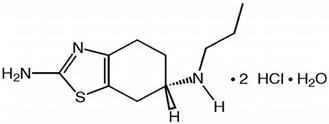
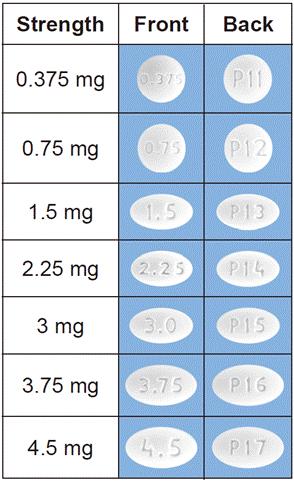
Pramipexole dihydrochloride extended- release tablets, like immediate-release pramipexole tablets, display linear pharmacokinetics over the entire clinical dosage range. Slow release of pramipexole from pramipexole dihydrochloride extended- release tablets with once-daily administration results in the same daily maximum and minimum pramipexole plasma concentrations (Cmax, Cmin) as three times daily administration of immediate-release pramipexole tablets.
Absorption
The absolute bioavailability of pramipexole is greater than 90%, indicating that it is well absorbed and undergoes little presystemic metabolism.
Increase in systemic exposure of pramipexole following oral administration of 0.375 mg to 4.5 mg of pramipexole dihydrochloride extended- release tablets was dose-proportional. For pramipexole dihydrochloride extended-release tablets, steady state of exposure is reached within 5 days of continuous dosing.
Relative bioavailability of pramipexole dihydrochloride extended- release tablets compared with immediate-release tablets was approximately 100%. In a repeat-dose study in healthy, normal volunteers, pramipexole dihydrochloride extended- release tablets 4.5 mg administered once daily was bioequivalent with regard to Cmax and AUC over 24 hours to immediate-release pramipexole tablets 1.5 mg administered three times daily. The average time-to-peak concentration for pramipexole dihydrochloride extended-release tablets is 6 hours. Administration of pramipexole dihydrochloride extended- release tablets with food (i.e., high-fat meal) did not affect AUC but increased Cmax by approximately 20% and delayed Tmax by approximately 2 hours compared with dosing under fasted conditions; these differences are not considered to be clinically relevant [see Dosage and Administration (2.1)].
Distribution
Pramipexole is extensively distributed, having a volume of distribution of about 500 L (coefficient of variation [CV] = 20%). It is about 15% bound to plasma proteins. Pramipexole distributes into red blood cells as indicated by an erythrocyte-to-plasma ratio of approximately 2.
Metabolism
Pramipexole is metabolized only to a negligible extent (<10%). No specific active metabolite has been identified in human plasma or urine.
Elimination
Urinary excretion is the major route of pramipexole elimination, with 90% of a pramipexole dose recovered in urine, almost all as unchanged drug. The renal clearance of pramipexole is approximately 400 mL/min (CV=25%), approximately three times higher than the glomerular filtration rate. Thus, pramipexole is secreted by the renal tubules, probably by the organic cation transport system.
Pharmacokinetics in Specific Populations
Because therapy with pramipexole dihydrochloride extended-release tablets is initiated at a low dose and gradually titrated upward according to clinical tolerability to obtain the optimum therapeutic effect, adjustment of the initial dose based on gender, weight, race, or age is not necessary. However, renal insufficiency causes a large decrease in the ability to eliminate pramipexole. This will necessitate dosage adjustment in patients with moderate to severe renal impairment [see Dosage and Administration (2.2)].
Gender
Pramipexole clearance is about 30% lower in women than in men, but this difference can be accounted for by differences in body weight. There is no difference in plasma half-life between males and females.
Age
Pramipexole clearance is reduced by approximately 30% in the elderly (aged 65 years or older) compared with young, healthy volunteers (aged less than 40 years). This difference is most likely due to the reduction in renal function with age, since pramipexole clearance is correlated with renal function, as measured by creatinine clearance.
Race
No racial differences in metabolism and elimination have been identified.
Hepatic Impairment
The influence of hepatic insufficiency on pramipexole pharmacokinetics has not been evaluated. Because approximately 90% of the recovered dose is excreted in the urine as unchanged drug, hepatic impairment would not be expected to have a significant effect on pramipexole elimination.
Renal Impairment
Clearance of immediate-release pramipexole was about 75% lower in patients with severe renal impairment (creatinine clearance approximately 20 mL/min) and about 60% lower in patients with moderate impairment (creatinine clearance approximately 40 mL/min) compared with healthy volunteers [see Dosage and Administration (2.2) and Warnings and Precautions (5.7)]. In patients with varying degrees of renal impairment, pramipexole clearance correlates well with creatinine clearance. Therefore, creatinine clearance can be used as a predictor of the extent of decrease in pramipexole clearance.
Drug Interactions
No specific pharmacokinetic drug interaction trials were conducted with pramipexole dihydrochloride extended-release tablets since the potential for drug interactions mainly depends on the active drug substance pramipexole and not the formulation. The following interaction data were obtained using immediate-release pramipexole tablets.
Carbidopa/levodopa: Carbidopa/levodopa did not influence the pharmacokinetics of pramipexole in healthy volunteers (N=10). Pramipexole did not alter the extent of absorption (AUC) or the elimination of carbidopa/levodopa, although it caused an increase in levodopa Cmax by about 40% and a decrease in Tmax from 2.5 to 0.5 hours.
Selegiline: In healthy volunteers (N=11), selegiline did not influence the pharmacokinetics of pramipexole.
Amantadine: Population pharmacokinetic analyses suggest that amantadine may slightly decrease the oral clearance of pramipexole.
Cimetidine: Cimetidine, a known inhibitor of renal tubular secretion of organic bases via the cationic transport system, caused a 50% increase in pramipexole AUC and a 40% increase in half-life (N=12).
Probenecid: Probenecid, a known inhibitor of renal tubular secretion of organic acids via the anionic transporter, did not noticeably influence pramipexole pharmacokinetics (N=12).
Other drugs eliminated via renal secretion: Population pharmacokinetic analysis suggests that co- administration of drugs that are secreted by the cationic transport system (e.g., cimetidine, ranitidine, diltiazem, triamterene, verapamil, quinidine, and quinine) decreases the oral clearance of pramipexole by about 20%, while those secreted by the anionic transport system (e.g., cephalosporins, penicillins, indomethacin, hydrochlorothiazide, and chlorpropamide) are likely to have little effect on the oral clearance of pramipexole. Other known organic cation transport substrates and/or inhibitors (e.g., cisplatin and procainamide) may also decrease the clearance of pramipexole.
CYP interactions: Inhibitors of cytochrome P450 enzymes would not be expected to affect pramipexole elimination because pramipexole is not appreciably metabolized by these enzymes in vivo or in vitro. Pramipexole does not inhibit CYP enzymes CYP1A2, CYP2C9, CYP2C19, CYP2E1, and CYP3A4. Inhibition of CYP2D6 was observed with an apparent Ki of 30 µM, indicating that pramipexole will not inhibit CYP enzymes at plasma concentrations observed following the clinical dose of 4.5 mg/day.
Drugs affecting gastrointestinal motility or gastric pH: Population pharmacokinetic analysis suggests that co-administration of antacids (N=6) decreased the oral clearance of pramipexole by about 25%, while H2-blockers (N=5), anticholinergics (N=27), propulsive (N=7), and proton pump inhibitors (N=16) are likely to have little effect on the oral clearance of pramipexole.