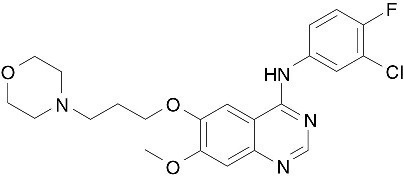
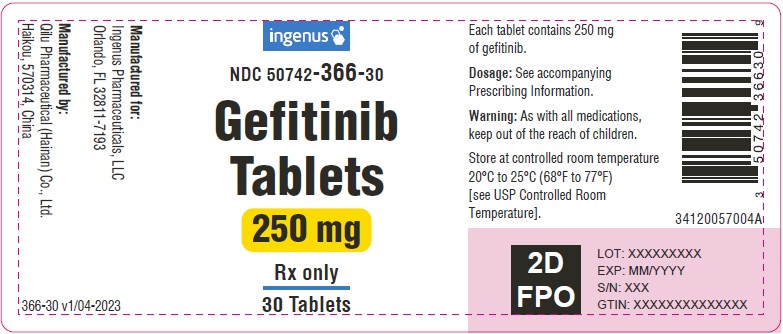
Gefitinib tablets are a prescription medicine used to treat people with non-small cell lung cancer (NSCLC) that has spread to other parts of the body and:
- that have certain types of abnormal epidermal growth factor receptor (EGFR) genes, and
- who have not had previous treatment for cancer
Your healthcare provider will perform a test to make sure that gefitinib tablets are right for you.
It is not known if gefitinib tablets are safe and effective in people with NSCLC that have other types of EGFR genes.
It is not known if gefitinib tablets are safe and effective in children.
Before taking gefitinib tablets, tell your healthcare provider about all of your medical conditions, including if you:
•have lung or breathing problems
•ever had liver problems
•have vision or eye problems
•are pregnant or plan to become pregnant. Gefitinib tablets can harm your unborn baby.
∘Females who are able to become pregnant should use an effective method of birth control during treatment with gefitinib tablets and for at least 2 weeks after the last dose of gefitinib tablets. You should avoid becoming pregnant during treatment with gefitinib tablets.
∘Tell your healthcare provider right away if you become pregnant during treatment with gefitinib tablets.
•are breastfeeding or plan to breastfeed. It is not known if gefitinib tablet passes into your breast milk. Do not breastfeed during treatment with gefitinib tablets. Talk to your healthcare provider about the best way to feed your baby during this time.
Tell your healthcare provider about all the medicines you take, including prescription and over-the-counter medicines, vitamins, or herbal supplements.
If you take a proton pump inhibitor (PPI), H2 blocker, or an antacid medicine, talk to your healthcare provider about the best time to take it during treatment with gefitinib tablets.
If you take a blood thinner called warfarin, your healthcare provider should do blood tests regularly to check how fast your blood clots, during treatment with gefitinib tablets.
How should I take gefitinib tablets?
•Take gefitinib tablets exactly as your healthcare provider tells you to take it.
•Your healthcare provider may change your dose, temporarily stop, or permanently stop treatment with gefitinib tablets if you have side effects.
•Take gefitinib tablet 1 time each day.
•You can take gefitinib tablets with or without food.
•If you miss a dose of gefitinib tablets, take it as soon as you remember. If it is less than 12 hours until your next dose, skip the missed dose. Take your next dose at your regular time.
•If you take too much gefitinib tablets, call your healthcare provider or go to the nearest emergency room right away.
•If you cannot swallow gefitinib tablets whole:
∘place your dose of gefitinib tablet in a container with 4 to 8 ounces of water and stir for about 15 minutes
∘drink the mixture right away
∘place another 4 to 8 ounces of water in the same container, and drink it right away
What are the possible side effects of gefitinib tablets?
Gefitinib tablets may cause serious side effects, including:
•lung or breathing problems. Gefitinib tablets may cause inflammation of the lung that may lead to death. Symptoms may be similar to those symptoms from lung cancer. Tell your healthcare provider right away if you have any new or worsening lung problems, or any combination of the following symptoms: trouble breathing or shortness of breath, cough, or fever.
•liver problems. Gefitinib tablets may cause inflammation of the liver that may lead to death. Tell your healthcare provider right away if you have any symptoms of a liver problem which may include:
∘yellowing of your skin or the white part of your eyes (jaundice)
∘dark or brown (tea colored) urine
∘light-colored bowel movements (stools)
∘decreased appetite
∘pain on the right side of your stomach (abdomen)
Your healthcare provider will do blood tests to check your liver function during your treatment with gefitinib tablets.
•a tear in the wall of your stomach or intestines (perforation). Get emergency medical help right away if you have severe stomach (abdomen) pain.
•diarrhea. Diarrhea is common with gefitinib tablets and can sometimes be severe. Tell your healthcare provider right away if you have severe diarrhea or diarrhea that will not go away.
•eye problems. Tell your healthcare provider if you get watery eyes, sensitivity to light, blurred vision, eye pain, eye redness, or vision changes.
•skin reactions. Skin redness, rash, itching, and acne are common with gefitinib tablets. This may occur on any part of your body. Get medical help right away if you develop severe skin reactions such as peeling or blistering of your skin.
Gefitinib tablets may cause fertility problems in females. Talk to your healthcare provider if you plan to become pregnant.
Tell your healthcare provider if you have any side effect that bothers you or that does not go away.
These are not all the possible side effects of gefitinib tablets. For more information, ask your healthcare provider or pharmacist.
Call your doctor for medical advice about side effects.
You may report side effects to FDA at 1-800-FDA-1088.
How should I store gefitinib tablets?
Store gefitinib tablets at room temperature between 68˚F to 77˚F (20˚C to 25˚C)
Keep gefitinib tablets and all medicines out of the reach of children.
General information about the safe and effective use of gefitinib tablets.
Medicines are sometimes prescribed for purposes other than those listed in Patient Information leaflet. Do not use gefitinib tablets for a condition for which it was not prescribed. Do not give gefitinib tablets to other people, even if they have the same symptoms you have. It may harm them. You can ask your healthcare provider or pharmacist for information about gefitinib tablets that is written for health professionals.
What are the ingredients in gefitinib tablets?
Active ingredient: gefitinib
Inactive ingredients: lactose monohydrate, microcrystalline cellulose, croscarmellose sodium, povidone, sodium lauryl sulfate, magnesium stearate
Tablet coating contains:polyvinyl alcohol-part hydrolysed, polyethylene glycol 3350, talc, titanium dioxide, red ferric oxide, ferrosoferric oxide and yellow ferric oxide
Manufactured for:
Ingenus Pharmaceuticals, LLC
Orlando, FL 32811-7193
Manufactured by:
Qilu Pharmaceutical (Hainan) Co., Ltd.
Haikou, 570314, China
This Patient Information has been approved by the U.S. Food and Drug Administration
Revised: April 2023