Estradiol And Norethindrone Acetate Tablet
Product Images NDC 50742-657
View Photos of Packaging, Regulatory Labels, and Product Appearance
Product Visual Gallery
This gallery contains 19 technical images submitted to the FDA as part of the official labeling for Estradiol And Norethindrone Acetate (NDC 50742-657). Unlike standard consumer photos, these assets often include clinical data figures, molecular chemical structures, and official manufacturer packaging layouts.
As provided by Ingenus Pharmaceuticals, Llc, these visuals offer a comprehensive scientific overview of the product's physical and chemical identity, aiding pharmacists and researchers in product verification and study.
Product Images & Figures Index
Image (Image 02)
Image (Image 03)
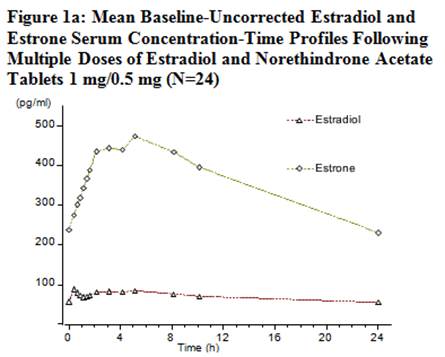
This appears to be a figure with a chart showing the mean baseline-uncorrected estradiol and estrone serum concentration-time profiles following multiple doses of 1mg/0.5mg estradiol and norethindrone acetate tablets. Unfortunately, the data provided is not clear enough to draw any further insights.*
Image (Image 04)
Figure 1b shows the mean baseline-uncorrected serum concentration-time profile of Norethindrone after multiple doses of Estradiol and Norethindrone Acetate tablets. The graph demonstrates the concentration levels of Norethindrone in ngimi over a period of 24 hours, with 24 participants included in the study.*
Image (Image 05)
Image (Image 06)
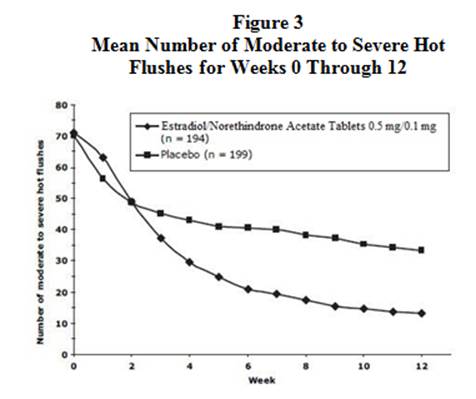
The text describes a figure (Figure 3) showing the mean number of moderate to severe hot flushes per week for a period of 12 weeks. The data compares the effects of Estradiol Norethindrone Acetate Tablets in doses of 0.5 mg and 0.1 mg against a placebo. The sample sizes for each treatment group are 154 and 199, respectively.*
Image (Image 07)
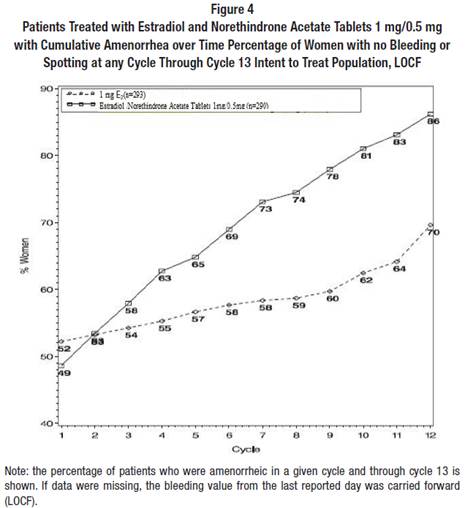
The text provides a figure (Figure 4) that shows the percentage of women treated with Estradiol and Norethindrone Acetate tablets who experienced no bleeding or spotting during their menstrual cycles over a period of 13 cycles. Data is shown for the Intent to Treat Population and missing data was carried forward using the LOCP method.*
Image (Image 08)
The text provides a figure (Figure 5) showing the percentage of women with no bleeding or spotting while being treated with estradiol and norethindrone acetate tablets, compared to a placebo group. The graph shows cumulative amenorrhea over time, up to cycle 6, in the intent-to-treat population using last observation carried forward (LOCF) analysis.*
Image (Image 09)
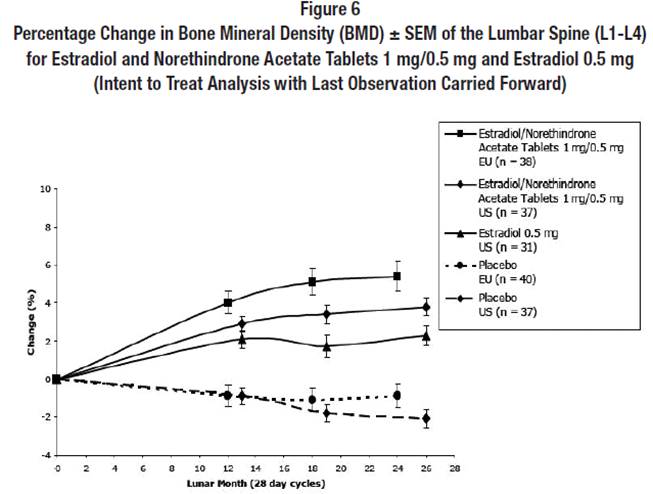
This is a figure showing the percentage change in Bone Mineral Density (BMD) for different treatments. Three treatments are compared: Estradiol/Noreshincione Acetate Tablets 1mg/0.5mg, Estradiol/Noreshincione Acetate Tablets 0.5mg and Placebo. The study includes an Intent to Treat Analysis with Last Observation Carried Forward. The x-axis shows the Lunar Month (28 day cycles) and the y-axis shows the percentage change in BMD represented by SEM of the Lumbar Spine (L1-L4).*
Image (Image 10)
Table 6 shows the relative and absolute risk seen in the Estrogen Plus Progestin Sub study of WHI at an average of 5.6 years. The table presents data for events including CHD events, Non-fatal MI, CHD death, all strokes, ischemic stroke, deep vein thrombosis, pulmonary embolism, invasive breast cancer, colorectal cancer, endometrial cancer, cervical cancer, hip fracture, vertebral fractures, lower arm or wrist fractures, total fractures, overall mortality and global index. The results are based on centrally adjudicated data. Nominal confidence intervals are unadjusted for multiple looks and multiple comparisons.*
Image (Image 11)
Image (Image 12)
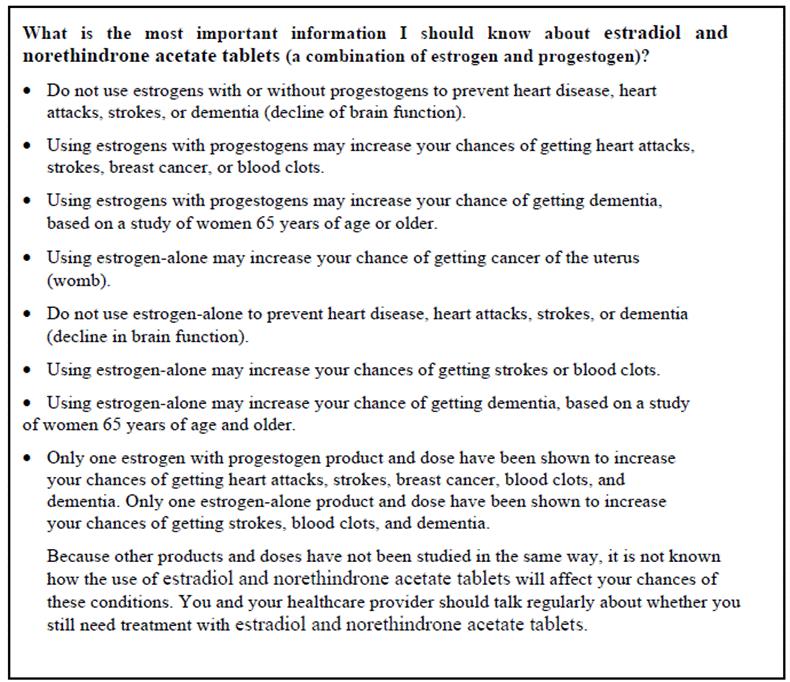
This text contains important information related to the use of estradiol and norethindrone acetate tablets, a combination of estrogen and progestogen. It warns against using this medication to prevent heart disease, heart attacks, strokes, or dementia. It highlights that using estrogens with progestogens or estrogen-alone may increase the chances of getting heart attacks, strokes, breast cancer, blood clots, or dementia. The text also emphasizes that specific estrogen-only and estrogen with progestogen products and doses have been shown to increase these risks. Other estradiol and norethindrone acetate products and doses have not been studied in the same way, and patients should discuss with their healthcare provider whether they still need treatment with this medication.*
Image (Image 13)
Image (Image 14)
Image (Image 15)
Image (Image 16)
This is a description of the medication Estradiol and Norethindrone Acetate Tablets, USP. Each yellow bottle contains 28 active tablets made up of a mixture of estradiol, USP 1 mg and norethindrone acetate, USP 0.5 mg per tablet. The medication should be kept in a dry place at room temperature, away from children. An enclosed information for the patient including a boxed warning is provided, along with a patient information insert and day label stickers. The label also asks the dispensing pharmacist to include an important information card with each compact dispensed to the patient.*
Image (Image 17)
Image (Image 18)
Image (Image 19)
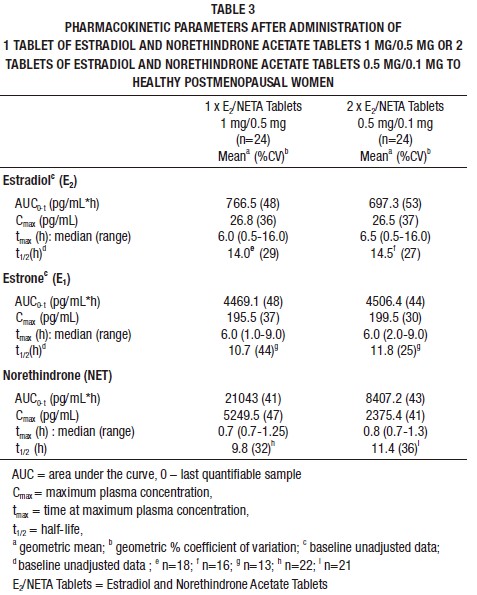
This is a table showing the pharmacokinetic parameters of the administration of either 1 tablet of Estradiol and Norethindrone Acetate Tablets 1 mg/0.5 mg or 2 tablets of Estradiol and Norethindrone Acetate Tablets 0.5 mg/0.1 mg to healthy postmenopausal women. The table shows values for AUC (area under the curve), Coa (maximum plasma concentration), t.5 (half-life) and other parameters for Estradiol, Estrone and Norethindrone.*
* These product label images have been analyzed using experimental machine learning. Please verify findings with the primary label text.