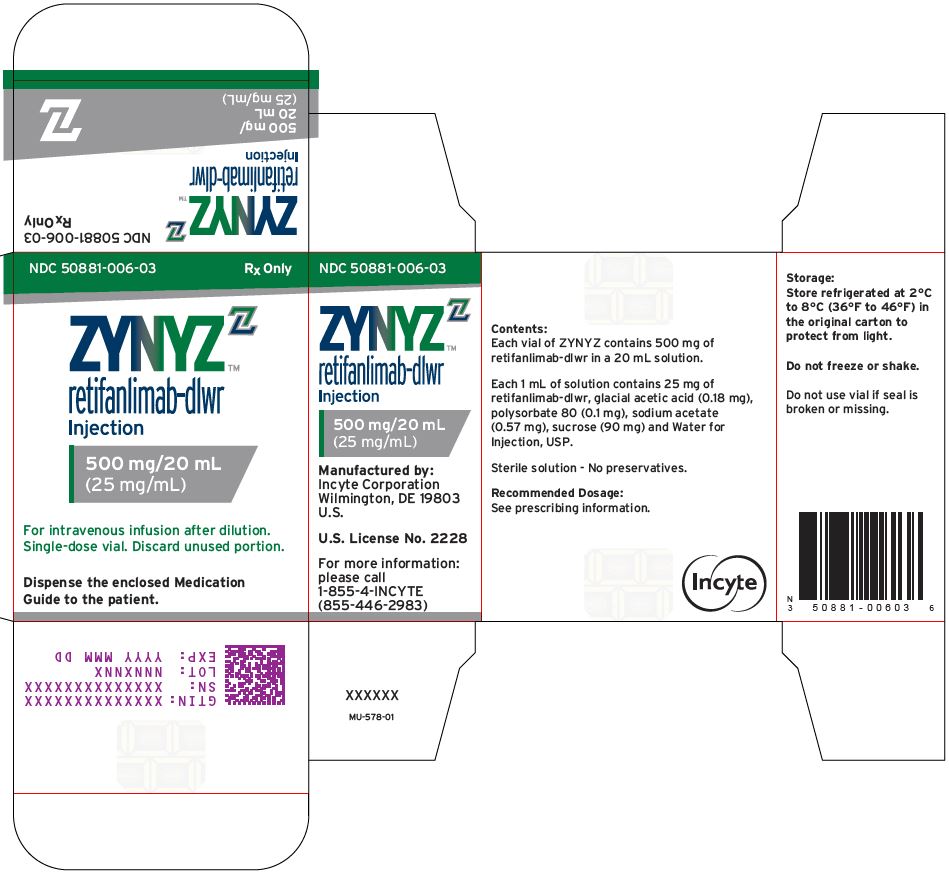
ZYNYZ is a monoclonal antibody that belongs to a class of drugs that binds to either the programmed death receptor-1 (PD-1) or the PD-ligand 1 (PD-L1), blocking the PD-1/PD-L1 pathway, thereby removing inhibition of the immune response with the potential for breaking of peripheral tolerance and induction of immune-mediated adverse reactions. Important immune‑mediated adverse reactions listed under Warnings and Precautions may not be inclusive of all possible severe and fatal immune-mediated reactions.
Immune-mediated adverse reactions, which may be severe or fatal, can occur in any organ system or tissue. Immune-mediated adverse reactions can occur at any time after starting treatment with a PD-1/PD-L1–blocking antibody. While immune-mediated adverse reactions usually manifest during treatment with PD-1/PD-L1–blocking antibodies, immune-mediated adverse reactions can also manifest after discontinuation of PD-1/PD-L1–blocking antibodies. Immune-mediated adverse reactions affecting more than one body system can occur simultaneously.
Early identification and management of immune‐mediated adverse reactions are essential to ensure safe use of PD-1/PD-L1–blocking antibodies. Monitor patients closely for symptoms and signs that may be clinical manifestations of underlying immune-mediated adverse reactions. Evaluate liver enzymes, creatinine, and thyroid function at baseline and periodically during treatment. In cases of suspected immune-mediated adverse reactions, initiate appropriate workup to exclude alternative etiologies, including infection. Institute medical management promptly, including specialty consultation as appropriate.
Withhold or permanently discontinue ZYNYZ depending on severity [see Dosage and Administration (2.2)]. In general, if ZYNYZ requires interruption or discontinuation, administer systemic corticosteroid therapy (1 to 2 mg/kg/day prednisone or equivalent) until improvement to Grade 1 or less. Upon improvement to Grade 1 or less, initiate corticosteroid taper and continue to taper over at least 1 month. Consider administration of other systemic immunosuppressants in patients whose immune-mediated adverse reactions are not controlled with corticosteroids.
Toxicity management guidelines for adverse reactions that do not necessarily require systemic steroids (e.g., endocrinopathies and dermatologic reactions) are discussed below.
Immune-Mediated Pneumonitis
ZYNYZ can cause immune-mediated pneumonitis. In patients treated with other PD-1/PD-L1–blocking antibodies, the incidence of pneumonitis is higher in patients who have received prior thoracic radiation.
Immune-mediated pneumonitis occurred in 3% (13/440) of patients receiving ZYNYZ, including 1 (0.2%) patient with fatal pneumonitis, Grade 3 (0.9%), and Grade 2 (1.4%). Pneumonitis led to permanent discontinuation of ZYNYZ in 1 patient and withholding of ZYNYZ in 0.9% of patients.
Systemic corticosteroids were required in 77% (10/13) of patients with pneumonitis. Pneumonitis resolved in 10 of the 13 patients. Of the 4 patients in whom ZYNYZ was withheld for pneumonitis, 3 reinitiated ZYNYZ after symptom improvement; of these, 1 had recurrence of pneumonitis.
Immune-Mediated Colitis
ZYNYZ can cause immune-mediated colitis. Cytomegalovirus infection/reactivation have occurred in patients with corticosteroid-refractory immune-mediated colitis treated with PD-1/PD-L1–blocking antibodies. In cases of corticosteroid-refractory colitis, consider repeating infectious workup to exclude alternative etiologies.
Immune-mediated colitis occurred in 1.6% (7/440) of patients receiving ZYNYZ, including Grade 4 (0.2%), Grade 3 (0.2%), and Grade 2 (0.7%). Colitis led to permanent discontinuation of ZYNYZ in 1 patient and withholding of ZYNYZ in 0.9% of patients.
Systemic corticosteroids were required in 71% (5/7) of patients. Colitis resolved in 4 of the 7 patients. Of the 4 patients in whom ZYNYZ was withheld for colitis, 1 reinitiated ZYNYZ after symptom improvement; this patient did not have recurrence of colitis.
Immune-Mediated Hepatitis
ZYNYZ can cause immune-mediated hepatitis.
Immune-mediated hepatitis occurred in 3% (13/440) of patients receiving ZYNYZ, including Grade 4 (0.2%), Grade 3 (2.3%), and Grade 2 (0.5%). Hepatitis led to permanent discontinuation of ZYNYZ in 1.4% of patients and withholding of ZYNYZ in 0.9% of patients.
Systemic corticosteroids were required in 85% (11/13) of patients. Hepatitis resolved in 6 of the 13 patients. Of the 4 patients in whom ZYNYZ was withheld for hepatitis, 2 reinitiated ZYNYZ after symptom improvement; of these, 1 had recurrence of hepatitis.
Immune-Mediated Endocrinopathies
Adrenal Insufficiency
ZYNYZ can cause primary or secondary adrenal insufficiency. For Grade 2 or higher adrenal insufficiency, initiate symptomatic treatment per institutional guidelines, including hormone replacement as clinically indicated. Withhold or permanently discontinue ZYNYZ depending on severity [see Dosage and Administration (2.2)].
Adrenal insufficiency occurred in 0.7% (3/440) of patients receiving ZYNYZ, including Grade 3 (0.5%) and Grade 2 (0.2%). Adrenal insufficiency did not lead to permanent discontinuation of ZYNYZ. ZYNYZ was withheld for 1 patient with adrenal insufficiency. All patients required systemic corticosteroids. Adrenal insufficiency resolved in 1 of the 3 patients.
Hypophysitis
ZYNYZ can cause immune-mediated hypophysitis. Hypophysitis can present with acute symptoms associated with mass effect such as headache, photophobia, or visual field cuts. Hypophysitis can cause hypopituitarism. Initiate hormone replacement as clinically indicated. Withhold or permanently discontinue ZYNYZ depending on severity [see Dosage and Administration (2.2)].
Hypophysitis occurred in 0.5% (2/440, both Grade 2) of patients receiving ZYNYZ. No patients discontinued or withheld ZYNYZ due to hypophysitis. All patients required systemic steroids. Hypophysitis resolved in 1 of the 2 patients.
Thyroid Disorders
ZYNYZ can cause immune-mediated thyroid disorders. Thyroiditis can present with or without endocrinopathy. Hypothyroidism can follow hyperthyroidism. Initiate hormone replacement or medical management of hyperthyroidism as clinically indicated. Withhold or permanently discontinue ZYNYZ depending on severity [see Dosage and Administration (2.2)].
Thyroiditis occurred in 0.7% (3/440, all Grade 1) of patients receiving ZYNYZ. No patients discontinued or withheld ZYNYZ due to thyroiditis. Thyroiditis resolved in 1 of the 3 patients.
Hypothyroidism
Hypothyroidism occurred in 10% (42/440) of patients receiving ZYNYZ, including Grade 2 (4.8%). No patients discontinued ZYNYZ due to hypothyroidism. Hypothyroidism led to withholding of ZYNYZ in 0.5% of patients. Systemic corticosteroids were required for 1 patient and 79% (33/42) of patients received endocrine therapy.
Hyperthyroidism
Hyperthyroidism occurred in 6% (24/440) of patients receiving ZYNYZ, including Grade 2 (2.5%). No patients discontinued ZYNYZ due to hyperthyroidism. Hyperthyroidism led to withholding of ZYNYZ in 1 patient. Systemic corticosteroids were required for 13% (3/24) of patients and 46% (11/24) of patients received endocrine therapy.
Type 1 Diabetes Mellitus, Which Can Present with Diabetic Ketoacidosis
Monitor patients for hyperglycemia or other signs and symptoms of diabetes. Initiate treatment with insulin as clinically indicated. Withhold ZYNYZ depending on severity [see Dosage and Administration (2.2)].
Type 1 diabetes mellitus occurred in 0.2% (1/440) of patients receiving ZYNYZ, including Grade 3 (0.2%) adverse reactions. Type 1 diabetes mellitus led to withholding of ZYNYZ in 1 patient. This event led to ZYNYZ being withheld and did not lead to permanent discontinuation of ZYNYZ. The patient received insulin.
Immune-Mediated Nephritis with Renal Dysfunction
ZYNYZ can cause immune-mediated nephritis.
Immune-mediated nephritis occurred in 1.6% (7/440) of patients receiving ZYNYZ, including Grade 4 (0.5%), Grade 3 (0.7%), and Grade 2 (0.5%). Nephritis led to permanent discontinuation of ZYNYZ in 0.9% of patients and withholding of ZYNYZ in 1 patient.
Systemic corticosteroids were required in 57% (4/7) of patients. Nephritis resolved in 3 of the 7 patients. The 1 patient in whom ZYNYZ was withheld for immune-mediated nephritis had ZYNYZ reinitiated after symptom improvement and did not have recurrence of immune-mediated nephritis.
Immune-Mediated Dermatologic Adverse Reactions
ZYNYZ can cause immune-mediated rash or dermatitis. Bullous and exfoliative dermatitis, including Stevens-Johnson syndrome (SJS), drug rash with eosinophilia and systemic symptoms (DRESS), and toxic epidermal necrolysis (TEN), has occurred with PD-1/PD-L1–blocking antibodies. Topical emollients and/or topical corticosteroids may be adequate to treat mild to moderate non-exfoliative rashes. Withhold or permanently discontinue ZYNYZ depending on severity [see Dosage and Administration (2.2)].
Immune-mediated skin reactions occurred in 8% (36/440) of patients receiving ZYNYZ, including Grade 3 (1.1%) and Grade 2 (7%). Immune-mediated dermatologic adverse reactions led to permanent discontinuation of ZYNYZ in 1 patient and withholding of ZYNYZ in 2.3% of patients.
Systemic corticosteroids were required in 25% (9/36) of patients. Immune-mediated dermatologic adverse reactions resolved in 75% (27/36) of patients. Of the 10 patients in whom ZYNYZ was withheld for immune-mediated dermatologic adverse reactions, 7 reinitiated ZYNYZ after symptom improvement; of these, 1 had recurrence of immune-mediated dermatologic adverse reactions.
Other Immune-Mediated Adverse Reactions
The following clinically significant immune-mediated adverse reactions occurred at an incidence of < 1% in 440 patients who received ZYNYZ [see Adverse Reactions (6.1)] or were reported with the use of other PD-1/PD-L1–blocking antibodies, including severe or fatal cases.
Cardiac/vascular: myocarditis, pericarditis, vasculitis
Gastrointestinal: pancreatitis, to include increases in serum amylase and lipase levels, gastritis, duodenitis
Musculoskeletal: myositis/polymyositis, rhabdomyolysis (and associated sequelae, including renal failure), arthritis, polymyalgia rheumatica
Neurological: meningitis, encephalitis, myelitis and demyelination, myasthenic syndrome/myasthenia gravis (including exacerbation), Guillain-Barré syndrome, nerve paresis, autoimmune neuropathy
Ocular: uveitis, iritis, and other ocular inflammatory toxicities. Some cases can be associated with retinal detachment. Various grades of visual impairment to include blindness can occur. If uveitis occurs in combination with other immune-mediated adverse reactions, consider a Vogt‑Koyanagi-Harada–like syndrome, as this may require treatment with systemic steroids to reduce the risk of permanent vision loss.
Endocrine: hypoparathyroidism
Other (Hematologic/Immune): hemolytic anemia, aplastic anemia, hemophagocytic lymphohistiocytosis, systemic inflammatory response syndrome, histiocytic necrotizing lymphadenitis (Kikuchi lymphadenitis), sarcoidosis, immune thrombocytopenic purpura, solid organ transplant rejection.