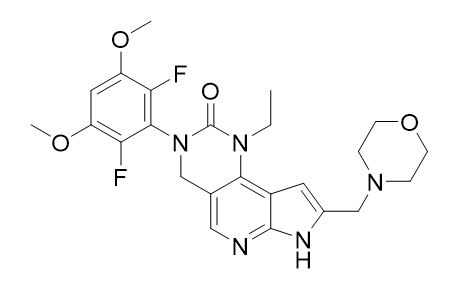
The geometric mean steady-state pemigatinib AUC0-24h was 2620 nM·h (54% CV) and Cmax was 236 nM (56% CV) for 13.5 mg orally once daily. Steady state pemigatinib concentrations increased proportionally over the dose range of 1 to 20 mg (0.07 to 1.5 times the recommended dose). Steady-state was achieved within 4 days following repeated once daily dosing. With repeated once daily dosing, pemigatinib accumulated with a median accumulation ratio of 1.63 (range 0.63 to 3.28).
Absorption
The median time to achieve peak pemigatinib plasma concentration (Tmax) was 1.13 (0.50‑6.00) hours.
Effect of Food
Administration of PEMAZYRE with a high-fat and high-calorie meal (approximately 1000 calories with 150 calories from protein, 250 calories from carbohydrate, and 500‑600 calories from fat) had no clinically meaningful effect on pemigatinib pharmacokinetics.
Distribution
The estimated apparent volume of distribution was 235 L (60.8%) following a 13.5 mg oral dose. In vitro, pemigatinib was 90.6% bound to human plasma proteins at concentrations ranging from 1 to 10 µM.
Elimination
The geometric mean elimination half-life (t½) of pemigatinib was 15.4 (51.6% CV) hours and the geometric mean apparent clearance (CL/F) was 10.6 L/h (54% CV).
Metabolism
Pemigatinib is predominantly metabolized by CYP3A4 in vitro. The major drug-related moiety in plasma was unchanged pemigatinib in a human [14C] mass balance study.
Excretion
Following a single oral 11 mg dose of radiolabeled pemigatinib, 82.4% of the dose was recovered in feces (1.4% as unchanged) and 12.6% in urine (1% as unchanged).
Specific Populations
No clinically meaningful differences in the systemic exposure of pemigatinib were observed based on age (21 ‑ 79 years), sex, race/ethnicity, body weight (39.8 ‑ 156 kg), mild to moderate renal impairment, or mild to moderate hepatic impairment. The effect of severe renal impairment, renal dialysis in end-stage renal disease, or severe hepatic impairment on pemigatinib exposure is unknown.
Drug Interaction Studies
Clinical Studies and Model-Based Approaches
Effect of CYP3A Inhibitors on Pemigatinib: Itraconazole, a strong CYP3A inhibitor, increased Cmax by 17% and increased AUC by 88% following a single oral PEMAZYRE dose of 4.5 mg [see Drug Interactions (7.1)].
Concomitant use of moderate CYP3A inhibitors is predicted to increase pemigatinib exposure by approximately 50-80% [see Drug Interactions (7.1)].
Effect of CYP3A Inducers on Pemigatinib: Rifampin, a strong CYP3A inducer, decreased pemigatinib Cmax by 62% and AUC by 85% following a single oral PEMAZYRE dose of 13.5 mg [see Drug Interactions (7.1)]. Concomitant use of a moderate CYP3A inducer is predicted to decrease pemigatinib exposure by more than 50% [see Drug Interactions (7.1)].
Effect of Acid-Lowering Agents on Pemigatinib: Esomeprazole, a proton pump inhibitor, decreased pemigatinib Cmax by 35% and AUC by 8% following a single oral PEMAZYRE dose of 13.5 mg; these differences are not expected to be clinically meaningful. Ranitidine, a histamine-2 antagonist, did not affect pemigatinib exposure.
Other Drugs: No clinically significant differences in glucose levels were observed when metformin (OCT2/MATE1 substrate) was co-administered with pemigatinib.
In Vitro Studies
Effect of Pemigatinib on CYP Enzymes: Pemigatinib is not an inhibitor of CYP1A2, CYP2B6, CYP2C8, CYP2C9, CYP2C19, CYP2D6, or CYP3A4 or an inducer of CYP1A2, CYP2B6, or CYP3A4.
Pemigatinib as a Substrate for Transporters: Pemigatinib is a substrate of both P-gp and BCRP. P-gp or BCRP inhibitors are not expected to affect pemigatinib exposure at clinically relevant concentrations.
Effect of Pemigatinib on Transporters: Pemigatinib is an inhibitor of P-gp, OCT2, and MATE1. Pemigatinib may increase serum creatinine by decreasing renal tubular secretion of creatinine; this may occur due to inhibition of renal transporters OCT2 and MATE1 and may not affect glomerular function [see Adverse Reactions (6.1)].