Other
Bronchospasm
ADASUVE can cause bronchospasm that has the potential to lead to respiratory distress and respiratory arrest, particularly in patients with lung diseases. Administer ADASUVE only in a certified healthcare setting that has immediate access on site to supplies and healthcare professionals competent in the management of acute bronchospasm and access to emergency assistance for symptoms that require immediate medical attention [see Warnings and Precautions (5.1, 5.2)] . Certified healthcare settings must have a short-acting bronchodilator (e.g. albuterol) available for the immediate treatment of bronchospasm; this short-acting bronchodilator can be delivered by inhaler (with spacer) or nebulizer. Prior to administering ADASUVE, screen patients regarding a current diagnosis, history, or symptoms of asthma, COPD and other lung diseases, and assess (including chest auscultation) patients for respiratory signs. Monitor for signs and symptoms of bronchospasm following treatment with ADASUVE [see Dosage and Administration (2.2, 2.4) and Contraindications (4)] .
Because of the risk of bronchospasm, ADASUVE is available only through a restricted program under a Risk Evaluation and Mitigation Strategy (REMS) called the ADASUVE REMS [see Warnings and Precautions (5.2)] .
Increased Mortality in Elderly Patients with Dementia-Related Psychosis
Elderly patients with dementia-related psychosis treated with antipsychotic drugs are at an increased risk of death. ADASUVE is not approved for the treatment of patients with dementia-related psychosis [see Warnings and Precautions (5.3)] .
Limitations of Use:
As part of the ADASUVE REMS Program to mitigate the risk of bronchospasm, ADASUVE must be administered only in a certified healthcare setting [see Warnings and Precautions (5.2)] .
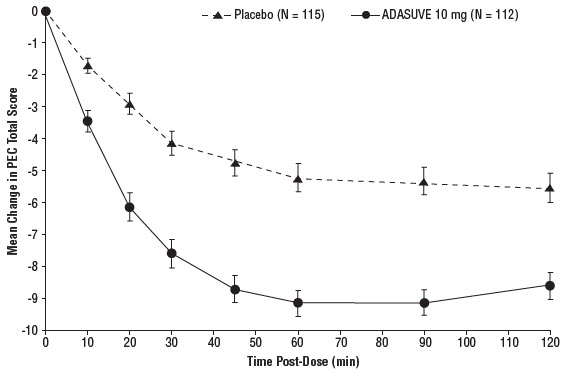
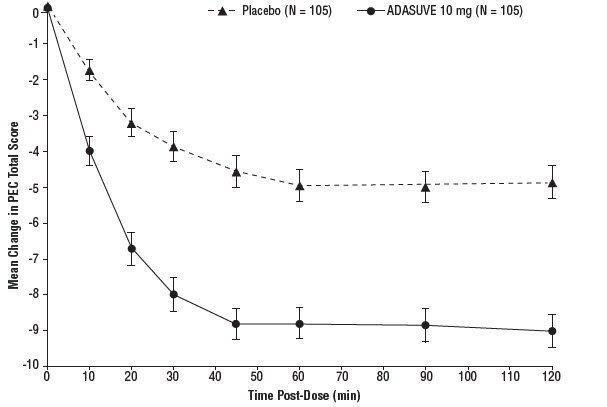
Commonly Observed Adverse Reactions: In the 3 trials in acute agitation, the most common adverse reactions were dysgeusia, sedation, and throat irritation. These reactions occurred at a rate of at least 2% of the ADASUVE group and at a rate greater than in the placebo group. (Refer to Table 1).
| Adverse Reaction | Placebo
(n = 263) | ADASUVE
(n = 259) |
|---|---|---|
| Dysgeusia | 5% | 14% |
| Sedation | 10% | 12% |
| Throat Irritation | 0% | 3% |
Airway Adverse Reactions in the 3 Trials in Acute Agitation
Agitated patients with Schizophrenia or Bipolar Disorder: In the 3 short-term (24-hour), placebo-controlled trials in patients with agitation associated with schizophrenia or bipolar disorder (Studies 1, 2, and 3), bronchospasm (which includes reports of wheezing, shortness of breath and cough) occurred more frequently in the ADASUVE group, compared to the placebo group: 0% (0/263) in the placebo group and 0.8% (2/259) in the ADASUVE 10 mg group. One patient with schizophrenia, without a history of pulmonary disease, had significant bronchospasm requiring rescue treatment with a bronchodilator and oxygen.
Bronchospasm and Airway Adverse Reactions in Pulmonary Safety Trials
Clinical pulmonary safety trials demonstrated that ADASUVE can cause bronchospasm as measured by FEV1, and as indicated by respiratory signs and symptoms in the trials. In addition, the trials demonstrated that patients with asthma or other pulmonary diseases, such as COPD are at increased risk of bronchospasm. The effect of ADASUVE on pulmonary function was evaluated in 3 randomized, double-blind, placebo-controlled clinical pulmonary safety trials in healthy volunteers, patients with asthma, and patients with COPD. Pulmonary function was assessed by serial FEV1 tests, and respiratory signs and symptoms were assessed. In the asthma and COPD trials, patients with respiratory symptoms or FEV1 decrease of ≥ 20% were administered rescue treatment with albuterol (metered dose inhaler or nebulizer) as required. These patients were not eligible for a second dose; however, they had continued FEV1 monitoring in the trial.
Healthy Volunteers: In the healthy volunteer crossover trial, 30 subjects received 2 doses of either ADASUVE or placebo 8 hours apart, and 2 doses of the alternate treatment at least 4 days later. The results for maximum decrease in FEV1 are presented in Table 2. No subjects in this trial developed airway related adverse reactions (cough, wheezing, chest tightness, or dyspnea).
Asthma Patients: In the asthma trial, 52 patients with mild-moderate persistent asthma (with FEV1 ≥ 60% of predicted) were randomized to treatment with 2 doses of ADASUVE 10 mg or placebo. The second dose was to be administered 10 hours after the first dose. Approximately 67% of these patients had a baseline FEV1 ≥ 80% of predicted. The remaining patients had an FEV1 60-80% of predicted. Nine patients (17%) were former smokers. As shown in Table 2 and Figure 7, there was a marked decrease in FEV1 immediately following the first dose (maximum mean decreases in FEV1 and % predicted FEV1 were 303 mL and 9.1%, respectively). Furthermore, the effect on FEV1 was greater following the second dose (maximum mean decreases in FEV1 and % predicted FEV1 were 537 mL and 14.7%, respectively). Respiratory-related adverse reactions (bronchospasm, chest discomfort, cough, dyspnea, throat tightness, and wheezing) occurred in 54% of ADASUVE-treated patients and 12% of placebo-treated patients. There were no serious adverse events. Nine of 26 (35%) patients in the ADASUVE group, compared to one of 26 (4%) in the placebo group, did not receive a second dose of study medication, because they had a ≥ 20% decrease in FEV1 or they developed respiratory symptoms after the first dose. Rescue medication (albuterol via metered dose inhaler or nebulizer) was administered to 54% of patients in the ADASUVE group [7 patients (27%) after the first dose and 7 of the remaining 17 patients (41%) after the second dose] and 12% in the placebo group (1 patient after the first dose and 2 patients after the second dose).
COPD Patients: In the COPD trial, 53 patients with mild to severe COPD (with FEV1 ≥ 40% of predicted) were randomized to treatment with 2 doses of ADASUVE 10 mg or placebo. The second dose was to be administered 10 hours after the first dose. Approximately 57% of these patients had moderate COPD [Global Initiative for Chronic Obstructive Lung Disease (GOLD) Stage II]; 32% had severe disease (GOLD Stage III); and 11% had mild disease (GOLD Stage I). As illustrated in Table 2 there was a decrease in FEV1 soon after the first dose (maximum mean decreases in FEV1 and % predicted FEV1 were 96 mL and 3.5%, respectively), and the effect on FEV1 was greater following the second dose (maximum mean decreases in FEV1 and % predicted FEV1 were 125 mL and 4.5%, respectively). Respiratory adverse reactions occurred more frequently in the ADASUVE group (19%) than in the placebo group (11%). There were no serious adverse events. Seven of 25 (28%) patients in the ADASUVE group and 1 of 27 (4%) in the placebo group did not receive a second dose of study medication because of a ≥ 20% decrease in FEV1 or the development of respiratory symptoms after the first dose. Rescue medication (albuterol via MDI or nebulizer) was administered to 23% of patients in the ADASUVE group: 8% of patients after the first dose and 21% of patients after the second dose, and to 15% of patients in the placebo group.
| Healthy Volunteer | Asthma | COPD | |||||
|---|---|---|---|---|---|---|---|
| Maximum % FEV ↓ | Placebo
n (%) | ADASUVE
10 mg n (%) | Placebo
n (%) | ADASUVE
10 mg n (%) | Placebo
n (%) | ADASUVE
10 mg n (%) | |
| After any Dose | N=26 | N=26 | N=26 | N=26 | N=27 | N=25 | |
| ≥10 | 7 (27) | 7 (27) | 3 (12) | 22 (85) | 18 (67) | 20 (80) | |
| ≥15 | 1 (4) | 5 (19) | 1 (4) | 16 (62) | 9 (33) | 14 (56) | |
| ≥20 | 0 | 1 (4) | 1 (4) | 11 (42) | 3 (11) | 10 (40) | |
| After Dose 1 | N=26 | N=26 | N=26 | N=26 | N=27 | N=25 | |
| ≥10 | 4 (15) | 5 (19) | 2 (8) | 16 (62) | 8 (30) | 16 (64) | |
| ≥15 | 1 (4) | 2 (8) | 1 (4) | 8 (31) | 4 (15) | 10 (40) | |
| ≥20 | 0 | 0 | 1 (4) | 6 (23) | 2 (7) | 9 (36) | |
| After Dose 2 | N=26 | N=25 | N=25 | N=17 | N=26 | N=19 | |
| ≥10 | 5 (19) | 6 (24) | 3 (12) | 12 (71) | 15 (58) | 12 (63) | |
| ≥15 | 0 | 5 (20) | 1 (4) | 9 (53) | 6 (23) | 10 (53) | |
| ≥20 | 0 | 1 (4) | 1 (4) | 5 (30) | 1 (4) | 5 (26) | |
FEV1 categories are cumulative; i.e. a subject with a maximum decrease of 21% is included in all 3 categories. Patients with a ≥ 20% decrease in FEV1 did not receive a second dose of study drug.
Figure 7: LS Mean Change from Baseline in FEV1 in Patients with Asthma
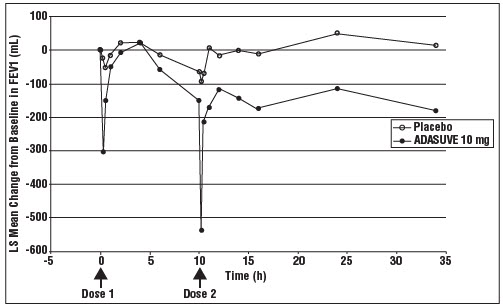
Figure 7 (Adasuve 07)
Patients with a ≥ 20% decrease in FEV1 did not receive a second dose of study drug and are not included in the curves beyond hour 10.
Extrapyramidal Symptoms (EPS): Extrapyramidal reactions have occurred during the administration of oral loxapine. In most patients, these reactions involved parkinsonian symptoms such as tremor, rigidity, and masked facies. Akathisia (motor restlessness) has also occurred.
In the 3 short-term (24-hour), placebo-controlled trials of ADASUVE in 259 patients with agitation associated with schizophrenia or bipolar disorder, extrapyramidal reactions occurred. One patient (0.4%) treated with ADASUVE developed neck dystonia and oculogyration. The incidence of akathisia was 0% and 0.4% in the placebo and ADASUVE groups, respectively.
Dystonia (Antipsychotic Class Effect): Symptoms of dystonia, prolonged abnormal contractions of muscle groups, may occur in susceptible individuals during treatment with ADASUVE. Dystonic symptoms include spasm of the neck muscles, sometimes progressing to tightness of the throat, difficulty swallowing or breathing, and/or protrusion of the tongue.
Acute dystonia tends to be dose-related, but can occur at low doses, and occurs more frequently with first generation antipsychotic drugs such as ADASUVE. The risk is greater in males and younger age groups.
Cardiovascular Reactions: Tachycardia, hypotension, hypertension, orthostatic hypotension, lightheadedness, and syncope have been reported with oral administration of loxapine.
Pregnancy Exposure Registry
There is a pregnancy exposure registry that monitors pregnancy outcomes in women exposed to atypical antipsychotics during pregnancy. Healthcare providers are encouraged to register patients by contacting the National Pregnancy Registry for Atypical Antipsychotics at 1-866-961-2388 or online at http://womensmentalhealth.org/clinical-and-research-programs/pregnancyregistry/.
Risk Summary
Neonates exposed to antipsychotic drugs, including ADASUVE, during the third trimester are at risk for extrapyramidal and/or withdrawal symptoms following delivery (see Clinical Considerations). The available data from published case reports and pharmacovigilance cases with loxapine, the active ingredient in ADASUVE, in pregnant women are insufficient to determine a drug-associated risk for major birth defects, miscarriage or adverse maternal or fetal outcomes. There are risks to the mother associated with untreated schizophrenia or bipolar I disorder, and with exposure to antipsychotics, including ADASUVE, during pregnancy (see Clinical Considerations) .
In animal reproduction studies, increased embryofetal toxicity and death in rat fetuses and offspring were observed when pregnant rats were orally administered loxapine, during the period of organogenesis, at doses approximately less than or equal to the maximum recommended human dose (MRHD) based on mg/m 2 body surface area (see Data) .
The estimated background risk of major birth defects and miscarriage for the indicated population is unknown. All pregnancies have a background risk of birth defect, loss, or other adverse outcomes. In the U.S. general population, the estimated background risk of major birth defects and miscarriage in clinically recognized pregnancies is 2 to 4% and 15 to 20%, respectively.
Clinical Considerations
Fetal/Neonatal Adverse Reactions
Extrapyramidal and/or withdrawal symptoms, including agitation, hypertonia, hypotonia, tremor, somnolence, respiratory distress, and feeding disorder have been reported in neonates who were exposed to antipsychotic drugs, including ADASUVE, during the third trimester of pregnancy. These symptoms have varied in severity. Monitor neonates for extrapyramidal and/or withdrawal symptoms and manage symptoms appropriately. Some neonates recovered within hours or days without specific treatment; others required prolonged hospitalization.
Data
Animal Data
Pregnant rats were administered oral doses of 1, 4, and 12 mg/kg/day loxapine (~1, 4, and 12 times the MRHD of 10 mg/day based on mg/m 2 body surface area, respectively) during the period of organogenesis. Embryofetal toxicity (increased fetal resorptions, reduced weights, and hydronephrosis with hydroureter) was observed at doses equal to the MRHD and higher based on mg/m 2 body surface area.
Pregnant rabbits were administered oral doses of 20 and 60 mg/kg/day loxapine (~40 and 120 times the MRHD based on mg/m 2 body surface area) during the period of organogenesis. Loxapine did not cause adverse developmental effects in rabbits at doses up to 120 times the MRHD based on mg/m 2 body surface area.
Pregnant rats were administered oral doses of 0.21, 0.62, and 1.86 mg/kg/day loxapine (~0.2, 0.6, and 1.8 times the MRHD based on mg/m 2 body surface area) during the period of organogenesis and through lactation. Fetal toxicity (increased prenatal death, decreased postnatal survival, reduced fetal weights, delayed ossification, and/or distended renal pelvis with reduced or absent papillae) was observed at doses of 0.6 times the MRHD and higher based on mg/m 2 body surface area.
Risk Summary
There is no available information on the presence of loxapine in human milk, the effects of loxapine on the breastfed infant, or the effects of loxapine on milk production. Loxapine is present in the milk of lactating dogs. When a drug is present in animal milk, it is likely that the drug will be present in human milk. The developmental and health benefits of breastfeeding should be considered along with the mother's clinical need for ADASUVE and any potential adverse effects on the breastfed child from ADASUVE or from the underlying maternal condition.
Signs and Symptoms of Overdosage
As would be expected from the pharmacologic actions of loxapine, the clinical findings may include CNS depression, unconsciousness, profound hypotension, respiratory depression, extrapyramidal symptoms, and seizure.
Management of Overdosage
For the most up to date information on the management of ADASUVE overdosage, contact a certified poison control center (1-800-222-1222 or www.poison.org). Provide supportive care including close medical supervision and monitoring. Treatment should consist of general measures employed in the management of overdosage with any drug. Consider the possibility of multiple drug overdosage. Ensure an adequate airway, oxygenation, and ventilation. Monitor cardiac rhythm and vital signs. Use supportive and symptomatic measures.
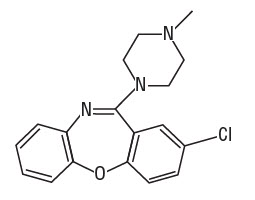
Active Ingredient: Loxapine (base). Loxapine, a dibenzoxazepine compound, represents a subclass of tricyclic antipsychotic agents, chemically distinct from the thioxanthenes, butyrophenones, and phenothiazines. Chemically, it is 2-Chloro-11-(4-methyl-1-piperazinyl) dibenz [b,f] [1,4] oxazepine.
Chemical Structure (Adasuve 08)
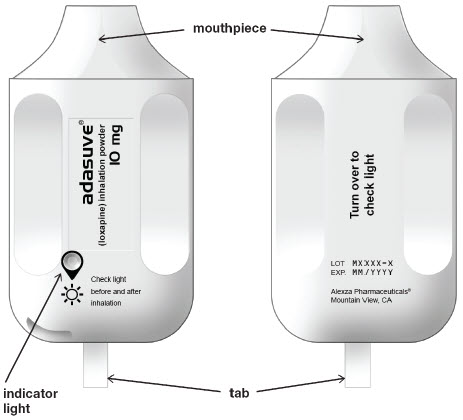
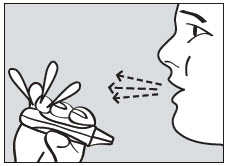
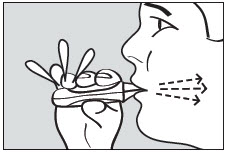
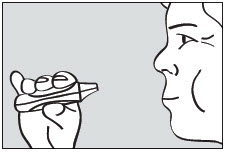
ADASUVE is a single-use, drug-device combination product that provides rapid systemic delivery by inhalation of a thermally-generated aerosol of loxapine. Oral inhalation through the product initiates the controlled rapid heating of a thin film of excipient-free loxapine to form a thermally-generated drug vapor. The vapor condenses into aerosol particles that are dispersed into the airstream created by the patient inhaling through the mouthpiece.
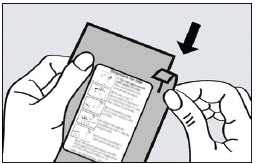
Each product is packaged inside a sealed foil pouch. The product is a white to off-white plastic unit, with a mouthpiece on one end and a pull-tab protruding from the other end.
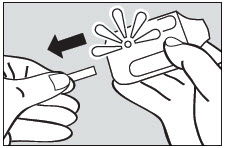
Removal of a pull-tab from the product renders it ready for use, as indicated by illumination of a green light. After inhalation through the mouthpiece, successful dosing is signaled by the green light turning off.
Under standardized in vitro test conditions, ADASUVE, 10 mg delivers 9.1 mg of loxapine out of the mouthpiece.
Thorough QTc Study
ADASUVE did not prolong the QTc interval. The effect of ADASUVE on QTc prolongation was evaluated in a randomized, double-blinded, positive- (moxifloxacin 400 mg) and placebo-controlled parallel study in healthy subjects. A total of 48 healthy subjects were administered ADASUVE 10 mg. In this study with a demonstrated ability to detect small effects, the upper bound of the 90% confidence interval (CI) for the largest placebo-adjusted, baseline-corrected QTc based on individual correction method was below 10 milliseconds, the threshold for regulatory concern.
Absorption: The single-dose pharmacokinetic parameters of loxapine following administration of single doses of ADASUVE 10 mg in healthy adult subjects are presented in Table 3 and Figure 8.
Administration of ADASUVE resulted in rapid absorption of loxapine, with a median time of maximum plasma concentration (T max) of 2 minutes. Loxapine exposure in the first 2 hours after administration (AUC 0-2h) was 66.7 ng∙h/mL for the 10 mg dose. As a consequence of the very rapid absorption of loxapine after oral inhalation, there is substantial variability in the early plasma concentrations of loxapine. The mean plasma loxapine concentrations following administration of ADASUVE were linear over the clinical dose range. AUC 0-2h, AUC inf, and C max increased in a dose-dependent manner.
| Parameter | Healthy Subjects |
|---|---|
| ADASUVE 10 mg (N=114) | |
| AUC 0-2h (ng∙h/mL), mean ± SD | 66.7 ± 18.2 |
| AUC inf (ng∙h/mL), mean ± SD | 188 ± 47 |
| C max (ng/mL), mean ± SD | 257 ± 219 |
| T max (minutes), median (25%, 75%) | 1.13 (1, 2) |
| Half-life(h), mean ± SD | 7.61 ± 1.87 |
Figure 8. Mean Plasma Concentrations of Loxapine following Single-Dose Administration ADASUVE 10 mg in Healthy Subjects
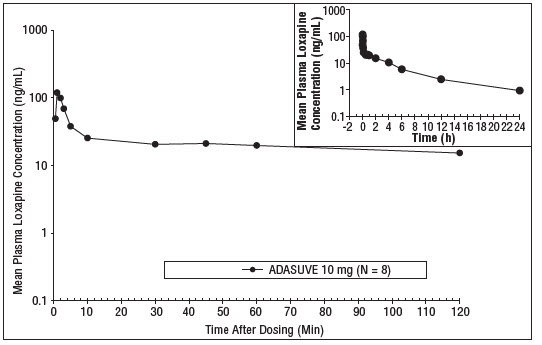
Figure 8 (Adasuve 09)
Distribution: Loxapine is removed rapidly from the plasma and distributed in tissues. Animal studies following oral administration suggest an initial preferential distribution in the lungs, brain, spleen, heart, and kidney. Loxapine is 96.6% bound to human plasma proteins.
Metabolism: Loxapine is metabolized extensively in the liver following oral administration, with multiple metabolites formed. The main metabolic pathways include: 1) hydroxylation to form 8-OH-loxapine by CYP1A2 and 7-OH-loxapine by CYP3A4 and CYP2D6, 2) N-oxidation to form loxapine N-oxide by flavanoid monoamine oxidases (FMOs), and 3) de-methylation to form amoxapine. Because there are multiple metabolic pathways, the risk of metabolic interactions caused by an effect on an individual isoform is minimal. For ADASUVE, the order of metabolites observed in humans (based on systemic exposure) was 8-OH-loxapine >> loxapine N-oxide, 7-OH-loxapine > amoxapine. Plasma levels of 8-OH-loxapine are similar to those of the parent compound.
Excretion: Excretion occurs mainly in the first 24 hours. Metabolites are excreted in the urine in the form of conjugates and in the feces unconjugated. The terminal elimination half-life (T½) ranged from 6 to 8 hours.
Transporter Interaction: In vitro studies indicated that loxapine was not a substrate for p-glycoprotein (P-gp): however, loxapine inhibited P-gp.
Special Populations:
Pharmacokinetics in Smokers: Loxapine exposures in nonsmokers and smokers are similar, with geometric mean ratios of 92%, 85%, and 99% for AUC 0-2h, AUC inf, and C max respectively. No dosage adjustment is recommended based on smoking status.
Demographic Effects: There were no clinically significant differences in loxapine pharmacokinetics following administration of ADASUVE in subgroups based on age, weight, body mass index, gender, or race.
Carcinogenesis: No studies have been conducted.
Mutagenesis: Loxapine was not mutagenic in the in vitro bacterial reverse mutation (Ames) test, nor clastogenic in the in vitro human peripheral blood lymphocyte chromosomal aberration assay or in the in vivo mouse bone marrow micronucleus assay.
The loxapine metabolite, 8-OH-loxapine, was not mutagenic in the in vitro bacterial reverse mutation (Ames), test nor clastogenic in the in vitro human peripheral blood lymphocyte chromosomal aberration assay.
Impairment of Fertility: Loxapine was administered orally in diet to female rats from 14 days prior to mating through day 20 of gestation at doses of 0.19 and 1.28 mg/kg (~0.2 and 1 times the MRHD of 10 mg/day based on mg/m 2 body surface area, respectively). In female rats, mating was decreased at both doses and no mating occurred at a dose equal to the MRHD based on mg/m 2 body surface area because these animals were in persistent diestrus. Loxapine was administered orally in diet to male rats from 60 days prior to and through mating at doses of 0.197 and 1.69 mg/kg (~0.2 and 1.6 times the MRHD based on mg/m 2 body surface area, respectively). In male rats, no effects on fertility were noted at any dose up to 1.6 times the MRHD based on mg/m 2 body surface area. Loxapine was administered orally in diet to female rabbits for 60 days prior to and through mating at doses of 0.23 and 0.77 mg/kg (~0.4 and 1.5 times the MRHD based on mg/m 2 body surface area, respectively). In female rabbits, no effects on fertility were noted at any dose up to 1.5 times the MRHD based on mg/m 2 body surface area.
Bronchospasm
Advise patients and caregivers that there is a risk of bronchospasm. Advise patients to inform their healthcare professional if they develop any breathing problems such as wheezing, shortness of breath, chest tightness, or cough following treatment with ADASUVE [see Boxed Warning and Warnings and Precautions (5.1)] .
Interference with Cognitive and Motor Performance
Caution patients and caregivers about performing activities requiring mental alertness, such as operating hazardous machinery or operating a motor vehicle, until they are reasonably certain that ADASUVE has not affected them adversely [see Warnings and Precautions (5.8)] .
Caution patients and caregivers about the potential for sedation, especially when used concurrently with other CNS depressants (e.g., alcohol, opioid analgesics, benzodiazepines, tricyclic antidepressants, general anesthetics, phenothiazines, sedative/hypnotics, muscle relaxants, and/or illicit CNS depressants).
Neuroleptic Malignant Syndrome
Patients and caregivers should be counseled that a potentially fatal symptom complex sometimes referred to as NMS has been reported in association with administration of antipsychotic drugs. Signs and symptoms of NMS include hyperpyrexia, muscle rigidity, altered mental status, and evidence of autonomic instability (irregular pulse or blood pressure, tachycardia, diaphoresis, and cardiac dysrhythmia) [see Warnings and Precautions (5.4)] .
Hypotension and Syncope
Advise patients and caregivers of the risk of hypotension or orthostatic hypotension (symptoms include feeling dizzy or lightheaded upon standing) [see Warnings and Precautions (5.5)] .
Anticholinergic Reactions
Counsel patients and caregivers about the potential risks of anticholinergic reactions, such as exacerbation of glaucoma and urinary retention [see Warnings and Precautions (5.10)] .
Pregnancy
Advise pregnant women to notify their healthcare provider if they become pregnant or intend to become pregnant during treatment with ADASUVE. Advise patients that ADASUVE may cause extrapyramidal and/or withdrawal symptoms (agitation, hypertonia, hypotonia, tremor, somnolence, respiratory distress, and feeding disorder) in a neonate. Advise patients that there is a pregnancy exposure registry that monitors pregnancy outcomes in women exposed to ADASUVE during pregnancy [see Use in Specific Populations (8.1)] .
Manufactured by: Alexza Pharmaceuticals, Inc., Mountain View, CA 94043