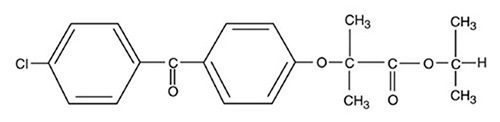
Plasma concentrations of fenofibric acid after administration of three 48 mg or one 145 mg tablets are equivalent under fed conditions to one 200 mg micronized fenofibrate capsule.
Fenofibrate is a pro-drug of the active chemical moiety fenofibric acid. Fenofibrate is converted by ester hydrolysis in the body to fenofibric acid which is the active constituent measurable in the circulation.
Absorption
The absolute bioavailability of fenofibrate cannot be determined as the compound is virtually insoluble in aqueous media suitable for injection. However, fenofibrate is well absorbed from the gastrointestinal tract. Following oral administration in healthy volunteers, approximately 60% of a single dose of radiolabelled fenofibrate appeared in urine, primarily as fenofibric acid and its glucuronate conjugate, and 25% was excreted in the feces. Peak plasma levels of fenofibric acid occur within 6 to 8 hours after administration.
Exposure to fenofibric acid in plasma, as measured by C
maxand AUC, is not significantly different when a single 145 mg dose of fenofibrate is administered under fasting or nonfasting conditions.
Distribution
Upon multiple dosing of fenofibrate, fenofibric acid steady state is achieved within 9 days. Plasma concentrations of fenofibric acid at steady state are approximately double of those following a single dose. Serum protein binding was approximately 99% in normal and hyperlipidemic subjects.
Metabolism
Following oral administration, fenofibrate is rapidly hydrolyzed by esterases to the active metabolite, fenofibric acid; no unchanged fenofibrate is detected in plasma.
Fenofibric acid is primarily conjugated with glucuronic acid and then excreted in urine. A small amount of fenofibric acid is reduced at the carbonyl moiety to a benzhydrol metabolite which is, in turn, conjugated with glucuronic acid and excreted in urine.
In vivometabolism data indicate that neither fenofibrate nor fenofibric acid undergo oxidative metabolism (e.g., cytochrome P450) to a significant extent.
Elimination
After absorption, fenofibrate is mainly excreted in the urine in the form of metabolites, primarily fenofibric acid and fenofibric acid glucuronide. After administration of radiolabelled fenofibrate, approximately 60% of the dose appeared in the urine and 25% was excreted in the feces.
Fenofibric acid is eliminated with a half-life of 20 hours, allowing once daily dosing.
Special Populations
Geriatrics
In elderly volunteers 77 to 87 years of age, the oral clearance of fenofibric acid following a single oral dose of fenofibrate was 1.2 L/h, which compares to 1.1 L/h in young adults. This indicates that a similar dosage regimen can be used in elderly with normal renal function, without increasing accumulation of the drug or metabolites
[see
Dosage and Administration (2.5)and
Use in Specific Populations (8.5)]
.
Pediatrics
The pharmacokinetics of fenofibrate has not been studied in pediatric populations.
Gender
No pharmacokinetic difference between males and females has been observed for fenofibrate.
Race
The influence of race on the pharmacokinetics of fenofibrate has not been studied, however fenofibrate is not metabolized by enzymes known for exhibiting inter-ethnic variability.
Renal Impairment
The pharmacokinetics of fenofibric acid was examined in patients with mild, moderate, and severe renal impairment. Patients with severe renal impairment (estimated glomerular filtration rate [eGFR] < 30 mL/min/1.73m
2) showed 2.7-fold increase in exposure for fenofibric acid and increased accumulation of fenofibric acid during chronic dosing compared to that of healthy subjects. Patients with mild to moderate renal impairment (eGFR 30-59 mL/min/1.73m
2) had similar exposure but an increase in the half-life for fenofibric acid compared to that of healthy subjects. Based on these findings, the use of fenofibrate should be avoided in patients who have severe renal impairment and dose reduction is required in patients having mild to moderate renal impairment
[see
Dosage and Administration (2.4)]
.
Hepatic Impairment
No pharmacokinetic studies have been conducted in patients with hepatic impairment.
Drug-drug Interactions
In vitrostudies using human liver microsomes indicate that fenofibrate and fenofibric acid are not inhibitors of cytochrome (CYP) P450 isoforms CYP3A4, CYP2D6, CYP2E1, or CYP1A2. They are weak inhibitors of CYP2C8, CYP2C19 and CYP2A6, and mild-to-moderate inhibitors of CYP2C9 at therapeutic concentrations.
Table 2 describes the effects of co-administered drugs on fenofibric acid systemic exposure.
Table 3 describes the effects of co-administered fenofibrate or fenofibric acid on other drugs.
Table 2. Effects of Co-Administered Drugs on Fenofibric Acid Systemic Exposure from Fenofibrate Administration| Co-Administered Drug | Dosage Regimen of Co-Administered Drug | Dosage Regimen of Fenofibrate | Changes in Fenofibric Acid Exposure |
| AUC | C
max |
| Lipid-lowering agents |
| Atorvastatin | 20 mg once daily for 10 days | Fenofibrate 160 mg
1once daily for 10 days
| ↓2% | ↓4% |
| Pravastatin | 40 mg as a single dose | Fenofibrate 3 x 67 mg
2as a single dose
| ↓1% | ↓2% |
| Fluvastatin | 40 mg as a single dose | Fenofibrate 160 mg
1as a single dose
| ↓2% | ↓10% |
| Anti-diabetic agents |
| Glimepiride | 1 mg as a single dose | Fenofibrate 145 mg
1once daily for 10 days
| ↑1% | ↓1% |
| Metformin | 850 mg three times daily for 10 days | Fenofibrate 54 mg
1three times daily for 10 days
| ↓9% | ↓6% |
| Rosiglitazone | 8 mg once daily for 5 days | Fenofibrate 145 mg
1once daily for 14 days
| ↑10% | ↑3% |
1Fenofibrate oral tablet
2Fenofibrate oral micronized capsule
|
Table 3. Effects of Fenofibrate Co-Administration on Systemic Exposure of Other Drugs| Dosage Regimen of Fenofibrate | Dosage Regimen of Co- Administered Drug | Change in Co-Administered Drug Exposure |
| Analyte | AUC | C
max |
| Lipid-lowering agents |
Fenofibrate 160 mg
1once
daily for 10 days
| Atorvastatin, 20 mg once daily for 10 days | Atorvastatin | ↓17% | 0% |
| Fenofibrate 3 x 67 mg
2as a single dose
| Pravastatin, 40 mg as a single dose | Pravastatin | ↑13% | ↑13% |
| 3α-Hydroxyl-iso-pravastatin | ↑26% | ↑29% |
| Fenofibrate 160 mg
1as a single dose
| Fluvastatin, 40 mg as a single dose | (+)-3R, 5S-Fluvastatin | ↑15% | ↑16% |
| Anti-diabetic agents |
| Fenofibrate 145 mg
1once daily for 10 days
| Glimepiride, 1 mg as a single dose | Glimepiride | ↑35% | ↑18% |
| Fenofibrate 54 mg
1three times daily for 10 days
| Metformin, 850 mg three times daily for 10 days | Metformin | ↑3% | ↑6% |
| Fenofibrate 145 mg
1once daily for 14 days
| Rosiglitazone, 8 mg once daily for 5 days | Rosiglitazone | ↑6% | ↓1% |
1Fenofibrate oral tablet
2Fenofibrate oral micronized capsule
|