Ambrisentan Tablet, Film Coated
Product Images NDC 51407-595

View Photos of Packaging, Regulatory Labels, and Product Appearance

Product Visual Gallery

This gallery contains 7 technical images submitted to the FDA as part of the official labeling for Ambrisentan (NDC 51407-595). Unlike standard consumer photos, these assets often include clinical data figures, molecular chemical structures, and official manufacturer packaging layouts.

As provided by Golden State Medical Supply, Inc., these visuals offer a comprehensive scientific overview of the product's physical and chemical identity, aiding pharmacists and researchers in product verification and study.

FDA Label Image

Mock (51407-594-30LB)
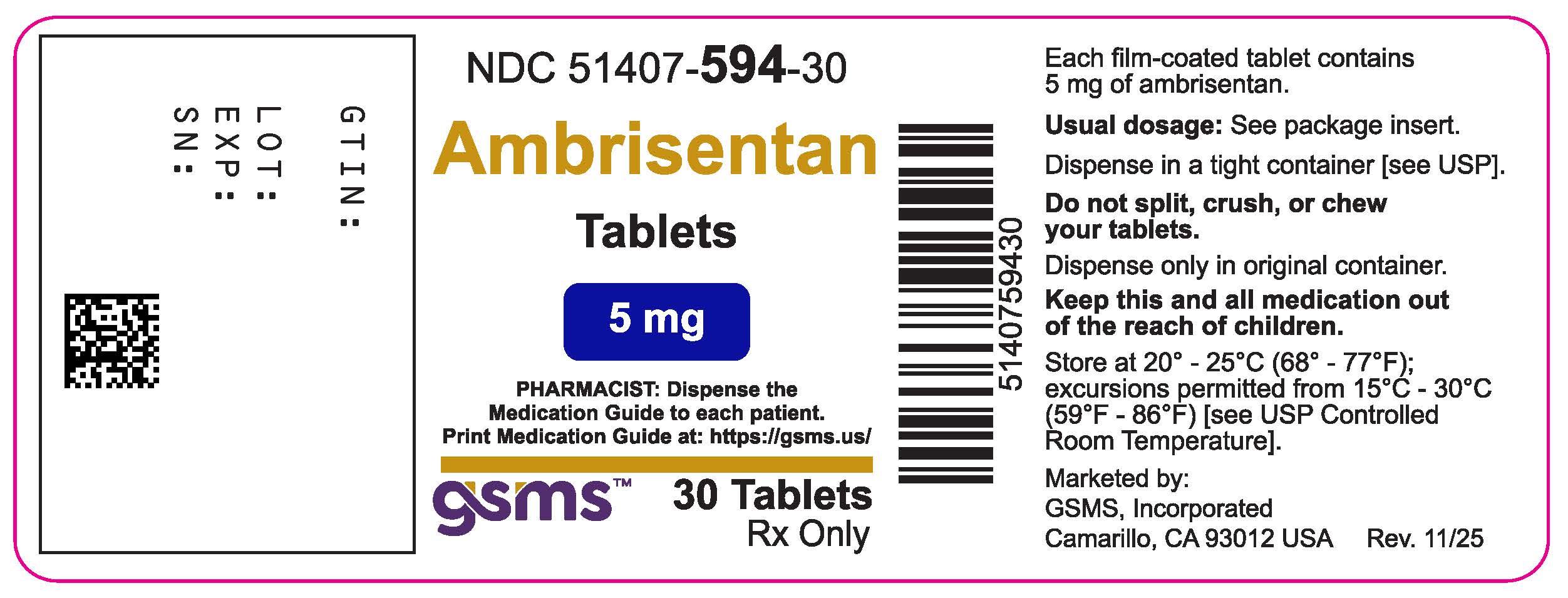
Mock (51407-594-30LB)
Label for Ambrisentan 5 mg film-coated tablets, oral use, containing 30 tablets per bottle. The label includes the NDC 51407-594-30 and states the medication is Rx only, marketed by GSMS, Incorporated. It features storage instructions, precautions not to split, crush, or chew tablets, and a website for the medication guide.*
FDA Label Image

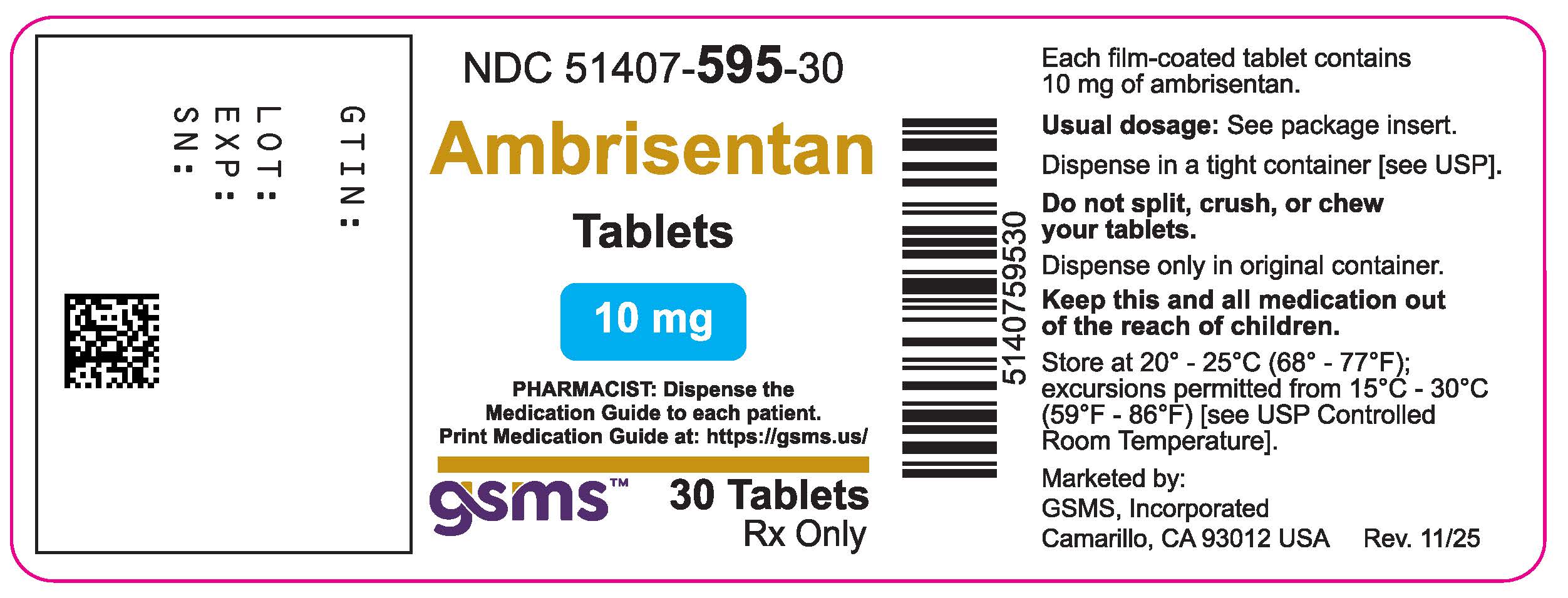
Mock (51407-595-30LB)

Mock (51407-595-30LB)
Label for Ambrisentan 10 mg film-coated tablets by Golden State Medical Supply, Inc. The label shows the NDC number 51407-595-30 and indicates a package size of 30 tablets for prescription use. It includes pharmacist dispensing instructions and storage conditions, with contact and marketing information for GSMS, Incorporated in Camarillo, CA.*
FDA Label Image

Figure-2 (Figure 2)

Figure-2 (Figure 2)
A scatter plot figure showing fold change and 90% confidence intervals in pharmacokinetic parameters (Cmax and AUC) for various interacting drugs relative to ambrisentan alone. Drugs listed include Cyclosporine, Mycophenolate Mofetil, Ketoconazole, Omeprazole, Rifampin, Ritonavir, Sildenafil, Tacrolimus, Tadalafil, and Warfarin, with their respective changes plotted along a horizontal axis labeled 'Change relative to ambrisentan alone.'*
FDA Label Image

Figure-3 (Figure 3)

Figure-3 (Figure 3)
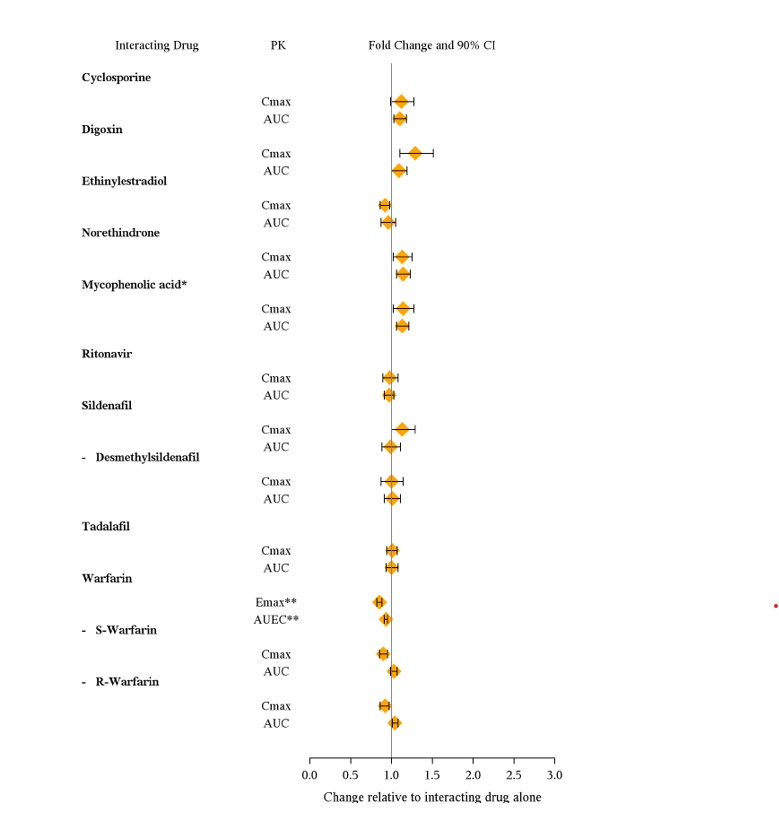
A forest plot chart showing fold changes and 90% confidence intervals in pharmacokinetic parameters (Cmax, AUC, Emax, AUEC) for various drugs interacting with a reference drug. The x-axis represents the change relative to the interacting drug alone, with values centered around 1. Drugs listed include Cyclosporine, Digoxin, Ethinylestradiol, Norethindrone, Mycophenolic acid, Ritonavir, Sildenafil, Desmethylsildenafil, Tadalafil, and Warfarin including its isomers S-Warfarin and R-Warfarin.*
FDA Label Image

Figure-4 (Figure 4)

Figure-4 (Figure 4)
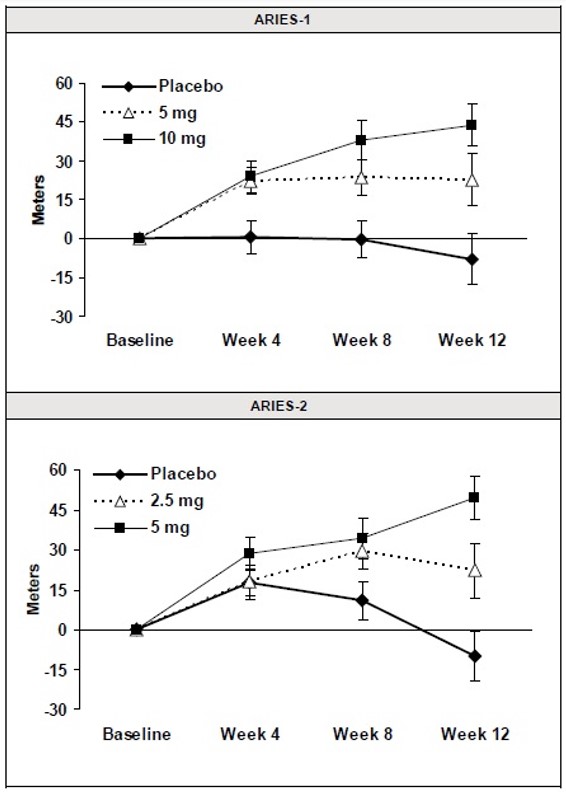
Two line graphs labeled ARIES-1 and ARIES-2 display changes in meters over time from Baseline to Week 12. Each graph compares Placebo with varying doses of Ambrisentan (5 mg and 10 mg in ARIES-1; 2.5 mg and 5 mg in ARIES-2), showing mean values with error bars. The vertical axis measures distance in meters, and the horizontal axis tracks time points Baseline, Week 4, Week 8, and Week 12.*
FDA Label Image

Figure-5 (Figure 5)

Figure-5 (Figure 5)
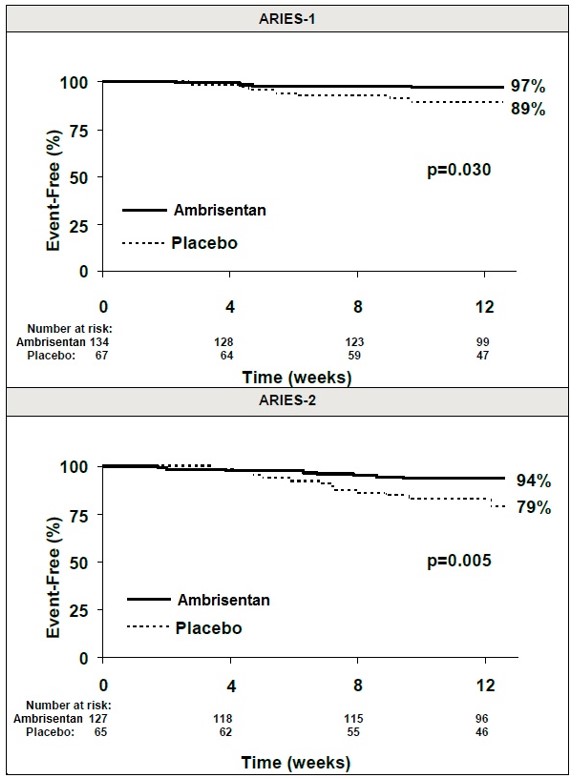
These are two Kaplan-Meier survival curves labeled ARIES-1 and ARIES-2 showing event-free percentages over 12 weeks for Ambrisentan versus placebo. Both graphs show higher event-free percentages for Ambrisentan (97% and 94%) compared to placebo (89% and 79%) with p-values of 0.030 and 0.005 respectively. Numbers at risk for each group across time points are included below each graph.*
FDA Label Image

Structure (Structure)

Structure (Structure)
Chemical structure diagram of the active ingredient ambrisentan, showing its molecular composition including aromatic rings, methyl, methoxy, and carboxylic acid functional groups.*

* About these descriptions: Image descriptions on this page are generated by automated AI analysis of the product label images from the manufacturer's FDA label submission (SPL). They are provided for reference only and may contain errors or omissions. Always rely on the printed label itself and the official FDA labeling, and consult a pharmacist or healthcare professional with any questions about this product.