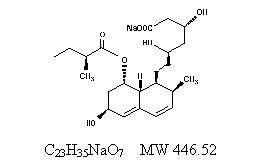
General
Absorption
Pravastatin sodium is administered orally in the active form. In studies in man, peak plasma pravastatin concentrations occurred 1 to 1.5 hours upon oral administration. Based on urinary recovery of total radiolabeled drug, the average oral absorption of pravastatin is 34% and absolute bioavailability is 17%. While the presence of food in the gastrointestinal tract reduces systemic bioavailability, the lipid-lowering effects of the drug are similar whether taken with or 1 hour prior to meals.
Pravastatin plasma concentrations, including area under the concentration-time curve (AUC), C
max, and steady-state minimum (C
min), are directly proportional to administered dose. Systemic bioavailability of pravastatin administered following a bedtime dose was decreased 60% compared to that following an AM dose. Despite this decrease in systemic bioavailability, the efficacy of pravastatin administered once daily in the evening, although not statistically significant, was marginally more effective than that after a morning dose.
The coefficient of variation (CV), based on between-subject variability, was 50% to 60% for AUC. The geometric means of pravastatin C
max and AUC following a 20 mg dose in the fasted state were 26.5 ng/mL and 59.8 ng*hr/mL, respectively.
Steady-state AUCs, C
max, and C
min plasma concentrations showed no evidence of pravastatin accumulation following once or twice daily administration of pravastatin sodium tablets.
Distribution
Approximately 50% of the circulating drug is bound to plasma proteins.
Metabolism
The major biotransformation pathways for pravastatin are: (a) isomerization to 6-epi pravastatin and the 3α-hydroxyisomer of pravastatin (SQ 31,906) and (b) enzymatic ring hydroxylation to SQ 31,945. The 3α-hydroxyisomeric metabolite (SQ 31,906) has 1/10 to 1/40 the HMG-CoA reductase inhibitory activity of the parent compound. Pravastatin undergoes extensive first-pass extraction in the liver (extraction ratio 0.66).
Excretion
Approximately 20% of a radiolabeled oral dose is excreted in urine and 70% in the feces. After intravenous administration of radiolabeled pravastatin to normal volunteers, approximately 47% of total body clearance was via renal excretion and 53% by non-renal routes (i.e., biliary excretion and biotransformation).
Following single dose oral administration of
14C-pravastatin, the radioactive elimination t
½ for pravastatin is 1.8 hours in humans.
Specific Populations
Renal Impairment
A single 20 mg oral dose of pravastatin was administered to 24 patients with varying degrees of renal impairment (as determined by creatinine clearance). No effect was observed on the pharmacokinetics of pravastatin or its 3α-hydroxy isomeric metabolite (SQ 31,906). Compared to healthy subjects with normal renal function, patients with severe renal impairment had 69% and 37% higher mean AUC and C
max values, respectively, and a 0.61 hour shorter t½ for the inactive enzymatic ring hydroxylation metabolite (SQ 31,945).
Hepatic Impairment
In a study comparing the kinetics of pravastatin in patients with biopsy confirmed cirrhosis (N=7) and normal subjects (N=7), the mean AUC varied 18-fold in cirrhotic patients and 5-fold in healthy subjects. Similarly, the peak pravastatin values varied 47-fold for cirrhotic patients compared to 6-fold for healthy subjects [see
Warnings and Precautions
(5.3)].
Geriatric
In a single oral dose study using pravastatin 20 mg, the mean AUC for pravastatin was approximately 27% greater and the mean cumulative urinary excretion (CUE) approximately 19% lower in elderly men (65 to 75 years old) compared with younger men (19 to 31 years old). In a similar study conducted in women, the mean AUC for pravastatin was approximately 46% higher and the mean CUE approximately 18% lower in elderly women (65 to 78 years old) compared with younger women (18 to 38 years old). In both studies, C
max, T
max, and t
½ values were similar in older and younger subjects [see
Use in Specific Populations
(8.5)].
Pediatric
After 2 weeks of once-daily 20 mg oral pravastatin administration, the geometric means of AUC were 80.7 (CV 44%) and 44.8 (CV 89%) ng*hr/mL for children (8 to 11 years, N=14) and adolescents (12 to 16 years, N=10), respectively. The corresponding values for C
max were 42.4 (CV 54%) and 18.6 ng/mL (CV 100%) for children and adolescents, respectively. No conclusion can be made based on these findings due to the small number of samples and large variability [see
Use in Specific Populations
(8.4)].
Drug-Drug Interactions
Table 3: Effect of Coadministered Drugs on the Pharmacokinetics of Pravastatin
| Coadministered Drug and Dosing Regimen | Pravastatin |
| Dose (mg) | Change in AUC | Change in C
max |
| Cyclosporine 5 mg/kg single dose | 40 mg single dose | ↑282% | ↑327% |
| Clarithromycin 500 mg BID for 9 days | 40 mg OD for 8 days | ↑110% | ↑128% |
| Boceprevir 800 mg TID for 6 days | 40 mg single dose | ↑63% | ↑49% |
| Darunavir 600 mg BID/Ritonavir 100 mg BID for 7 days | 40 mg single dose | ↑81% | ↑63% |
| Colestipol 10 g single dose | 20 mg single dose | ↓47% | ↓53% |
Cholestyramine 4 g single dose
Administered simultaneously
Administered 1 hour prior to cholestyramine
Administered 4 hours after cholestyramine
| 20 mg single dose |
↓40%
↑12%
↓12%
|
↓39%
↑30%
↓6.8%
|
| Cholestyramine 24 g OD for 4 weeks | 20 mg BID for 8 weeks
5 mg BID for 8 weeks
10 mg BID for 8 weeks
| ↓51%
↓38%
↓18%
| ↑4.9%
↑23%
↓33%
|
Fluconazole
200 mg IV for 6 days
200 mg PO for 6 days
| 20 mg PO+10 mg IV
20 mg PO+10 mg IV
| ↓34%
↓16%
| ↓33%
↓16%
|
| Kaletra 400 mg/100 mg BID for 14 days | 20 mg OD for 4 days | ↑33% | ↑26% |
Verapamil IR 120 mg for 1 day and
Verapamil ER 480 mg for 3 days
| 40 mg single dose | ↑31% | ↑42% |
| Cimetidine 300 mg QID for 3 days | 20 mg single dose | ↑30% | ↑9.8% |
| Antacids 15 mL QID for 3 days | 20 mg single dose | ↓28% | ↓24% |
| Digoxin 0.2 mg OD for 9 days | 20 mg OD for 9 days | ↑23% | ↑26% |
| Probucol 500 mg single dose | 20 mg single dose | ↑14% | ↑24% |
| Warfarin 5 mg OD for 6 days | 20 mg BID for 6 days | ↓13% | ↑6.7% |
| Itraconazole 200 mg OD for 30 days | 40 mg OD for 30 days | ↑11% (compared to Day 1) | ↑17% (compared to Day 1) |
| Gemfibrozil 600 mg single dose | 20 mg single dose | ↓7.0% | ↓20% |
| Aspirin 324 mg single dose | 20 mg single dose | ↑4.7% | ↑8.9% |
| Niacin 1 g single dose | 20 mg single dose | ↓3.6% | ↓8.2% |
| Diltiazem | 20 mg single dose | ↑2.7% | ↑30% |
| Grapefruit juice | 40 mg single dose | ↓1.8% | ↑3.7% |
BID = twice daily; OD = once daily; QID = four times daily
Table 4: Effect of Pravastatin on the Pharmacokinetics of Coadministered Drugs
| Pravastatin Dosing Regimen | Name and Dose | Change in AUC | Change in C
max |
| 20 mg BID for 6 days | Warfarin 5 mg OD for 6 days
Change in mean prothrombin time
| ↑17%↑0.4 sec | ↑15% |
| 20 mg OD for 9 days | Digoxin 0.2 mg OD for 9 days | ↑4.6% | ↑5.3% |
20 mg BID for 4 weeks
10 mg BID for 4 weeks
5 mg BID for 4 weeks
| Antipyrine 1.2 g single dose | ↑3.0%↑1.6%↑Less than 1% | Not Reported |
| 20 mg OD for 4 days | Kaletra 400 mg/100 mg
BID for 14 days
| No change | No change |
BID = twice daily; OD = once daily