Highlights Of Prescribing Information
These highlights do not include all the information needed to use HEPARIN SODIUM IN 0.45% SODIUM CHLORIDE INJECTION safely and effectively. See full prescribing information for HEPARIN SODIUM IN 0.45% SODIUM CHLORIDE INJECTION.
HEPARIN SODIUM IN 0.45% SODIUM CHLORIDE INJECTION, for intravenous use
Initial U.S. Approval: 1939
INDICATIONS AND USAGE
Heparin sodium is indicated for: ( 1)
•
Prophylaxis and treatment of venous thromboembolism
•
Prophylaxis and treatment of the thromboembolic complications associated with atrial fibrillation
•
Treatment of acute and chronic consumption coagulopathies
•
Prevention of clotting in arterial and cardiac surgery
•
Prophylaxis and treatment of peripheral arterial embolism
•
Anticoagulant use in extracorporeal circulation and dialysis procedure
DOSAGE AND ADMINISTRATION
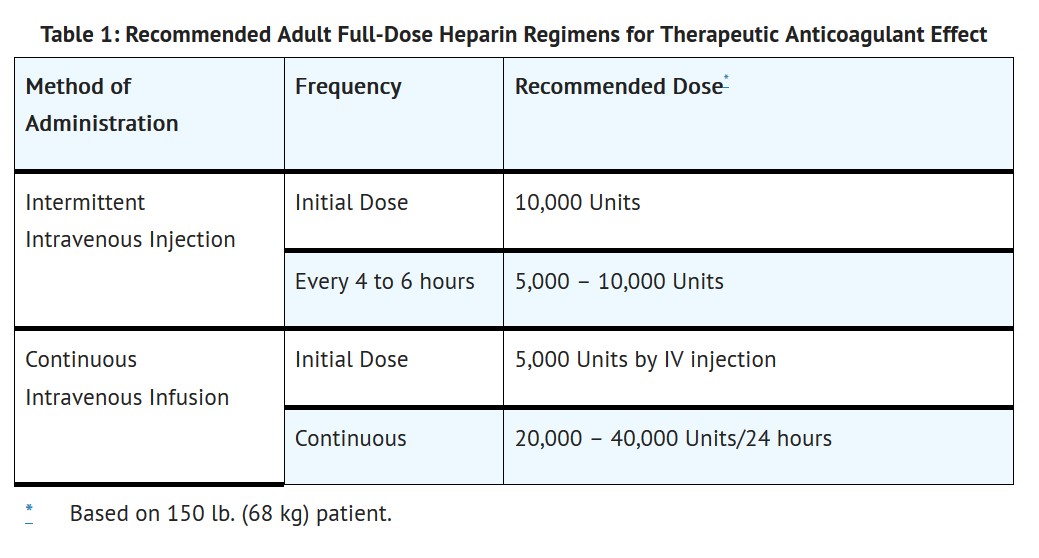
Recommended Adult Dosages:
•
Therapeutic Anticoagulant Effect with Full-Dose Heparin* (
2-2.3)
• Surgery of the Heart and Blood Vessels ( 2-2.5)
Extracorporeal Dialysis ( 2-2.8)
DOSAGE FORMS AND STRENGTHS
•
Heparin sodium is available as: (
3)
•
Injection: 100 USP Units/mL in 0.45% Sodium Chloride clear solution (25,000 USP Units/250 mL) in single-dose plastic container
•
Injection: 50 USP Units/mL in 0.45% Sodium Chloride clear solution (12,500 USP Units/250 mL) in single-dose plastic container
•
Injection: 50 USP Units/mL in 0.45% Sodium Chloride clear solution (25,000 USP Units/500 mL) in single-dose plastic container
CONTRAINDICATIONS
•
History of Heparin-induced Thrombocytopenia (HIT) (With or Without Thrombosis) (
4)
•
Known hypersensitivity to heparin or pork products (
4)
•
In whom suitable blood coagulation tests cannot be performed at appropriate intervals (
4)
WARNINGS AND PRECAUTIONS
•
Fatal Medication Errors: Confirm choice of correct strength prior to administration. (
5-5.1)
•
Hemorrhage: Fatal cases have occurred. Use caution in conditions with increased risk of hemorrhage.
5-(5.2)
•
HIT (With or Without Thrombosis): Monitor for signs and symptoms and discontinue if indicative of HIT (With or Without Thrombosis). (
5-5.3)
•
Monitoring: Blood coagulation tests guide therapy for full-dose heparin.
Monitor platelet count and hematocrit in all patients receiving heparin. (
5-5.5)
ADVERSE REACTIONS
Most common adverse reactions are hemorrhage, thrombocytopenia, HIT (With or Without Thrombosis), injection site irritation, general hypersensitivity reactions, and elevations of aminotransferase levels ( 6-6.1)
To report SUSPECTED ADVERSE REACTIONS, contact Hospira, Inc. at 1-800-441-4100, or FDA at 1-800-FDA-1088 or www.fda.gov/medwatch.
DRUG INTERACTIONS
•
Drugs that interfere with platelet aggregation: May induce bleeding. (
7-7.2)
See 17 for PATIENT COUNSELING INFORMATION.
Revised: 3/2016