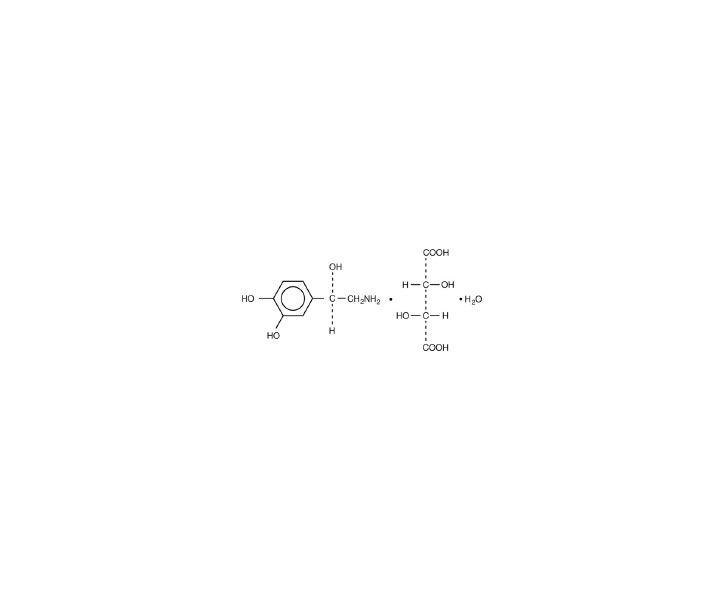
Highlights Of Prescribing Information
These highlights do not include all the information needed to use NOREPINEPHRINE BITARTRATE INJECTION, USP safely and effectively. See full prescribing information for NOREPINEPHRINE BITARTRATE INJECTION, USP.
NOREPINEPHRINE BITARTRATE INJECTION, USP for intravenous use Initial U.S. Approval: 1950
INDICATIONS AND USAGE
Norepinephrine Bitartrate Injection is a catecholamine indicated for restoration of blood pressure in adult patients with acute hypotensive states. ( 1)
DOSAGE AND ADMINISTRATION
Initial dose of 0.25 mL to 0.375 mL (from 8 mcg to 12 mcg of base) per minute, adjust the rate of flow to establish and maintain a low to normal blood pressure (usually 80 mm Hg to 100 mm Hg systolic) sufficient to maintain the circulation of vital organs. (
2.2)
The average maintenance dose ranges from 0.0625 mL to 0.125 mL per minute (from 2 mcg to 4 mcg of base). (
2.2)
DOSAGE FORMS AND STRENGTHS
Injection: 4 mg/4 mL (1 mg/mL) norepinephrine base in single-dose glass vial. ( 3)
CONTRAINDICATIONS
WARNINGS AND PRECAUTIONS
Tissue Ischemia: Avoid extravasation of Norepinephrine Bitartrate Injection into the tissues, as local necrosis might ensue due to the vasoconstrictive action of the drug. Infuse Norepinephrine Bitartrate Injection into a large vein. To prevent sloughing and necrosis in areas in which extravasation has taken place, the area should be infiltrated as soon as possible with 10 mL to 15 mL of saline solution containing from 5 mg to 10 mg of an adrenergic blocking agent. (
5.1)
Hypotension After Abrupt Discontinuation: Sudden cessation of the infusion rate may result in marked hypotension. Reduce the Norepinephrine Bitartrate Injection infusion rate gradually. (
5.2)
Cardiac Arrhythmias: Norepinephrine Bitartrate Injection may cause arrhythmias. Monitor cardiac function in patients with underlying heart disease. (
5.3)
Allergic Reactions with Sulfite: Norepinephrine Bitartrate Injection contains sodium metabisulfite. Sulfite may cause allergic-type-reactions. (
5.4)
ADVERSE REACTIONS
Most common adverse reactions are ischemic injury, bradycardia, anxiety, transient headache, respiratory difficulty, and extravasation necrosis at injection site. ( 6)
To report SUSPECTED ADVERSE REACTIONS, contact Hikma Pharmaceuticals USA Inc. at 1-877-845-0689 or FDA at 1-800-FDA-1088 or www.fda.gov/medwatch.
DRUG INTERACTIONS
Monoamine oxidase inhibitors (MAOI) or antidepressants of the triptyline or imipramine types may result in hypertension. (
7.1)
Cyclopropane and halothane anesthetics increase cardiac autonomic irritability. (
7.4)
USE IN SPECIFIC POPULATIONS
Elderly patients may be at greater risk of developing adverse reactions. ( 8.5)
See 17 for PATIENT COUNSELING INFORMATION.
Revised: 11/2020