Ziprasidone Mesylate Injection, Powder, Lyophilized, For Solution
Product Images NDC 51662-1564

View Photos of Packaging, Regulatory Labels, and Product Appearance

Product Visual Gallery

This gallery contains 21 technical images submitted to the FDA as part of the official labeling for Ziprasidone Mesylate (NDC 51662-1564). Unlike standard consumer photos, these assets often include clinical data figures, molecular chemical structures, and official manufacturer packaging layouts.

As provided by Hf Acquisition Co Llc, Dba Healthfirst, these visuals offer a comprehensive scientific overview of the product's physical and chemical identity, aiding pharmacists and researchers in product verification and study.

FDA Label Image

Pouch (51662 1564 2 Pouch Label)

Pouch (51662 1564 2 Pouch Label)
Label of ZIPRASIDONE MESYLATE injection, powder, lyophilized, for solution, 20 mg/mL strength in a 5 mL vial. The label shows the NDC 51662-1564-2, a lot number, an expiration date of 2025-01-01, and storage instructions. Manufactured by HF Acquisition Co., LLC, Mukilteo, WA. The product is for intramuscular use only and is prescription only.*
FDA Label Image

Case (51662 1564 3 Case Label)

Case (51662 1564 3 Case Label)
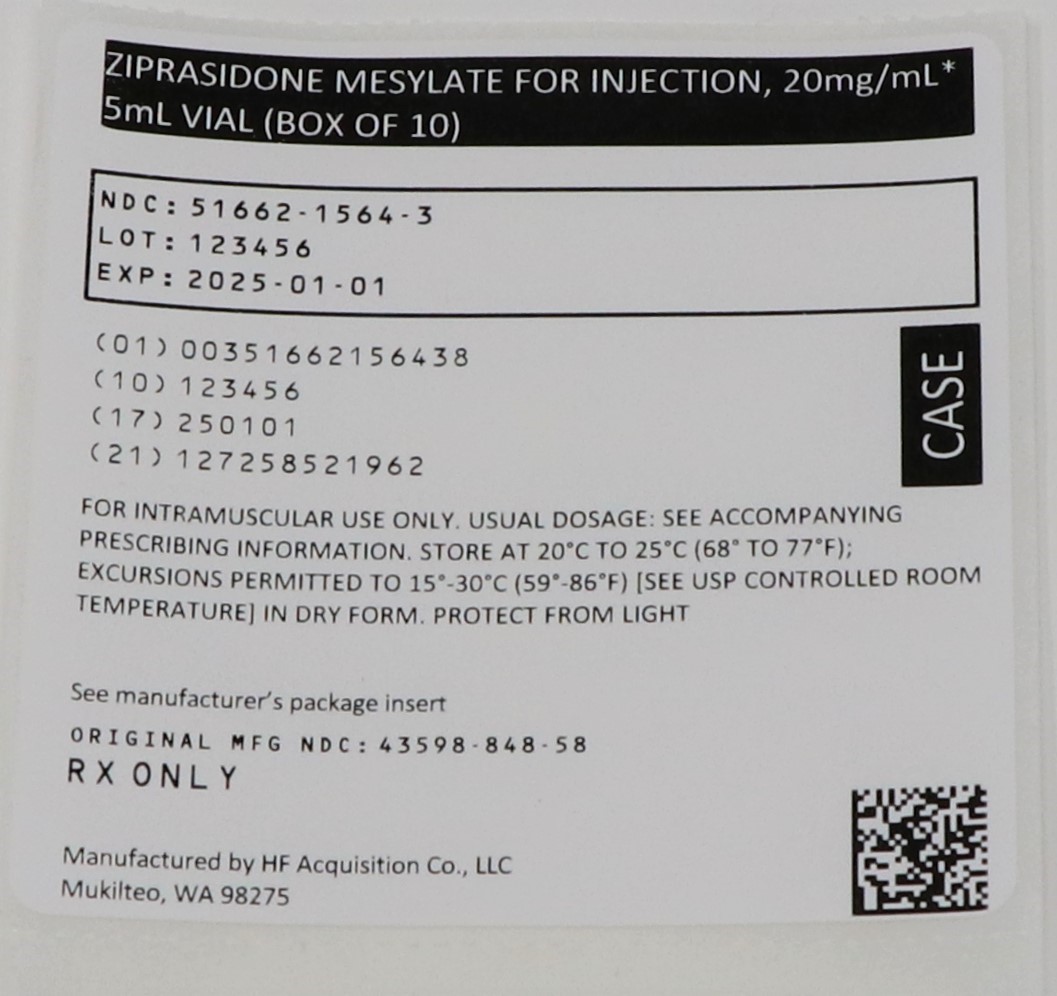
Label for Ziprasidone Mesylate for Injection, 20 mg/mL, in a 5 mL vial box of 10. The label includes NDC 51662-1564-3, lot number 123456, and expiration date 2025-01-01. Manufactured by HF Acquisition Co., LLC, Mukilteo, WA. Instructions specify intramuscular use and storage temperatures, along with a barcode and indication of Rx only.*
FDA Label Image

Serialized (51662 1564 3 Serialized Labeling)

Serialized (51662 1564 3 Serialized Labeling)
A small white label featuring a barcode and numerical codes including a GTIN and lot number. The label states the product is distributed by HF Acquisition Co., LLC located in Mukilteo, WA 98275, and includes the text 'RX ONLY' indicating prescription-only status. It advises to see the manufacturer's package insert for more information.*
FDA Label Image

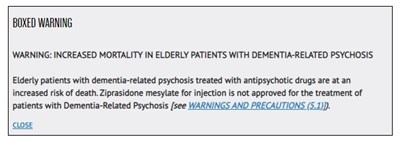
Box Warning (Boxed Warning)

Box Warning (Boxed Warning)
A boxed warning panel stating the increased mortality risk in elderly patients with dementia-related psychosis treated with antipsychotic drugs. It notes that Ziprasidone mesylate injection is not approved for treating dementia-related psychosis and references the WARNINGS AND PRECAUTIONS section for more information.*
FDA Label Image

Highlights (Highlights)

Highlights (Highlights)
Warning panel stating increased mortality risk in elderly patients with dementia-related psychosis treated with antipsychotic drugs. It specifies that Ziprasidone Mesylate for injection is not approved for this patient population. The warning advises consulting full prescribing information for the complete boxed warning details.*
FDA Label Image

Hs (Hs)

Hs (Hs)
A data table titled 'Ziprasidone mesylate for injection' displaying packaging and NDC information. It lists single-dose vials packaged in cartons of 10 vials, each with a concentration of 20 mg/mL, and an associated NDC code of 43598-848-58.*
FDA Label Image

Structure (Structure)

Structure (Structure)
Chemical structure of ziprasidone mesylate depicted as a two-dimensional molecular diagram showing the arrangement of atoms and bonds in the molecule.*
FDA Label Image

Vial (Vial Labeling)

Vial (Vial Labeling)
Label for Ziprasidone Mesylate for Injection 20 mg/mL, a single-dose vial for intramuscular use. The label indicates it is sterile, Rx only, and produced by Dr. Reddy's. It includes storage instructions, reconstitution directions, barcode, and lot/expiration placeholders. The label also notes the product is made in India.*
FDA Label Image

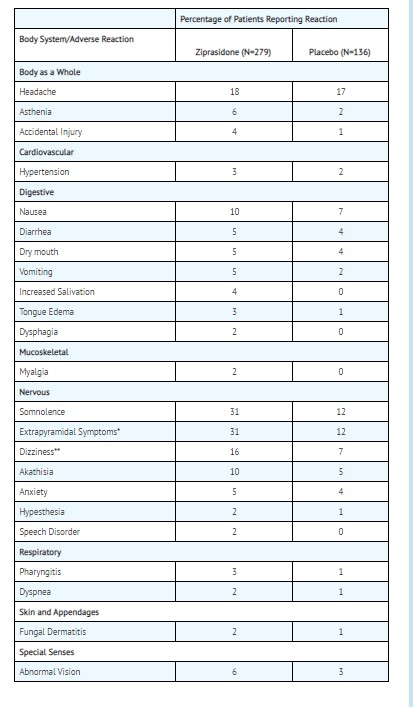
A2 (Adverse 2)

A2 (Adverse 2)
A data table showing the percentage of patients reporting various adverse reactions to Ziprasidone compared to placebo. It lists body system categories and specific reactions, with percentages reported for Ziprasidone (N=279) and placebo (N=136) patients, including reactions like headache, nausea, somnolence, extrapyramidal symptoms, dizziness, and abnormal vision.*
FDA Label Image

A3 (Adverse 3)

A3 (Adverse 3)
A data table showing the percentage of patients reporting various adverse reactions to Ziprasidone at doses of 2 mg, 10 mg, and 20 mg. The table categorizes reactions by body system, including general body symptoms, cardiovascular, digestive, nervous, respiratory, skin and appendages, and urogenital effects. It details specific reactions like headache, injection site pain, nausea, dizziness, and others, with percentages varying by dose group.*
FDA Label Image

A1 (Adverse)

A1 (Adverse)
A data table showing the percentage of patients reporting various adverse reactions to Ziprasidone Mesylate (N=702) compared to placebo (N=275). The table categorizes reactions by body system including digestive, nervous, respiratory, skin, and special senses, with percentages listed for each reaction such as nausea, extrapyramidal symptoms, respiratory tract infection, rash, and abnormal vision.*
FDA Label Image

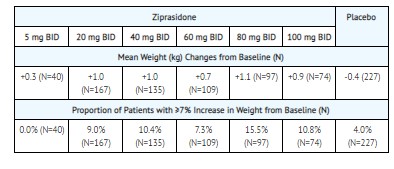
9 (Warning 9)

9 (Warning 9)
A data table comparing mean weight changes and the proportion of patients with at least 7% increase in weight from baseline across different dosages of Ziprasidone (5 mg to 100 mg BID) and placebo groups. The table includes sample sizes and specific percentage values for weight change and patient proportions for each dosage level.*
FDA Label Image

1 (Warnings 1)

1 (Warnings 1)
A data table showing mean random glucose change from baseline in mg/dL for Ziprasidone at various doses (5 mg BID to 100 mg BID) compared to placebo. The table includes the number of subjects (N) for each dose group and placebo group.*
FDA Label Image

10 (Warnings 10)

10 (Warnings 10)
A data table comparing weight changes and proportions of patients with ≥7% weight increase from baseline among those treated with ziprasidone at low dose (20-40 mg BID), high dose (60-80 mg BID), and placebo groups. It includes mean weight change in kilograms and percentage of patients experiencing the weight increase, with respective sample sizes (N).*
FDA Label Image

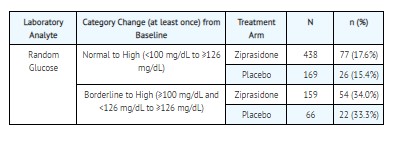
2 (Warnings 2)

2 (Warnings 2)
A data table presenting study results on random glucose level changes from baseline categorized as Normal to High or Borderline to High, compared between treatment arms of Ziprasidone and Placebo. It shows the number of participants (N) and counts and percentages (n %) experiencing these category changes.*
FDA Label Image

3 (Warnings 3)

3 (Warnings 3)
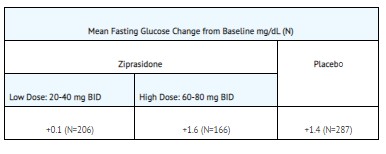
Data table titled 'Mean Fasting Glucose Change from Baseline mg/dL (N)' comparing Ziprasidone doses and placebo. It shows glucose changes for low dose (20-40 mg BID), high dose (60-80 mg BID) Ziprasidone, and placebo groups, with sample sizes noted.*
FDA Label Image

4 (Warnings 4)

4 (Warnings 4)
A data table presenting changes in fasting glucose levels from baseline in patients treated with Ziprasidone versus placebo. It categorizes changes as Normal to High and Borderline to High, showing the number and percentage of patients in each treatment arm.*
FDA Label Image

5 (Warnings 5)

5 (Warnings 5)
A data table showing mean lipid changes from baseline in mg/dL for triglycerides and total cholesterol. The table compares various doses of Ziprasidone (5 mg to 100 mg BID) against a placebo group, with sample sizes (N) provided for each category.*
FDA Label Image

6 (Warnings 6)

6 (Warnings 6)
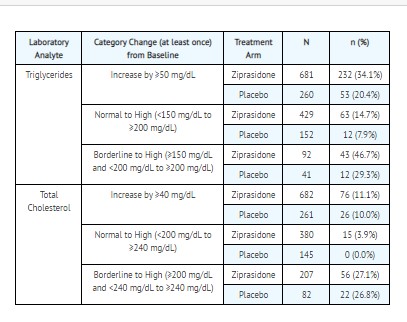
A data table presenting triglycerides and total cholesterol laboratory analyte changes from baseline across treatment arms of Ziprasidone and placebo. The table shows category changes including increased levels, normal to high, and borderline to high, with corresponding subject counts and percentages for each category and treatment group.*
FDA Label Image

7 (Warnings 7)

7 (Warnings 7)
A data table presenting the mean change from baseline (mg/dL) for various lipid analytes in patients treated with Ziprasidone at low dose (20-40 mg BID), high dose (60-80 mg BID), and placebo. The analytes include fasting triglycerides, total cholesterol, LDL cholesterol, and HDL cholesterol, with patient numbers noted for each group.*
FDA Label Image

8 (Warnings 8)

8 (Warnings 8)
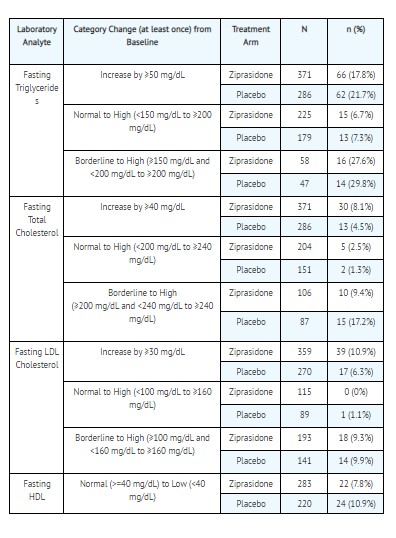
A data table presenting changes in lipid levels categorized by fasting triglycerides, total cholesterol, LDL cholesterol, and HDL cholesterol. The table compares the number and percentage of participants experiencing various category changes from baseline under treatment arms with Ziprasidone versus Placebo.*

* About these descriptions: Image descriptions on this page are generated by automated AI analysis of the product label images from the manufacturer's FDA label submission (SPL). They are provided for reference only and may contain errors or omissions. Always rely on the printed label itself and the official FDA labeling, and consult a pharmacist or healthcare professional with any questions about this product.