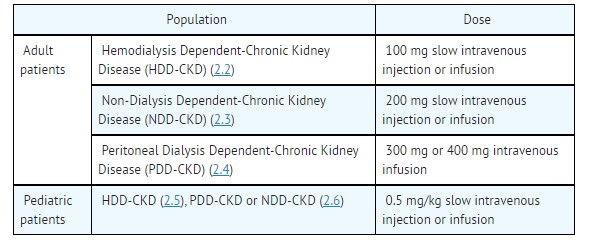
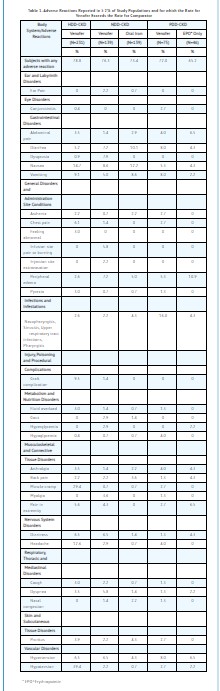
Five clinical trials involving 647 adult patients and one clinical trial involving 131 pediatric patients were conducted to assess the safety and efficacy of Venofer.
14.1 Clinical Studies Overview
Five clinical trials involving 647 adult patients and one clinical trial involving 131 pediatric patients were conducted to assess the safety and efficacy of Venofer.
14.2 Study A: Hemodialysis Dependent-Chronic Kidney Disease (HDD–CKD)
Study A was a multicenter, open-label, historically-controlled study in 101 patients with HDD-CKD (77 patients with Venofer treatment and 24 in the historical control group) with IDA. Eligibility criteria for Venofer treatment included patients undergoing chronic hemodialysis, receiving erythropoietin, hemoglobin level between 8.0 and 11.0 g/dL, transferrin saturation <20%, and serum ferritin <300 ng/mL. The mean age of the patients was 65 years with the age range of 31 to 85 years. Of the 77 patients, 44 (57%) were male and 33 (43%) were female.
Venofer 100 mg was administered at 10 consecutive dialysis sessions either as slow injection or a slow infusion. The historical control population consisted of 24 patients with similar ferritin levels as patients treated with Venofer, who were off intravenous iron for at least 2 weeks and who had received erythropoietin therapy with hematocrit averaging 31 to 36 for at least two months prior to study entry. The mean age of patients in the historical control group was 56 years, with an age range of 29 to 80 years. Patient age and serum ferritin level were similar between treatment and historical control patients.
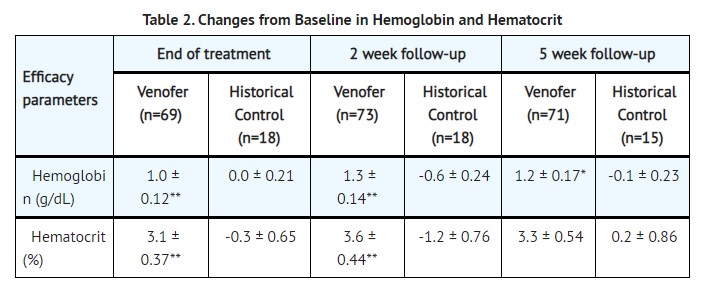
Patients in the Venofer treated population showed a greater increase in hemoglobin and hematocrit than did patients in the historical control population. See Table 2.
**p < 0.01 and *p < 0.05 compared to historical control from ANCOVA analysis with baseline hemoglobin, serum ferritin and erythropoietin dose as covariates.
Serum ferritin increased at endpoint of study from baseline in the Venofer-treated population (165.3 ± 24.2 ng/mL) compared to the historical control population (-27.6 ± 9.5 ng/mL). Transferrin saturation also increased at endpoint of study from baseline in the Venofer-treated population (8.8 ± 1.6%) compared to this historical control population (-5.1 ± 4.3%).
14.3 Study B: Hemodialysis Dependent-Chronic Kidney Disease (HDD-CKD)
Study B was a multicenter, open label study of Venofer in 23 patients with iron deficiency and HDD-CKD who had been discontinued from iron dextran due to intolerance. Eligibility criteria were otherwise identical to Study A. The mean age of the patients in this study was 53 years, with ages ranging from 21 to 79 years. Of the 23 patients enrolled in the study, 10 (44%) were male and 13 (56%) were female.
All 23 enrolled patients were evaluated for efficacy. Increases in mean hemoglobin (1.1 ± 0.2 g/dL), hematocrit (3.6 ± 0.6%), serum ferritin (266.3 ± 30.3 ng/mL) and transferrin saturation (8.7 ± 2.0%) were observed from baseline to end of treatment.
14.4 Study C: Hemodialysis Dependent-Chronic Kidney Disease (HDD-CKD)
Study C was a multicenter, open-label study in patients with HDD-CKD. This study enrolled patients with a hemoglobin ≤ 10 g/dL, a serum transferrin saturation ≤ 20%, and a serum ferritin ≤ 200 ng/mL, who were undergoing maintenance hemodialysis 2 to 3 times weekly. The mean age of the patients enrolled in this study was 41 years, with ages ranging from 16 to 70 years. Of 130 patients evaluated for efficacy in this study, 68 (52%) were male and 62 (48%) were female. Forty-eight percent of the patients had previously been treated with oral iron. Exclusion criteria were similar to those in studies A and B. Venofer was administered in doses of 100 mg during sequential dialysis sessions until a pre-determined (calculated) total dose of iron was administered. A 50 mg dose (2.5 mL) was given to patients within two weeks of study entry as a test dose. Twenty-seven patients (20%) were receiving erythropoietin treatment at study entry and they continued to receive the same erythropoietin dose for the duration of the study.
The modified intention-to-treat (mITT) population consisted of 131 patients. Increases from baseline in mean hemoglobin (1.7 g/dL), hematocrit (5%), serum ferritin (434.6 ng/mL), and serum transferrin saturation (14%) were observed at week 2 of the observation period and these values remained increased at week 4 of the observation period.
14.5 Study D: Non-Dialysis Dependent-Chronic Kidney Disease (NDD-CKD)
Study D (NCT00236977) was a randomized, open-label, multicenter, active-controlled study of the safety and efficacy of oral iron versus Venofer in patients with NDD-CKD with or without erythropoietin therapy. Erythropoietin therapy was stable for 8 weeks prior to randomization. In the study 188 patients with NDD-CKD, hemoglobin of ≤ 11.0 g/dL, transferrin saturation ≤ 25%, ferritin ≤ 300 ng/mL were randomized to receive oral iron (325 mg ferrous sulfate three times daily for 56 days); or Venofer (either 200 mg over 2 to 5 minutes 5 times within 14 days or two 500 mg infusions on Day 1 and Day 14, administered over 3.5 to 4 hours). The mean age of the 91 treated patients in the Venofer group was 61.6 years (range 25 to 86 years) and 64 years (range 21 to 86 years) for the 91 patients in the oral iron group.
A statistically significantly greater proportion of Venofer subjects (35/79; 44.3%) compared to oral iron subjects (23/82; 28%) had an increase in hemoglobin ≥ 1 g/dL at anytime during the study (p = 0.03).
14.6 Study E: Peritoneal Dialysis Dependent-Chronic Kidney Disease (PDD-CKD)
Study E (NCT00236938) was a randomized, open-label, multicenter study comparing patients with PDD-CKD receiving an erythropoietin and intravenous iron to patients with PDD-CKD receiving an erythropoietin alone without iron supplementation. Patients with PDD-CKD, stable erythropoietin for 8 weeks, hemoglobin of ≤ 11.5 g/dL, TSAT ≤ 25%, ferritin ≤ 500 ng/mL were randomized to receive either no iron or Venofer (300 mg in 250 mL 0.9% NaCl over 1.5 hours on Day 1 and 15 and 400 mg in 250 mL 0.9% NaCl over 2.5 hours on Day 29). The mean age of the 75 treated patients in the Venofer / erythropoietin group was 51.9 years (range 21 to 81 years) vs. 52.8 years (range 23 to 77 years) for 46 patients in the erythropoietin alone group.
Patients in the Venofer / erythropoietin group had statistically significantly greater mean change from baseline to the highest hemoglobin value (1.3 g/dL), compared to subjects who received erythropoietin alone (0.6 g/dL) (p < 0.01). A greater proportion of subjects treated with Venofer / erythropoietin (59.1 %) had an increase in hemoglobin of ≥ 1 g/dL at any time during the study compared to the subjects who received erythropoietin only (33.3%).
14.7 Study F: Iron Maintenance Treatment Dosing in Pediatric Patients Ages 2 Years and Older with Chronic Kidney Disease
Study F (NCT00239642) was a randomized, open-label, dose-ranging study for iron maintenance treatment in pediatric patients with dialysis-dependent or non-dialysis-dependent CKD on stable erythropoietin therapy. The study randomized patients to one of three doses of Venofer (0.5 mg/kg, 1 mg/kg or 2 mg/kg). The mean age was 13 years (range 2 to 20 years). Over 70% of patients were 12 years or older in all three groups. There were 84 males and 61 females. About 60% of patients underwent hemodialysis and 25% underwent peritoneal dialysis in all three dose groups. At baseline, the mean hemoglobin was 12 g/dL, the mean TSAT was 33% and the mean ferritin was 300 ng/mL. Patients with HDD-CKD received Venofer once every other week for 6 doses. Patients with PDD-CKD or NDD-CKD received Venofer once every 4 weeks for 3 doses. Among 131 evaluable patients with stable erythropoietin dosing, the proportion of patients who maintained hemoglobin between 10.5 g/dL and 14.0 g/dL during the 12-week treatment period was 58.7%, 46.7%, and 45.0% in the Venofer 0.5 mg/kg, 1 mg/kg, and 2 mg/kg groups, respectively. A dose-response relationship was not demonstrated.