Highlights Of Prescribing Information
These highlights do not include all the information needed to use HEPARIN SODIUM IN 0.45% SODIUM CHLORIDE INJECTION or HEPARIN SODIUM IN 5% DEXTROSE INJECTION safely and effectively. See full prescribing information for HEPARIN SODIUM IN 0.45% SODIUM CHLORIDE INJECTION or HEPARIN SODIUM IN 5% DEXTROSE INJECTION.
HEPARIN SODIUM, for intravenous use
Initial U.S. Approval: 1939
Rx only
INDICATIONS AND USAGE
Heparin sodium is an anticoagulant indicated for: ( 1)
Prophylaxis and treatment of venous thromboembolism and pulmonary embolism
Atrial fibrillation with embolization
Treatment of acute and chronic consumptive coagulopathies (disseminated intravascular coagulation)
Prevention of clotting in arterial and cardiac surgery
Prophylaxis and treatment of peripheral arterial embolism
Anticoagulant use in blood transfusions, extracorporeal circulation, and dialysis procedures.
DOSAGE AND ADMINISTRATION
Recommended Adult Dosages:
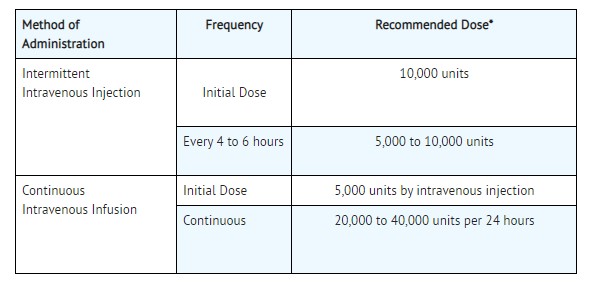
Therapeutic Anticoagulant Effect with Full-Dose Heparin* ( 2.3)
Surgery of the Heart and Blood Vessels ( 2.5)
Extracorporeal Dialysis ( 2.8)
See full prescribing information for recommended pediatric dosage. ( 2.4)
DOSAGE FORMS AND STRENGTHS
Heparin sodium is available as: ( 3)
Heparin Sodium in 0.45% Sodium Chloride Injection:
Injection: 50 USP units per mL in 0.45% Sodium Chloride clear solution (25,000 USP units per 500 mL) in single-dose freeflex® bag
Injection: 100 USP units per mL in 0.45% Sodium Chloride clear solution (25,000 USP units per 250 mL) in single-dose freeflex® bag
Heparin Sodium in 5% Dextrose Injection:
Injection: 50 USP units per mL in 5% Dextrose clear solution (25,000 USP units per 500 mL) in single-dose freeflex® bag
Injection: 100 USP units per mL in 5% Dextrose clear solution (25,000 USP units per 250 mL) in single-dose freeflex® bag
CONTRAINDICATIONS
History of Heparin-Induced Thrombocytopenia (HIT) and Heparin-Induced Thrombocytopenia and Thrombosis (HITT) (
4)
Known hypersensitivity to heparin or pork products (
4)
In whom suitable blood coagulation tests cannot be performed at appropriate intervals (
4)
WARNINGS AND PRECAUTIONS
Fatal Medication Errors: Confirm choice of correct strength prior to administration. (
5.1)
Hemorrhage: Fatal cases have occurred. Use caution in conditions with increased risk of hemorrhage. (
5.2)
HIT and HITT: Monitor for signs and symptoms and discontinue if indicative of HIT and HITT. (
5.3)
Monitoring: Blood coagulation tests guide therapy for full-dose heparin. Monitor platelet count and hematocrit in all patients receiving heparin. (
5.5)
ADVERSE REACTIONS
Most common adverse reactions are hemorrhage, thrombocytopenia, HIT and HITT, hypersensitivity reactions, and elevations of aminotransferase levels. ( 6.1)
To report SUSPECTED ADVERSE REACTIONS, contact Fresenius Kabi USA, LLC at 1-800-551-7176 or FDA at 1-800-FDA-1088 or www.fda.gov/medwatch.
DRUG INTERACTIONS
Drugs that interfere with coagulation, platelet aggregation or drugs that counteract coagulation may induce bleeding. ( 7)
See 17 for PATIENT COUNSELING INFORMATION.
Revised: 12/2019