Highlights Of Prescribing Information
These highlights do not include all the information needed to use VASOPRESSIN INJECTION safely and effectively. See full prescribing information for VASOPRESSIN INJECTION.
VASOPRESSIN injection, for intravenous use
Initial U.S. Approval: 2014
INDICATIONS AND USAGE
Vasopressin injection is indicated to increase blood pressure in adults with vasodilatory shock who remain hypotensive despite fluids and catecholamines. (1)
DOSAGE AND ADMINISTRATION
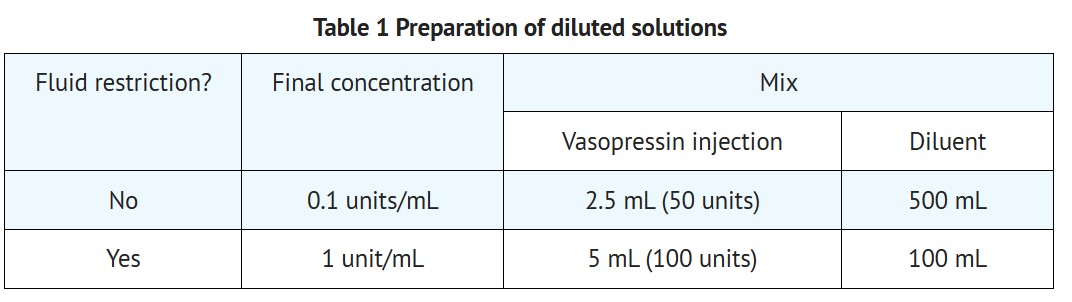
Dilute 20 units/mL multiple dose vial contents with normal saline (0.9% sodium chloride) or 5% dextrose in water (D5W) to either 0.1 units/mL or 1 unit/mL for intravenous administration. Discard unused diluted solution after 18 hours at room temperature or 24 hours under refrigeration.
(2)
Post-cardiotomy shock: 0.03 to 0.1 units/minute
(2)
Septic shock: 0.01 to 0.07 units/minute
(2)
DOSAGE FORMS AND STRENGTHS
Injection: 20 units/mL in a multiple dose vial. To be used after dilution. (3)
CONTRAINDICATIONS
Vasopressin injection is contraindicated in patients with known allergy or hypersensitivity to 8-L-arginine vasopressin or chlorobutanol. (4)
WARNINGS AND PRECAUTIONS
Can worsen cardiac function.
(5)
Reversible diabetes insipidus
(5)
ADVERSE REACTIONS
The most common adverse reactions include decreased cardiac output, bradycardia, tachyarrhythmias, hyponatremia and ischemia (coronary, mesenteric, skin, digital).
(6)
To report SUSPECTED ADVERSE REACTIONS, contact AuroMedics Pharma LLC at 1-866-850-2876 or FDA at 1-800-FDA-1088 or www.fda.gov/medwatch.
DRUG INTERACTIONS
Pressor effects of catecholamines and vasopressin injection are expected to be additive.
(7)
Indomethacin may prolong effects of vasopressin injection.
(7)
Co-administration of ganglionic blockers or drugs causing SIADH may increase the pressor response.
(7)
Co-administration of drugs causing diabetes insipidus may decrease the pressor response.
(7)
USE IN SPECIFIC POPULATIONS
Pregnancy: May induce uterine contractions.
(8)
Pediatric Use: Safety and effectiveness have not been established.
(8)
Geriatric Use: No safety issues have been identified in older patients.
(8)
Revised: 6/2022