Rocuronium Bromide Injection
Product Images NDC 51662-1710

View Photos of Packaging, Regulatory Labels, and Product Appearance

Product Visual Gallery

This gallery contains 17 technical images submitted to the FDA as part of the official labeling for Rocuronium Bromide (NDC 51662-1710). Unlike standard consumer photos, these assets often include clinical data figures, molecular chemical structures, and official manufacturer packaging layouts.

As provided by Hf Acquisition Co. Llc, Dba Healthfirst, these visuals offer a comprehensive scientific overview of the product's physical and chemical identity, aiding pharmacists and researchers in product verification and study.

FDA Label Image

0143-9251-01 (0143 9251 01 Rocuronium Bromide Injection 100mg Per 10ml Vial Image)
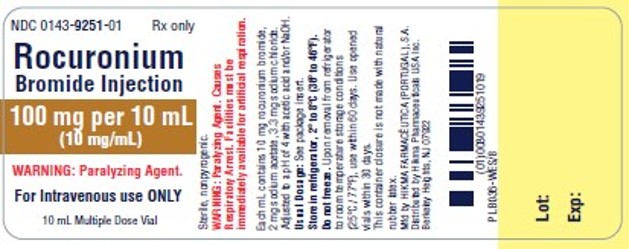
0143-9251-01 (0143 9251 01 Rocuronium Bromide Injection  100mg Per 10ml Vial Image)
Label for Rocuronium Bromide Injection, 10 mg/mL (100 mg per 10 mL) multiple dose vial. The label warns that this is a paralyzing agent and is for intravenous use only. The product is sterile and nonpyrogenic, with a listed sodium chloride concentration and pH. The label includes dosage and storage information and is distributed by HF Acquisition Co. LLC, DBA HealthFirst.*
FDA Label Image

51662-1710-1 (51662 1710 1 Rocuronium Bromide Injection 100mg Per 10ml (10mgml) 10ml Vial Rfid Label Image)

51662-1710-1 (51662 1710 1 Rocuronium Bromide Injection  100mg Per 10ml (10mgml) 10ml Vial Rfid Label Image)
A rectangular white label with black text and a small QR code on the left side. The label includes various numeric codes, the phrase 'SEE MANUFACTURER'S INSERT,' and states that the product is distributed by HF Acquisition Co., LLC in Mukilteo, WA 98275. The label is affixed to a transparent surface with a silver edge at the top.*
FDA Label Image

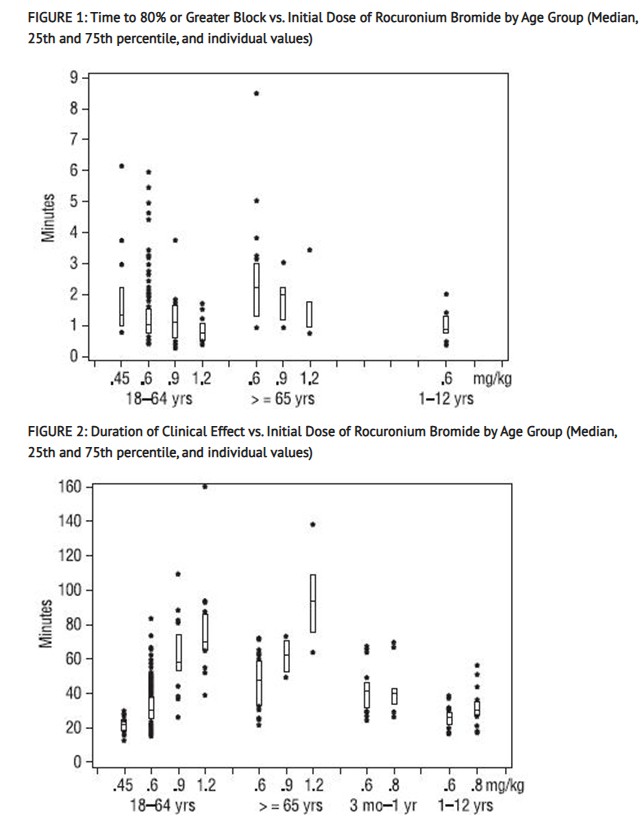
Figure (Figure 1)

Figure (Figure 1)
Two box plot charts depicting pharmacodynamic data related to Rocuronium Bromide injection. Figure 1 shows the time to 80% or greater neuromuscular block versus initial dose across age groups (18-64 yrs, ≥65 yrs, 1-12 yrs) with doses ranging from 0.45 to 1.2 mg/kg on the x-axis and minutes on the y-axis. Figure 2 presents the duration of clinical effect versus initial dose by the same age groups but includes a 3 mo–1 yr group and doses from 0.45 to 1.2 mg/kg, with duration in minutes on the y-axis. Both figures display median, 25th and 75th percentiles, and individual values.*
FDA Label Image

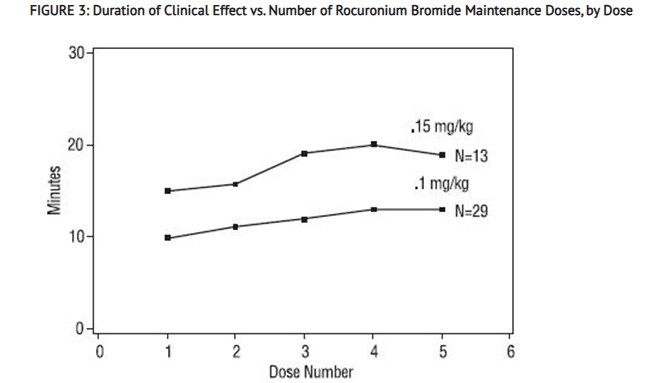
Figure (Figure 2)

Figure (Figure 2)
A line graph titled 'Duration of Clinical Effect vs. Number of Rocuronium Bromide Maintenance Doses, by Dose' displays two lines representing doses of 0.15 mg/kg and 0.1 mg/kg. The x-axis shows dose number (1 to 5), and the y-axis shows duration in minutes up to 30. The 0.15 mg/kg dose line shows higher duration values, peaking around 20 minutes, while the 0.1 mg/kg dose line increases gradually, peaking around 15 minutes.*
FDA Label Image

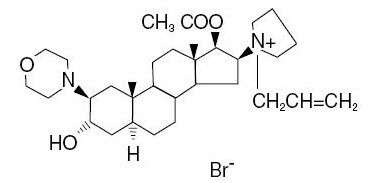
Structure (Structure 1)

Structure (Structure 1)
Chemical structure of Rocuronium Bromide, showing its molecular configuration including a steroid backbone with associated substituents like CH3 COO, a quaternary ammonium group (N+), alkenyl and hydroxyl groups, and a bromide ion (Br-).*
FDA Label Image

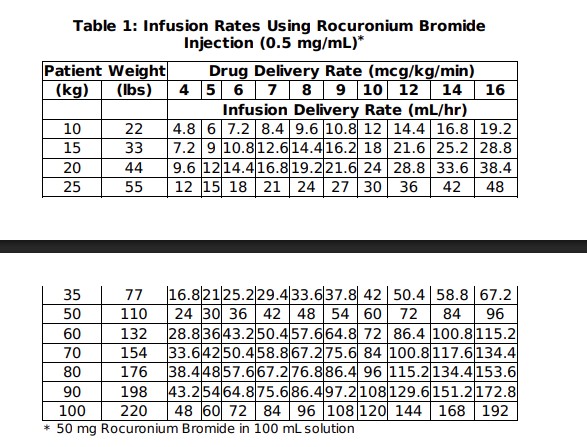
Table 1: Infusion Rates Using Rocuronium Bromide Injection (0.5 mg/ml) (Table 1)

Table 1: Infusion Rates Using Rocuronium Bromide Injection (0.5 mg/ml) (Table 1)
A data table titled "Infusion Rates Using Rocuronium Bromide Injection (0.5 mg/mL)" showing infusion delivery rates in mL/hr for different patient weights ranging from 10 kg to 100 kg and drug delivery rates in mcg/kg/min from 4 to 16. The table provides calculated infusion rates to guide dosage based on patient weight and desired drug delivery rate.*
FDA Label Image

Table (Table 10)

Table (Table 10)
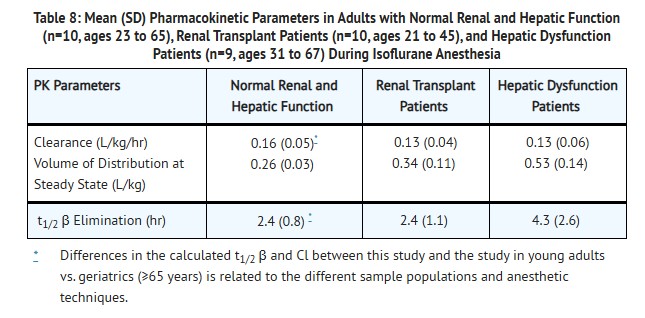
A data table titled 'Mean (SD) Pharmacokinetic Parameters in Adults' presenting clearance, volume of distribution, and t1/2 ß elimination during Isoflurane Anesthesia. It compares Normal Renal and Hepatic Function adults, Renal Transplant Patients, and Hepatic Dysfunction Patients with corresponding numerical values for each pharmacokinetic parameter and includes a note about differences related to study populations and techniques.*
FDA Label Image

Table (Table 11)

Table (Table 11)
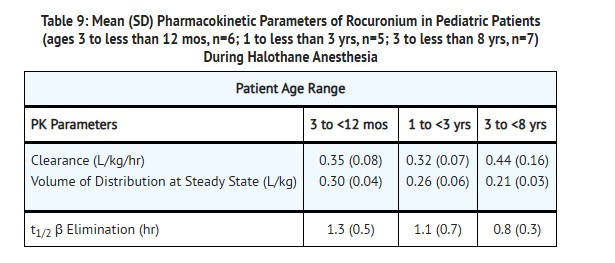
A data table presenting mean (SD) pharmacokinetic parameters of Rocuronium in pediatric patients during halothane anesthesia. The table shows clearance, volume of distribution at steady state, and elimination half-life across three age ranges: 3 to less than 12 months, 1 to less than 3 years, and 3 to less than 8 years.*
FDA Label Image

Table (Table 12)

Table (Table 12)
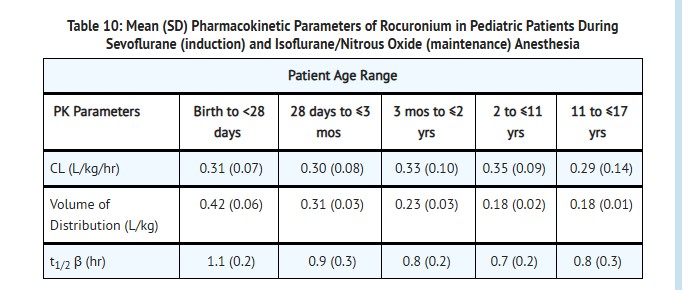
This table presents the mean and standard deviation pharmacokinetic parameters of Rocuronium in pediatric patients during Sevoflurane induction and Isoflurane/Nitrous Oxide maintenance anesthesia. Parameters include clearance (CL), volume of distribution, and elimination half-life (t1/2 ß) across age ranges from birth to 17 years.*
FDA Label Image

Table 2: Infusion Rates Using Rocuronium Bromide Injection (1 mg/ml)* (Table 2)

Table 2: Infusion Rates Using Rocuronium Bromide Injection (1 mg/ml)* (Table 2)
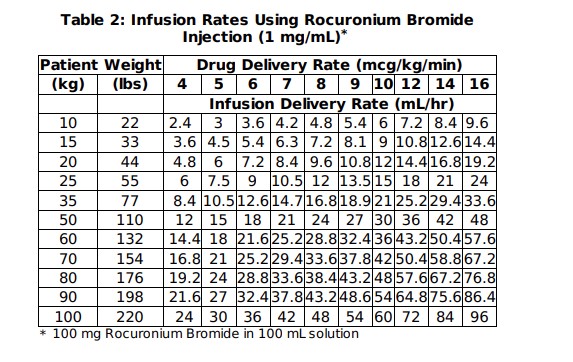
A data table titled 'Infusion Rates Using Rocuronium Bromide Injection (1 mg/mL)' showing infusion delivery rates in mL/hr calculated by patient weight in kg and lbs, versus drug delivery rate in mcg/kg/min. The table cross-references weight from 10 to 100 kg with drug delivery rates from 4 to 16 mcg/kg/min, providing corresponding infusion rates for clinical use at the specified concentration.*
FDA Label Image

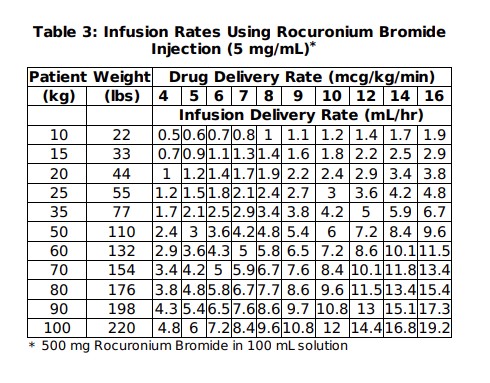
Table (Table 3)

Table (Table 3)
A data table titled 'Infusion Rates Using Rocuronium Bromide Injection (5 mg/mL)' showing patient weight in kilograms and pounds alongside corresponding drug delivery rates in micrograms per kilogram per minute and infusion delivery rates in milliliters per hour. The table provides infusion rates for various patient weights ranging from 10 kg to 100 kg and drug delivery rates from 4 to 16 mcg/kg/min.*
FDA Label Image

Tbale 4 (Table 4)

Tbale 4 (Table 4)
A table listing various injectable solutions including 0.9% NaCl solution, 5% glucose in saline, lactated Ringers, 5% glucose in water, and sterile water for injection, likely indicating compatible diluents or solutions relevant to preparation or administration.*
FDA Label Image

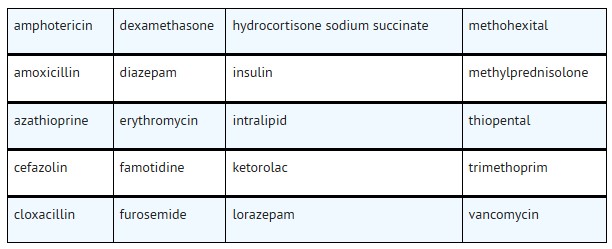
Table 5 (Table 5)

Table 5 (Table 5)
A data table listing various pharmaceutical substances including amphotericin, dexamethasone, hydrocortisone sodium succinate, methohexital, amoxicillin, diazepam, insulin, methylprednisolone, azathioprine, erythromycin, intralipid, thiopental, cefazolin, famotidine, ketorolac, trimethoprim, cloxacillin, furosemide, lorazepam, and vancomycin.*
FDA Label Image

Table (Table 6)

Table (Table 6)
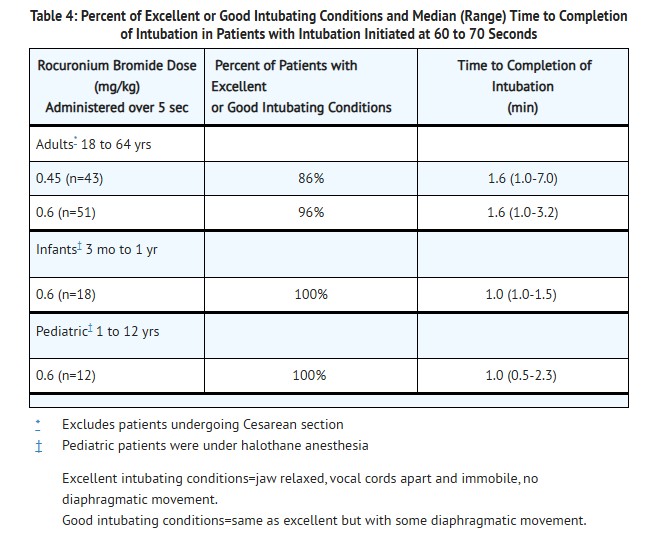
A data table titled "Percent of Excellent or Good Intubating Conditions and Median (Range) Time to Completion of Intubation in Patients with Intubation Initiated at 60 to 70 Seconds" showing Rocuronium Bromide doses (mg/kg) administered over 5 seconds for different age groups (adults 18-64 years, infants 3 months to 1 year, pediatric 1 to 12 years). The table provides the percent of patients with excellent or good intubating conditions and the time to completion of intubation in minutes for each dose and age group.*
FDA Label Image

Table (Table 7)

Table (Table 7)
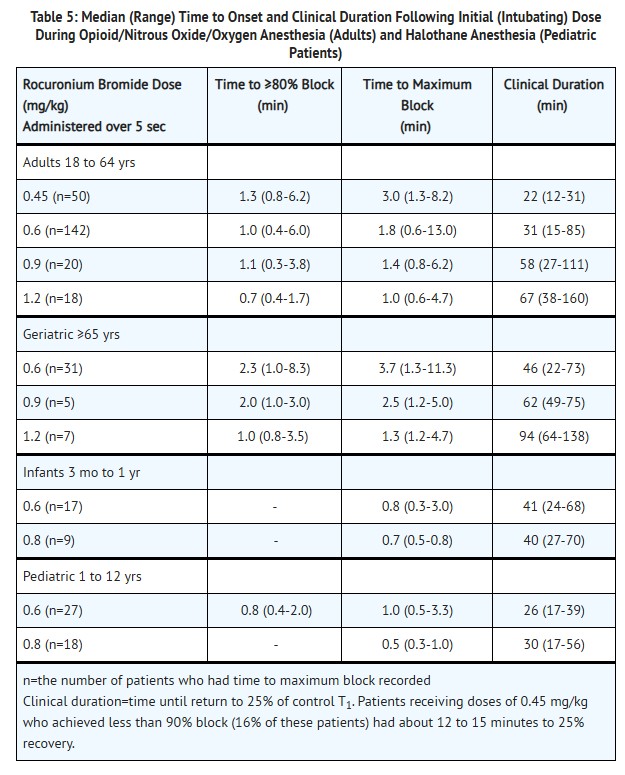
A data table titled 'Table 5: Median (Range) Time to Onset and Clinical Duration Following Initial (Intubating) Dose During Opioid/Nitrous Oxide/Oxygen Anesthesia (Adults) and Halothane Anesthesia (Pediatric Patients)' for Rocuronium Bromide. It displays median and range values for time to ≥80% block, time to maximum block, and clinical duration across different doses (mg/kg) and age groups, including adults 18-64 years, geriatric ≥65 years, infants 3 months to 1 year, and pediatric 1 to 12 years.*
FDA Label Image

Table (Table 8)

Table (Table 8)
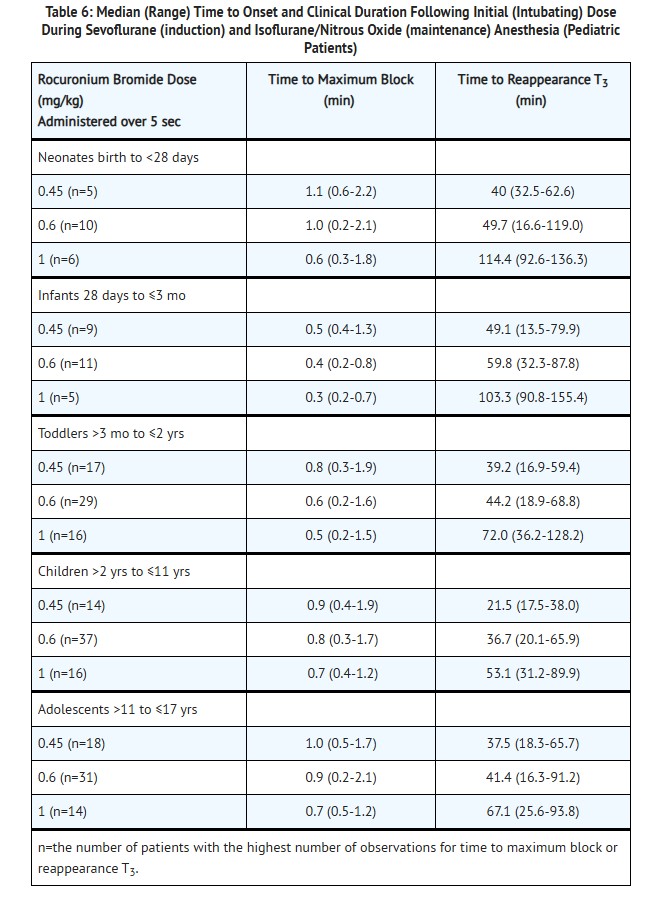
A data table titled 'Table 6' presenting median and range times for onset and clinical duration after initial intubating doses of rocuronium bromide in pediatric patients during specific anesthesia. It details rocuronium bromide doses (mg/kg) administered over 5 seconds, time to maximum block (minutes), and time to reappearance T3 (minutes) across age groups from neonates to adolescents, with patient counts noted for each dose.*
FDA Label Image

Table (Table 9)

Table (Table 9)
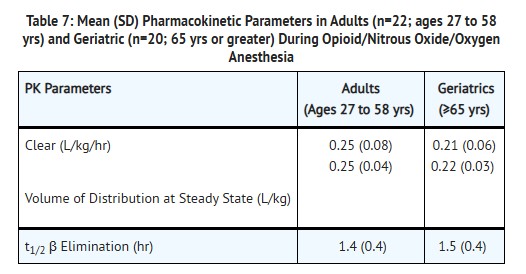
A table presenting mean and standard deviation pharmacokinetic parameters in adults (ages 27 to 58) and geriatrics (65 years or older) during opioid/nitrous oxide/oxygen anesthesia. Parameters include clearance (L/kg/hr), volume of distribution at steady state (L/kg), and half-life elimination time (hours).*

* About these descriptions: Image descriptions on this page are generated by automated AI analysis of the product label images from the manufacturer's FDA label submission (SPL). They are provided for reference only and may contain errors or omissions. Always rely on the printed label itself and the official FDA labeling, and consult a pharmacist or healthcare professional with any questions about this product.