Other
For Dermatologic Use Only -- Not for Ophthalmic Use.
Rx Only
Mfd. by: Sun Pharma Canada Inc., Brampton, Ontario, Canada L6T 1C1
Dist. by: Sun Pharmaceutical Industries, Inc., Cranbury, NJ 08512
Revised: July, 2025
5263435-0725-01
The following Structured Product Label (SPL) was submitted to the FDA by Sun Pharmaceutical Industries, Inc. for the product Alclometasone Dipropionate (NDC 51672-1306). This document serves as the official prescribing information, containing essential scientific data and clinical materials required for healthcare providers and patients.
This specific version of the label includes detailed information regarding other, description, clinical pharmacology, pharmacokinetics, indications and usage, contraindications, general, information for patients, and other regulatory disclosures. Use the navigation below to review specific sections of the FDA submission.
For Dermatologic Use Only -- Not for Ophthalmic Use.
Rx Only
Mfd. by: Sun Pharma Canada Inc., Brampton, Ontario, Canada L6T 1C1
Dist. by: Sun Pharmaceutical Industries, Inc., Cranbury, NJ 08512
Revised: July, 2025
5263435-0725-01
Alclometasone Dipropionate Cream USP, 0.05% contains alclometasone dipropionate (7α-chloro-11β,17,21-trihydroxy-16α-methylpregna-1,4-diene-3,20-dione 17,21-dipropionate), a synthetic corticosteroid for topical dermatologic use. The corticosteroids constitute a class of primarily synthetic steroids used topically as anti-inflammatory and antipruritic agents.
Chemically, alclometasone dipropionate is C28H37ClO7. It has the following structural formula:

Chemical Structure (Alclometasone 01)
Alclometasone dipropionate has the molecular weight of 521. It is a white powder, insoluble in water, slightly soluble in propylene glycol, and moderately soluble in hexylene glycol.
Each gram of alclometasone dipropionate cream contains 0.5 mg of alclometasone dipropionate in a hydrophilic, emollient cream base of Ceteth-20, cetyl alcohol, chlorocresol, glyceryl monostearate, monobasic sodium phosphate, PEG 100 stearate, phosphoric acid, propylene glycol, purified water, stearyl alcohol, and white petrolatum.
Like other topical corticosteroids, alclometasone dipropionate has anti-inflammatory, antipruritic, and vasoconstrictive properties. The mechanism of the anti-inflammatory activity of the topical steroids, in general, is unclear. However, corticosteroids are thought to act by the induction of phospholipase A 2inhibitory proteins, collectively called lipocortins. It is postulated that these proteins control the biosynthesis of potent mediators of inflammation such as prostaglandins and leukotrienes by inhibiting the release of their common precursor, arachidonic acid. Arachidonic acid is released from membrane phospholipids by phospholipase A 2.
The extent of percutaneous absorption of topical corticosteroids is determined by many factors, including the vehicle and the integrity of the epidermal barrier. Occlusive dressings with hydrocortisone for up to 24 hours have not been demonstrated to increase penetration; however, occlusion of hydrocortisone for 96 hours markedly enhances penetration. Topical corticosteroids can be absorbed from normal intact skin. Inflammation and/or other disease processes in the skin may increase percutaneous absorption. A study utilizing a radio labeled alclometasone dipropionate ointment formulation was performed to measure systemic absorption and excretion. Results indicated that approximately 3% of the steroid was absorbed during 8 hours of contact with intact skin of normal volunteers.
Studies performed with alclometasone dipropionate cream indicate that this product is in the low to medium range of potency as compared with other topical corticosteroids.
Alclometasone Dipropionate Cream USP, 0.05% is a low to medium potency corticosteroid indicated for the relief of the inflammatory and pruritic manifestations of corticosteroid-responsive dermatoses. Alclometasone dipropionate cream may be used in pediatric patients 1 year of age or older, although the safety and efficacy of drug use for longer than 3 weeks have not been established (see PRECAUTIONS: Pediatric Use). Since the safety and efficacy of alclometasone dipropionate cream have not been established in pediatric patients below 1 year of age, their use in this age-group is not recommended.
Alclometasone Dipropionate Cream USP, 0.05% is contraindicated in those patients with a history of hypersensitivity to any of the components in this preparation.
Systemic absorption of topical corticosteroids can produce reversible hypothalamic-pituitary-adrenal (HPA) axis suppression with the potential for glucocorticosteroid insufficiency after withdrawal of treatment. Manifestations of Cushing syndrome, hyperglycemia, and glucosuria can also be produced in some patients by systemic absorption of topical corticosteroids while on treatment. Patients applying a topical steroid to a large surface area or to areas under occlusion should be evaluated periodically for evidence of HPA axis suppression. This may be done by using the ACTH stimulation, A.M. plasma cortisol, and urinary free cortisol tests.
The effects of alclometasone dipropionate cream on the HPA axis have been evaluated. In one study, alclometasone dipropionate cream was applied to 30% of the body twice daily for 7 days, and occlusive dressings were used in selected patients either 12 hours or 24 hours daily. In another study, alclometasone dipropionate cream was applied to 80% of the body surface of normal subjects twice daily for 21 days with daily 12-hour periods of whole body occlusion. Average plasma and urinary free cortisol levels and urinary levels of 17-hydroxysteroids were decreased (about 10%), suggesting suppression of the HPA axis under these conditions. Plasma cortisol levels have also been demonstrated to decrease in pediatric patients treated twice daily for 3 weeks without occlusion.
If HPA axis suppression is noted, an attempt should be made to withdraw the drug, to reduce the frequency of application, or to substitute a less potent corticosteroid. Recovery of HPA axis function is generally prompt upon discontinuation of topical corticosteroids. Infrequently, signs and symptoms of glucocorticosteroid insufficiency may occur, requiring supplemental systemic corticosteroids. For information on systemic supplementation, see prescribing information for those products.
Pediatric patients may be more susceptible to systemic toxicity from equivalent doses due to their larger skin surface area to body mass ratios (see PRECAUTIONS: Pediatric Use).
If irritation develops, alclometasone dipropionate cream should be discontinued and appropriate therapy instituted. Allergic contact dermatitis with corticosteroids is usually diagnosed by observing a failure to heal rather than noting a clinical exacerbation, as with most topical products not containing corticosteroids. Such an observation should be corroborated with appropriate diagnostic patch testing. If concomitant skin infections are present or develop, an appropriate antifungal or antibacterial agent should be used. If a favorable response does not occur promptly, use of alclometasone dipropionate cream should be discontinued until the infection has been adequately controlled.
In a transgenic mouse study, chronic use of alclometasone dipropionate cream led to an increased number of animals with benign neoplasms of the skin at the treatment site (see PRECAUTIONS: Carcinogenesis, Mutagenesis, Impairment of Fertility). The clinical relevance of the findings in animal studies to humans is not clear.
Patients using topical corticosteroids should receive the following information and instructions:
The following tests may be helpful in evaluating patients for HPA axis suppression:
Systemic long-term animal studies have not been performed to evaluate the carcinogenic potential of alclometasone dipropionate. The effects of alclometasone dipropionate on mutagenesis or fertility have not been evaluated.
In a 26-week dermal carcinogenicity study conducted in transgenic (Tg.AC) mice, topical application once daily of both the vehicle cream and the 0.05% alclometasone dipropionate cream significantly increased the incidence of benign neoplasms of the skin in both sexes at the treatment site when compared to untreated controls. This suggests that the positive effect may be associated with the vehicle application. The clinical relevance of the findings in animals to humans is not clear.
Corticosteroids have been shown to be teratogenic in laboratory animals when administered systemically at relatively low dosage levels. Some corticosteroids have been shown to be teratogenic after dermal application in laboratory animals. There are no adequate and well-controlled studies in pregnant women. Alclometasone dipropionate cream should be used during pregnancy only if the potential benefit justifies the potential risk to the fetus.
Systemically administered corticosteroids appear in human milk and could suppress growth, interfere with endogenous corticosteroid production, or cause other untoward effects. It is not known whether topical administration of topical corticosteroids could result in sufficient systemic absorption to produce detectable quantities in human milk. Because many drugs are excreted in human milk, caution should be exercised when alclometasone dipropionate cream is administered to a nursing woman.
Alclometasone dipropionate cream may be used with caution in pediatric patients 1 year of age or older, although the safety and efficacy of drug use for longer than 3 weeks have not been established. Use of alclometasone dipropionate cream is supported by results from adequate and well-controlled studies in pediatric patients with corticosteroid-responsive dermatoses. Since the safety and efficacy of alclometasone dipropionate cream has not been established in pediatric patients below 1 year of age, its use in this age-group is not recommended. Because of a higher ratio of skin surface area to body mass, pediatric patients are at a greater risk than adults of HPA axis suppression and Cushing syndrome when they are treated with topical corticosteroids. They are therefore also at greater risk of adrenal insufficiency during and/or after withdrawal of treatment. Adverse effects, including striae, have been reported with inappropriate use of topical corticosteroids in infants and children. Pediatric patients applying alclometasone dipropionate cream to >20% of the body surface area are at higher risk for HPA axis suppression.
HPA axis suppression, Cushing syndrome, linear growth retardation, delayed weight gain, and intracranial hypertension have been reported in pediatric patients receiving topical corticosteroids. Manifestations of adrenal suppression in pediatric patients include low plasma cortisol levels and absence of response to ACTH stimulation. Manifestations of intracranial hypertension include bulging fontanelles, headaches, and bilateral papilledema.
Alclometasone dipropionate cream should not be used in the treatment of diaper dermatitis.
A limited number of patients at or above 65 years of age have been treated with alclometasone dipropionate cream and ointment in US clinical trials. The number of patients is too small to permit separate analysis of efficacy and safety. No adverse events were reported with alclometasone dipropionate ointment in geriatric patients, and the single adverse reaction reported with alclometasone dipropionate cream in this population was similar to those reactions reported by younger patients. Based on available data, no adjustment of dosage of alclometasone dipropionate cream and ointment in geriatric patients is warranted.
In studies where geriatric patients (65 years of age or older, see PRECAUTIONS) have been treated with alclometasone dipropionate cream, safety did not differ from that in younger patients; therefore, no dosage adjustment is recommended.
The following local adverse reactions have been reported with alclometasone dipropionate cream in approximately 2% of patients: itching and burning, erythema, dryness, irritation, and papular rashes.
The following additional local adverse reactions have been reported infrequently with topical corticosteroids, but may occur more frequently with the use of occlusive dressings. These reactions are listed in approximate decreasing order of occurrence: folliculitis, acneiform eruptions, hypopigmentation, perioral dermatitis, allergic contact dermatitis, secondary infection, skin atrophy, striae, and miliaria.
To report SUSPECTED ADVERSE REACTIONS, contact Sun Pharmaceutical Industries, Inc. at 1-866-923-4914 or FDA at 1-800-FDA-1088 or www.fda.gov/medwatch.
Topically applied alclometasone dipropionate cream can be absorbed in sufficient amounts to produce systemic effects (see PRECAUTIONS).
Apply a thin film of Alclometasone Dipropionate Cream USP, 0.05% to the affected skin areas two or three times daily; massage gently until the medication disappears.
Alclometasone dipropionate cream may be used in pediatric patients 1 year of age or older. Safety and effectiveness of alclometasone dipropionate cream in pediatric patients for more than 3 weeks of use have not been established. Use in pediatric patients under 1 year of age is not recommended.
As with other corticosteroids, therapy should be discontinued when control is achieved. If no improvement is seen within 2 weeks, reassessment of diagnosis may be necessary.
Alclometasone dipropionate cream should not be used with occlusive dressings unless directed by a physician. Alclometasone dipropionate cream should not be applied in the diaper area if the child still requires diapers or plastic pants as these garments may constitute occlusive dressing.
Alclometasone Dipropionate Cream USP, 0.05% is supplied in 15 g (NDC 51672-1306-1), 45 g (NDC 51672-1306-6), and 60 g (NDC 51672-1306-3) tubes.
Store at 20°-25°C (68°-77°F) [see USP Controlled Room Temperature].
Alclometasone Dipropionate
Cream USP, 0.05%
FOR DERMATOLOGIC USE ONLY.
NOT FOR OPHTHALMIC USE.
Rx only
Keep this and all medications out of the reach of children.
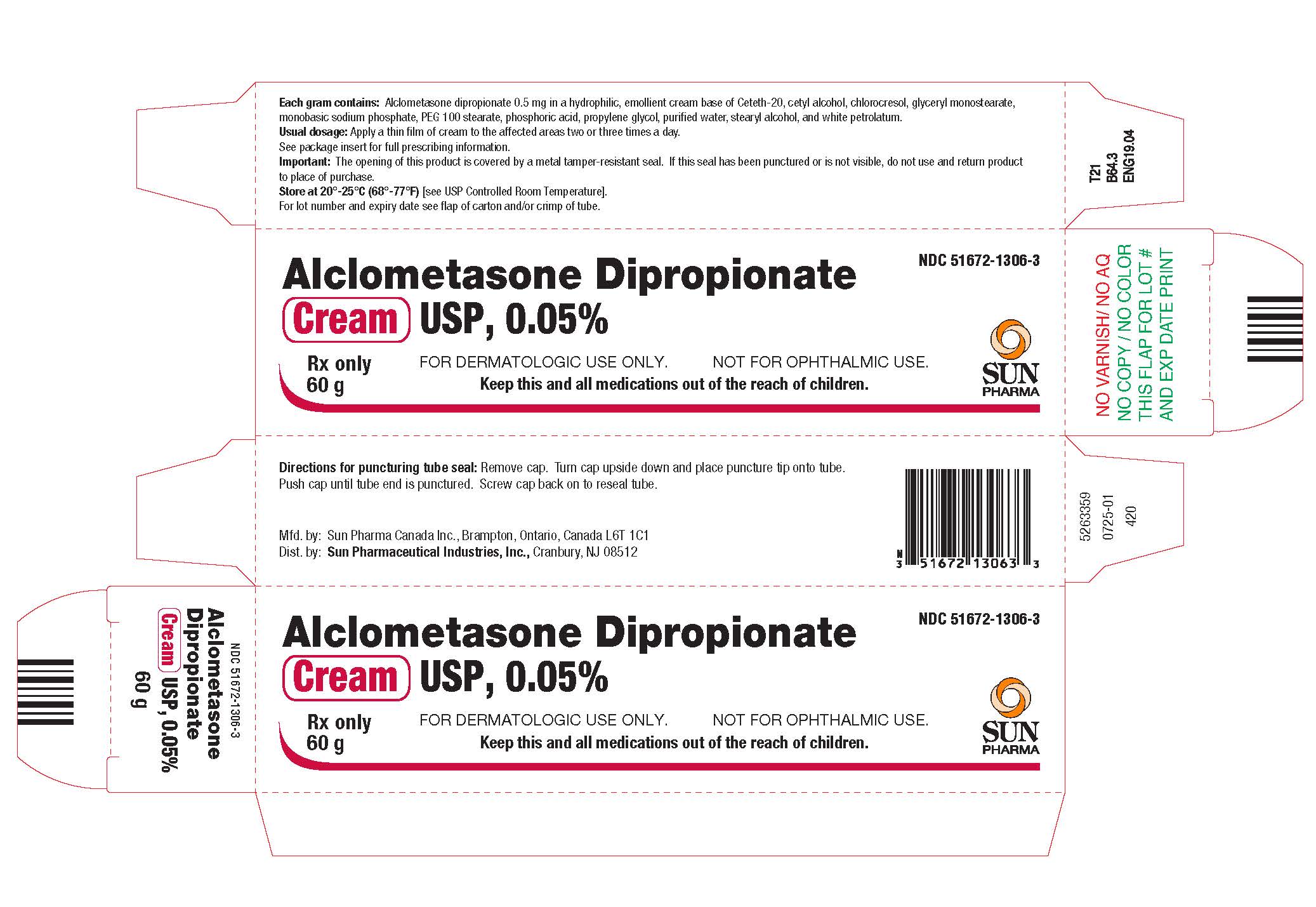
Carton-sun (Carton Sun)

Principal Display Panel (15 g Tube Carton)
* Please review the disclaimer below.
