- Safety and effectiveness have not been established for the treatment of transfusional iron overload in patients with other chronic anemias.
Starting Dose
The recommended initial dose of deferiprone is 25 mg/kg actual body weight, orally, three times per day for a total of 75 mg/kg/day. Round dose to the nearest 250 mg (half-tablet).
Table 1a: Tablet requirement to achieve a 25 mg/kg dose (rounded to the nearest half-tablet) for administration three times a day.Body Weight
(kg) | Dose (mg) | Number of 500 mg tablets |
|---|
| 20 | 500 | 1 |
| 30 | 750 | 1.5 |
| 40 | 1,000 | 2 |
| 50 | 1,250 | 2.5 |
| 60 | 1,500 | 3 |
| 70 | 1,750 | 3.5 |
| 80 | 2,000 | 4 |
| 90 | 2,250 | 4.5 |
Dose Adjustments
Tailor dose adjustments to the individual patient's response and therapeutic goals (maintenance or reduction of body iron burden). The maximum dose is 33 mg/kg actual body weight, three times per day for a total of 99 mg/kg/day.
Table 1b: Tablet requirement to achieve a 33 mg/kg dose (rounded to the nearest half-tablet) for administration three times a day.Body Weight
(kg) | Dose (mg) | Number of 500 mg tablets |
|---|
| 20 | 660 | 1.5 |
| 30 | 990 | 2 |
| 40 | 1,320 | 2.5 |
| 50 | 1,650 | 3.5 |
| 60 | 1,980 | 4 |
| 70 | 2,310 | 4.5 |
| 80 | 2,640 | 5.5 |
| 90 | 2,970 | 6 |
Monitor serum ferritin concentration every two to three months to assess the effect of deferiprone on body iron stores. If the serum ferritin is consistently below 500 mcg/L, consider temporarily interrupting deferiprone therapy until serum ferritin rises above 500 mcg/L.
For agranulocytosis (ANC < 0.5 × 10⁹/L):
Consider hospitalization and other management as clinically appropriate.
Do not resume deferiprone in patients who have developed agranulocytosis unless potential benefits outweigh potential risks. Do not rechallenge patients who have developed neutropenia with deferiprone unless potential benefits outweigh potential risks.
For neutropenia (ANC < 1.5 × 10⁹/L and > 0.5 × 10⁹/L):
Instruct the patient to immediately discontinue deferiprone and all other medications with a potential to cause neutropenia.
Obtain a complete blood cell (CBC) count, including a white blood cell (WBC) count corrected for the presence of nucleated red blood cells, an absolute neutrophil count (ANC), and a platelet count daily until recovery (ANC ≥ 1.5 × 10⁹/L).
UDP-Glucuronosyltransferases (UGTs)
Avoid co-administration of deferiprone with a UGT1A6 inhibitor (e.g., diclofenac, probenecid, or silymarin (milk thistle)) [see Dosage and Administration (2.2), Adverse Reactions (6.1), and Clinical Pharmacology (12.3)].
Polyvalent Cations
Deferiprone has the potential to bind polyvalent cations (e.g., iron, aluminum, and zinc); allow at least a 4-hour interval between administration of deferiprone and other medications (e.g., antacids) or supplements containing these polyvalent cations [see Dosage and Administration (2.2)].
Risk Summary
In animal reproduction studies, oral administration of deferiprone to pregnant rats and rabbits during organogenesis at doses 33% and 49%, respectively, of the maximum recommended human dose (MRHD) resulted in structural abnormalities, embryo-fetal mortality and alterations to growth (see Data). The limited data from deferiprone use in pregnant women are insufficient to inform a drug-associated risk of major birth defects and miscarriage. Based on evidence of genotoxicity and developmental toxicity in animal studies, deferiprone can cause fetal harm when administered to a pregnant woman. Advise pregnant women and females of reproductive potential of the potential risk to a fetus.
The estimated background risk of major birth defects and miscarriage for the indicated population is unknown. All pregnancies have a background risk of birth defect, loss, or other adverse outcomes. In the U.S. general population, the estimated background risk of major birth defects and of miscarriage is 2 to 4% and 15 to 20%, respectively.
Data
Human Data
Post-marketing data available from 39 pregnancies of deferiprone-treated patients and 10 pregnancies of partners of deferiprone-treated patients are as follows:
Of the 39 pregnancies in deferiprone-treated patients, 23 resulted in healthy newborns, 6 ended in spontaneous abortion, 9 had unknown outcomes, and 1 infant was born with anal atresia, nephroptosis, ventricular septal defect, hemivertebra and urethral fistula.
Of the 10 pregnancies in partners of deferiprone-treated patients, 5 resulted in healthy newborns, 1 resulted in a healthy newborn with slight hypospadias, 1 was electively terminated, 1 resulted in the intrauterine death of twins, and 2 had unknown outcomes.
Animal Data
During organogenesis, pregnant rats and rabbits received deferiprone at oral doses of 0, 30, 80 or 200 mg/kg/day, and 0, 10, 50, or 150 mg/kg/day, respectively. The daily dose was administered as two equal divided doses approximately 7 hours apart. Doses of 200 mg/kg/day in rats and 150 mg/kg/day in rabbits, approximately 33% and 49% of the MRHD, respectively, resulted in increased post-implantation loss and reduced fetal weights in the presence of maternal toxicity (reduced maternal body weight and body weight gain in both rats and rabbits; abnormal large placenta at low incidence in rats). The 200 mg/kg/day dose in rats resulted in external, visceral and skeletal fetal malformations, such as cranial malformations, cleft palate, limb malrotation, anal atresia, internal hydrocephaly, anophthalmia, and fused bones. The dose of 150 mg/kg/day in rabbits resulted in external fetal malformations (partially opened eyes) and minor blood vessel and skeletal variations.
In rats, malformations including micrognathia and persistent ductus arteriosus could be observed in the absence of maternal toxicity at doses equal to or greater than 30 and 80 mg/kg/day, approximately 5% and 13% of the MHRD, respectively.
Risk Summary
There is no information regarding the presence of deferiprone in human milk, the effects on the breastfed child, or the effects on milk production.
Because of the potential for serious adverse reactions in the breastfed child, including the potential for tumorigenicity shown for deferiprone in animal studies, advise patients that breastfeeding is not recommended during treatment with deferiprone, and for at least 2 weeks after the last dose.
Pregnancy Testing
Pregnancy testing is recommended for females of reproductive potential prior to initiating deferiprone.
Contraception
Females
Deferiprone can cause embryo-fetal harm when administered to a pregnant woman [see Use in Specific Populations (8.1)]. Advise female patients of reproductive potential to use effective contraception during treatment with deferiprone and for at least 6 months after the last dose.
Males
Based on genotoxicity findings, advise males with female partners of reproductive potential to use effective contraception during treatment with deferiprone and for at least 3 months after the last dose [see Nonclinical Toxicology (13.1)].
Cardiac Electrophysiology
At a dose 1.5 times the maximum approved recommended dosage, deferiprone does not prolong the QT interval to any clinically relevant extent.
Absorption
Deferiprone appeared in the blood within 5 to 10 minutes after oral administration. Peak serum concentration of deferiprone was reached approximately 1 to 2 hours after a single dose.
Effect of Food
No clinically significant differences in the pharmacokinetics of deferiprone were observed following administration with food.
Elimination
The elimination half-life of deferiprone is approximately 2 hours.
Metabolism
Deferiprone is metabolized primarily by UGT1A6. The major metabolite of deferiprone is the 3-O-glucuronide, which lacks iron binding capability.
Excretion
Following oral administration, 75% to 90% of the administered dose was recovered in urine (primarily as metabolite) in the first 24 hours.
Specific Populations
No clinically significant differences in the pharmacokinetics of deferiprone were observed based on sex, race/ethnicity, body weight, mild to severe (eGFR 15 to 89 mL/min/1.73 m2) renal impairment, or mild (Child Pugh Class A) to moderate (Child Pugh Class B) hepatic impairment. The effect of age, including geriatric or pediatric populations, end stage renal disease, or severe (Child Pugh Class C) hepatic impairment on the pharmacokinetics of deferiprone is unknown.
Drug Interaction Studies
In Vitro Studies
UGT1A6 Inhibitors: Co-administration of deferiprone with phenylbutazone (UGT1A6 inhibitor) decreased glucuronidation of deferiprone by up to 78%.
Polyvalent Cations: Deferiprone has the potential to bind polyvalent cations (e.g., iron, aluminum, and zinc).
Transfusional Iron Overload
In a prospective, planned, pooled analysis of patients from several studies, the efficacy of deferiprone was assessed in transfusion-dependent iron overload patients in whom previous iron chelation therapy had failed or was considered inadequate due to poor tolerance. The main criterion for chelation failure was serum ferritin > 2,500 mcg/L before treatment with deferiprone. Deferiprone therapy (35 to 99 mg/kg/day) was considered successful in individual patients who experienced a ≥ 20% decline in serum ferritin within one year of starting therapy.
Data from a total of 236 patients were analyzed. Of the 224 patients with thalassemia who received deferiprone monotherapy and were eligible for serum ferritin analysis, 105 (47%) were male and 119 (53%) were female. The mean age of these patients was 18.2 years.
For the patients in the analysis, the endpoint of at least a 20% reduction in serum ferritin was met in 50% (of 236 subjects), with a 95% confidence interval of 43% to 57%.
A small number of patients with thalassemia and iron overload were assessed by measuring the change in the number of milliseconds (ms) in the cardiac MRI T2* value before and after treatment with deferiprone for one year. There was an increase in cardiac MRI T2* from a mean at baseline of 11.8 ± 4.9 ms to a mean of 15.1 ± 7.0 ms after approximately one year of treatment. The clinical significance of this observation is not known.
Embryo-Fetal toxicity
Advise pregnant women and females of reproductive potential of the potential risk to a fetus. Advise females to inform their healthcare provider of a known or suspected pregnancy [see Warnings and Precautions (5.4) and Use in Specific Populations (8.1)]. Advise female patients of reproductive potential to use effective contraception during treatment with deferiprone and for at least six months after the last dose [see Use in Specific Populations (8.1, 8.3)]. Advise males with female partners of reproductive potential to use effective contraception during treatment with deferiprone and for at least three months after the last dose [see Use in Specific Populations (8.3) and Nonclinical Toxicology (13.1)].
Lactation
Advise females not to breastfeed during treatment with deferiprone and for at least 2 weeks after the last dose [see Use in Specific Populations (8.2)].
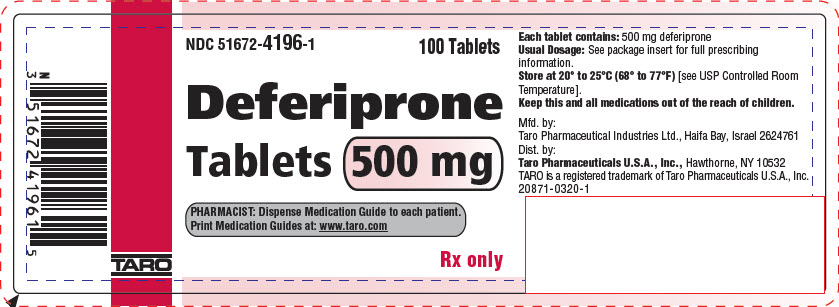
Mfd. by: Taro Pharmaceutical Industries Ltd., Haifa Bay, Israel, 2624761
Dist. by: Taro Pharmaceuticals U.S.A., Inc., Hawthorne, NY, 10532
Revised: March 2020
20872-0320-1
Dispense with Medication Guide available at:
https://www.taro.com/usa-medication-guides