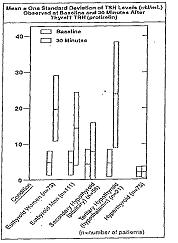
Interpretation of the TSH response to TRH requires an understanding of thyroid-pituitary-hypothalamic physiology and knowledge of the clinical status of the individual patient. Because the TSH test results may vary with the laboratory, the physician should be familiar with the TSH assay method used and the normal range for the laboratory performing the assay. TSH response 30 minutes after TRH administration in normal subjects and in patients with hyperthyroidism and hypothyroidism are presented in Figure 2. The diagnoses were established prior to the administration of TRH on the basis of the clinical history, physical examination, and the results of other thyroid and/or pituitary function tests.
Among the normal euthyroid subjects, women and children were found to have higher levels of TSH at 30 minutes than men.
Among the patients with hyperthyroidism or primary (thyroidal), secondary (pituitary), or tertiary (hypothalamic) hypothyroidism, no significant differences in TSH levels by age or sex were found.
Figure 2

Ad867c7e-figure-02 (Ad867c7e Figure 02)
Normal: Baseline TSH levels of less than 10 microunits/mL (μU/mL) were observed in 97% of euthyroid normal subjects tested. Thirty minutes after TRH, the serum TSH increased by 2.0 mμU/mL or more in 95% of euthyroid subjects.
Hyperthyroidism: All hyperthyroid patients tested had baseline TSH levels of less than 10 μU/mL and a rise of less than 2 μU/pL 30 minutes after TRH.
Primary (thyroidal) hypothyroidism: The diagnosis of primary hypothyroidism is frequently supported by finding clearly elevated baseline TSH levels; 93% of patients tested had levels above 10 μU/mL. TRH administration to these patients generally would not be expected to yield additional useful information. Ninety-four percent of patients with primary hypothyroidism given ® TRH in clinical trials responded with a rise in TSH of 2.0 μU/mL or greater. Since this response is also found in normal subjects, TRH testing does not differentiate primary hypothyroidism from normal.
Secondary (pituitary) and tertiary (hypothalamic) hypothyroidism: In the presence of clinical and other laboratory evidence of hypothyroidism, the finding of a baseline TSH level less than 10 mU/mL should suggest secondary or tertiary hypothyroidism. In this situation, a response to TRH of less than 2 μU/mL suggests secondary hypothyroidism since this response was observed in about 60% of patients with, secondary hypothyroidism and only approximately 5% of patients with tertiary hypothyroidism. A TSH response to TRH greater than 2 μU/mL is not helpful in differentiating between secondary and tertiary hypothyroidism since this response was noted in about 40% of the former and about 95% of the latter.
Establishing the diagnosis of secondary or tertiary hypothyroidism requires a careful history and physical examination along with appropriate tests of anterior pituitary and/or target gland function. The TRH test should not be used as the only laboratory determinant for establishing these diagnoses.