Other
Embryo-Fetal Toxicity
- Pomalidomide capsules are contraindicated in pregnancy. Pomalidomide capsules are a thalidomide analogue. Thalidomide is a known human teratogen that causes severe birth defects or embryo-fetal death. In females of reproductive potential, obtain 2 negative pregnancy tests before starting pomalidomide capsules treatment.
- Females of reproductive potential must use 2 forms of contraception or continuously abstain from heterosexual sex during and for 4 weeks after stopping pomalidomide capsules treatment [see Contraindications (4), Warnings and Precautions (5.1) and Use in Specific Populations (8.1, 8.3)].
- ANC less than 500 per mcL or febrile neutropenia (fever greater than or equal to 38.5°C and ANC less than 1,000 per mcL)
- Withhold pomalidomide capsules until ANC is greater than or equal to 500 per mcL; follow CBC weekly.
- Resume pomalidomide capsules dose at 1 mg less than the previous dose.
Permanently discontinue pomalidomide capsules if unable to tolerate 1 mg once daily.
- For each subsequent drop of ANC less than 500 per mcL
- Withhold pomalidomide capsules until ANC is greater than or equal to 500 mcL.
- Resume pomalidomide capsules dose at 1 mg less than the previous dose.
- Platelets less than 25,000 per mcL
- Withhold pomalidomide capsules until platelets are greater than or equal to 50,000 per mcL; follow CBC weekly.
- Resume pomalidomide capsules dose at 1 mg less than the previous dose.
- For each subsequent drop of platelets less than 25,000 per mcL
- Withhold pomalidomide capsules until platelets are greater than or equal to 50,000 per mcL.
- Resume pomalidomide capsules at 1 mg less than the previous dose.
- Withhold pomalidomide capsules until ANC is greater than or equal to 1,000 per mcL.
- Resume pomalidomide capsules at the same dose. During cycle
- Continue pomalidomide capsules at the current dose.
- Withhold pomalidomide capsules until ANC is greater than or equal to 1,000 per mcL.
- Resume pomalidomide capsules at the same dose.
- Withhold pomalidomide capsules until ANC is greater than or equal to 1,000 per mcL.
- Resume pomalidomide capsules at dose 1 mg less than the previous dose.
Permanently discontinue pomalidomide capsules if unable to tolerate 1mg once daily.
- Withhold pomalidomide capsules until platelet count is greater than or equal to 50,000 per mcL.
- Resume pomalidomide capsules at the same dose. During cycle:
- Continue pomalidomide capsules at the current dose.
- Advise females of reproductive potential that they must avoid pregnancy while taking pomalidomide capsules and for at least 4 weeks after completing therapy.
- Initiate pomalidomide capsules treatment in females of reproductive potential only following a negative pregnancy test.
- Advise females of reproductive potential of the importance of monthly pregnancy tests and the need to use 2 different forms of contraception, including at least 1 highly effective form, simultaneously during pomalidomide capsules therapy, during dose interruptions, and for 4 weeks after she has completely finished taking pomalidomide capsules. Highly effective forms of contraception other than tubal ligation include IUD and hormonal (birth control pills, injections, patch, or implants) and a partner's vasectomy. Additional effective contraceptive methods include latex or synthetic condom, diaphragm, and cervical cap.
- Instruct patient to immediately stop taking pomalidomide capsules and contact her healthcare provider if she becomes pregnant while taking this drug, if she misses her menstrual period or experiences unusual menstrual bleeding, if she stops taking birth control, or if she thinks FOR ANY REASON that she may be pregnant.
- Advise patient that if her healthcare provider is not available, she should call the REMS Call Center at 1-888-423-5436 [see Warnings and Precautions (5.1) and Use in Specific Populations (8.3)].
- Advise males to always use a latex or synthetic condom during any sexual contact with females of reproductive potential while taking pomalidomide capsules and for up to 4 weeks after discontinuing pomalidomide capsules, even if they have undergone a successful vasectomy.
- Advise male patients taking pomalidomide capsules that they must not donate sperm [see Warnings and Precautions (5.1) and Use in Specific Populations (8.3)].
- All patients must be instructed to not donate blood while taking pomalidomide capsules and for 4 weeks following discontinuation of pomalidomide capsules [see Warnings and Precautions (5.1)].
- Patients must sign a Patient-Physician Agreement Form and comply with the requirements to receive pomalidomide capsules. In particular, females of reproductive potential must comply with the pregnancy testing, contraception requirements, and participate in monthly telephone surveys. Males must comply with the contraception requirements [see Use in Specific Populations (8.3)].
- Pomalidomide capsules are available only from pharmacies that are certified in PS-Pomalidomide REMS. Provide patients with the telephone number and website for information on how to obtain the product.
- Pomalidomide capsules should be taken once daily at about the same time each day.
- Patients on hemodialysis should take pomalidomide capsules following hemodialysis, on hemodialysis days.
- Pomalidomide capsules may be taken with or without food.
- The capsules should not be opened, broken, or chewed. pomalidomide capsules should be swallowed whole with water.
- Instruct patients that if they miss a dose of pomalidomide capsules, they may still take it up to 12 hours after the time they would normally take it. If more than 12 hours have elapsed, they should be instructed to skip the dose for that day. The next day, they should take pomalidomide capsules at the usual time. Warn patients not to take 2 doses to make up for the one that they missed.
Pomalidomide capsules are only available through a restricted distribution program called PS-Pomalidomide REMS [see Warnings and Precautions (5.2)]. Information about PS-Pomalidomide REMS is available at www.PS-PomalidomideREMS.com or by calling the REMS Call Center at 1-888-423-5436.
Venous and Arterial Thromboembolism
Deep venous thrombosis (DVT), pulmonary embolism (PE), myocardial infarction, and stroke occur in patients with multiple myeloma treated with pomalidomide capsules. Prophylactic antithrombotic measures were employed in clinical trials. Thromboprophylaxis is recommended, and the choice of regimen should be based on assessment of the patient's underlying risk factors [see Warnings and Precautions (5.3)].
Multiple Myeloma: Dosage Modifications for Hematologic Adverse Reactions
Initiate a new cycle of pomalidomide capsules in patients with multiple myeloma (MM) when the neutrophil count is at least 500 per mcL and the platelet count is at least 50,000 per mcL.
Dosage modification for pomalidomide capsules for hematologic adverse reactions in patients with MM are summarized in Table 1.
| Adverse Reaction | Severity | Dosage Modification |
|---|---|---|
| ANC= absolute neutrophil count | ||
| Neutropenia [see Warnings and Precautions (5.5)] | ||
| Thrombocytopenia [see Warnings and Precautions (5.5)] | ||
Kaposi Sarcoma : Dosage Modifications for Hematologic Adverse Reactions
Initiate a new cycle of pomalidomide capsules in patients with KS when the neutrophil count is at least 1000 per mcL and the platelet count is at least 75,000 per mcL.
Dose modifications for pomalidomide capsules for hematologic adverse reactions in patients with KS are summarized in Table 2.
| Adverse Reaction | Severity | Dosage Modification |
|---|---|---|
| ANC= absolute neutrophil count | ||
| Neutropenia [see Warnings and Precautions (5.5)] | ANC 500 to less than 1,000 per mcL | Day 1 of cycle |
| ANC less than 500 per mcL | ||
| Febrile Neutropenia [see Warnings and Precautions (5.5)] | ANC less than 1,000 per mcL and single temperature greater than or equal to 38.3°C or ANC less than 1,000 per mcL and sustained temperature greater than or equal to 38°C for more than 1 hour | |
| Thrombocytopenia [see Warnings and Precautions (5.5)] | Platelet count 25,000 to less than 50,000 per mcL | Day 1 of cycle |
| Platelet count less than 25,000 per mcL | Permanently discontinue pomalidomide capsules. | |
Multiple Myeloma
For patients with MM with mild or moderate hepatic impairment (Child-Pugh A or B), reduce the recommended dosage to 3 mg orally daily.
For patients with MM with severe hepatic impairment (Child-Pugh C), reduce the recommended dosage to 2 mg [see Use in Specific Populations (8.7) and Clinical Pharmacology (12.3)].
Kaposi Sarcoma
For patients with KS with mild, moderate, or severe hepatic impairment (Child-Pugh A, B, or C), reduce the recommended dosage to 3 mg orally daily [see Use in Specific Populations (8.7) and Clinical Pharmacology (12.3)].
Females of Reproductive Potential
Females of reproductive potential must avoid pregnancy for at least 4 weeks before beginning Pomalidomide Capsules therapy, during therapy, during dose interruptions and for at least 4 weeks after completing therapy.
Females must commit either to abstain continuously from heterosexual sexual intercourse or to use 2 methods of reliable birth control, beginning 4 weeks prior to initiating treatment with pomalidomide capsules, during therapy, during dose interruptions, and continuing for 4 weeks following discontinuation of pomalidomide capsules therapy.
Two negative pregnancy tests must be obtained prior to initiating therapy. The first test should be performed within 10-14 days and the second test within 24 hours prior to prescribing pomalidomide capsules therapy and then weekly during the first month, then monthly thereafter in females with regular menstrual cycles, or every 2 weeks in females with irregular menstrual cycles [see Use in Specific Populations (8.3)].
Males
Pomalidomide is present in the semen of patients receiving the drug. Therefore, males must always use a latex or synthetic condom during any sexual contact with females of reproductive potential while taking pomalidomide capsules and for up to 4 weeks after discontinuing pomalidomide capsules, even if they have undergone a successful vasectomy. Male patients taking pomalidomide capsules must not donate sperm [see Use in Specific Populations (8.3)].
Blood Donation
Patients must not donate blood during treatment with pomalidomide capsules and for 4 weeks following discontinuation of the drug because the blood might be given to a pregnant female patient whose fetus must not be exposed to pomalidomide capsules.
Multiple Myeloma
In trials 1 and 2 in patients who received pomalidomide capsules + Low-dose Dex, neutropenia was the most frequently reported Grade 3 or 4 adverse reaction, followed by anemia and thrombocytopenia. Neutropenia of any grade was reported in 51% of patients in both trials. The rate of Grade 3 or 4 neutropenia was 46%. The rate of febrile neutropenia was 8%.
Monitor patients for hematologic toxicities, especially neutropenia. Monitor complete blood counts weekly for the first 8 weeks and monthly thereafter. Patients may require dose interruption and/or modification [see Dosage and Administration (2.4)].
Kaposi Sarcoma
In Trial 12-C-0047, hematologic toxicities were the most common (all grades and Grade 3 or 4) adverse reactions [see Adverse Reactions (6.1)]. Fifty percent of patients had Grade 3 or 4 neutropenia. Monitor patients for hematologic toxicities, especially decreased neutrophils. Monitor complete blood counts every 2 weeks for the first 12 weeks and monthly thereafter. Withhold, reduce the dose, or permanently discontinue pomalidomide capsules based on the severity of the reaction [see Dosage and Administration (2.4)].
Multiple Myeloma (MM)
In Trial 1, data were evaluated from 219 patients (safety population) who received treatment with pomalidomide capsules + Low-dose Dex (112 patients) or pomalidomide capsules alone (107 patients). Median number of treatment cycles was 5. Sixty-seven percent of patients in the study had a dose interruption of either drug due to adverse reactions. Forty-two percent of patients in the study had a dose reduction of either drug due to adverse reactions. The discontinuation rate due to adverse reactions was 11%.
In Trial 2, data were evaluated from 450 patients (safety population) who received treatment with pomalidomide capsules + Low-dose Dex (300 patients) or High-dose Dexamethasone (High-dose Dex) (150 patients). The median number of treatment cycles for the pomalidomide capsules + Low-dose Dex arm was 5. In the pomalidomide capsules + Low-dose Dex arm, 67% of patients had a dose interruption of pomalidomide capsules, the median time to the first dose interruption of pomalidomide capsules was 4.1 weeks. Twenty-seven percent of patients had a dose reduction of pomalidomide capsules, the median time to the first dose reduction of Pomalidomide capsules was 4.5 weeks. Eight percent of patients discontinued pomalidomide capsules due to adverse reactions.
Tables 3 and 4 summarize the adverse reactions reported in Trials 1 and 2, respectively.
| All Adverse Reactions ≥10% in Either Arm | Grade 3 or 4 ≥5% in Either Arm | |||
|---|---|---|---|---|
| Body System Adverse Reaction | Pomalidomide capsules Pomalidomide capsules alone arm includes all patients randomized to the pomalidomide capsules alone arm who took study drug; 61 of the 107 patients had dexamethasone added during the treatment period. (N=107) | Pomalidomide capsules + Low-dose Dex (N=112) | Pomalidomide capsules (N=107) | Pomalidomide capsules + Low-dose Dex (N=112) |
| Data cutoff: 01 March 2013 | ||||
| Number (%) of patients with at least one adverse reaction | 107 (100) | 112 (100) | 98 (92) | 102 (91) |
| Blood and lymphatic system disorders | ||||
| Neutropenia Serious adverse reactions were reported in at least 2 patients in any pomalidomide capsules treatment arm. | 57 (53) | 55 (49) | 51 (48) | 46 (41) |
| Anemia | 41 (38) | 47 (42) | 25 (23) | 24 (21) |
| Thrombocytopenia | 28 (26) | 26 (23) | 24 (22) | 21 (19) |
| Leukopenia | 14 (13) | 22 (20) | 7 (7) | 11 (10) |
| Febrile neutropenia | <10% | <10% | 6 (6) | 3 (3) |
| Lymphopenia | 4 (4) | 17 (15) | 2 (2) | 8 (7) |
| General disorders and administration site conditions | ||||
| Fatigue and asthenia | 62 (58) | 70 (63) | 13 (12) | 19 (17) |
| Edema peripheral | 27 (25) | 19 (17) | 0 (0.0) | 0 (0.0) |
| Pyrexia | 25 (23) | 36 (32) | <5% | <5% |
| Chills | 11 (10) | 14 (13) | 0 (0.0) | 0 (0.0) |
| Gastrointestinal disorders | ||||
| Nausea | 39 (36) | 27 (24) | <5% | <5% |
| Constipation | 38 (36) | 41 (37) | <5% | <5% |
| Diarrhea | 37 (35) | 40 (36) | <5% | <5% |
| Vomiting | 15 (14) | 16 (14) | <5% | 0 (0.0) |
| Musculoskeletal and connective tissue disorders | ||||
| Back pain | 37 (35) | 36 (32) | 15 (14) | 11 (10) |
| Musculoskeletal chest pain | 25 (23) | 22 (20) | <5% | 0(0.0) |
| Muscle spasms | 23 (21) | 22 (20) | <5% | <5% |
| Arthralgia | 18 (17) | 17 (15) | <5% | <5% |
| Muscular weakness | 15 (14) | 15 (13) | 6 (6) | 4 (4) |
| Bone pain | 13 (12) | 8 (7) | <5% | <5% |
| Musculoskeletal pain | 13 (12) | 19 (17) | <5% | <5% |
| Pain in extremity | 8 (7) | 16 (14) | 0 (0.0) | <5% |
| Infections and infestations | ||||
| Upper respiratory tract infection | 40 (37) | 32 (29) | <5% | <5% |
| Pneumonia | 30 (28) | 38 (34) | 21 (20) | 32 (29) |
| Urinary tract infection | 11 (10) | 19 (17) | 2 (2) | 10 (9) |
| Sepsis | <10% | <10% | 6 (6) | 5 (4) |
| Metabolism and nutrition disorders | ||||
| Decreased appetite | 25 (23) | 21 (19) | <5% | 0 (0.0) |
| Hypercalcemia | 23 (21) | 13 (12) | 11 (10) | 1 (<1) |
| Hypokalemia | 13 (12) | 13 (12) | <5% | <5% |
| Hyperglycemia | 12 (11) | 17 (15) | <5% | <5% |
| Hyponatremia | 12 (11) | 14 (13) | <5% | <5% |
| Dehydration | <10% | <10% | 5 (4.7) | 6 (5.4) |
| Hypocalcemia | 6 (6) | 13 (12) | 0 (0.0) | <5% |
| Respiratory, thoracic and mediastinal disorders | ||||
| Dyspnea | 38 (36) | 50 (45) | 8 (7) | 14 (13) |
| Cough | 18 (17) | 25 (22) | 0 (0.0) | 0 (0.0) |
| Epistaxis | 18 (17) | 12 (11) | <5% | 0 (0.0) |
| Productive cough | 10 (9) | 14 (13) | 0 (0.0) | 0 (0.0) |
| Oropharyngeal pain | 6 (6) | 12 (11) | 0 (0.0) | 0 (0.0) |
| Nervous system disorders | ||||
| Dizziness | 24 (22) | 20 (18) | <5% | <5% |
| Peripheral neuropathy | 23 (21) | 20 (18) | 0 (0.0) | 0 (0.0) |
| Headache | 16 (15) | 15 (13) | 0 (0.0) | <5% |
| Tremor | 11 (10) | 15 (13) | 0 (0.0) | 0 (0.0) |
| Skin and subcutaneous tissue disorders | ||||
| Rash | 22 (21) | 18 (16) | 0 (0.0) | <5% |
| Pruritus | 16 (15) | 10 (9) | 0 (0.0) | 0 (0.0) |
| Dry skin | 10 (9) | 12 (11) | 0 (0.0) | 0 (0.0) |
| Hyperhidrosis | 8 (7) | 18 (16) | 0 (0.0) | 0 (0.0) |
| Night sweats | 5 (5) | 14 (13) | 0 (0.0) | 0 (0.0) |
| Investigations | ||||
| Blood creatinine increased | 20 (19) | 11 (10) | 6 (6) | 3 (3) |
| Weight decreased | 16 (15) | 10 (9) | 0 (0.0) | 0 (0.0) |
| Weight increased | 1 (<1) | 12 (11) | 0 (0.0) | 0 (0.0) |
| Psychiatric disorders | ||||
| Anxiety | 14 (13) | 8 (7) | 0 (0.0) | 0 (0.0) |
| Confusional state | 13 (12) | 15 (13) | 6 (6) | 3 (3) |
| Insomnia | 7 (7) | 18 (16) | 0 (0.0) | 0 (0.0) |
| Renal and urinary disorders | ||||
| Renal failure | 16 (15) | 11 (10) | 9 (8) | 8 (7) |
| All Adverse Reactions (≥5% in Pomalidomide Capsules + Low-dose Dex arm, and at least 2% higher than the High-dose-Dex arm) | Grade 3 or 4 (≥1% in Pomalidomide Capsules + Low-dose Dex arm, and at least 1% higher than the High-dose-Dex arm) | |||
|---|---|---|---|---|
| Body System Adverse Reaction | Pomalidomide Capsules + Low-dose Dex (N=300) | High dose Dex (N=150) | Pomalidomide Capsules + Low-dose Dex (N=300) | High-dose Dex (N=150) |
| Data cutoff: 01 March 2013 | ||||
| Number (%) of patients with at least one adverse reaction | 297 (99) | 149 (99) | 259 (86) | 127 (85) |
| Blood and lymphatic system disorders | ||||
| Neutropenia Serious adverse reactions were reported in at least 3 patients in the POM + Low-dose Dex arm, AND at least 1% higher than the High-dose-Dex arm percentage. | 154 (51) | 31 (21) | 145 (48) | 24 (16) |
| Thrombocytopenia | 89 (30) Percentage did not meet the criteria to be considered as an adverse reaction for pomalidomide capsules for that category of event (i.e., all adverse events or Grade 3 or 4 adverse events). | 44 (29) | 66 (22) | 39 (26) |
| Leukopenia | 38 (13) | 8 (5) | 27 (9) | 5 (3) |
| Febrile neutropenia | 28 (9) | 0 (0.0) | 28 (9) | 0 (0.0) |
| General disorders and administration site conditions | ||||
| Fatigue and asthenia | 140 (47) | 64 (43) | 26 (9) | 18 (12) |
| Pyrexia | 80 (27) | 35 (23) | 9 (3) | 7 (5) |
| Edema peripheral | 52 (17) | 17 (11) | 4 (1) | 3 (2) |
| Pain | 11 (4) | 3 (2) | 5 (2) | 1 (<1) |
| Infections and infestations | ||||
| Upper respiratory tract infection | 93 (31) | 19 (13) | 9 (3) | 1 (<1) |
| Pneumonia | 58 (19) | 20 (13) | 47 (16) | 15 (10) |
| Neutropenic sepsis | 3 (1) | 0 (0.0) | 3 (1) | 0 (0.0) |
| Gastrointestinal disorders | ||||
| Diarrhea | 66 (22) | 28 (19) | 3 (1) | 2 (1) |
| Constipation | 65 (22) | 22 (15) | 7 (2) | 0 (0.0) |
| Nausea | 45 (15) | 17 (11) | 3 (1) | 2 (1) |
| Vomiting | 23 (8) | 6 (4) | 3 (1) | 0 (0.0) |
| Musculoskeletal and connective tissue disorders | ||||
| Back pain | 59 (20) | 24 (16) | 15 (5) | 6 (4) |
| Bone pain | 54 (18) | 21 (14) | 22 (7) | 7 (5) |
| Muscle spasms | 46 (15) | 11 (7) | 1 (<1) | 1 (<1) |
| Arthralgia | 26 (9) | 7 (5) | 2 (<1) | 1 (<1) |
| Pain in extremity | 20 (7) | 9 (6) | 6 (2) | 0 (0.0) |
| Respiratory, thoracic and mediastinal disorders | ||||
| Dyspnea | 76 (25) | 25 (17) | 17 (6) | 7 (5) |
| Cough | 60 (20) | 15 (10) | 2 (<1) | 1 (<1) |
| Chronic obstructive pulmonary disease | 5 (2) | 0 (0.0) | 4 (1) | 0 (0.0) |
| Nervous system disorders | ||||
| Peripheral neuropathy | 52 (17) | 18 (12) | 5 (2) | 2 (1) |
| Dizziness | 37 (12) | 14 (9) | 4 (1) | 2 (1) |
| Headache | 23 (8) | 8 (5) | 1 (<1) | 0 (0.0) |
| Tremor | 17 (6) | 2 (1) | 2 (<1) | 0 (0.0) |
| Depressed level of consciousness | 5 (2) | 0 (0.0) | 3 (1) | 0 (0.0) |
| Metabolism and nutrition disorders | ||||
| Decreased appetite | 38 (13) | 12 (8) | 3 (1) | 2 (1) |
| Hypokalemia | 28 (9) | 12 (8) | 12 (4) | 4 (3) |
| Hypocalcemia | 12 (4) | 9 (6) | 5 (2) | 1 (<1) |
| Skin and subcutaneous tissue disorders | ||||
| Rash | 23 (8) | 2 (1) | 3 (1) | 0 (0.0) |
| Pruritus | 22 (7) | 5 (3) | 0 (0.0) | 0 (0.0) |
| Hyperhidrosis | 15 (5) | 1 (<1) | 0 (0.0) | 0 (0.0) |
| Investigations | ||||
| Neutrophil count decreased | 15 (5) | 1 (<1) | 14 (5) | 1 (<1) |
| Platelet count decreased | 10 (3) | 3 (2) | 8 (3) | 2 (1) |
| White blood cell count decreased | 8 (3) | 1 (<1) | 8 (3) | 0 (0.0) |
| Alanine aminotransferase increased | 7 (2) | 2 (1) | 5 (2) | 0 (0.0) |
| Aspartate aminotransferase increased | 4 (1) | 2 (1) | 3 (1) | 0 (0.0) |
| Lymphocyte count decreased | 3 (1) | 1 (<1) | 3 (1) | 0 (0.0) |
| Renal and urinary disorders | ||||
| Renal failure | 31 (10) | 18 (12) | 19 (6) | 8 (5) |
| Injury, poisoning and procedural complications | ||||
| Femur fracture | 5 (2) | 1 (<1) | 5 (2) | 1 (<1) |
| Reproductive system and breast disorders | ||||
| Pelvic pain | 6 (2) | 3 (2) | 4 (1) | 0 (0.0) |
Other Adverse Reactions
Other adverse reactions of pomalidomide capsules in patients with MM, not described above, and considered important:
Cardiac Disorders: Myocardial infarction, Atrial fibrillation, Angina pectoris, Cardiac failure congestive
Ear and Labyrinth Disorders: Vertigo
Gastrointestinal disorders: Abdominal pain
General Disorders and Administration Site Conditions: General physical health deterioration, Non-cardiac chest pain, Multi-organ failure
Hepatobiliary Disorders: Hyperbilirubinemia
Infections and Infestations: Pneumocystis jiroveci pneumonia, Respiratory syncytial virus infection, Neutropenic sepsis, Bacteremia, Pneumonia respiratory syncytial viral, Cellulitis, Urosepsis, Septic shock, Clostridium difficile colitis, Pneumonia streptococcal, Lobar pneumonia, Viral infection, Lung infection
Investigations: Alanine aminotransferase increased, Hemoglobin decreased
Injury, poisoning and procedural complications: Fall, Compression fracture, Spinal compression fracture
Metabolism and nutritional disorders: Hyperkalemia, Failure to thrive
Nervous system disorders: Depressed level of consciousness, Syncope
Psychiatric disorders: Mental status change
Renal and urinary disorders: Urinary retention, Hyponatremia
Reproductive system and breast disorders: Pelvic pain
Respiratory, thoracic, and mediastinal disorders: Interstitial lung disease, Pulmonary embolism, Respiratory failure, Bronchospasm
Vascular disorders: Hypotension
Kaposi Sarcoma (KS)
The safety of pomalidomide capsules in patients with KS was evaluated in Trial 12-C-0047 [see Clinical Studies (14.2)]. Twenty-eight patients received pomalidomide capsules 5 mg taken orally once daily on Days 1 through 21 of repeated 28- day cycles. The study excluded patients with procoagulant disorders or a history of venous or arterial thromboembolism. Patients received DVT prophylaxis with daily low dose aspirin. Across all patients treated on Trial 12-C-0047, 75% were exposed to pomalidomide for 6 months or longer and 25% were exposed for greater than one year.
Serious adverse reactions occurred in 18% (5/28) of patients who received pomalidomide capsules. The following serious adverse reactions each occurred in 1 patient: anemia, decreased neutrophil count, and hematuria.
Permanent discontinuation due to an adverse reaction occurred in 11% (3/28) of patients who received pomalidomide capsules.
Dosage interruptions due to an adverse reaction occurred in 14% (4/28) of patients who received pomalidomide capsules. The most frequent adverse reaction requiring dosage interruption was decreased neutrophil count, which occurred in 3 patients.
The pomalidomide capsules dose was reduced due to an adverse reaction in 1 patient due to gout.
Tables 5 and 6 summarize the adverse reactions and select laboratory abnormalities reported in Trial 12-C-0047.
| Adverse Reaction | Grades 1-4 N=28 % | Grade 3 or 4 N=28 % |
|---|---|---|
| Rash, maculo-papular | 71 | 3.6 |
| Constipation | 71 | 0 |
| Fatigue | 68 | 0 |
| Nausea | 36 | 0 |
| Diarrhea | 32 | 3.6 |
| Cough | 29 | 0 |
| Dyspnea | 29 | 0 |
| Peripheral Edema | 29 | 3.6 |
| Upper respiratory tract infection | 29 | 0 |
| Muscle spasms | 25 | 0 |
| Hypothyroidism | 21 | 0 |
| Dry skin | 21 | 0 |
| Chills | 21 | 0 |
| Laboratory Abnormality | Grades 1-4 Denominator is the number of patients for whom there is a baseline and at least one post baseline assessment for the laboratory parameter. % | Grades 3-4 % |
|---|---|---|
| Hematology | ||
| Decreased Absolute Neutrophil Count | 96 | 50 |
| Decreased White Blood Cells | 79 | 3.6 |
| Decreased Hemoglobin | 54 | 0 |
| Decreased Platelets | 54 | 0 |
| Chemistry | ||
| Elevated Creatinine | 86 | 3.6 |
| Elevated Glucose | 57 | 7 |
| Decreased Albumin | 54 | 0 |
| Decreased Phosphate | 54 | 25 |
| Decreased Calcium | 50 | 0 |
| Increased Alanine Aminotransferase (ALT) | 32 | 0 |
| Increased Aspartate Aminotransferase (AST) | 25 | 0 |
| Elevated Creatine Kinase | 25 | 7 |
| Decreased Magnesium | 14 | 0 |
| Elevated Alkaline Phosphate | 14 | 3.6 |
CYP1A2 inhibitors:
In healthy subjects, co-administration of fluvoxamine, a strong CYP1A2 inhibitor, increased Cmax and AUC of pomalidomide by 24% and 125% respectively [see Clinical Pharmacology (12.3)]. Increased pomalidomide exposure may increase the risk of exposure related toxicities. Avoid co-administration of strong CYP1A2 inhibitors (e.g. ciprofloxacin and fluvoxamine). If co-administration is unavoidable, reduce the pomalidomide capsules dose [see Dosage and Administration (2.6)].
Pregnancy Exposure Registry
There is a pregnancy exposure registry that monitors pregnancy outcomes in females exposed to pomalidomide capsules during pregnancy as well as female partners of male patients who are exposed to pomalidomide capsules. This registry is also used to understand the root cause for the pregnancy. Report any suspected fetal exposure to pomalidomide capsules to the FDA via the MedWatch program at 1-800-FDA-1088 and also to the REMS Call Center at 1-888-423-5436.
Risk Summary
Based on the mechanism of action [see Clinical Pharmacology (12.1)] and findings from animal studies, pomalidomide capsules can cause embryo-fetal harm when administered to a pregnant female and is contraindicated during pregnancy [see Contraindications (4), and Warnings and Precautions (5.1)].
pomalidomide capsules are a thalidomide analogue. Thalidomide is a human teratogen, inducing a high frequency of severe and life-threatening birth defects such as amelia (absence of limbs), phocomelia (short limbs), hypoplasticity of the bones, absence of bones, external ear abnormalities (including anotia, micropinna, small or absent external auditory canals), facial palsy, eye abnormalities (anophthalmos, microphthalmos), and congenital heart defects. Alimentary tract, urinary tract, and genital malformations have also been documented, and mortality at or shortly after birth has been reported in about 40% of infants.
Pomalidomide was teratogenic in both rats and rabbits when administered during the period of organogenesis. Pomalidomide crossed the placenta after administration to pregnant rabbits (see Data). If this drug is used during pregnancy or if the patient becomes pregnant while taking this drug, the patient should be apprised of the potential risk to a fetus.
If pregnancy does occur during treatment, immediately discontinue the drug. Under these conditions, refer patient to an obstetrician/gynecologist experienced in reproductive toxicity for further evaluation and counseling. Report any suspected fetal exposure to pomalidomide capsules to the FDA via the MedWatch program at 1-800-FDA-1088 and also to the REMS Call Center at 1-888-423-5436.
The estimated background risk of major birth defects and miscarriage for the indicated population is unknown. The estimated background risk in the U.S. general population of major birth defects is 2%-4% and of miscarriage is 15%-20% of clinically recognized pregnancies.
Data
Animal Data
Pomalidomide was teratogenic in both rats and rabbits in the embryo-fetal developmental studies when administered during the period of organogenesis.
In rats, pomalidomide was administered orally to pregnant animals at doses of 25 to 1000 mg/kg/day. Malformations or absence of urinary bladder, absence of thyroid gland, and fusion and misalignment of lumbar and thoracic vertebral elements (vertebral, central, and/or neural arches) were observed at all dose levels. There was no maternal toxicity observed in this study. The lowest dose in rats resulted in an exposure (AUC) approximately 85-fold of the human exposure at the recommended dose of 4 mg/day. Other embryo-fetal toxicities included increased resorptions leading to decreased number of viable fetuses.
In rabbits, pomalidomide was administered orally to pregnant animals at doses of 10 to 250 mg/kg/day. Increased cardiac malformations such as interventricular septal defect were seen at all doses with significant increases at 250 mg/kg/day. Additional malformations observed at 250 mg/kg/day included anomalies in limbs (flexed and/or rotated fore- and/or hindlimbs, unattached or absent digit) and associated skeletal malformations (not ossified metacarpal, misaligned phalanx and metacarpal, absent digit, not ossified phalanx, and short not ossified or bent tibia), moderate dilation of the lateral ventricle in the brain, abnormal placement of the right subclavian artery, absent intermediate lobe in the lungs, low-set kidney, altered liver morphology, incompletely or not ossified pelvis, an increased average for supernumerary thoracic ribs, and a reduced average for ossified tarsals. No maternal toxicity was observed at the low dose (10 mg/kg/day) that resulted in cardiac anomalies in fetuses; this dose resulted in an exposure (AUC) approximately equal to that reported in humans at the recommended dose of 4 mg/day. Additional embryo-fetal toxicity included increased resorption.
Following daily oral administration of pomalidomide from Gestation Day 7 through Gestation Day 20 in pregnant rabbits, fetal plasma pomalidomide concentrations were approximately 50% of the maternal Cmax at all dosages (5 to 250 mg/kg/day), indicating that pomalidomide crossed the placenta.
Risk Summary
There is no information regarding the presence of pomalidomide in human milk, the effects of pomalidomide capsules on the breastfed child, or the effects of pomalidomide capsules on milk production. Pomalidomide was excreted in the milk of lactating rats (see Data). Because many drugs are excreted in human milk and because of the potential for adverse reactions in a breastfed child from pomalidomide capsules, advise women not to breastfeed during treatment with pomalidomide capsules.
Data
Animal Data
Following a single oral administration of pomalidomide to lactating rats approximately 14 days postpartum, pomalidomide was transferred into milk, with milk to plasma ratios of 0.63 to 1.46.
Pregnancy Testing
Pomalidomide capsules can cause fetal harm when administered during pregnancy [see Use in Specific Populations (8.1)]. Verify the pregnancy status of females of reproductive potential prior to initiating pomalidomide capsules therapy and during therapy. Advise females of reproductive potential that they must avoid pregnancy 4 weeks before therapy, while taking pomalidomide capsules, during dose interruptions and for at least 4 weeks after completing therapy.
Females of reproductive potential must have 2 negative pregnancy tests before initiating pomalidomide capsules. The first test should be performed within 10-14 days, and the second test within 24 hours prior to prescribing pomalidomide capsules. Once treatment has started and during dose interruptions, pregnancy testing for females of reproductive potential should occur weekly during the first 4 weeks of use, then pregnancy testing should be repeated every 4 weeks in females with regular menstrual cycles. If menstrual cycles are irregular, the pregnancy testing should occur every 2 weeks. Pregnancy testing and counseling should be performed if a patient misses her period or if there is any abnormality in her menstrual bleeding. pomalidomide capsules treatment must be discontinued during this evaluation.
Contraception
Females
Females of reproductive potential must commit either to abstain continuously from heterosexual sexual intercourse or to use 2 methods of reliable birth control simultaneously: one highly effective form of contraception – tubal ligation, IUD, hormonal (birth control pills, injections, hormonal patches, vaginal rings, or implants), or partner's vasectomy, and 1 additional effective contraceptive method – male latex or synthetic condom, diaphragm, or cervical cap. Contraception must begin 4 weeks prior to initiating treatment with pomalidomide capsules, during therapy, during dose interruptions, and continuing for 4 weeks following discontinuation of pomalidomide capsules therapy. Reliable contraception is indicated even where there has been a history of infertility, unless due to hysterectomy. Females of reproductive potential should be referred to a qualified provider of contraceptive methods, if needed.
Males
Pomalidomide is present in the semen of males who take pomalidomide capsules. Therefore, males must always use a latex or synthetic condom during any sexual contact with females of reproductive potential while taking pomalidomide capsules and for up to 4 weeks after discontinuing pomalidomide capsules, even if they have undergone a successful vasectomy. Male patients taking pomalidomide capsules must not donate sperm.
Infertility
Based on findings in animals, female fertility may be compromised by treatment with pomalidomide capsules [see Nonclinical Toxicology (13.1)].
Multiple Myeloma
Of the total number of patients in clinical studies of pomalidomide capsules, 44% were aged older than 65 years, while 10% were aged older than 75 years. No overall differences in effectiveness were observed between these patients and younger patients. In these studies, patients older than 65 years were more likely than patients less than or equal to 65 years of age to experience pneumonia.
Kaposi Sarcoma
Of the 28 patients who received pomalidomide capsules, 11% were 65 years or older, and 3.6% were 75 years of age or older. The clinical study did not include sufficient numbers of patients aged 65 and over to determine whether they respond differently from younger patients.
Cardiac Electrophysiology
The QTc prolongation potential of pomalidomide was evaluated in a single center, randomized, double-blind crossover study (N=72) using 4 mg pomalidomide, 20 mg pomalidomide, placebo, and 400 mg moxifloxacin (positive control). No significant QTc prolongation effect of pomalidomide was observed following pomalidomide doses of 4 and 20 mg.
Absorption
Following administration of single oral doses of pomalidomide capsules, the maximum plasma concentration (Cmax) for pomalidomide occurs at 2 to 3 hours postdose in patients with MM or KS.
Effect of Food
Co-administration of pomalidomide capsules with a high-fat meal (approximately 50% of the total caloric content) and high-calorie meal (approximately 800 to 1000 calories) (the meal contained approximately 150, 250, and 500 to 600 calories from protein, carbohydrates, and fat, respectively) delays the Tmax by 2.5 hours, decreased mean plasma Cmax and AUC in healthy subjects by about 27% and 8%, respectively.
Distribution
Pomalidomide has a mean apparent volume of distribution (Vd/F) between 62 and 138 L at steady state in patients with MM or KS.
Pomalidomide is distributed in semen of healthy subjects at a concentration of approximately 67% of plasma level at 4 hours postdose (~Tmax) after 4 days of 2 mg once-daily dosing.
Human plasma protein binding of pomalidomide ranges from 12% to 44% and is not concentration dependent. Pomalidomide is a substrate for P-gp.
Elimination
Pomalidomide has a mean total body clearance (CL/F) of 7-10 L/h in patients with MM or KS. Pomalidomide is eliminated with a median plasma half-life of 9.5 hours in healthy subjects and 7.5 hours in patients with MM or KS.
Metabolism
Pomalidomide is primarily metabolized in the liver by CYP1A2 and CYP3A4. Minor contributions from CYP2C19 and CYP2D6 were also observed in vitro.
Excretion
Following a single oral administration of [14C]-pomalidomide to healthy subjects, approximately 73% and 15% of the radioactive dose was eliminated in urine and feces, respectively, with approximately 2% and 8% of the radiolabeled dose eliminated unchanged as pomalidomide in urine and feces.
Specific Populations
Age (61 to 85 years old), sex and race have no clinically significant effect on the systemic exposure of pomalidomide.
Patients with Renal Impairment
Pomalidomide pharmacokinetic parameters were not significantly affected in patients with moderate (30 mL/min ≤ CLcr< 60 mL/min) or severe (15 mL/min ≤ CLcr< 30 mL/min) renal impairment relative to patients with normal renal function (CLcr ≥ 60 mL/min). Mean exposure (AUC) to pomalidomide increased by 38% in patients with severe renal impairment requiring dialysis (CLcr< 30 mL/min requiring dialysis) and 40% in patients with end stage renal disease (CLcr< 15 mL/min) on non-dialysis days. In patients with severe renal impairment requiring dialysis, the estimated dialysis clearance is approximately 12 L/h which is higher than pomalidomide total body clearance, indicating hemodialysis will remove pomalidomide from the blood circulation.
Patients with Hepatic Impairment
Mean exposure (AUC) of pomalidomide increased by 51%, 58% and 72% in subjects with mild, moderate or severe hepatic impairment as defined by Child-Pugh criteria, respectively.
Drug Interaction Studies
Clinical Studies
Co-administration of pomalidomide capsules with the following drugs did not increase pomalidomide exposure to a clinically significant extent: ketoconazole (a strong CYP3A4 and P-gp inhibitor), carbamazepine (a strong CYP3A4 inducer) and dexamethasone (a weak to moderate CYP3A4 inducer). Co-administration of pomalidomide capsules with drugs that are CYP1A2 inducers has not been studied.
CYP1A2 Inhibitors: Co-administration of fluvoxamine (a strong CYP1A2 inhibitor) with pomalidomide capsules increased mean [90% confidence interval] pomalidomide exposure by 125% [98% to 157%] compared to pomalidomide capsules alone in healthy subjects. Co-administration of fluvoxamine in the presence of ketoconazole (a strong CYP3A4 and P-gp inhibitor) with pomalidomide capsules increased mean pomalidomide exposure by 146% [126% to 167%] compared to pomalidomide capsules administered alone in healthy subjects, indicating the predominant effect of CYP1A2 inhibition in the increase of pomalidomide exposure [see Dosage and Administration (2.6) and Drug Interactions (7.1)].
Strong CYP3A4 and P-gp Inhibitors: Co-administration of ketoconazole (a strong CYP3A4 and P-gp inhibitor) in 16 healthy male subjects increased AUC of pomalidomide by 19% compared to pomalidomide capsules administered alone.
Strong CYP1A2 Inducers: Co-administration of pomalidomide capsules with drugs that are CYP1A2 inducers has not been studied and may reduce pomalidomide exposure.
Strong CYP3A4 Inducers: Co-administration of carbamazepine to 16 healthy male subjects decreased AUC of pomalidomide by 20% with a 90% confidence interval [13% to 27%] compared to when pomalidomide was administered alone.
Dexamethasone: Co-administration of multiple doses of 4 mg pomalidomide capsules with 20 mg to 40 mg dexamethasone (a weak to moderate inducer of CYP3A4) to patients with MM had no effect on thepharmacokinetics of pomalidomide compared to when pomalidomide was administered alone.
Smoking: In 14 healthy male subjects who smoked 25 cigarettes per day for a total of 10 days, after single oral dose of 4 mg pomalidomide capsules, Cmax of pomalidomide increased 14% while AUC of pomalidomide decreased 32%, compared to that in 13 healthy male subjects who were non-smokers.
In Vitro Studies
Pomalidomide does not inhibit or induce cytochrome p450 enzymes or transporters in vitro.
Trial 1
Trial 1 was a phase 2, multicenter, randomized open-label study in patients with relapsed multiple myeloma (MM) who were refractory to their last myeloma therapy and had received lenalidomide and bortezomib. Patients were considered relapsed if they had achieved at least stable disease for at least 1 cycle of treatment to at least 1 prior regimen and then developed progressive disease. Patients were considered refractory if they experienced disease progression on or within 60 days of their last therapy. A total of 221 patients were randomized to receive pomalidomide capsules alone or pomalidomide capsules with Low-dose Dex. In Trial 1, the safety and efficacy of pomalidomide capsules 4 mg, once daily for 21 of 28 days, until disease progression, were evaluated alone and in combination with Low-dose Dex (40 mg/day given only on Days 1, 8, 15, and 22 of each 28-day cycle for patients aged 75 years or younger, or 20 mg/day given only on Days 1, 8, 15, and 22 of each 28-day cycle for patients aged greater than 75 years). Patients in the pomalidomide capsules alone arm were allowed to add Low-dose Dex upon disease progression.
Table 7 summarizes the baseline patient and disease characteristics in Trial 1. The baseline demographics and disease characteristics were balanced and comparable between the study arms.
| Pomalidomide Capsules (n=108) | Pomalidomide Capsules + Low-dose Dex (n=113) | |
|---|---|---|
| Data cutoff: 01 April 2011 | ||
| Patient Characteristics | ||
| Median age, years (range) | 61 (37-88) | 64 (34-88) |
| Age distribution, n (%) | ||
| <65 years | 65 (60.2) | 60 (53.1) |
| ≥65 years | 43 (39.8) | 53 (46.9) |
| Sex, n (%) | ||
| Male | 57 (52.8) | 62 (54.9) |
| Female | 51 (47.2) | 51 (45.1) |
| Race/ethnicity, n (%) | ||
| White | 86 (79.6) | 92 (81.4) |
| Black or African American | 16 (14.8) | 17 (15) |
| All other race | 6 (5.6) | 4 (3.6) |
| ECOG Performance, n (%) | ||
| Status 0-1 | 95 (87.9) | 100 (88.5) |
| Disease Characteristics | ||
| Number of prior therapies | ||
| Median (min, max) | 5 (2, 12) | 5 (2, 13) |
| Prior transplant, n (%) | 82 (75.9) | 84 (74.3) |
| Refractory to bortezomib and lenalidomide, n (%) | 64 (59.3) | 69 (61.1) |
Table 8 summarizes the analysis results of overall response rate (ORR) and duration of response (DOR), based on assessments by the Independent Review Adjudication Committee for the treatment arms in Trial 1. ORR did not differ based on type of prior antimyeloma therapy.
| Pomalidomide Capsules Results are prior to the addition of dexamethasone. (n=108) | Pomalidomide Capsules + Low-dose Dex (n=113) | |
|---|---|---|
| CI, confidence interval; NE, not established (the median has not yet been reached). Data cutoff: 01 April 2011 | ||
| Response | ||
| Overall Response Rate (ORR), ORR = PR + CR per EBMT criteria. n (%) | 8 (7.4) | 33 (29.2) |
| 95% CI for ORR (%) | (3.3, 14.1) | (21.0, 38.5) |
| Complete Response (CR), n (%) | 0 (0.0) | 1 (0.9) |
| Partial Response (PR), n (%) | 8 (7.4) | 32 (28.3) |
| Duration of Response (DOR) | ||
| Median, months | NE | 7.4 |
| 95% CI for DOR (months) | NE | (5.1, 9.2) |
Trial 2
Trial 2 was a Phase 3 multi-center, randomized, open-label study, where pomalidomide capsules + Low-dose Dex therapy was compared to High-dose Dex in adult patients with relapsed and refractory MM, who had received at least two prior treatment regimens, including lenalidomide and bortezomib, and demonstrated disease progression on or within 60 days of the last therapy. Patients with creatinine clearance ≥ 45mL/min qualified for the trial. A total of 455 patients were enrolled in the trial: 302 in the pomalidomide capsules + Low-dose Dex arm and 153 in the High-dose Dex arm. Patients in the pomalidomide capsules + Low-dose Dex arm were administered 4 mg pomalidomide capsules orally on Days 1 to 21 of each 28-day cycle. Dexamethasone (40 mg) was administered once per day on Days 1, 8, 15 and 22 of a 28-day cycle. Patients > 75 years of age started treatment with 20 mg dexamethasone using the same schedule. For the High-dose Dex arm, dexamethasone (40 mg) was administered once per day on Days 1 through 4, 9 through 12, and 17 through 20 of a 28-day cycle. Patients > 75 years of age started treatment with 20 mg dexamethasone using the same schedule. Treatment continued until patients had disease progression.
Baseline patient and disease characteristics were balanced and comparable between the study arms, as summarized in Table 9. Overall, 94% of patients had disease refractory to lenalidomide, 79% had disease refractory to bortezomib and 74% had disease refractory to both lenalidomide and bortezomib.
| Pomalidomide Capsules + Low-dose Dex (N=302) | High-dose Dex (N=153) | |
|---|---|---|
| Data cutoff: 01March2013 | ||
| Patient Characteristics | ||
| Median Age, years (range) | 64 (35, 84) | 65 (35, 87) |
| Age Distribution n (%) | ||
| < 65 years | 158 (52) | 74 (48) |
| ≥ 65 years | 144 (48) | 79 (52) |
| Sex n (%) | ||
| Male | 181 (60) | 87 (57) |
| Female | 121 (40) | 66 (43) |
| Race/Ethnicity n (%) | ||
| White | 244 (81) | 113 (74) |
| Black or African American | 4 (1) | 3 (2) |
| Asian | 4 (1) | 0 (0) |
| Other Race | 2 (1) | 2 (1) |
| Not Collected | 48 (16) | 35 (23) |
| ECOG Performance n (%) | ||
| Status 0 | 110 (36) | 36 (24) |
| Status 1 | 138 (46) | 86 (56) |
| Status 2 | 52 (17) | 25 (16) |
| Status 3 | 0 (0) | 3 (2) |
| Missing | 2 (1) | 3 (2) |
| Disease Characteristics | ||
| Number of Prior Therapies Median, (Min, Max) | 5 (2, 14) | 5 (2, 17) |
| Prior stem cell transplant n (%) | 214 (71) | 105 (69) |
| Refractory to bortezomib and lenalidomide n (%) | 225 (75) | 113 (74) |
Table 10 summarizes the progression free survival (PFS) and overall response rate (ORR) based on the assessment by the Independent Review Adjudication Committee (IRAC) review at the final PFS analysis and overall survival (OS) at the OS analysis. PFS was significantly longer with pomalidomide capsules + Low-dose Dex than High-dose Dex: HR 0.45 (95% CI: 0.35-0.59 p < 0.001). OS was also significantly longer with pomalidomide capsules + Low-dose Dex than High-dose Dex: HR 0.70 (95% CI: 0.54-0.92 p = 0.009). The Kaplan-Meier curves for PFS and OS for the ITT population are provided in Figures 1 and 2, respectively.
| Pomalidomide Capsules + Low-dose Dex (N=302) | High-dose Dex (N=153) | |
|---|---|---|
| Note: CI=Confidence interval; HD-Dex=High dose dexamethasone; IRAC=Independent Review Adjudication Committee; LD-Dex=Low dose dexamethasone. Data cutoff: 01 Mar 2013 for OS and ORR | ||
| Progression Free Survival Time | ||
| Number (%) of events | 164 (54.3) | 103 (67.3) |
| Median The median is based on Kaplan-Meier estimate. (2-sided 95% CI) (months) | 3.6 [3.0, 4.6] | 1.8 [1.6, 2.1] |
| Hazard Ratio (Pom+LD-Dex:HD-Dex) 2-Sided 95% CI Based on Cox proportional hazards model comparing the hazard functions associated with treatment groups, stratified by age (≤75 vs >75), diseases population (refractory to both Lenalidomide and Bortezomib vs not refractory to both drugs), and prior number of antimyeloma therapy (=2 vs >2), stratification factors for the trial. | 0.45 [0.35, 0.59] | |
| Log-Rank Test 2-sided P-Value The p-value is based on a stratified log-rank test with the same stratification factors as the above Cox model. | <0.001 | |
| Overall Survival Time 53% of patients in the High-dose Dex arm subsequently received Pomalidomide Capsules. | ||
| Number (%) of deaths | 147 (48.7) | 86 (56.2) |
| Median | 12.4 [10.4, 15.3] | 8.0 [6.9, 9.0] |
| Hazard Ratio (Pom+LD-Dex:HD-Dex) 2-Sided 95% CI Based on Cox proportional hazards model (unstratified) comparing the hazard functions associated with treatment groups. | 0.70 [0.54, 0.92] | |
| Log-Rank Test 2-sided P-Value The p-value is based on an unstratified log-rank test. ,Alpha control for PFS and OS. Data cutoff: 07 Sep 2012 for PFS | 0.009 | |
| Overall Response Rate, n (%) | 71 (23.5) | 6 (3.9) |
| Complete Response | 1 (0.3) | 0 |
| Very Good Partial Response | 8 (2.6) | 1 (0.7) |
| Partial Response | 62 (20.5) | 5 (3.3) |
| Figure 1: Progression Free Survival Based on IRAC Review of Response by IMWG Criteria (Stratified Log Rank Test) (ITT Population) | |
|---|---|
 Figure 1 (Pomalidomide 02) | |
| Data cut-off: 07 Sep 2012 | |
| Figure 2: Kaplan-Meier Curve of Overall Survival (ITT Population) | |
|---|---|
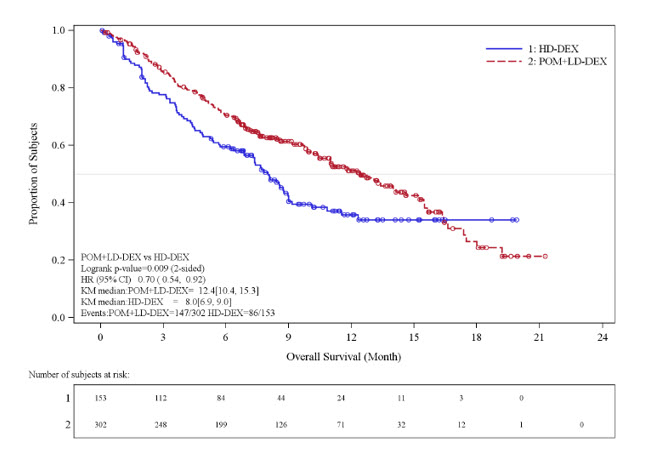 Figure 2 (Pomalidomide 03) | |
| Data cutoff: 01 Mar 2013 | |
Embryo-Fetal Toxicity
Advise patients that pomalidomide capsules are contraindicated in pregnancy [see Contraindications (4)]. Pomalidomide capsules are a thalidomide analogue and may cause serious birth defects or death to a developing baby [see Warnings and Precautions (5.1) and Use in Specific Populations (8.1)].
PS-Pomalidomide REMS
Because of the risk of embryo-fetal toxicity, pomalidomide capsules are only available through a restricted program called PS-Pomalidomide REMS [see Warnings and Precautions (5.2)].
Pregnancy Exposure Registry
Inform females that there is a Pregnancy Exposure Registry that monitors pregnancy outcomes in females exposed to pomalidomide capsules during pregnancy and that they can contact the Pregnancy Exposure Registry by calling 1-888-423-5436 [see Use in Specific Populations (8.1)].
Venous and Arterial Thromboembolism
Inform patients of the risk of developing DVT, PE, MI, and stroke and to report immediately any signs and symptoms suggestive of these events for evaluation [see Warnings and Precautions (5.3)].
Hematologic Toxicities
Inform patients on the risks of developing neutropenia, thrombocytopenia, and anemia and the need to report signs and symptoms associated with these events to their healthcare provider for further evaluation [see Warnings and Precautions (5.5)].
Hepatotoxicity
Inform patients on the risks of developing hepatotoxicity, including hepatic failure and death, and to report signs and symptoms associated with these events to their healthcare provider for evaluation [see Warnings and Precautions (5.6)].
Severe Cutaneous Reactions
Inform patients of the potential risk for severe skin reactions such as SJS, TEN and DRESS and to report any signs and symptoms associated with these reactions to their healthcare provider for evaluation [see Warnings and Precautions (5.7)].
Dizziness and Confusional State
Inform patients of the potential risk of dizziness and confusional state with the drug, to avoid situations where dizziness or confusional state may be a problem, and not to take other medications that may cause dizziness or confusional state without adequate medical advice [see Warnings and Precautions (5.8)].
Neuropathy
Inform patients of the risk of neuropathy and to report the signs and symptoms associated with these events to their healthcare provider for further evaluation [see Warnings and Precautions (5.9)].
Second Primary Malignancies
Inform the patient that the potential risk of developing acute myelogenous leukemia during treatment with pomalidomide capsules is unknown [see Warnings and Precautions (5.10)].
Tumor Lysis Syndrome
Inform patients of the potential risk of tumor lysis syndrome and to report any signs and symptoms associated with this event to their healthcare provider for evaluation [see Warnings and Precautions (5.11)].
Hypersensitivity
Inform patients of the potential for severe hypersensitivity reactions such as angioedema and anaphylaxis to pomalidomide capsules. Instruct patients to contact their healthcare provider right away for any signs and symptoms of these reactions. Advise patients to seek emergency medical attention for signs or symptoms of severe hypersensitivity reactions [see Warnings and Precautions (5.12)].
Smoking Tobacco
Advise patients that smoking tobacco may reduce the efficacy of pomalidomide capsules [see Use in Specific Populations (8.8) and Clinical Pharmacology (12.3)].
Dosing Instructions
Inform patients on how to take pomalidomide capsules [see Dosage and Administration (2.2, 2.3, 2.9)]
Manufactured by:
Natco Pharma Limited
Parawada – 531019, India.
Distributed by:
Breckenridge Pharmaceutical, Inc.
Berkeley Heights, NJ 07922
Revised: 08/2025


