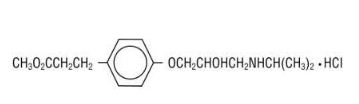
Esmolol hydrochloride is a beta1-selective (cardioselective) adrenergic receptor blocking agent with rapid onset, a very short duration of action, and no significant intrinsic sympathomimetic or membrane stabilizing activity at therapeutic dosages. Its elimination halflife after intravenous infusion is approximately 9 minutes. Esmolol hydrochloride inhibits the beta1 receptors located chiefly in cardiac muscle, but this preferential effect is not absolute and at higher doses it begins to inhibit beta2 receptors located chiefly in the bronchial and vascular musculature.
Pharmacokinetics and Metabolism
Esmolol hydrochloride is rapidly metabolized by hydrolysis of the ester linkage, chiefly by the esterases in the cytosol of red blood cells and not by plasma cholinesterases or red cell membrane acetylcholinesterase. Total body clearance in man was found to be about 20 L/kg/hr, which is greater than cardiac output; thus the metabolism of esmolol hydrochloride is not limited by the rate of blood flow to metabolizing tissues such as the liver or affected by hepatic or renal blood flow. Esmolol hydrochloride has a rapid distribution half-life of about 2 minutes and an elimination half-life of about 9 minutes. Using an appropriate loading dose, steady-state blood levels of esmolol hydrochloride for dosages from 50-300 mcg/kg/min (0.05-0.3
mg/kg/min) are obtained within five minutes. (Steady-state is reached in about 30 minutes without the loading dose.) Steady-state blood levels of esmolol hydrochloride increase linearly over this dosage range and elimination kinetics are dose-independent over this range. Steady-state blood levels are maintained during infusion but decrease rapidly after termination of the infusion. Because of its short half-life, blood levels of esmolol hydrochloride can be rapidly altered by increasing or decreasing the infusion rate and rapidly eliminated by discontinuing the infusion.
Consistent with the high rate of blood-based metabolism of esmolol hydrochloride, less than 2% of the drug is excreted unchanged in the urine. Within 24 hours of the end of infusion, approximately 73-88% of the dosage has been accounted for in the urine as the acid metabolite of esmolol hydrochloride. Metabolism of esmolol hydrochloride results in the formation of the corresponding free acid and methanol. The acid metabolite has been shown in animals to have about 1/1500th the activity of esmolol and in normal volunteers its blood levels do not correspond to the level of beta blockade. The acid metabolite has an elimination half-life of about 3.7 hours and is excreted in the urine with a patients with renal disease, with the elimination half-life increased to about ten-fold that of normals, and plasma levels considerably elevated. Methanol blood levels, monitored in subjects receiving esmolol hydrochloride for up to 6 hours at 300 mcg/kg/min (0.3 mg/kg/ min) and 24 hours at 150 mcg/kg/min (0.15 mg/kg/min), approximated endogenous levels and were less than 2% of levels usually associated with methanol toxicity. Esmolol hydrocloride has been shown to be 55% bound to human plasma protein, while the acid metabolite is only 10% bound.
Pharmacodynamics
Clinical pharmacology studies in normal volunteers have confirmed the beta blocking activity of esmolol hydrochloride, showing reduction in heart rate at rest and during exercise, and attenuation of isoproterenol-induced increases in heart rate. Blood levels of esmolol hydrochloride have been shown to correlate with extent of beta blockade. After termination of infusion, substantial recovery from beta blockade is observed in 10-20 minutes. In human electrophysiology studies, esmolol hydrochloride produced effects typical of a beta blocker; a decrease in the heart rate, increase in sinus cycle length, prolongation of the sinus node recovery time, prolongation of the AH interval during normal sinus rhythm and during atrial pacing, and an increase in antegrade Wenckebach cycle length. In patients undergoing radionuclide angiography, esmolol hydrochloride, at dosages of 200 mcg/kg/min (0.2 mg/kg/min), produced reductions in heart rate, systolic blood pressure, rate pressure product, left and right ventricular ejection fraction and cardiac index at rest, which were similar in magnitude to those produced by intravenous propranolol (4 mg). During exercise, esmolol hydrochloride produced reductions in heart rate, rate pressure product and cardiac index which were also similar to those produced by propranolol,
but produced a significantly larger fall in systolic blood pressure. In patients undergoing cardiac catheterization, the maximum therapeutic dose of 300 mcg/kg/min (0.3 mg/kg/min) of esmolol hydrochloride produced similar effects and, in addition, there were small, clinically insignificant increases in the left ventricular end diastolic pressure and pulmonary capillary wedge pressure. At thirty minutes after the discontinuation of esmolol hydrochloride infusion, all of the hemodynamic parameters had returned to pretreatment levels. The relative cardioselectivity of esmolol hydrochloride was demonstrated in 10 mildly asthmatic patients. Infusions of esmolol hydrochloride [100, 200 and 300 mcg/kg/min (0.1, 0.2 and 0.3 mg/kg/min)] produced no significant increases in specific airway resistance compared to placebo. At 300 mcg/kg/min (0.3 mg/kg/min), esmolol hydrochloride produced slightly enhanced bronchomotor sensitivity to dry air stimulus. These effects were not clinically significant, and esmolol hydrochloride was well tolerated by all patients. Six of the patients also received intravenous propranolol, and at a dosage of 1 mg, two experienced significant, symptomatic bronchospasm requiring bronchodilator treatment. One other propranolol-treated patient also experienced dry air-induced bronchospasm. No adverse pulmonary effects were observed in patients with COPD who received therapeutic dosages of esmolol hydrochloride for treatment of supraventricular tachycardia (51 patients) or in perioperative settings (32 patients).
Supraventricular Tachycardia
In two multicenter, randomized, double-blind, controlled comparisons of esmolol hydrochloride with placebo and propranolol, maintenance doses of 50 to 300 mcg/kg/min (0.05 to 0.3 mg/kg/min) of esmolol hydrochloride were found to be more effective than placebo and about as effective as propranolol, 3-6 mg given by bolus injections, in the treatment of supraventricular tachycardia, principally atrial fibrillation and atrial flutter. The majority of these patients developed their arrhythmias postoperatively. About 60-70% of the patients treated with esmolol hydrochloride had a desired therapeutic effect (either a 20% reduction in heart rate, a decrease in heart rate to less than 100 bpm, or, rarely, conversion to NSR) and about 95% of those who responded did so at a dosage of 200 mcg/kg/min (0.2 mg/kg/min) or less. The average effective dosage of esmolol hydrochloride was approximately 100-115 mcg/ kg/min (0.1-0.115 mg/kg/min) in the two studies. Other multicenter baseline-controlled studies gave essentially similar results. In the comparison with propranolol, about 50% of patients in both the esmolol hydrochloride and propranolol groups were on concomitant digoxin. Response rates were slightly higher with both beta blockers in the digoxin-treated patients. In all studies significant decreases of blood pressure occurred in 20-50% of patients, identified either as adverse reaction reports by investigators, or by observation of systolic pressure less than 90 mmHg or diastolic pressure less than 50 mmHg. The hypotension was symptomatic (mainly diaphoresis or dizziness) in about 12% of patients, and therapy was discontinued in about 11% of patients,
about half of whom were symptomatic. In comparison to propranolol, hypotension was about three times as frequent with esmolol hydrochloride, 53% vs. 17%. The hypotension was rapidly reversible with decreased infusion rate or after discontinuation of therapy with esmolol hydrochloride. For both esmolol hydrochloride and propranolol, hypotension was reported less frequently in patients receiving concomitant digoxin.