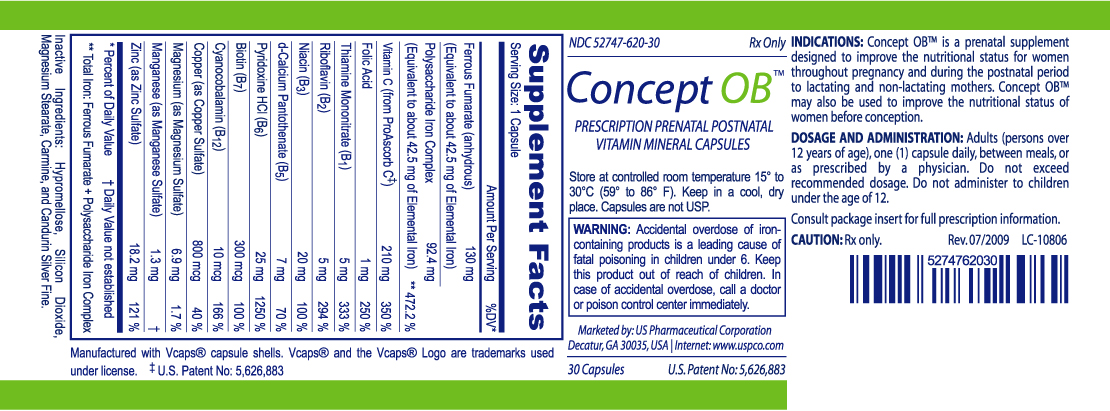
CLINICAL PHARMACOLOGY: Concept OBTM also supplies important prenatal vitamin minerals in a formulation that was especially designed to supplement the nutritional needs of pregnant women, before, during and after pregnancy. In Concept OBTM, patients receive the balanced support of 14 essential vitamins and minerals, including 1 mg of folic acid. The essential role of iron supplementation for pregnant women has long been recognized. Concept OBTM is unique in that it utilizes two (2) different forms of iron, i.e., Ferrous Fumarate and Polysaccharide Iron Complex (as cell-contracted akaganèite), making available a total of 85 mg of elemental iron per capsule as follows:
Ferrous Fumarate (anhydrous) 130 mg Polysaccharide iron complex (PIC) 92.4 mg
Ferrous Fumarate: Provides about 42.5 mg of elemental iron per dose. Ferrous Fumarate is an anhydrous salt of a combination of ferrous iron and fumaric acid, containing 33% of iron per weight. The acute toxicity in experimental animals is low and Ferrous Fumarate is well tolerated clinically. As a ferrous salt, it is more efficiently absorbed in the duodenum. Ferrous Fumarate contrasts very favorably with the availability of the 20% of elemental iron of ferrous sulfate, and the 13% of elemental iron of ferrous gluconate.
Polysaccharide Iron Complex: Provides about 42.5 mg elemental iron, as a cell-contracted akaganèite. It is a product of ferric iron complexed to a low molecular weight polysaccharide. This polysaccharide is produced by the extensive hydrolysis of starch and is a dark brown powder that dissolves in water to form a very dark brown solution, which is virtually odorless and tasteless.
The most frequent cause of anemia in pregnant women is iron deficiency. Because of the continuous loss of iron due to monthly menstruation, most women enter pregnancy with less than optimal iron stores. Supplementation of iron must suffice to meet the needs for maternal and fetal erythropoisis, and account for daily maternal gastrointestinal losses and obligate fetal transfer and growth. Iron requirements during pregnancy usually cannot be met with the average diet. (ACOG technical bulletin (1993): Nutrition during Pregnancy. p.4. Number 179-April 1993: The American College of Obstetricians and Gynecologists, Washington, D.C. 20024-2188).
Concept OBTM does not contain calcium, as calcium may inhibit iron absorption because of the binding or conversion of ferrous salts by calcium and other minerals. Calcium salts can always be prescribed separately for women at high nutritional risk, including those who do not eat adequate amounts of dairy products. The recommendation of the National Academy of Sciences Tenth Ed. 1989 National Academy Press, Washington, D.C., suggests the supplementation of 1200 mg of calcium for pregnant and lactating women for the prevention of calcium deficiency.
Folic acid is a hematopoetic vitamin and has been used extensively for the prevention of neural tube defects. The need for folic acid in pregnancy, with its increased demands of the fetus, or lactation, is not being met by normal dietary sources. Concept OBTM capsules contain 1 mg of folic acid. Neural tube defects (NTD's) are the most common birth defects that result in infant mortality and serious disability. For women with a previous pregnancy that resulted in a child with a neural tube malformation, the use of 4 mg/d of folic acid has been reported to be effective in preventing a recurrence (MRC Vitamin Study Research Group, 1991). However, earlier studies from the United Kingdom suggested that lower daily doses, for example 0.36 mg, might result in a comparable reduction of a recurrence of NTD's. Since neural tube closure is complete by four weeks following conception, beginning folic acid supplementation after that time is not likely to be of any value. It should be noted that a daily 4 mg dose of folic acid did not prevent all NTD's in the MRC study. Patients should be cautioned that folic acid supplementation does not preclude the need for consideration for prenatal testing for NTD's (ACOG Committee Opinion, Number 120, March 1993: The American College of Obstetricians and Gynecologists, Washington D.C. 20024-2188). The U.S. Public Health Service has recommended that all women of childbearing age in the United States who are capable of becoming pregnant should consume 0.4 mg of folic acid per day for reducing their risk of having a pregnancy affected with spina bifida or other NTD's (Center of Disease Control, 1992). Recommendation for the use of folic acid to reduce the number of cases of spina bifida and other neural tube defects: MMWR 1992: 41(RR14): 1-7). Concept OBTM has been formulated without the addition of vitamins A, D, E and K. These fat-soluble vitamins can accumulate and lead to birth defects. Supplementation of vitamins A, D, E and K should be based on an individual need assessment.
All ConceptTM products include a unique patented source of iron, e.g. Ferrous Fumarate and Polysaccharide Iron Complex (U.S. Patent No: 11/243,043 Pending). An increase in tolerability is observed with the (patented formulation) and is believed to occur as the result of distributing the total iron content in the composition among compounds that
NDC 52747-620-30 Concept OBTM Prescription Prenatal Postnatal Vitamin Mineral Capsules
52747620300709
Back side Concept OB LC-10807 Rev 07/2009
provide iron to the patient's blood stream via two different mechanisms. The ferrous salts are readily absorbed in the upper gut, by direct dissolution and absorption of the ferrous iron by the bloodstream. However, the iron available from PIC is absorbed in the lower gut, via an active protein transport mechanism". The Concept OBTM formulation also supplies additional important prenatal vitamin and minerals, which supplement the nutritional needs of pregnant women, before, during and after pregnancy. Deficiencies of these ingredients are common during pregnancy and lactation.