Topiramate tablets are available as debossed, coated, round tablets in the following strengths and colors:
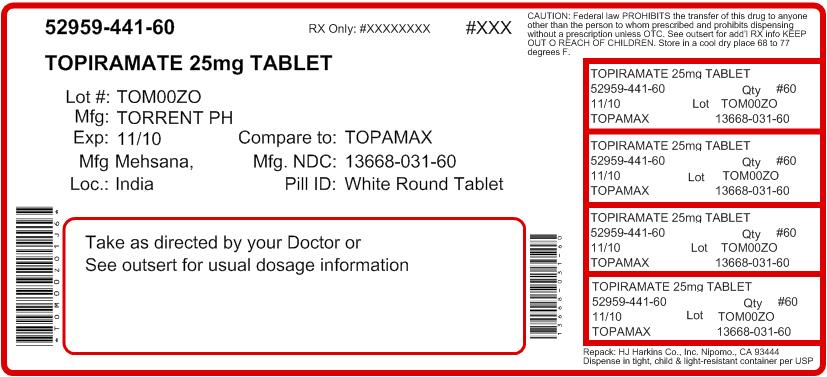
25 mg white to off white (debossed "1031" on one side; "25" on the other)
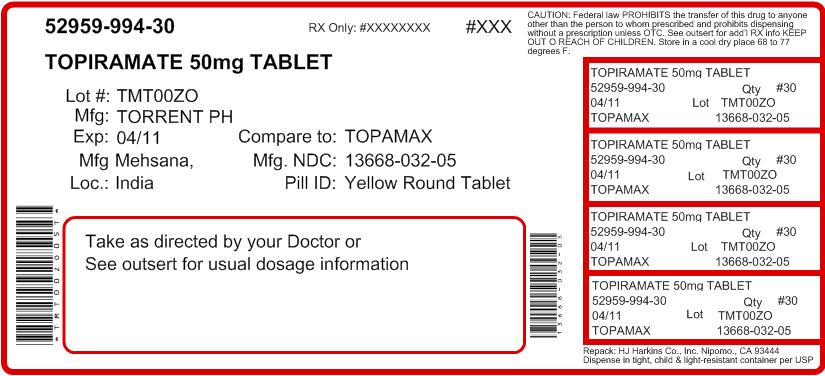
50 mg yellow (debossed "1032" on one side; "50" on the other)
100 mg light yellow (debossed "1033" on one side; "100" on the other)
200 mg peach (debossed "1034" on one side; "200" on the other)
None.
The data described in the following section were obtained using topiramate tablets.
In vitro studies indicate that topiramate does not inhibit enzyme activity for CYP1A2, CYP2A6, CYP2B6, CYP2C9, CYP2D6, CYP2E1, and CYP3A4/5 isozymes. In vitro studies indicate that topiramate is a mild inhibitor of CYP2C19 and a mild inducer of CYP3A4. Drug interactions with some antiepileptic drugs, CNS depressants and oral contraceptives are described here. For other drug interactions, please refer to Clinical Pharmacology (12.5).
Hydrochlorothiazide
A drug-drug interaction study conducted in healthy volunteers evaluated the steady-state pharmacokinetics of hydrochlorothiazide (HCTZ) (25 mg q24h) and topiramate (96 mg q12h) when administered alone and concomitantly. The results of this study indicate that topiramate Cmax increased by 27% and AUC increased by 29% when HCTZ was added to topiramate. The clinical significance of this change is unknown. The addition of HCTZ to topiramate therapy may require an adjustment of the topiramate dose. The steady-state pharmacokinetics of HCTZ were not significantly influenced by the concomitant administration of topiramate. Clinical laboratory results indicated decreases in serum potassium after topiramate or HCTZ administration, which were greater when HCTZ and topiramate were administered in combination.
Metformin
Topiramate treatment can frequently cause metabolic acidosis, a condition for which the use of metformin is contraindicated.
A drug-drug interaction study conducted in healthy volunteers evaluated the steady-state pharmacokinetics of metformin (500 mg every 12 hr) and topiramate in plasma when metformin was given alone and when metformin and topiramate (100 mg every 12 hr) were given simultaneously. The results of this study indicated that the mean metformin Cmax and AUC0-12h increased by 17% and 25%, respectively, when topiramate was added. Topiramate did not affect metformin tmax. The clinical significance of the effect of topiramate on metformin pharmacokinetics is not known. Oral plasma clearance of topiramate appears to be reduced when administered with metformin. The clinical significance of the effect of metformin on topiramate pharmacokinetics is unclear. [See Drug Interactions (7.4)].
Pioglitazone
A drug-drug interaction study conducted in healthy volunteers evaluated the steady-state pharmacokinetics of topiramate and pioglitazone when administered alone and concomitantly. A 15% decrease in the AUCτ,ss of pioglitazone with no alteration in Cmax,ss was observed. This finding was not statistically significant. In addition, a 13% and 16% decrease in Cmax,ss and AUCτ,ss respectively, of the active hydroxy-metabolite was noted as well as a 60% decrease in Cmax,ss and AUCτ,ss of the active keto-metabolite. The clinical significance of these findings is not known. When topiramate is added to pioglitazone therapy or pioglitazone is added to topiramate therapy, careful attention should be given to the routine monitoring of patients for adequate control of their diabetic disease state.
Glyburide
A drug-drug interaction study conducted in patients with type 2 diabetes evaluated the steady-state pharmacokinetics of glyburide (5 mg/day) alone and concomitantly with topiramate (150 mg/day). There was a 22% decrease in Cmax and 25% reduction in AUC24 for glyburide during topiramate administration. Systemic exposure (AUC) of the active metabolites, 4-trans-hydroxy-glyburide (M1) and 3-cis-hydroxyglyburide (M2), was also reduced by 13% and 15%, reduced Cmax by 18% and 25%, respectively. The steady-state pharmacokinetics of topiramate were unaffected by concomitant administration of glyburide.
Lithium
In patients, the pharmacokinetics of lithium were unaffected during treatment with topiramate at doses of 200 mg/day; however, there was an observed increase in systemic exposure of lithium (27% for Cmax and 26% for AUC) following topiramate doses up to 600 mg/day. Lithium levels should be monitored when co-administered with high-dose topiramate [See Drug Interactions (7.5)].
Haloperidol
The pharmacokinetics of a single dose of haloperidol (5 mg) were not affected following multiple dosing of topiramate (100 mg every 12 hr) in 13 healthy adults (6 males, 7 females).
Amitriptyline
There was a 12% increase in AUC and Cmax for amitriptyline (25 mg per day) in 18 normal subjects (9 males; 9 females) receiving 200 mg/day of topiramate. Some subjects may experience a large increase in amitriptyline concentration in the presence of topiramate and any adjustments in amitriptyline dose should be made according to the patient's clinical response and not on the basis of plasma levels.
Sumatriptan
Multiple dosing of topiramate (100 mg every 12 hrs) in 24 healthy volunteers (14 males, 10 females) did not affect the pharmacokinetics of single dose sumatriptan either orally (100 mg) or subcutaneously (6 mg).
Risperidone
When administered concomitantly with topiramate at escalating doses of 100, 250 and 400 mg/day, there was a reduction in risperidone (systemic exposure (16% and 33% for steady-state AUC at the 250 and 400 mg/day doses of topiramate). No alterations of 9-hydroxyrisperidone levels were observed. Coadministration of topiramate 400 mg/day with risperidone resulted in a 14% increase in Cmax and a 12% increase in AUC12 of topiramate. There were no clinically significant changes in the systemic exposure of risperidone plus 9-hydroxyrisperidone or of topiramate, therefore this interaction is not likely to be of clinical significance.
Propranolol
Multiple dosing of topiramate (200 mg/day) in 34 healthy volunteers (17 males, 17 females) did not affect the pharmacokinetics of propranolol following daily 160 mg doses. Propranolol doses of 160 mg/day in 39 volunteers (27 males, 12 females) had no effect on the exposure to topiramate at a dose of 200 mg/day of topiramate.
Dihydroergotamine
Multiple dosing of topiramate (200 mg/day) in 24 healthy volunteers (12 males, 12 females) did not affect the pharmacokinetics of a 1 mg subcutaneous dose of dihydroergotamine. Similarly, a 1 mg subcutaneous dose of dihydroergotamine did not affect the pharmacokinetics of a 200 mg/day dose of topiramate in the same study.
Diltiazem
Co-administration of diltiazem (240 mg Cardizem CD®) with topiramate (150 mg/day) resulted in a 10% decrease in Cmax and 25% decrease in diltiazem AUC, 27% decrease in Cmax and 18% decrease in des-acetyl diltiazem AUC, and no effect on N-desmethyl diltiazem, Coadministration of topiramate with diltiazem resulted in a 16% increase in Cmax and a 19% increase in AUC12 of topiramate.
Venlafaxine
Multiple dosing of topiramate (150 mg/day) in healthy volunteers did not affect the pharmacokinetics of venlafaxine or O-desmethyl venlafaxine. Multiple dosing of venlafaxine (150 mg Effexor XR®) did not affect the pharmacokinetics of topiramate.
Other Carbonic Anhydrase Inhibitors
Concomitant use of topiramate, a carbonic anhydrase inhibitor, with any other carbonic anhydrase inhibitor (e.g., zonisamide, acetazolamide or dichlorphenamide), may increase the severity of metabolic acidosis and may also increase the risk of kidney stone formation. Therefore, if topiramate is given concomitantly with another carbonic anhydrase inhibitor, the patient should be monitored for the appearance or worsening of metabolic acidosis [see Drug Interactions (7.5)].
Drug/Laboratory Tests Interactions
There are no known interactions of topiramate with commonly used laboratory tests.
Adjunctive Therapy Epilepsy Controlled Trials in Adults and Pediatric Patients (Ages 2 to 16 Years)
The effectiveness of topiramate as an adjunctive treatment for pediatric patients ages 2 to 16 years with partial onset seizures was established in a multicenter, randomized, double-blind, placebo-controlled trial, comparing topiramate and placebo in patients with a history of partial onset seizures, with or without secondarily generalized seizures.
Patients in this study were permitted a maximum of two antiepileptic drugs (AEDs) in addition to topiramate tablets or placebo. In this study, patients were stabilized on optimum dosages of their concomitant AEDs during an 8-week baseline phase. Patients who experienced at least six partial onset seizures, with or without secondarily generalized seizures, during the baseline phase were randomly assigned to placebo or topiramate tablets in addition to their other AEDs.
Following randomization, patients began the double-blind phase of treatment. Patients received active drug beginning at 25 or 50 mg per day; the dose was then increased by 25 mg to 150 mg/day increments every other week until the assigned dosage of 125, 175, 225 or 400 mg/day based on patients' weight to approximate a dosage of 6 mg/kg per day was reached, unless intolerance prevented increases. After titration, patients entered an 8-week stabilization period.
Adjunctive Therapy Controlled Trial in Patients With Primary Generalized Tonic-Clonic Seizures
The effectiveness of topiramate as an adjunctive treatment for primary generalized tonic-clonic seizures in patients 2 years old and older was established in a multicenter, randomized, double-blind, placebo-controlled trial, comparing a single dosage of topiramate and placebo.
Patients in this study were permitted a maximum of two antiepileptic drugs (AEDs) in addition to topiramate or placebo. Patients were stabilized on optimum dosages of their concomitant AEDs during an 8-week baseline phase. Patients who experienced at least three primary generalized tonic-clonic seizures during the baseline phase were randomly assigned to placebo or topiramate in addition to their other AEDs.
Following randomization, patients began the double-blind phase of treatment. Patients received active drug beginning at 50 mg per day for four weeks; the dose was then increased by 50 mg to 150 mg/day increments every other week until the assigned dose of 175, 225 or 400 mg/day based on patients' body weight to approximate a dosage of 6 mg/kg per day was reached, unless intolerance prevented increases. After titration, patients entered a 12-week stabilization period.
Adjunctive Therapy Controlled Trial in Patients With Lennox-Gastaut Syndrome
The effectiveness of topiramate as an adjunctive treatment for seizures associated with Lennox-Gastaut syndrome was established in a multicenter, randomized, double-blind, placebo-controlled trial comparing a single dosage of topiramate with placebo in patients 2 years of age and older.
Patients in this study were permitted a maximum of two antiepileptic drugs (AEDs) in addition to topiramate or placebo. Patients who were experiencing at least 60 seizures per month before study entry were stabilized on optimum dosages of their concomitant AEDs during a 4-week baseline phase. Following baseline, patients were randomly assigned to placebo or topiramate in addition to their other AEDs. Active drug was titrated beginning at 1 mg/kg per day for a week; the dose was then increased to 3 mg/kg per day for one week then to 6 mg/kg per day. After titration, patients entered an 8-week stabilization period. The primary measures of effectiveness were the percent reduction in drop attacks and a parental global rating of seizure severity.
Table 9:Topiramate Dose Summary During the Stabilization Periods of Each of Six Double-Blind, Placebo-Controlled, Add-On Trials in Adults with Partial Onset Seizuresb |
| Target Topiramate Dosage (mg/day)
|
Protocol
| Stabilization Dose
| Placeboa
| 200
| 400
| 600
| 800
| 1,000
|
YD
| N
| 42
| 42
| 40
| 41
| --
| --
|
| Mean Dose
| 5.9
| 200
| 390
| 556
| --
| --
|
| Median Dose
| 6.0
| 200
| 400
| 600
| --
| --
|
YE
|
N
|
44
|
--
|
--
|
40
|
45
|
40
|
| Mean Dose
| 9.7
| --
| --
| 544
| 739
| 796
|
| Median Dose
| 10.0
| --
| --
| 600
| 800
| 1,000
|
Y1
|
N
|
23
|
--
|
19
|
--
|
--
|
--
|
| Mean Dose
| 3.8
| --
| 395
| --
| --
| --
|
| Median Dose
| 4.0
| --
| 400
| --
| --
| --
|
Y2
|
N
|
30
|
--
|
--
|
28
|
--
|
--
|
| Mean Dose
| 5.7
| --
| --
| 522
| --
| --
|
| Median Dose
| 6.0
| --
| --
| 600
| --
| --
|
Y3
|
N
|
28
|
--
|
--
|
--
|
25
|
--
|
| Mean Dose
| 7.9
| --
| --
| --
| 568
| --
|
| Median Dose
| 8.0
| --
| --
| --
| 600
| --
|
119
|
N
|
90
|
157
|
--
|
--
|
--
|
--
|
| Mean Dose
| 8
| 200
| --
| --
| --
| --
|
| Median Dose
| 8
| 200
| --
| --
| --
| --
|
In all add-on trials, the reduction in seizure rate from baseline during the entire double-blind phase was measured. The median percent reductions in seizure rates and the responder rates (fraction of patients with at least a 50% reduction) by treatment group for each study are shown below in Table 10. As described above, a global improvement in seizure severity was also assessed in the Lennox-Gastaut trial.
Table 10: Efficacy Results in Double-Blind, Placebo-Controlled, Add-On Epilepsy Trials |
| Target Topiramate Dosage (mg/day)
|
Protocol Efficacy Results
| Placebo
| 200
| 400
| 600
| 800
| 1,000
| ≈6
mg/kg/day*
|
Partial Onset Seizures
Studies in Adults
|
YD
| N
| 45
| 45
| 45
| 46
| --
| --
| --
|
| Median % Reduction
| 11.6
| 27.2a
| 47.5b
| 44.7c
| --
| --
| --
|
| % Responders
| 18
| 24
| 44d
| 46d
| --
| --
| --
|
YE
|
N
|
47
|
--
|
--
|
48
|
48
|
47
|
--
|
| Median % Reduction
| 1.7
| --
| --
| 40.8c
| 41.0c
| 36.0c
| --
|
| % Responders
| 9
| --
| --
| 40 c
| 41 c
| 36d
| --
|
Y1
|
N
|
24
|
--
|
23
|
--
|
--
|
--
|
--
|
| Median % Reduction
| 1.1
| --
| 40.7e
| --
| --
| --
| --
|
| % Responders
| 8
| --
| 35d
| --
| --
| --
| --
|
Y2
|
N
|
30
|
--
|
--
|
30
|
--
|
--
|
--
|
| Median % Reduction
| -12.2
| --
| --
| 46.4f
| --
| --
| --
|
| % Responders
| 10
| --
| --
| 47c
| --
| --
| --
|
Y3
|
N
|
28
|
--
|
--
|
--
|
28
|
--
|
--
|
| Median % Reduction
| -20.6
| --
| --
| --
| 24.3c
| --
| --
|
| % Responders
| 0
| --
| --
| --
| 43c
| --
| --
|
119
|
N
|
91
|
168
|
--
|
--
|
--
|
--
|
--
|
| Median % Reduction
| 20.0
| 44.2c
| --
| --
| --
| --
| --
|
| % Responders
| 24
| 45c
| --
| --
| --
| --
| --
|
Studies in Pediatric Patients
|
YP
| N
| 45
| --
| --
| --
| --
| --
| 41
|
| Median % Reduction
| 10.5
| --
| --
| --
| --
| --
| 33.1d
|
| % Responders
| 20
| --
| --
| --
| --
| --
| 39
|
Primary Generalized Tonic-Clonich
|
YTC
| N
| 40
| --
| --
| --
| --
| --
| 39
|
| Median % Reduction
| 9.0
| --
| --
| --
| --
| --
| 56.7 d
|
| % Responders
| 20
| --
| --
| --
| --
| --
| 56c
|
Lennox-Gastaut Syndromei
|
YL
| N
| 49
| --
| --
| --
| --
| --
| 46
|
| Median % Reduction
| -5.1
| --
| --
| --
| --
| --
| 14.8d
|
| % Responders
| 14
| --
| --
| --
| --
| --
| 28g
|
Improvement in Seizure
severityj
| 28
| --
| --
| --
| --
| --
| 52d
|
Subset analyses of the antiepileptic efficacy of topiramate tablets in these studies showed no differences as a function of gender, race, age, baseline seizure rate, or concomitant AED. In clinical trials for epilepsy, daily dosages were decreased in weekly intervals by 50 to 100 mg per day in adults and over a 2 to 8 week period in children; transition was permitted to a new antiepileptic regimen when clinically indicated.
Manufactured by:
TORRENT PHARMACEUTICALS LTD., Indrad-382 721
Dist. Mehsana, INDIA.
For:
TORRENT PHARMA INC., 5380 Holiday Terrace, Suite 40, Kalamazoo, Michigan 49009.
8021903 Revised January 2010
Manufactured by:
TORRENT PHARMACEUTICALS LTD., Indrad-382 721
Dist. Mehsana, INDIA.
For:
TORRENT PHARMA INC., 5380 Holiday Terrace, Suite 40, Kalamazoo, Michigan 49009.
8021903 Revised January 2010