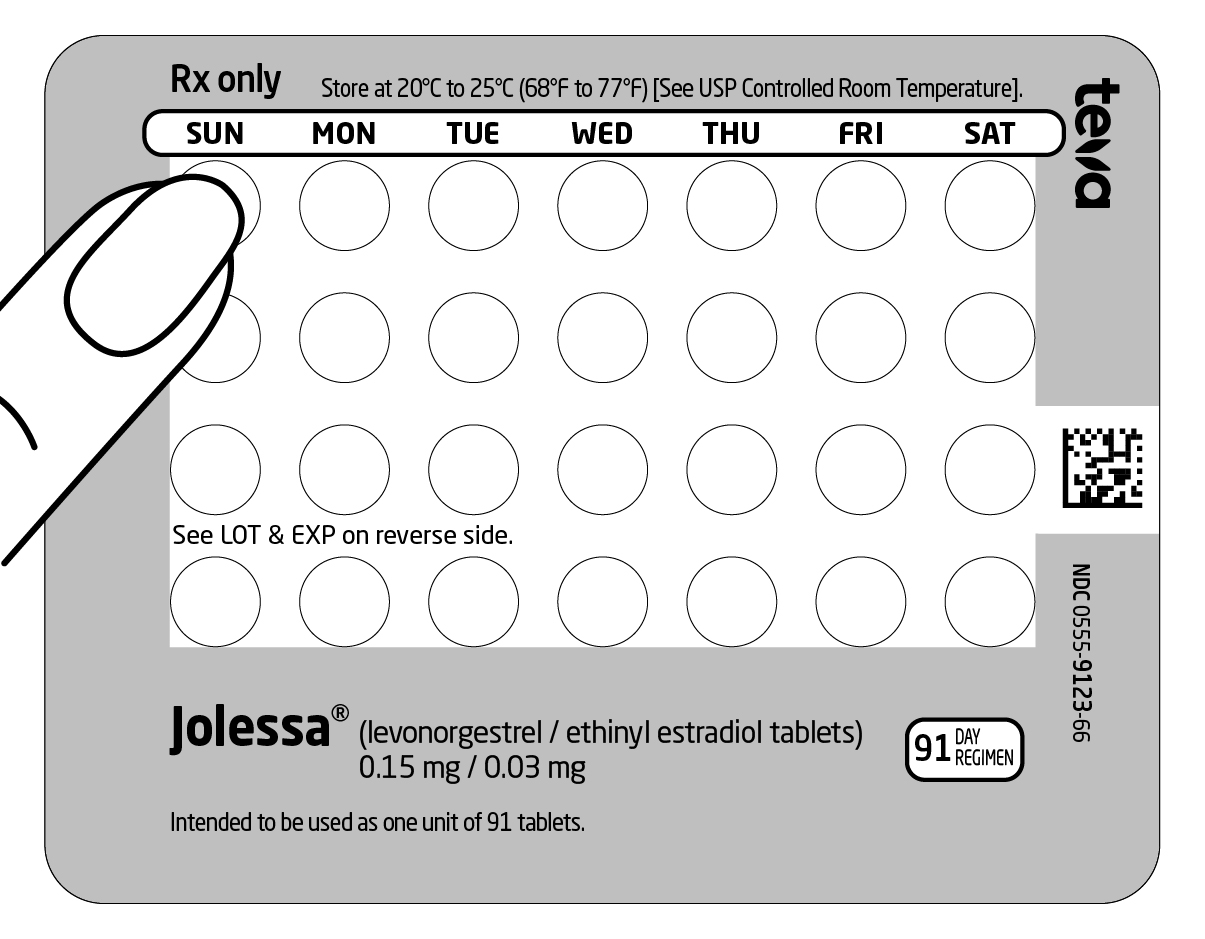
Bleeding and/or spotting that occurs at any time while taking the first 84 tablets of each extended-cycle regimen is considered “unscheduled” bleeding/spotting. Bleeding that occurs during the time a woman takes the seven white inert tablets is considered “scheduled” bleeding.
Unscheduled Bleeding and Spotting
Females using JOLESSA may experience unscheduled (breakthrough or intracyclic) bleeding and spotting especially during the first 3 months of use. Bleeding irregularities may resolve over time or by changing to a different contraceptive product. If unscheduled bleeding persists or occurs after previously regular cycles, evaluate for causes such as pregnancy or malignancy.
Before prescribing JOLESSA, advise the woman to weigh the occurrence of fewer scheduled menses (4 per year instead of 13 per year) against the occurrence of increased unscheduled bleeding and/or spotting.
The clinical trial of the efficacy of JOLESSA (91-day cycles) in preventing pregnancy also assessed scheduled and unscheduled bleeding. The participants in the study were composed primarily of women who had used oral contraceptives previously as opposed to new users. Women with a history of breakthrough bleeding/spotting ≥ 10 consecutive days on oral contraceptives were excluded from the study. More JOLESSA subjects, compared to subjects on the comparator 28-day cycle regimen, discontinued prematurely for unacceptable bleeding (7.7% [JOLESSA] vs. 1.8% [28-day cycle regimen]).
Unscheduled bleeding and unscheduled spotting decreased over successive 91-day cycles. Table 3 below presents the number of days with unscheduled bleeding and/or spotting for each respective 91-day cycle.
Table 3: Number of Unscheduled Bleeding and/or Spotting Days per 91-day Cycle
Cycle (N) | Days of Unscheduled Bleeding and/or Spotting per 84-Day Interval | Median Days Per Subject-Month |
Mean | Q1 | Median | Q3 |
1 (446) | 15.1 | 3.0 | 12 | 23.0 | 3.0 |
2 (368) | 11.6 | 2.0 | 6 | 17.5 | 1.5 |
3 (309) | 10.6 | 1.0 | 6 | 15.0 | 1.5 |
4 (282) | 8.8 | 1.0 | 4 | 14.0 | 1.0 |
Q1=Quartile 1: 25% of women had ≤ this number of days of unscheduled bleeding/spotting
Median: 50% of women had ≤ this number of days of unscheduled bleeding/spotting
Q3=Quartile 3: 75% of women had ≤ this number of days of unscheduled bleeding/spotting
Table 4 shows the percentages of women with ≥7 days and ≥20 days of unscheduled spotting and/or bleeding in the JOLESSA and the 28-day cycle treatment groups.
Table 4: Percentage of Subjects with Unscheduled Bleeding and/or Spotting
Days of unscheduled bleeding and/or spotting | Percentage of Subjects a |
JOLESSA | Cycle 1 (N=385) | Cycle 4 (N=261) |
≥ 7 days | 65% | 42% |
≥ 20 days | 35% | 15% |
28-day regimen | Cycles 1-4 (N=194) | Cycles 10-13 (N=158) |
≥ 7 days | 38% | 39% |
≥ 20 days | 6% | 4% |
a Based on spotting and/or bleeding on days 1-84 of a 91 day cycle in the JOLESSA subjects and days 1-21 of a 28 day cycle over 4 cycles in the 28-day dosing regimen.
Total days of bleeding and/or spotting (scheduled plus unscheduled) were similar over one year of treatment for JOLESSA subjects and subjects on the 28-day cycle regimen.
Amenorrhea and Oligomenorrhea
Females who use JOLESSA may experience absence of scheduled (withdrawal) bleeding, even if they are not pregnant. Based on data from the clinical trial of JOLESSA, amenorrhea occurred in approximately 0.8% of females during Cycle 1, 1.2% of females during Cycle 2, 3.7% of females during Cycle 3, and 3.4% of females during Cycle 4.
Because females using JOLESSA will likely have scheduled bleeding only 4 times per year, rule out pregnancy at the time of any missed menstrual period.
After discontinuation of JOLESSA, amenorrhea or oligomenorrhea may occur, especially if these conditions were pre-existent.