Budesonide And Formoterol Fumarate Dihydrate
Product Images NDC 53002-2667

View Photos of Packaging, Regulatory Labels, and Product Appearance

Product Visual Gallery

This gallery contains 17 technical images submitted to the FDA as part of the official labeling for Budesonide And Formoterol Fumarate Dihydrate (NDC 53002-2667). Unlike standard consumer photos, these assets often include clinical data figures, molecular chemical structures, and official manufacturer packaging layouts.

As provided by Rpk Pharmaceuticals, Inc., these visuals offer a comprehensive scientific overview of the product's physical and chemical identity, aiding pharmacists and researchers in product verification and study.

FDA Label Image

Counter Image 15 (308708 Rapihaler Counter 15 (black;130;485))

Counter Image 15 (308708 Rapihaler Counter 15 (black;130;485))
An illustration of a circular dosage counter dial typically found on inhaler devices, marked with numbers from 0 to 120. The dial features colored zones: red from 0 to 5, orange from 6 to 20, and white from 21 to 120, indicating remaining doses.*
FDA Label Image

Counter Image 80 (308710 Rapihaler Counter 80 (black;130;485))

Counter Image 80 (308710 Rapihaler Counter 80 (black;130;485))
A dial indicator graphic with numbers ranging from 0 to 120 marked in increments of 10. The dial features color-coded segments: red near zero, transitioning to orange around 10 to 20, and then to gray from 30 upwards. The needle points to approximately 80 on the scale.*
FDA Label Image

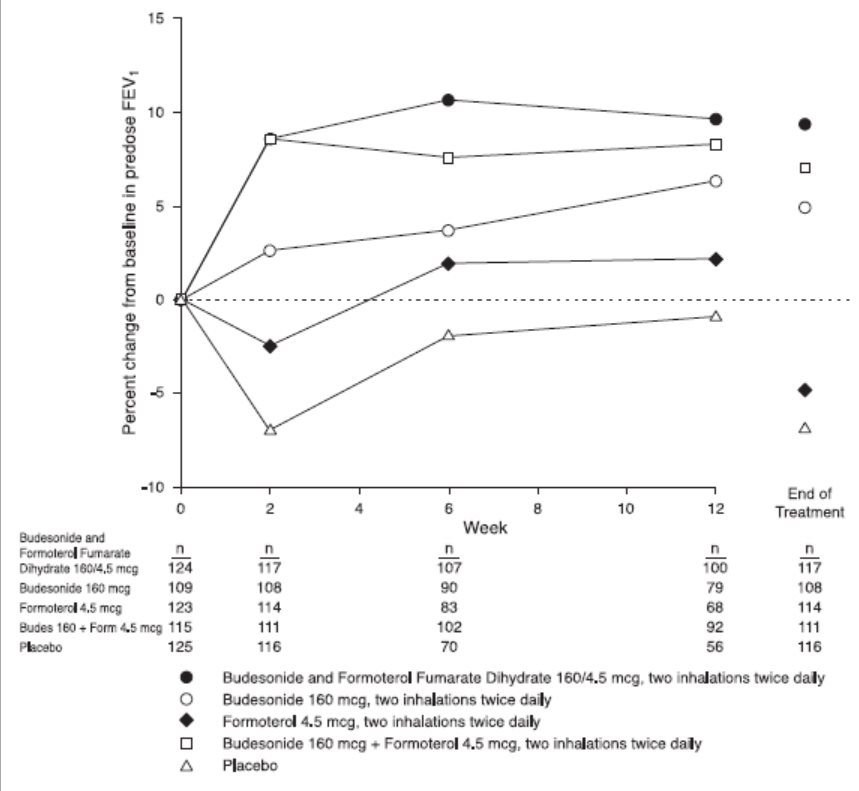
Figure 1 (Figure1bodytext)

Figure 1 (Figure1bodytext)
A line graph showing the percent change from baseline in pre-dose FEV1 over 12 weeks for different treatments: Budesonide and Formoterol Fumarate Dihydrate 160/4.5 mcg, Budesonide 160 mcg, Formoterol 4.5 mcg, Budesonide + Formoterol, and placebo. The y-axis represents percent change, ranging from -10 to 15, and the x-axis shows weeks from 0 to 12, ending with data at treatment conclusion. The graph includes a legend associating symbols with each treatment group along with sample sizes at different time points.*
FDA Label Image

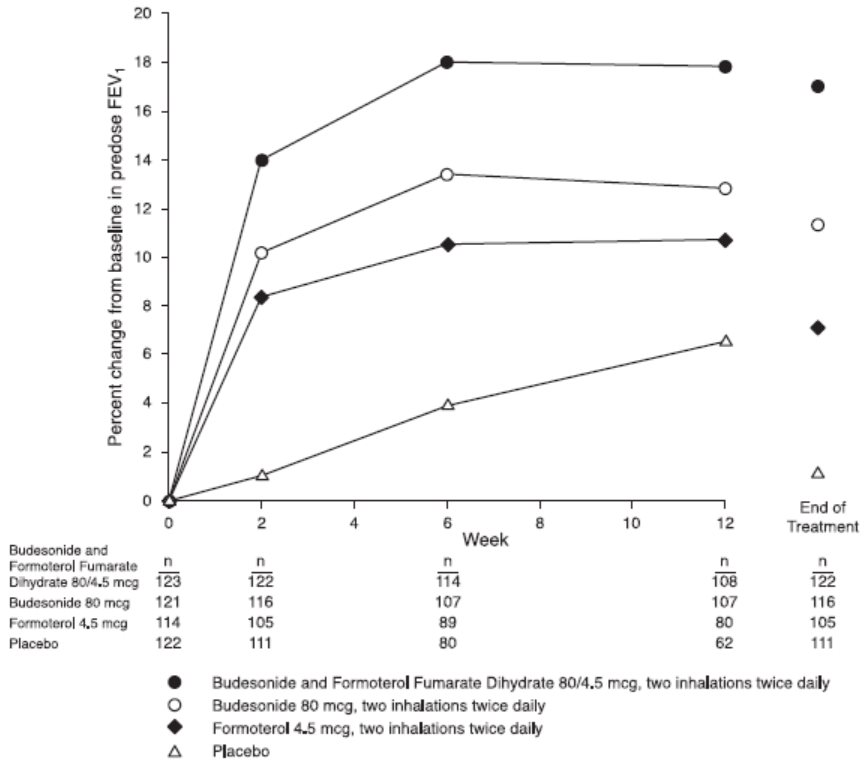
Figure 2 (Figure2bodytext)

Figure 2 (Figure2bodytext)
A line graph depicting percent change from baseline in predose FEV1 over 12 weeks of treatment. It compares four groups: Budesonide and Formoterol Fumarate Dihydrate 80/4.5 mcg, Budesonide 80 mcg, Formoterol 4.5 mcg, and placebo, each administered as two inhalations twice daily. The graph shows increasing FEV1 improvement over time for all treatments, with combination therapy having the largest effect and placebo the smallest.*
FDA Label Image

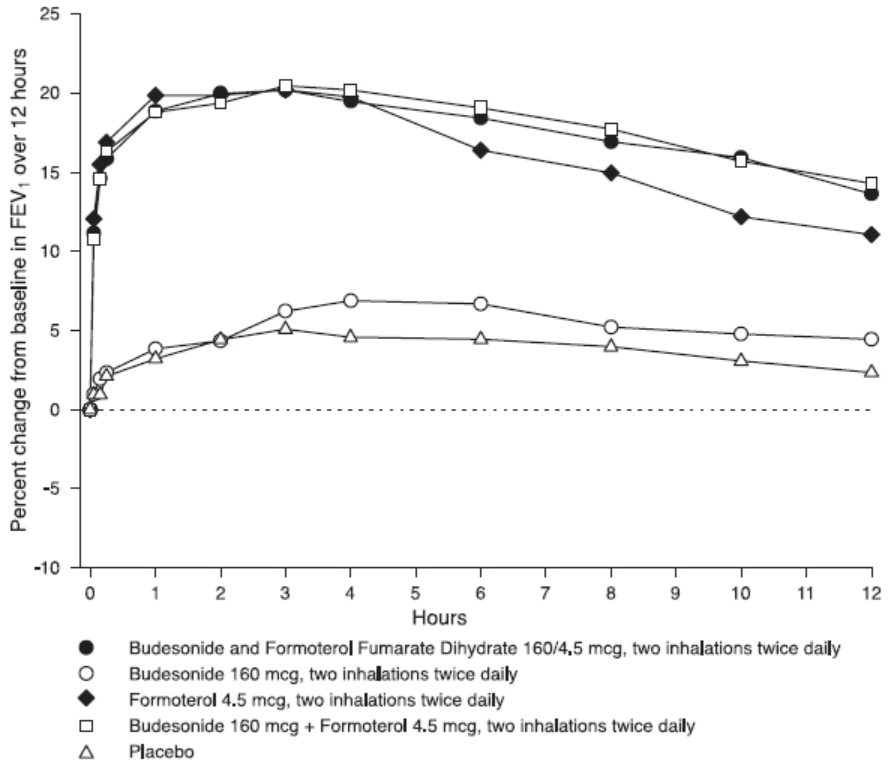
Figure 3 (Figure3bodytext)

Figure 3 (Figure3bodytext)
A line graph showing the percent change from baseline in FEV1 over 12 hours for different treatments. The x-axis represents hours from 0 to 12, and the y-axis shows percent change from -10 to 25. Five lines correspond to Budesonide and Formoterol Fumarate Dihydrate 160/4.5 mcg, Budesonide 160 mcg, Formoterol 4.5 mcg, Budesonide 160 mcg + Formoterol 4.5 mcg, and placebo, illustrating lung function changes after two inhalations twice daily.*
FDA Label Image

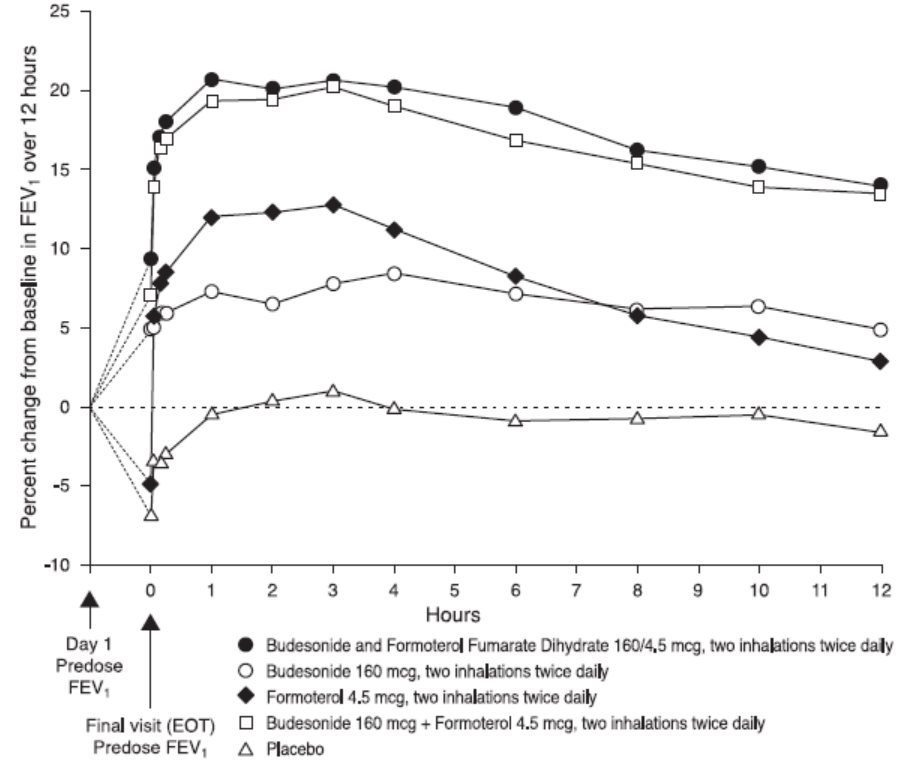
Figure 4 (Figure4bodytext)

Figure 4 (Figure4bodytext)
A line graph depicting percent change from baseline in FEV1 over 12 hours, comparing treatments of Budesonide and Formoterol Fumarate Dihydrate 160/4.5 mcg, Budesonide 160 mcg, Formoterol 4.5 mcg, their combination, and placebo. The x-axis represents hours, and the y-axis represents percent change in FEV1. Different symbol lines represent each treatment group.*
FDA Label Image

Figure 5 (Figure5bodytext)

Figure 5 (Figure5bodytext)
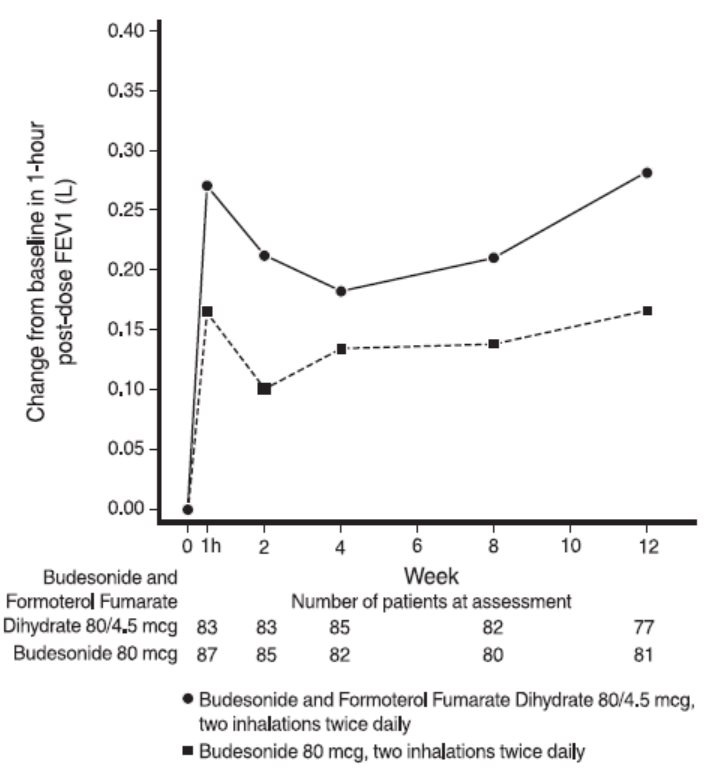
A line graph showing change from baseline in 1-hour post-dose FEV1 (L) over 12 weeks for Budesonide and Formoterol Fumarate Dihydrate 80/4.5 mcg and Budesonide 80 mcg. The x-axis represents weeks, and the y-axis shows change in FEV1. Two lines compare the treatments: one with circles for Budesonide and Formoterol Fumarate Dihydrate, and one with squares for Budesonide only. A patient count at each assessment is listed below the graph.*
FDA Label Image

Figure 6 (Figure6bodytext)

Figure 6 (Figure6bodytext)
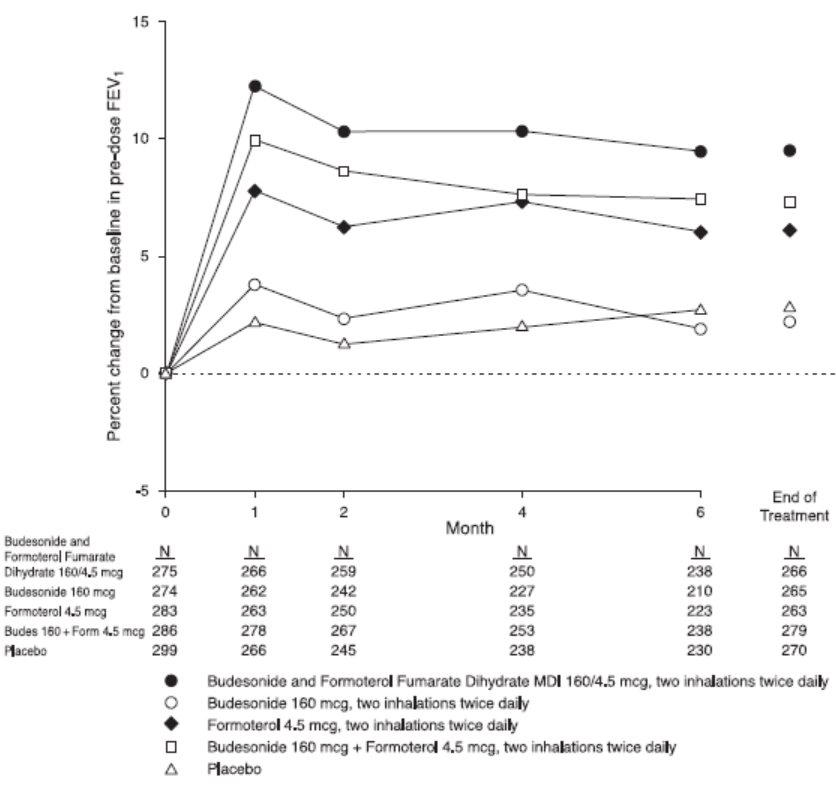
A line graph showing percent change from baseline in pre-dose FEV1 over 6 months for Budesonide and Formoterol Fumarate Dihydrate 160/4.5 mcg MDI and comparator groups, including Budesonide 160 mcg, Formoterol 4.5 mcg, Budesonide 160 mcg + Formoterol 4.5 mcg, and placebo, each administered twice daily. The graph tracks treatment effects with data points at months 0, 1, 2, 4, 6, and end of treatment, accompanied by a table of subject numbers per group at each time point.*
FDA Label Image

Figure 7 (Figure7bodytext)

Figure 7 (Figure7bodytext)
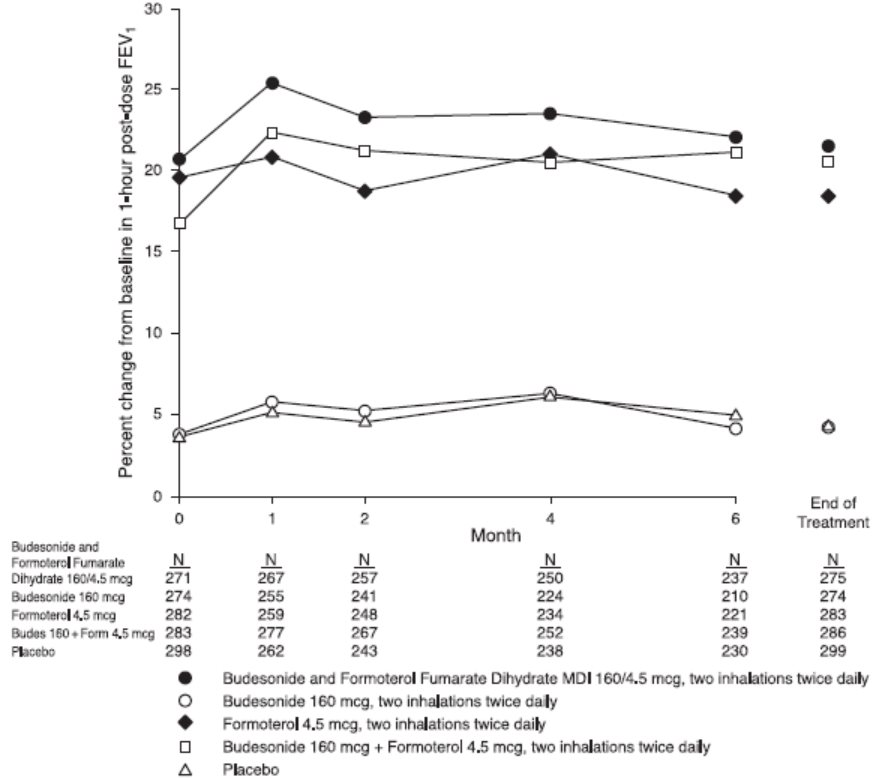
A line graph depicting percent change from baseline in 1-hour post-dose FEV1 over 6 months for multiple treatment groups: Budesonide and Formoterol Fumarate Dihydrate MDI 160/4.5 mcg, Budesonide 160 mcg, Formoterol 4.5 mcg, Budesonide 160 mcg + Formoterol 4.5 mcg, and placebo. The x-axis represents months, and the y-axis shows percent change. Sample sizes (N) are listed for each treatment and time point below the graph.*
FDA Label Image

Budesonide Structural Formula (Image 01)

Budesonide Structural Formula (Image 01)
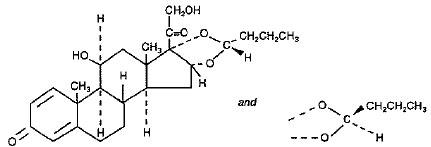
Chemical structure diagram showing the molecular formulas of Budesonide and Formoterol Fumarate Dihydrate, the active ingredients of the product labeled by RPK Pharmaceuticals, Inc. The two distinct chemical structures are depicted side by side with connecting notation 'and'.*
FDA Label Image

Structural Fumarate (Image 02)

Structural Fumarate (Image 02)
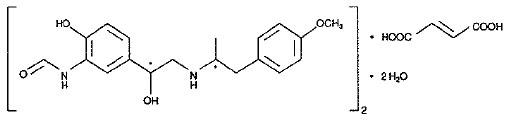
Chemical structure diagram of the active ingredient Formoterol Fumarate Dihydrate, showing its molecular arrangement including two molecules with associated water and fumaric acid components.*
FDA Label Image

Figure 1 (Image 03)

Figure 1 (Image 03)
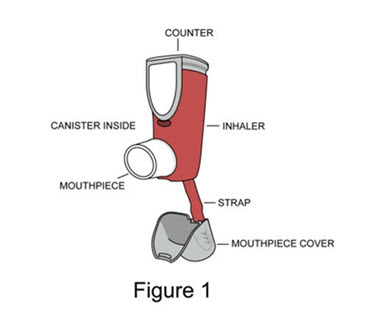
An instructional diagram of an inhaler device labeled with parts including the counter, canister inside, inhaler body, mouthpiece, strap, and mouthpiece cover. The image visually identifies each component to assist in understanding device assembly or use.*
FDA Label Image

Figure 2 Gray Arrows (Image 04)

Figure 2 Gray Arrows (Image 04)
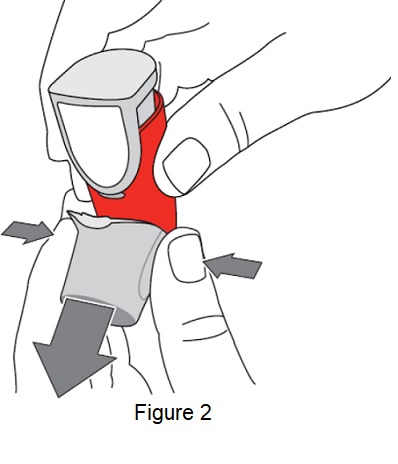
An instructional illustration showing hands removing a red inhaler device from its protective gray plastic cover, indicated by directional arrows. The figure is labeled as Figure 2 and demonstrates the steps to prepare the inhaler for use.*
FDA Label Image

Figure 3 (Image 05)

Figure 3 (Image 05)
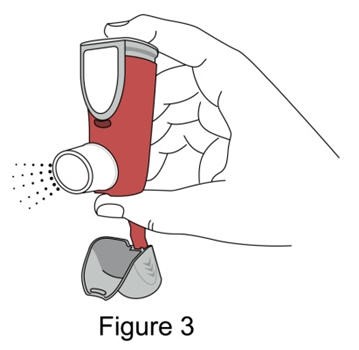
Illustration showing a hand holding a Budesonide and Formoterol Fumarate Dihydrate inhaler, with the mouthpiece facing outward and vapor spray depicted. The protective cap is removed and held below the inhaler. This figure demonstrates proper inhaler use technique.*
FDA Label Image

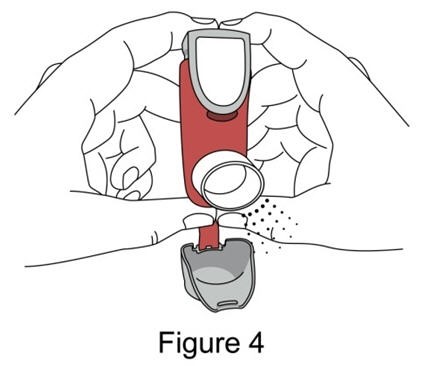
Figure 4 (Image 06)

Figure 4 (Image 06)
An instructional illustration showing hands using a red and gray dry powder inhaler device dispensing powder medication onto a finger. The image demonstrates the operation step of releasing the powder from the inhaler, labeled as Figure 4. No additional product or dosage information is visible.*
FDA Label Image

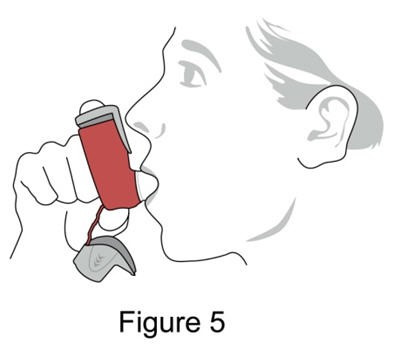
Figure 5 (Image 07)

Figure 5 (Image 07)
An instructional illustration showing a person using a red inhaler with a mouthpiece cover removed, demonstrating the correct technique for inhaling medication.*
FDA Label Image

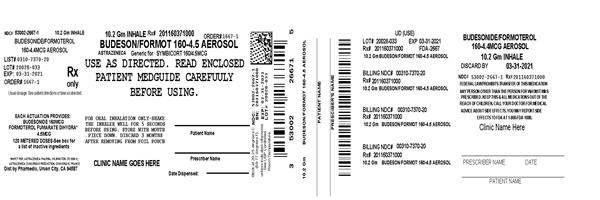
Label Image (Lbl530022667)

Label Image (Lbl530022667)
Packaging label for Budesonide and Formoterol Fumarate Dihydrate 160-4.5 MCQG aerosol, a 10.2 g inhaler product by RPK Pharmaceuticals, Inc. The label includes usage instructions, prescription-only designation, lot numbers, barcodes, and placeholders for clinic and patient information.*

* About these descriptions: Image descriptions on this page are generated by automated AI analysis of the product label images from the manufacturer's FDA label submission (SPL). They are provided for reference only and may contain errors or omissions. Always rely on the printed label itself and the official FDA labeling, and consult a pharmacist or healthcare professional with any questions about this product.