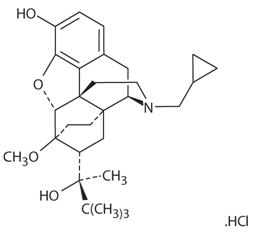
Clinical data on the safety and efficacy of buprenorphine were derived from studies of Buprenorphine Sublingual
Tablet formulations, with and without naloxone, and from studies of
sublingual administration of a more bioavailable ethanolic solution of
buprenorphine.
Buprenorphine Sublingual Tablets were studied in 1834 patients;
buprenorphine and naloxone tablets in 575 patients, and buprenorphine
sublingual solutions in 2470 patients. A total of 1270 women received
buprenorphine in those clinical trials. Dosing recommendations are based
on data from one trial of both tablet formulations and two trials of the
ethanolic solution. All trials used buprenorphine in conjunction with
psychosocial counseling as part of a comprehensive addiction treatment
program. There were no clinical studies conducted to assess the efficacy
of buprenorphine as the only component of treatment.
In a double-blind placebo- and active-controlled study, 326
heroin-addicted subjects were randomly assigned to either buprenorphine
and naloxone sublingual tablets, 16/4 mg per day; Buprenorphine Sublingual Tablets, 16 mg per day; or placebo sublingual tablets. For
subjects randomized to either active treatment, dosing began with one 8
mg Buprenorphine on Day 1, followed by 16 mg (two
8 mg tablets) of buprenorphine on Day 2. On Day
3, those randomized to receive buprenorphine and naloxone sublingual
tablets were switched to the combination tablet. Subjects randomized to
placebo received one placebo tablet on Day 1 and two placebo tablets per
day thereafter for four weeks. Subjects were seen daily in the clinic
(Monday through Friday) for dosing and efficacy assessments. Take-home
doses were provided for weekends. Subjects were instructed to hold the
medication under the tongue for approximately 5 to 10 minutes until
completely dissolved. Subjects received counseling regarding HIV
infection and up to one hour of individualized counseling per week. The
primary study comparison was to assess the efficacy of buprenorphine and
naloxone sublingual tablets and Buprenorphine Sublingual Tablets
individually against placebo sublingual tablet. The percentage of
thrice-weekly urine samples that were negative for non-study opioids was
statistically higher for both buprenorphine and naloxone sublingual
tablets and Buprenorphine Sublingual Tablets than for placebo
sublingual tablets.
In a double-blind, double-dummy, parallel-group study comparing
buprenorphine ethanolic solution to a full agonist active control, 162
subjects were randomized to receive the ethanolic sublingual solution of
buprenorphine at 8 mg/day (a dose which is roughly comparable to a dose
of 12 mg per day of Buprenorphine Sublingual Tablets), or two
relatively low doses of active control, one of which was low enough to
serve as an alternative to placebo, during a 3 to 10 day induction
phase, a 16-week maintenance phase and a 7-week detoxification phase.
Buprenorphine was titrated to maintenance dose by Day 3; active control
doses were titrated more gradually.
Maintenance dosing continued through Week 17, and then
medications were tapered by approximately 20% to 30% per week over Weeks
18 to 24, with placebo dosing for the last two weeks. Subjects received
individual and/or group counseling weekly.
Based on retention in treatment and the percentage of
thrice-weekly urine samples negative for non-study opioids,
buprenorphine was more effective than the low dose of the control, in
keeping heroin addicts in treatment and in reducing their use of opioids
while in treatment. The effectiveness of buprenorphine, 8 mg per day was
similar to that of the moderate active control dose, but equivalence was
not demonstrated.
In a dose-controlled, double-blind, parallel-group, 16-week
study, 731 subjects were randomized to receive one of four doses of
buprenorphine ethanolic solution: 1 mg, 4 mg, 8 mg, and 16 mg.
Buprenorphine was titrated to maintenance doses over 1 to 4 days and
continued for 16 weeks. Subjects received at least one session of AIDS
education and additional counseling ranging from one hour per month to
one hour per week, depending on site.
Based on retention in treatment and the percentage of
thrice-weekly urine samples negative for non-study opioids, the three
highest tested doses were superior to the 1 mg dose. Therefore, this
study showed that a range of buprenorphine doses may be effective. The 1
mg dose of buprenorphine sublingual solution can be considered to be
somewhat lower than a 2 mg tablet dose. The other doses used in the
study encompass a range of tablet doses from approximately 6 mg to
approximately 24 mg.