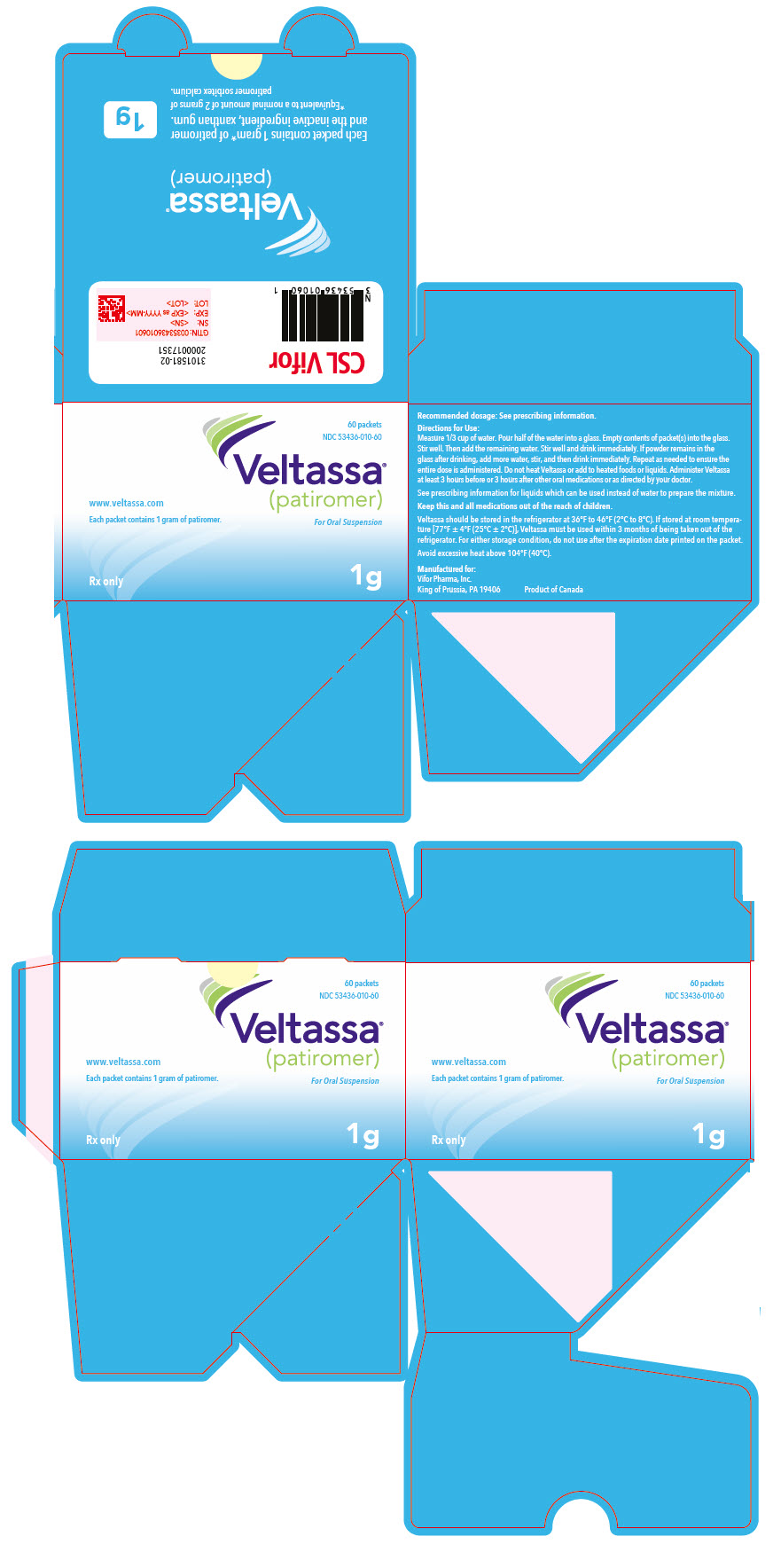
Adults: The recommended starting dose of Veltassa is 8.4 grams patiromer orally once daily. The dose can be up-titrated based on serum potassium level at 1-week or longer intervals, in increments of 8.4 grams.
Pediatric Patients Ages 12 years and older: The recommended starting dose of Veltassa is 4 grams patiromer orally once daily. The dose can be titrated based on serum potassium level at 1-week or longer intervals, in increments of 4 grams.
Adult Patients
Because clinical trials are conducted under widely varying conditions, adverse reaction rates observed in the clinical trials of Veltassa cannot be directly compared to rates in the clinical trials of other drugs and may not reflect the rates observed in practice.
In the safety and efficacy clinical trials, 666 adult patients received at least one dose of Veltassa, including 219 exposed for at least 6 months and 149 exposed for at least one year.
Table 1 provides a summary of the most common adverse reactions (occurring in ≥ 2% of patients) in adult patients treated with Veltassa in these clinical trials. Most adverse reactions were mild to moderate. Constipation generally resolved during the course of treatment.
Table 1: Adverse Reactions Reported in ≥ 2% of Patients| Adverse Reactions | Adult Patients treated with Veltassa
(N=666) |
|---|
| Note: Diarrhea is an aggregate term for Diarrhea and frequent bowel movements. Abdominal discomfort is an aggregate term for Abdominal discomfort, abdominal pain, abdominal pain upper, and abdominal pain lower. |
| Constipation | 7.2% |
| Hypomagnesemia | 5.3% |
| Diarrhea | 4.8% |
| Nausea | 2.3% |
| Abdominal discomfort | 2.0% |
| Flatulence | 2.0% |
The most commonly reported adverse reactions leading to discontinuation of Veltassa were gastrointestinal adverse reactions (2.7%), including vomiting (0.8%), diarrhea (0.6%), constipation (0.5%) and flatulence (0.5%).
Mild to moderate hypersensitivity reactions were reported in 0.3% of adult patients treated with Veltassa in clinical trials. Reactions have included edema of the lips.
Laboratory Abnormalities
Approximately 4.7% of adult patients in clinical trials developed hypokalemia with a serum potassium value < 3.5 mEq/L.
Approximately 9% of adult patients in clinical trials developed hypomagnesemia with a serum magnesium value < 1.4 mg/dL.
Pediatric Patients
In a single-arm, open-label pediatric study, 14 patients 12 to 17 years of age received at least one dose of Veltassa, including 12 patients exposed for at least 25 weeks. The safety profile was generally similar to that observed in adult patients.
Risk Summary
Veltassa is not absorbed systemically following oral administration and maternal use is not expected to result in fetal risk.
Risk Summary
Veltassa is not absorbed systemically by the mother, so breastfeeding is not expected to result in risk to the infant.
Absorption
In radiolabeled ADME studies in rats and dogs, patiromer was not systemically absorbed and was excreted in the feces. Quantitative whole-body autoradiography analysis in rats demonstrated that radioactivity was limited to the gastrointestinal tract, with no detectable level of radioactivity in any other tissues or organs.
Effect of Food
Veltassa can be taken with or without food. In an open-label study, 114 patients with hyperkalemia were randomized to Veltassa once daily with food or without food. Serum potassium at the end of treatment, the change from baseline in serum potassium, and the mean dose of Veltassa were similar between groups.
Drug Interactions
Veltassa has the potential to bind some oral co-administered medications, which could decrease their gastrointestinal absorption.
Fifty-six (56) drugs were tested in-vitro to determine the potential for interaction with Veltassa [see Drug Interactions (7)]. For oral drug products not listed in Table 3, administration of patiromer should be separated by at least 3 hours as a precautionary measure.
Twelve (12) drugs that showed an in vitro interaction were subsequently tested in vivo. These studies in healthy volunteers showed that Veltassa did not alter the systemic exposure of amlodipine, cinacalcet, clopidogrel, furosemide, lithium, metoprolol, trimethoprim, verapamil or warfarin when coadministered with Veltassa. Veltassa decreased the systemic exposure of coadministered ciprofloxacin, levothyroxine and metformin. However, there was no interaction when Veltassa and these drugs were taken 3 hours apart (Figure 2) [see Drug Interactions (7)].
Figure 2: Effects of Veltassa on the Pharmacokinetic Exposures of Other Orally Administered Medications with No Dosing Separation and with a 3-Hour Separation
Drug Interactions
Advise patients who are taking other oral medication that separation of dosing of Veltassa by at least 3 hours (before or after) may be needed except those shown to not have a clinically important interaction in Table 3 above [see Drug Interactions (7)].
Dosing Recommendations
Inform patients to take Veltassa as directed and adhere to their prescribed diets.
Inform patients that Veltassa should not be heated (e.g., microwaved) or added to heated foods or liquids and should not be taken in its dry form.
Manufactured for:
Vifor Pharma, Inc.
King of Prussia, PA 19406
Version 11; January 2025