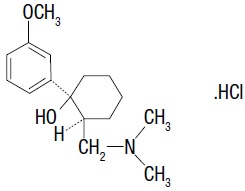
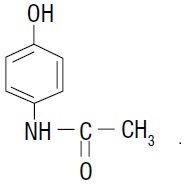
Tramadol is administered as a racemate and both the [-] and [+] forms of both tramadol and M1 are detected in the circulation.
Absorption
The absolute bioavailability of tramadol from tramadol hydrochloride and acetaminophen tablets has not been determined. Tramadol has a mean absolute bioavailability of approximately 75% following administration of a single 100 mg oral dose of tramadol hydrochloride tablets. The mean peak plasma concentration of racemic tramadol and M1 after administration of two tramadol hydrochloride and acetaminophen tablets occurs at approximately two and three hours, respectively, post-dose.
The pharmacokinetics of plasma tramadol and acetaminophen following oral administration of one tramadol hydrochloride and acetaminophen tablet are shown in Table 3. Tramadol has a slower absorption and longer half-life when compared to acetaminophen.
Table 3: Summary of Mean (±SD) Pharmacokinetic Parameters of the (+)- and (-) Enantiomers of Tramadol and M1 and Acetaminophen Following A Single Oral Dose Of One Tramadol/Acetaminophen Combination Tablet (37.5 mg/325 mg) in Volunteers
Parametera | (+)-Tramadol | (-)-Tramadol | (+)-M1 | (-)-M1 | acetaminophen |
Cmax (ng/mL) | 64.3 | (9.3) | 55.5 | (8.1) | 10.9 | (5.7) | 12.8 | (4.2) | 4.2 | (0.8) |
tmax (h) | 1.8 | (0.6) | 1.8 | (0.7) | 2.1 | (0.7) | 2.2 | (0.7) | 0.9 | (0.7) |
CL/F (mL/min) | 588 | (226) | 736 | (244) | - | - | - | - | 365 | (84) |
t1/2 (h) | 5.1 | (1.4) | 4.7 | (1.2) | 7.8 | (3) | 6.2 | (1.6) | 2.5 | (0.6) |
a For acetaminophen, Cmax was measured as mcg/mL. |
A single-dose pharmacokinetic study of tramadol hydrochloride and acetaminophen in volunteers showed no drug interactions between tramadol and acetaminophen.
Upon multiple oral dosing to steady-state, however, the bioavailability of tramadol and metabolite M1 was lower for the combination tablets compared to tramadol administered alone. The decrease in AUC was 14% for (+)-tramadol, 10.4% for (-)-tramadol, 11.9% for (+)-M1, and 24.2% for (-)-M1. The cause of this reduced bioavailability is not clear.
Peak plasma concentrations of acetaminophen occur within one hour and are not affected by co-administration with tramadol. Following single- or multiple-dose administration of tramadol hydrochloride and acetaminophen, no significant change in acetaminophen pharmacokinetics was observed when compared to acetaminophen given alone.
Food Effect
When tramadol hydrochloride and acetaminophen tablet was administered with food, the time to peak plasma concentration was delayed for approximately 35 minutes for tramadol and almost one hour for acetaminophen. However, peak plasma concentrations, and the extents of absorption, of tramadol and acetaminophen were not affected. The clinical significance of this difference is unknown.
Distribution
The volume of distribution of tramadol was 2.6 and 2.9 L/kg in male and female subjects, respectively, following a 100 mg intravenous dose. The binding of tramadol to human plasma proteins is approximately 20% and binding also appears to be independent of concentration up to 10 mcg/mL. Saturation of plasma protein binding occurs only at concentrations outside the clinically relevant range.
Acetaminophen appears to be widely distributed throughout most body tissues except fat. Its apparent volume of distribution is about 0.9 L/kg. A relative small portion (~20%) of acetaminophen is bound to plasma protein.
Elimination
Tramadol is eliminated primarily through metabolism by the liver and the metabolites are eliminated primarily by the kidneys. The mean (SD) apparent total clearance of tramadol after a single 37.5 mg dose is 588 (226) mL/min for the (+) isomer and 736 (244) mL/min for the (-) isomer. The plasma elimination half-lives of racemic tramadol and M1 are approximately 5 to 6 and 7 hours, respectively, after administration of tramadol hydrochloride and acetaminophen. The apparent plasma elimination half-life of racemic tramadol increased to 7 to 9 hours upon multiple dosing of tramadol hydrochloride and acetaminophen.
The half-life of acetaminophen is about 2 to 3 hours in adults. It is somewhat shorter in children and somewhat longer in neonates and in cirrhotic patients. Acetaminophen is eliminated from the body primarily by formation of glucuronide and sulfate conjugates in a dose dependent manner.
Metabolism
Following oral administration, tramadol is extensively metabolized by a number of pathways, including CYP2D6 and CYP3A4, as well as by conjugation of parent and metabolites. The major metabolic pathways appear to be N- and O-demethylation and glucuronidation or sulfation in the liver. Metabolite M1 (O-desmethyltramadol) is pharmacologically active in animal models. Formation of M1 is dependent on CYP2D6 and as such is subject to inhibition, which may affect the therapeutic response [see Drug Interactions (7)].
Approximately 7% of the population has reduced activity of the CYP2D6 isoenzyme of cytochrome P450. These individuals are “poor metabolizers” of debrisoquine, dextromethorphan, and tricyclic antidepressants, among other drugs. Based on a population PK analysis of Phase 1 studies in healthy subjects, concentrations of tramadol were approximately 20% higher in “poor metabolizers” versus “extensive metabolizers,” while M1 concentrations were 40% lower. In vitro drug interaction studies in human liver microsomes indicate that inhibitors of CYP2D6 such as fluoxetine and its metabolite norfluoxetine, amitriptyline, and quinidine inhibit the metabolism of tramadol to various degrees. The full pharmacological impact of these alterations in terms of either efficacy or safety is unknown.
Acetaminophen is primarily metabolized in the liver by first-order kinetics and involves three principal separate pathways:
a) conjugation with glucuronide;
b) conjugation with sulfate; and
c) oxidation via the cytochrome, P450-dependent, mixed-function oxidase enzyme pathway to form a reactive intermediate metabolite, which conjugates with glutathione and is then further metabolized to form cysteine and mercapturic acid conjugates. The principal cytochrome P450 isoenzyme involved appears to be CYP2E1, with CYP1A2 and CYP3A4 as additional pathways.
In adults, the majority of acetaminophen is conjugated with glucuronic acid and, to a lesser extent, with sulfate. These glucuronide-, sulfate-, and glutathione-derived metabolites lack biologic activity. In premature infants, newborns, and young infants, the sulfate conjugate predominates.
Excretion
Approximately 30% of the tramadol dose is excreted in the urine as unchanged drug, whereas 60% of the dose is excreted as metabolites.
Less than 9% of acetaminophen is excreted unchanged in the urine.
Special Populations
Hepatic Impairment
Pharmacokinetics of tramadol was studied in patients with mild or moderate hepatic impairment after receiving multiple doses of tramadol extended-release 100 mg. The exposure of (+)-and (-)-tramadol was similar in mild and moderate hepatic impairment patients in comparison to patients with normal hepatic function. However, exposure of (+)- and (-)-M1 decreased ~50% with increased severity of the hepatic impairment (from normal to mild and moderate). The pharmacokinetics of tramadol after the administration of tramadol extended-release has not been studied in patients with severe hepatic impairment. After the administration of tramadol immediate-release tablets to patients with advanced cirrhosis of the liver, tramadol area under the plasma concentration time curve was larger and the tramadol and M1 half-lives were longer than subjects with normal hepatic function [see Use in Specific Populations (8.6)].
Renal Impairment
Impaired renal function results in a decreased rate and extent of excretion of tramadol and its active metabolite, M1. The pharmacokinetics of tramadol were studied in patients with mild or moderate renal impairment after receiving multiple doses of tramadol extended-release 100 mg. There is no consistent trend observed for tramadol exposure related to renal function in patients with mild (CLcr: 50 to 80 mL/min) or moderate (CLcr: 30 to 50 mL/min) renal impairment in comparison to patients with normal renal function. However, exposure of M1 increased 20% to 40% with increased severity of the renal impairment (from normal to mild and moderate). Tramadol extended-release has not been studied in patients with severe renal impairment (CLcr < 30 mL/min). The total amount of tramadol and M1 removed during a 4-hour dialysis period is less than 7% of the administered dose [see Dosage and Administration (2.4), Use in Specific Populations (8.7)].
Geriatric Population
A population pharmacokinetic analysis of data obtained from a clinical trial in patients with chronic pain treated with tramadol hydrochloride and acetaminophen, which included 55 patients between 65 and 75 years of age and 19 patients over 75 years of age, showed no significant changes in the pharmacokinetics of tramadol and acetaminophen in elderly patients with normal renal and hepatic function [see Use in Specific Populations (8.5)].
Sex
Tramadol clearance was 20% higher in female subjects compared to males on four Phase 1 studies of tramadol hydrochloride and acetaminophen in 50 male and 34 female healthy subjects.
Poor / Extensive Metabolizers, CYP2D6The formation of the active metabolite, M1, is mediated by CYP2D6. Approximately 7% of the population has reduced activity of the CYP2D6 isoenzyme of cytochrome P-450. These individuals are “poor metabolizers” of debrisoquine, dextromethorphan, and tricyclic antidepressants, among other drugs. Based on a population PK analysis of Phase 1 studies with immediate-release tablets in healthy subjects, concentrations of tramadol were approximately 20% higher in “poor metabolizers” versus “extensive metabolizers,” while M1 concentrations were 40% lower.
Drug Interaction Studies
CYP2D6 Inhibitors
In vitro drug interaction studies in human liver microsomes indicate that inhibitors of CYP2D6 (fluoxetine, norfluoxetine, amitriptyline, and quinidine) inhibit the metabolism of tramadol to various degrees, suggesting that concomitant administration of these compounds could result in increases in tramadol concentrations and decreased concentrations of M1. The full pharmacological impact of these alterations in terms of either efficacy or safety is unknown.
Quinidine
Tramadol is metabolized to M1 by CYP2D6. A study was conducted to examine the effect of quinidine, a selective inhibitor of CYP2D6, on the pharmacokinetics of tramadol by administering 200 mg quinidine two hours before the administration of 100 mg tramadol extended release tablet. The results demonstrated that the exposure of tramadol increased 50% to 60% and the exposure of M1 decreased 50% to 60%. In vitro drug interaction studies in human liver microsomes indicate that tramadol has no effect on quinidine metabolism [see Warnings and Precautions (5.6) and Drug Interactions (7)].
Cimetidine
Concomitant administration of tramadol and cimetidine does not result in clinically significant changes in tramadol pharmacokinetics. Therefore, no alteration of the tramadol hydrochloride and acetaminophen dosage regimen is recommended.
CYP3A4 Inhibitors and Inducers
Tramadol is metabolized by CYP3A4. Administration of CYP3A4 inhibitors, such as ketoconazole and erythromycin, or CYP3A4 inducers, such as rifampin and St. John’s Wort, with tramadol may affect the metabolism of tramadol leading to altered tramadol exposure [see Warnings and Precautions (5.3 and 5.6) and Drug Interactions (7)].
CarbamazepineCarbamazepine, a CYP3A4 inducer, increases tramadol metabolism. Patients taking carbamazepine may have a significantly reduced analgesic effect of tramadol. Concomitant administration of tramadol and carbamazepine is not recommended.
Potential for Tramadol to Affect Other Drugs
In vitro studies indicate that tramadol is unlikely to inhibit the CYP3A4-mediated metabolism of other drugs when tramadol is administered concomitantly at therapeutic doses. Tramadol does not appear to induce its own metabolism in humans, since observed maximal plasma concentrations after multiple oral doses are higher than expected based on single dose data.