Xeloda
Product Images NDC 53808-0411

8 FDA label images from State Of Florida Doh Central Pharmacy · Packaging, Regulatory Labels, and Product Appearance

Product Visual Gallery

This gallery contains 8 technical images submitted to the FDA as part of the official labeling for Xeloda (NDC 53808-0411). Unlike standard consumer photos, these assets often include clinical data figures, molecular chemical structures, and official manufacturer packaging layouts.

As provided by State Of Florida Doh Central Pharmacy, these visuals offer a comprehensive scientific overview of the product's physical and chemical identity, aiding pharmacists and researchers in product verification and study.

FDA Label Image

Principal Display Panel (Xeloda 500mg(roche))

Principal Display Panel (Xeloda 500mg(roche))
Label for Xeloda 500 mg tablets, quantity 30, labeled RX only. The label shows the manufacturer as Roche and packaging by DOH Central Pharmacy, Tallahassee, FL. It includes lot number U9474 and an expiration date formatted as MM/YY. A barcode and UPC code are also visible.*
FDA Label Image

Chemical Structure (Xeloda 01)

Chemical Structure (Xeloda 01)
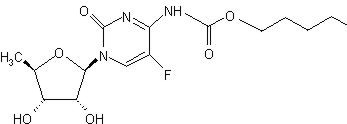
Chemical structure of capecitabine, the active ingredient in Xeloda. The diagram shows the molecular arrangement, including a fluorinated pyrimidine base linked to a sugar moiety and an ester side chain.*
FDA Label Image

Figure (Xeloda 02)

Figure (Xeloda 02)
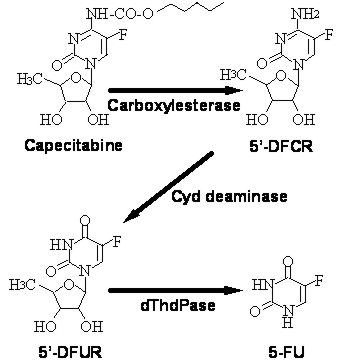
An illustration depicting the biochemical conversion pathway of capecitabine (Xeloda). It shows chemical structures of capecitabine, 5'-DFCR, 5'-DFUR, and 5-FU, with arrows indicating enzymatic steps involving carboxylesterase, Cyd deaminase, and dThdPase.*
FDA Label Image

Figure (Xeloda 03)

Figure (Xeloda 03)
A Kaplan-Meier survival curve showing estimated probability over months since randomization. The graph compares two treatment groups: a green dashed line representing 5-FU plus Leucovorin, and a solid blue line representing Capecitabine, with patient numbers at risk listed below the x-axis at various time points.*
FDA Label Image

Figure (Xeloda 04)

Figure (Xeloda 04)
A Kaplan-Meier survival curve showing estimated probability over time (days) comparing two treatment groups: 5-FU + Leucovorin (Mayo Regimen) and Xeloda 1250 mg/sqm twice daily intermittent. The graph illustrates the survival probability decline for each group up to about 1500 days.*
FDA Label Image

Figure (Xeloda 05)

Figure (Xeloda 05)
A Kaplan-Meier survival curve graph depicting estimated probability over time in days up to 800. It compares two dosing regimens of a medication: one with a dosage of 100 mg/m² every 3 weeks and another with a dosage of 1250 mg/m² twice daily for 14 days every 3 weeks. The graph includes time markers at 128 and 186 days.*
FDA Label Image

Figure (Xeloda 06)

Figure (Xeloda 06)
A survival curve chart comparing estimated probability over time in days for two treatment groups: docetaxel 100 mg/sqm every 3 weeks and Xeloda 1250 mg/sqm twice daily intermittently with docetaxel 75 mg/sqm every 3 weeks. Time is shown on the horizontal axis (0 to 800 days) and estimated probability on the vertical axis (0 to 1.0). Two lines represent the survival probabilities for each treatment group over time.*
FDA Label Image

Figure (Xeloda 07)

Figure (Xeloda 07)
Drug side effect information for Xeloda (capecitabine) tablets. The panel advises to stop taking Xeloda and contact a doctor if certain symptoms occur, including moderate diarrhea, diarrhea at night, moderate pain and redness in the mouth or mouth sores, nausea and vomiting, moderate pain, swelling and redness of hands and/or feet, or fever of 100.5°F or higher indicating possible infection. Additional notes explain that side effects usually improve after stopping Xeloda, with guidance to call a doctor if symptoms do not improve within 2 to 3 days and instructions on resuming treatment.*

* About these descriptions: Image descriptions on this page are generated by automated AI analysis of the product label images from the manufacturer's FDA label submission (SPL). They are provided for reference only and may contain errors or omissions. Always rely on the printed label itself and the official FDA labeling, and consult a pharmacist or healthcare professional with any questions about this product.