Divalproex Sodium
Product Images NDC 53808-0681

6 FDA label images from State Of Florida Doh Central Pharmacy · Packaging, Regulatory Labels, and Product Appearance

Product Visual Gallery

This gallery contains 6 technical images submitted to the FDA as part of the official labeling for Divalproex Sodium (NDC 53808-0681). Unlike standard consumer photos, these assets often include clinical data figures, molecular chemical structures, and official manufacturer packaging layouts.

As provided by State Of Florida Doh Central Pharmacy, these visuals offer a comprehensive scientific overview of the product's physical and chemical identity, aiding pharmacists and researchers in product verification and study.

FDA Label Image

This Is The Label For Divalproex Sodium Delayed-release Tablets, Usp 500 mg 30 Tablets. (Divalpoex Sod 500mg Qualitest)
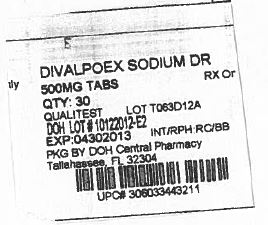
This Is The Label For Divalproex Sodium Delayed-release Tablets, Usp 500 mg 30 Tablets. (Divalpoex Sod 500mg Qualitest)
A pharmacy label for Divalproex Sodium Delayed-Release 500 mg tablets, quantity 30, from State of Florida DOH Central Pharmacy in Tallahassee, FL. The label includes lot number, expiration date, and a barcode with UPC 308033443211.*
FDA Label Image

Structural Formula Of Divalproex Sodium Delayed Release Tablets. (Divalproexdr 1)

Structural Formula Of Divalproex Sodium Delayed Release Tablets. (Divalproexdr 1)
Chemical structure of Divalproex Sodium, showing its molecular arrangement including sodium, carbon, oxygen, and hydrogen atoms in a delayed-release formulation.*
FDA Label Image

Figure 1. Percentage Of Patients Achieving ≥ 30% Reduction In Symptom Score From Baseline (Divalproexdr 2)

Figure 1. Percentage Of Patients Achieving ≥ 30% Reduction In Symptom Score From Baseline (Divalproexdr 2)
A bar graph titled 'Percentage of Patients Achieving ≥ 30% Reduction in Symptom Score From Baseline' comparing placebo (PBO) and divalproex sodium (DVPX) across two studies (YMRS and MRS). The y-axis shows percentage from 0% to 70%. DVPX bars show higher percentages (60% and 58%) than placebo (26% and 29%), with a statistical significance annotation (p < 0.05).*
FDA Label Image

Figure 2 (Divalproexdr 3)

Figure 2 (Divalproexdr 3)
A cumulative percentage plot showing the percentage reduction in CPS rate among patients treated with Divalproex Sodium compared to placebo. The y-axis represents the percent reduction in CPS rate ranging from -100% (worsening) to 100% (improvement), while the x-axis shows the percentage of patients from 0 to 100%. The solid line represents Divalproex Sodium and the dashed line represents placebo, illustrating a higher improvement rate with Divalproex Sodium.*
FDA Label Image

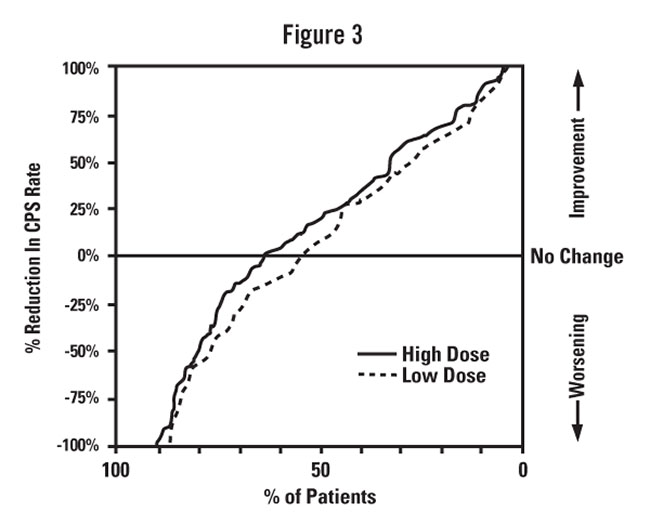
Figure 3 (Divalproexdr 4)

Figure 3 (Divalproexdr 4)
A Kaplan-Meier type curve chart showing percentage reduction in CPS (clinical parameter) rate on the vertical axis versus percentage of patients on the horizontal axis. The solid line represents high dose treatment, and the dashed line represents low dose treatment, with annotations indicating improvement and worsening relative to no change at 0% reduction.*
FDA Label Image

Figure 4. Mean 4-week Migraine Rates (Divalproexdr 5)

Figure 4. Mean 4-week Migraine Rates (Divalproexdr 5)
A bar chart titled 'Mean 4-week Migraine Rates' comparing migraine rates between placebo and divalproex sodium groups in two studies. The y-axis measures migraine rates from 0 to 6. In both studies, divalproex sodium groups show lower mean migraine rates than placebo groups.*

* About these descriptions: Image descriptions on this page are generated by automated AI analysis of the product label images from the manufacturer's FDA label submission (SPL). They are provided for reference only and may contain errors or omissions. Always rely on the printed label itself and the official FDA labeling, and consult a pharmacist or healthcare professional with any questions about this product.