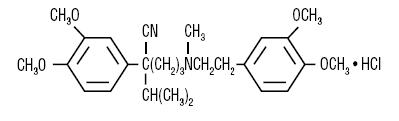
With the immediate-release formulation, more than 90% of the orally administered dose of verapamil HCl Is absorbed. Because of rapid biotransformation of verapamil during its first pass through the portal circulation, bioavailability ranges from 20% to 35%. Peak plasma concentrations are reached between 1 and 2 hours after oral administration. Chronic oral administration of 120 mg of verapamil hydrochloride every 6 hours resulted in plasma levels of verapamil ranging from 125 to 400 ng/mL, with higher values reported occasionally. A nonlinear correlation between the verapamil dose administered and verapamil plasma levels does exist.
In early dose titration with verapamil a relationship exists between verapamil plasma concentrations and the prolongation of the PR interval. However, during chronic administration this relationship may disappear.
The mean elimination half-life in single-dose studies ranged from 2.8 to 7.4 hours. In these same studies, after repetitive dosing, the half-life increased to a range from 4.5 to 12 hours (after less than 10 consecutive doses given 6 hours apart). Half-life of verapamil may increase during titration. No relationship has been established between the plasma concentration of verapamil and a reduction in blood pressure.
Aging may affect the pharmacokinetics of verapamil. Elimination half-life may be prolonged in the elderly.
In multiple-dose studies under fasting conditions, the bioavailability, measured by AUC, of extended-release verapamil was similar to immediate release verapamil; rates of absorption were, of course, different.
In a randomized, single dose, crossover study using healthy volunteers, administration of verapamil hydrochloride extended-release tablets 240 mg with food produced peak plasma verapamil concentrations of 79 ng/mL, time to peak plasma verapamil concentration of 7.71 hours, and AUC(0-24hr) of 841 ng-hr/mL. When verapamil hydrochloride extended-release tablets
were administered to fasting subjects, peak plasma verapamil concentration was 164 ng/mL; time to peak plasma verapamil concentration was 5.21 hours; and AUC(0-24hr) was 1,478 ng-hr/mL.
Similar results were demonstrated for plasma norverapamil. Food thus produces decreased bioavailability (AUC) but a narrower peak-to-trough ratio. Good correlation of dose and response is not available, but controlled studies of extended-release verapamil have shown effectiveness of doses similar to the effective doses of immediate-release verapamil.
In healthy man, orally administered verapamil HCl undergoes extensive metabolism in the liver. Twelve metabolites have been identified in plasma; all except norverapamil are present in trace amounts only.
Norverapamil can reach steady-state plasma concentrations approximately equal to those of verapamil itself.
The cardiovascular activity of norverapamil appears to be approximately 20% that of verapamil.
Approximately 70% of an administered dose is excreted as metabolites in the urine and 16% or more in the feces within 5 days. About 3% to 4% is excreted in the urine as unchanged drug. Approximately 90% is bound to plasma proteins. In patients with hepatic insufficiency, metabolism of immediate-release verapamil is delayed and elimination half-life prolonged up to 14 to 16 hours (see PRECAUTIONS); the volume of distribution is increased and plasma clearance reduced to about 30% of normal. Verapamil clearance values suggest that patients with liver dysfunction may attain therapeutic verapamil plasma concentrations with one-third of the oral daily dose required for patients with normal liver function.
After four weeks of oral dosing (120 mg q.i.d.), verapamil and norverapamil levels were noted in the cerebrospinal fluid with estimated partition coefficient of 0.06 for verapamil and 0.04 for norverapamil.
In ten healthy males, administration of oral verapamil (80 mg every 8 hours for 6 days) and a single oral dose of ethanol (0.8 g/kg) resulted in a 17% increase in mean peak ethanol concentrations (106.45 ± 21.40 to 124.23 ± 24.74 mg•hr/dL) compared to placebo. The area under the blood ethanol concentration versus time curve (AUC over 12 hours) increased by 30% (365.67 ± 93.52 to 475.07 ± 97.24 mg•hr/dL). Verapamil AUCs were positively correlated (r = 0.71) to increased ethanol blood AUC values (see PRECAUTIONS, Drug Interactions.)